Can a Common Law Spouse Receive Benefits
Yes, a common-law spouse can receive benefits, but only if the relationship qualifies as a valid common-law marriage under the law of the state where the couple lives or where the relationship began. The main obstacle is usually proof, not the length of the relationship.
You may have shared a home for years, combined household expenses, filed taxes together, and introduced each other as spouses. Then a retirement, disability, or unexpected death forces an agency to ask a question the couple never had to answer before: Can you prove that the law treated you as married?
That question affects far more than Social Security. A federal employee's partner may also need to establish eligibility for a FERS or CSRS survivor annuity, continued FEHB family coverage, FEGLI life insurance proceeds, or a TSP account distribution. Each program can apply its own paperwork and timing rules, even when the underlying state-law marriage is the same.
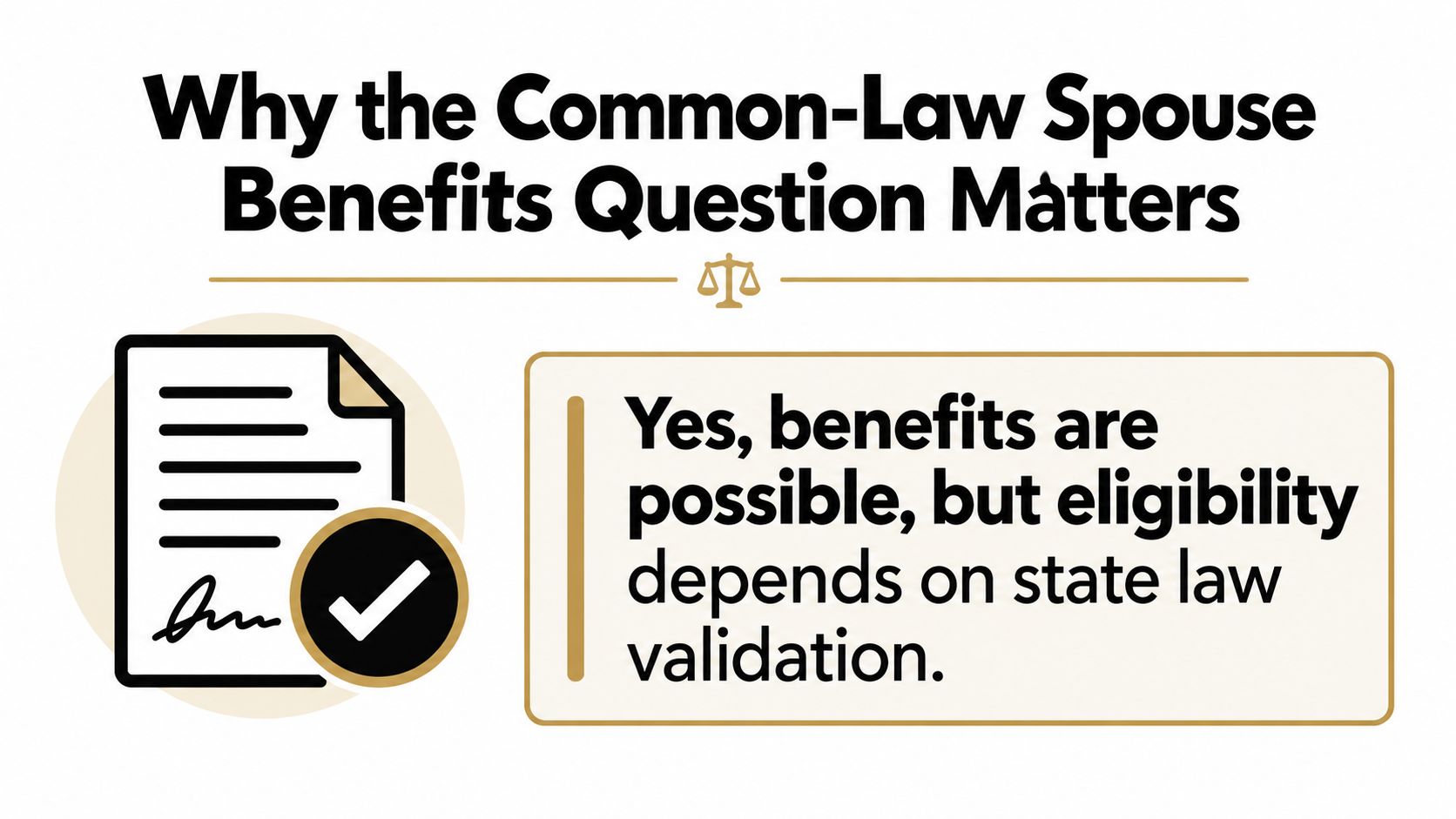
Why the Common-Law Spouse Benefits Question Matters
The short answer is yes, but federal agencies generally don't treat cohabitation as marriage automatically. A couple may live together, share bills, and describe themselves as married without creating a legally recognized common-law marriage. The relationship must satisfy the applicable state law, and the person claiming benefits usually carries the burden of showing that it does.
Three hurdles appear again and again:
- State recognition: The relevant jurisdiction must recognize the relationship as a marriage, either because the couple formed it there or because the jurisdiction accepts a valid union formed elsewhere.
- Documentary proof: The claimant must produce records and statements that support mutual intent, cohabitation, and public representation as spouses.
- Program-specific rules: Social Security, federal retirement plans, health insurance, life insurance, and savings accounts don't all process a spouse claim in the same way.
A denied survivor annuity can change a household's retirement income. An outdated TSP beneficiary form can direct an account to a former partner instead of the person who now claims to be the spouse. A failure to establish FEHB eligibility can create a serious coverage problem after the employee dies.
Practical rule: Federal programs won't guess in favor of an unmarried couple. Build the legal record before a claim becomes urgent.
The issue matters most for couples who assumed that a long relationship would speak for itself. It won't. Agencies look for a legally valid marriage and evidence that connects the relationship to the required date, place, and benefit program.
What a Common-Law Marriage Actually Is
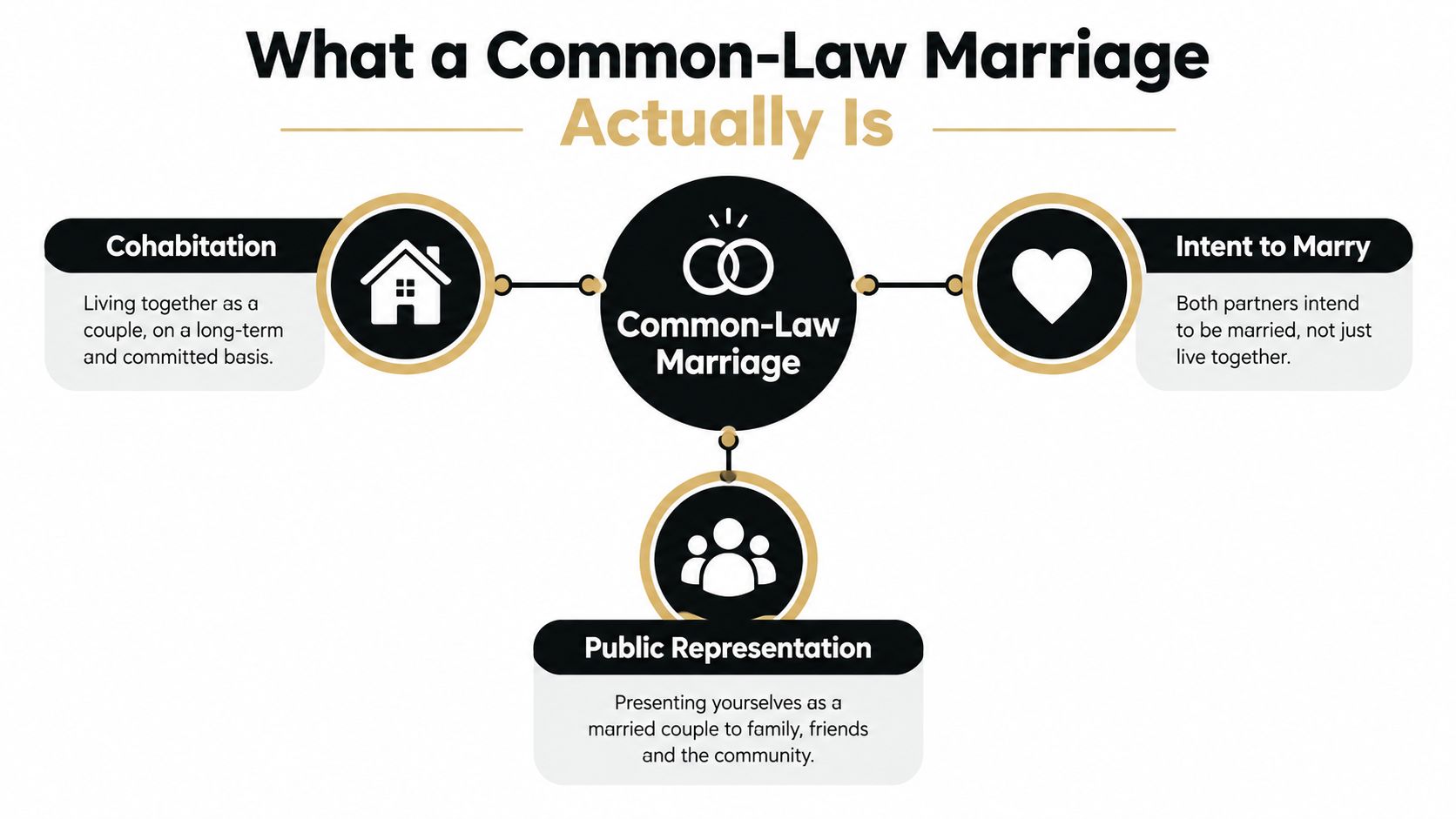
A common-law marriage is a legally recognized marriage created without a ceremonial wedding or marriage license. In plain language, the law may treat a couple as married when they live together, intend to be married, and present themselves publicly as spouses, provided they meet the requirements of a jurisdiction that recognizes this form of marriage.
That isn't the same as dating, cohabiting, or being registered domestic partners. A shared address demonstrates a household, but it doesn't by itself establish a marriage. Joint expenses may support a claim, yet they don't replace the legal requirements.
The elements agencies usually examine
The details vary by jurisdiction, but the usual questions are practical:
- Did both people mutually agree that they were married?
- Did they live together as a couple?
- Did they represent themselves to relatives, friends, employers, or the community as spouses?
- Did both have the legal capacity to marry?
- Was either person already married or otherwise subject to an impediment?
Private intent alone may not be enough. If one partner believed the relationship was a marriage but the couple consistently presented themselves as unmarried, an agency or court may question whether a common-law marriage formed.
For a plain-language discussion of how cohabitation fits into the broader legal analysis, the Law Office of Bryan Fagan cohabitation guide can provide useful background. It shouldn't replace advice about the law governing your own relationship.
The practical problem is timing. The question may arise years later, after a death, incapacity, or retirement claim. At that point, one partner may be unable to answer questions, old accounts may be closed, and witnesses may have incomplete memories. A relationship that felt obvious inside the home can look uncertain in an agency file.
Which States Recognize Common-Law Marriage
Common-law marriage follows a patchwork of state rules. Only a minority of jurisdictions still allow couples to form new common-law marriages, while other states may recognize a union that was validly formed in another jurisdiction.
States identified as permitting formation include Colorado, Iowa, Kansas, Montana, New Hampshire, Rhode Island, South Carolina, Texas, Utah, and the District of Columbia. Pennsylvania is an example of a jurisdiction that recognizes certain older unions, including those formed before its cutoff for new common-law marriages.
| State Category | New Common-Law Marriages Allowed | Recognizes Valid Out-of-State Unions |
|---|---|---|
| Jurisdictions permitting formation | Yes, subject to local requirements | Generally assessed under applicable recognition rules |
| Jurisdictions with historical recognition | Usually not for new unions | Often recognizes qualifying older or out-of-state unions |
| Jurisdictions that don't permit formation | No | May recognize a marriage validly formed elsewhere |
The most important trap is the formation date. A couple may form a valid common-law marriage in a jurisdiction that permits it and later move to a state that doesn't allow new common-law marriages. Moving generally doesn't erase a marriage that was already valid when formed, but the couple may have more difficulty proving where and when the marriage began.
Rhode Island illustrates why dates matter. Recent coverage reports that the state ended new common-law marriages after January 1, 2026, while preserving existing ones. That means a claim can turn on both location and formation date, as explained in the Investopedia discussion of jurisdictional changes.
The familiar idea that seven years of cohabitation automatically creates a marriage is a myth. No universal cohabitation period performs that function. For practical help organizing the records that may support a claim, review this guide to evidence for common law marriage from SMB Law, PC.
How Social Security Treats a Common-Law Spouse
Suppose a federal employee applies for survivor benefits after a partner dies. The couple shared a home for years, combined finances, and considered themselves married, yet no traditional marriage certificate exists. Social Security begins with the relationship's legal status, then examines whether the records support that status.
The SSA applies a two-step test. First, it validates the marriage under the state law that governs the relationship. Second, it evaluates whether the evidence meets its standards. Both steps must succeed for the claim to proceed.
Once the marriage is accepted, the claimant enters the ordinary spousal framework, rather than a separate program for informal partners. A recognized common-law spouse may qualify for the same Social Security spousal or survivor benefits as a formally married spouse. For survivor benefits, payments can begin at 71.5% of the deceased spouse's benefit and increase when the survivor delays claiming, according to the Social Security Administration's survivor benefit guidance.
What evidence can support the claim
No single record usually settles the question. A claimant should assemble documents that fit together and show how the couple represented their relationship in daily life:
| Type of Evidence | What It Shows | Strength of Proof |
|---|---|---|
| Shared lease or deed | A common residence | Strong for cohabitation |
| Joint bank or credit accounts | Combined financial life | Helpful supporting evidence |
| Tax returns filed as married | Public treatment of the relationship | Potentially significant |
| Statements from relatives or friends | Community understanding | Useful corroboration |
| Birth or hospital records naming both partners | Family connection and shared responsibility | Supporting evidence |
| Court or agency ruling | Formal recognition | Especially persuasive |
The claimant's statement has value, especially when it matches the rest of the file. A tax return, insurance record, lease, and witness statement should describe the same relationship and timeline. Conflicting records can create questions about whether the couple intended to be married and when that intent became established.
A favorable determination can affect retirement spousal benefits, survivor benefits, dependent benefits, and a possible lump-sum death payment. The rules for related claims are discussed in Social Security dependent payments explained.
Benefit amounts still depend on the applicable calculation rules. This guide to how spousal Social Security benefits are calculated explains that framework. The calculation becomes relevant only after the agency accepts the underlying marital status.
Federal Employee Benefits Beyond Social Security
A common-law marriage finding doesn't create one universal federal benefits result. Think of the marriage determination as a key that opens different doors, with each program still checking its own lock.
For FERS and CSRS survivor annuities, state-law recognition generally supplies the foundation. The retirement system may still require an application, supporting records, and compliance with the survivor election rules. A spouse claim therefore needs both a valid marriage and the right retirement paperwork.
FEHB family coverage involves enrollment administration. A federal employee generally must affirmatively enroll in family coverage and certify the relationship under the applicable rules. A legally recognized common-law spouse may qualify, but the agency or plan administrator may request evidence before accepting the enrollment or continuing coverage after death.
FEGLI and TSP require especially careful attention to beneficiary records. Life insurance proceeds generally follow the beneficiary designation on file, and a common-law spouse shouldn't assume that the relationship alone will override an older designation. TSP distributions also involve spousal rights and possible waivers, so the account record and marriage documentation should be reviewed together.
| Program | Recognizes Common-Law Spouse? | Affirmative Designation Required? |
|---|---|---|
| FERS survivor annuity | May, if the marriage is valid under applicable law | Survivor election and claim paperwork may be required |
| CSRS survivor annuity | May, under applicable state-law and plan rules | Survivor election and claim paperwork may be required |
| FEHB family coverage | May, when the marriage is legally recognized | Enrollment and certification are required |
| FEGLI | Relationship recognition may matter, but payment follows program rules | Beneficiary designation is critical |
| TSP | Spousal rights can apply to a recognized spouse | Account review, designation, and any waiver are critical |
The distinction is easy to miss. Marriage status answers whether the person may qualify. A designation or election often determines how the program pays. That is why federal employees should review these records before retirement, not only after a death.
The Federal Benefits Sherpa guide to federal employee survivor benefits provides related educational information about the separate survivor systems.
A Real Federal Employee Scenario
Maria and David have lived together for twelve years in a state that recognizes common-law marriage. They share a home, combine much of their finances, introduce each other as spouses, and appear together on records that reflect a married household. David is a FERS-covered federal employee, but neither partner has formally notified his agency that they consider themselves married.
David dies unexpectedly. Maria applies for a FERS survivor annuity, continuation of FEHB family coverage, and TSP death benefits. She expects one decision because, in her mind, there is one relationship. The programs don't work that way.
For the retirement claim, Maria must show that a valid common-law marriage existed under the relevant state law and satisfy the survivor-annuity requirements. For FEHB, she must establish eligibility for family coverage and provide the certification or documentation the administrator requires. For TSP, the account record and spousal rules become central.
A review then uncovers an old TSP designation naming David's former partner. Maria's relationship may support a spousal claim, but the account administrator still has to resolve the competing records under TSP rules. She also learns that a state declaration or court petition might have created a clearer record while David was alive, rather than leaving the issue for an after-death claim.
The difference between “we have always been spouses” and “the agency can verify it” is a file of consistent records.
Maria's evidence is valuable, but collecting it after David's death takes time. She contacts former landlords, searches old tax documents, asks relatives for statements, and looks for records showing how the couple represented themselves. Her experience demonstrates the gap between an apparent entitlement and money that can be released. The strongest protection would have been a coordinated review of marital status, survivor elections, enrollment records, and beneficiary forms before the crisis.
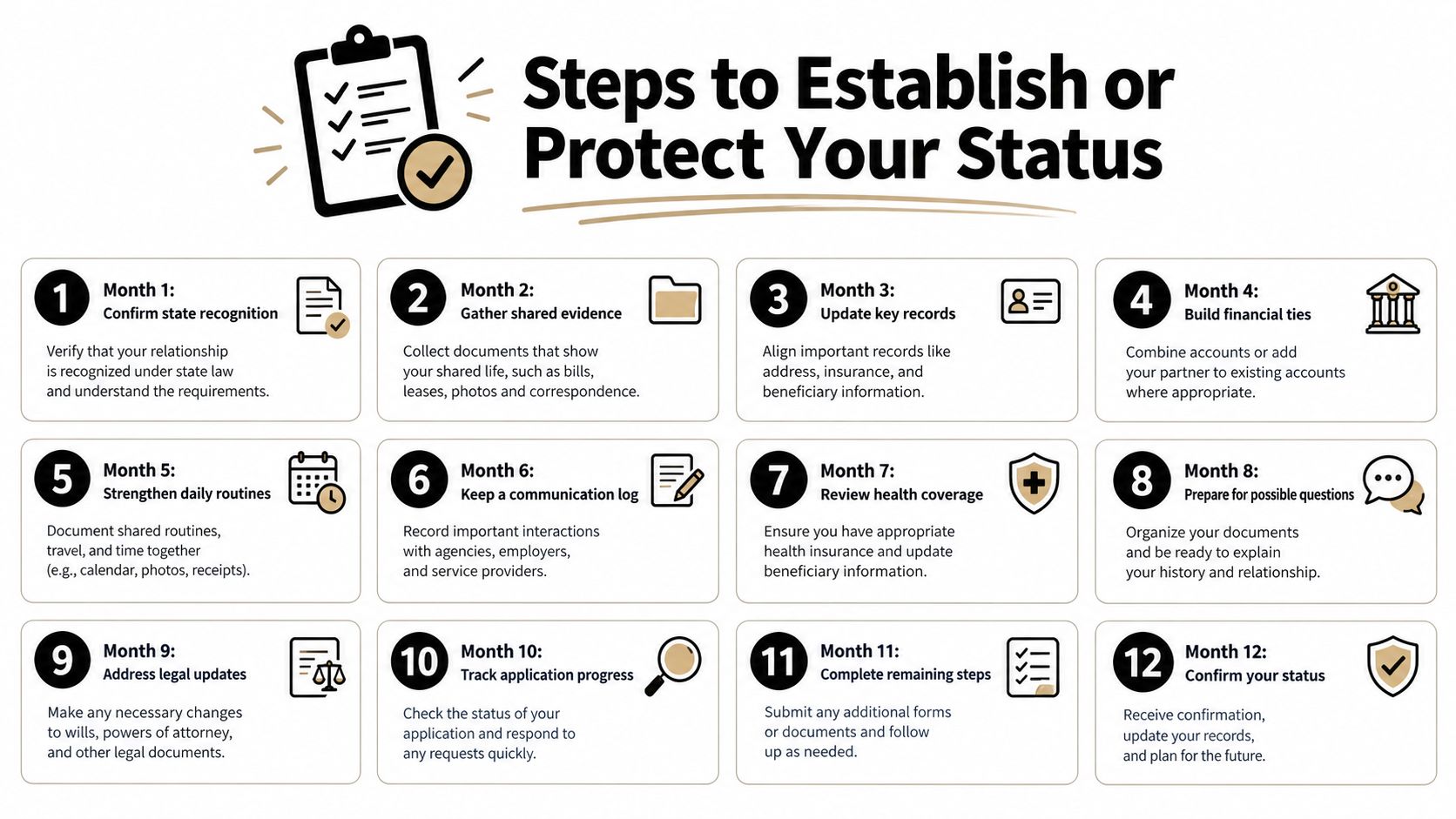
Steps to Establish or Protect Your Status
Treat this as a twelve-month maintenance plan, not a single form-filing exercise. The aim is to confirm the legal foundation, build the evidence file, and make every benefits record tell the same story.
- Month 1, confirm the governing law. Identify where the relationship began and whether that jurisdiction permits or recognizes common-law marriage.
- Month 2, gather shared residence records. Preserve leases, deeds, utility records, and mail showing a common household.
- Month 3, collect financial evidence. Save joint bank, credit, property, and household expense records.
- Month 4, document public representation. Look for tax filings, insurance records, employer records, and other documents describing you as spouses.
- Month 5, identify witnesses. Ask trusted relatives or friends whether they can accurately describe how you presented your relationship.
- Month 6, locate formal decisions. Gather prior court orders, agency determinations, declarations, or other official records.
- Month 7, review Social Security information. Check your earnings record and keep personal identifying information consistent across records.
- Month 8, inspect FEGLI records. Confirm the beneficiary designation and replace outdated instructions where appropriate.
- Month 9, review TSP instructions. Check the account's beneficiary record and ask about spousal rights, waivers, and documentation.
- Month 10, check FEHB eligibility. Confirm whether family enrollment and continuation rules recognize your spouse and what certification is required.
- Month 11, review the FERS or CSRS election. Ask the retirement office whether a survivor election or form such as SF-2807 or SF-3107 applies to your situation.
- Month 12, secure the file. Store certified copies safely, photograph originals, and tell a trusted person where the records are located.
The beneficiary designation form guide can help explain why these forms deserve a separate review. Keep digital copies protected, but don't rely on a photo alone when an agency requires a certified document.
Key Takeaways and What to Do Next
The controlling rule is simple even though the paperwork isn't: eligibility starts with a valid common-law marriage under the relevant state law. After that, each federal program applies its own claim process, election requirements, beneficiary rules, and evidence standards.
Three traps deserve immediate attention:
- Jurisdiction: A relationship formed where common-law marriage isn't recognized may not qualify, while a valid marriage formed elsewhere may remain valid after a move.
- Unfinished forms: FEGLI, TSP, FEHB, FERS, and CSRS records may require designations, elections, enrollment actions, or certifications.
- Missing proof: Shared life isn't the same as a preserved record. If the evidence disappears, the survivor may have to reconstruct the relationship under pressure.
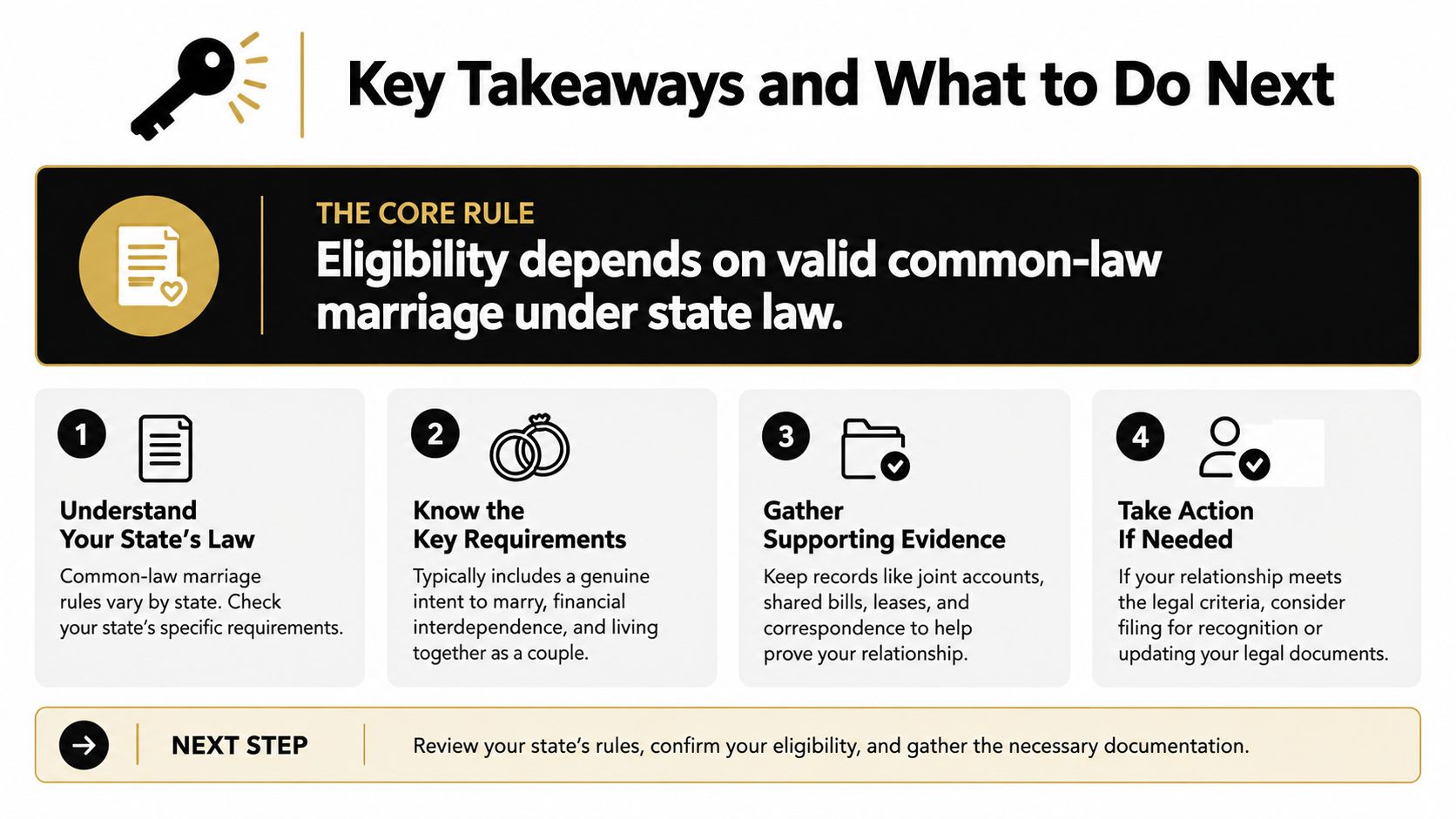
This week, verify the governing state law, collect your strongest relationship records, review every beneficiary and survivor election, and store the documents where your partner can find them. If the relationship crosses state lines or involves federal retirement benefits, a benefits specialist or attorney can help distinguish a valid marriage from a claim that still needs formal proof.
Federal Benefits Sherpa offers personalized federal benefit reviews, retirement planning, and gap analysis reports covering areas such as survivor benefits, FEHB, TSP, and Social Security. Visit Federal Benefits Sherpa to request a review of how your common-law status and current elections may affect your retirement and survivor planning.
