A Guide to Military Buy Back for Federal Retirement
If you've served in the military and are now working as a federal civilian employee, there's a powerful but often misunderstood benefit you need to know about: the military buy back program.
Think of it as a way to get credit for your time in uniform. You make a deposit into your federal retirement account, and in return, those years of military service get added to your civilian service time. This one move can dramatically increase the size of your federal pension when you retire. For anyone who has worn the uniform and then transitioned into a government job, this is a financial decision you can't afford to overlook.
Understanding the Military Buy Back Program

So, how does this actually work? Picture your military career and your federal civilian career as two separate buckets. The military buy back program lets you pour the years from your military bucket into your civilian one, creating a much fuller retirement bucket.
By making a special deposit, you are essentially "buying" that service credit. This merges your past military experience with your present civilian career for retirement calculation purposes, creating a single, more robust foundation for your future income.
Why Is This So Important?
The answer is simple: a bigger pension check every month for the rest of your life. When the government calculates your retirement annuity, the formula is heavily based on your total years of creditable service. Adding your military time can significantly increase that number.
This doesn't just mean more money. It can also make you eligible to retire earlier. For many federal employees, the military buy back is one of the most significant financial moves they'll make. The upfront cost is almost always dwarfed by the long-term payout.
The decision to complete a military buy back isn't just about crunching numbers. It's about honoring your past service in a way that directly secures a more comfortable future. A one-time investment can translate into tens, or even hundreds, of thousands of dollars in extra retirement income over your lifetime.
Military Buy Back at a Glance
To simplify things, here’s a quick breakdown of what the program is all about.
ConceptWho It's ForPrimary BenefitService Credit PurchaseVeterans with honorable active-duty service who now work as federal civilian employees.Adds military years to civilian service time, resulting in a larger federal pension.
This table boils it down, but the key takeaway is that you're paying a relatively small amount now for a much larger, guaranteed payout later.
This isn't a passive benefit; it requires you to take action. The process has specific steps and deadlines, and waiting too long can be costly. The longer you wait to make the deposit, the more interest accrues, increasing the total amount you'll have to pay. Understanding how it works from the get-go is the first step toward making a smart choice for your financial future.
Are You Even Eligible for Military Buy Back?
Before you get lost in the paperwork, the very first thing you need to do is figure out if you even qualify for a military buy back. It's like a gatekeeper for this powerful financial benefit—the rules are strict, but they're also straightforward. Not everyone who served gets a green light.
Your eligibility really boils down to two things: the specifics of your military service and your current status as a federal civilian employee. Let's break down what that means for you.
What Kind of Military Service Counts?
At its core, the program is designed for a specific type of military service. Here’s what they’re looking for:
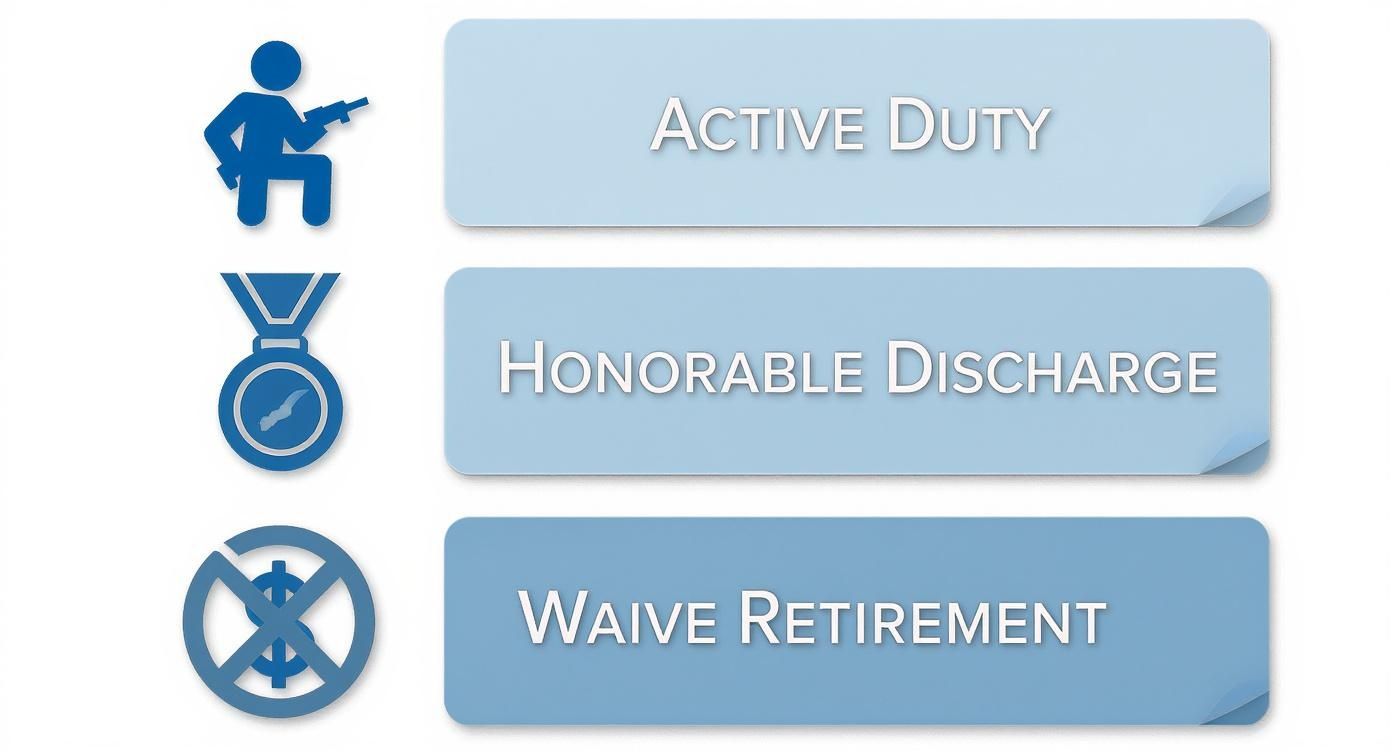
It has to be Active Duty: The time you want to "buy back" must have been full-time, active duty. Those weekend drills in the Guard or Reserve typically don't count.
You need an Honorable Discharge: This is non-negotiable. Your separation from the military must have been under honorable conditions. They'll verify this with your DD 214, so have it handy. Anything less than an honorable discharge is usually a deal-breaker.
These rules exist to ensure the service being credited toward your civilian pension was completed in good standing.
A common question I get is about National Guard or Reserve time. That service only counts if you were officially called up to active duty under federal orders (Title 10 or Title 32). Your standard training periods won't be eligible.
The military and federal retirement systems are two of the largest in the world. To give you some perspective, the Department of Defense paid out a staggering $48.6 billion in non-disability military retirement benefits in FY 2020 alone. You can dig into the numbers yourself in the full defense actuary report on the Military Retirement System.
The "No Double-Dipping" Rule
This is where things can get a little tricky, especially for military retirees. The government has a firm rule against "double-dipping." In simple terms, you can't get credit for the same period of service in two different federal retirement plans.
So, if you're already drawing a military pension, you generally can't use those same years of service to increase your FERS or CSRS pension.
But there's a big exception. You can choose to waive your military retired pay. By signing a waiver, you agree to give up your military pension when you start collecting your federal civilian retirement. In return, you can buy back those military years and have them count toward your FERS or CSRS pension instead. This is a huge financial decision and requires some serious number-crunching to see which path gives you a better lifetime income.
A few rare exceptions exist, mostly for those whose military retirement is based on a combat-related disability. But for most people, it's a choice: keep the military pension or waive it to get a bigger federal one. You need to understand all the angles, and you can learn more by checking out our guide on federal retirement eligibility explained.
This first step is all about making sure you're on the right track. Once you've confirmed your honorable, active-duty service and understand the rules about retired pay, you can move forward with confidence.
How Your Military Buy Back Deposit Is Calculated
So, you're considering the military buy back. The first question that probably pops into your head is, "Okay, but what's this actually going to cost me?" It's a fair question, and the answer isn't just one number for everyone. The cost is a direct percentage of the total base pay you earned while on active duty.
The math itself is pretty simple, but the percentage hinges on which federal retirement system you're in.
For FERS Employees: Your deposit is 3% of your total military base pay.
For CSRS Employees: Your deposit is 7% of your total military base pay.
Let's put that into perspective. If you earned, say, an estimated $100,000 in base pay over a four-year enlistment, your deposit would be $3,000 under FERS or a slightly steeper $7,000 under CSRS. That deposit is your ticket to adding those four years of service directly to your federal retirement calculation.
The Critical Role of Timing and Interest
Now, while the base calculation is straightforward, there's a huge variable that can dramatically increase what you owe: interest.
The government gives you an interest-free grace period to make your deposit. This is, without a doubt, the smartest and cheapest time to do it. You typically have the first two years after you're hired into your federal civilian job to pay the deposit without any interest tacked on. You might hear some people say it’s three years, so always double-check with your HR department to be certain about your specific deadline.
Miss that window, and interest starts to build up. It accrues and is compounded every single year. The rate changes annually, so what started as a manageable $3,000 deposit could easily swell to $5,000 or more if you let it sit for a decade.
Delaying your military service deposit is one of the costliest financial mistakes a veteran federal employee can make. That interest-free grace period is a golden opportunity you don't want to miss.
Understanding the Key Calculation Components
To break it down even further, let's look at what goes into that final number. Your agency's benefits specialist will handle the official calculation, but knowing the inputs helps you see what's coming.
As you can see, it all starts with your service record. Once you've confirmed your eligibility, the financial part kicks in. Here are the pieces of the puzzle:
Total Military Base Pay: This is the sum of all the basic pay you earned during the active duty period you're buying back.
Retirement System Percentage: The 3% (FERS) or 7% (CSRS) multiplier applied to that base pay.
Accrued Interest: This only comes into play if you make the deposit after your grace period has closed.
Imagine a FERS employee with four years of service and an estimated base pay of $120,000. If they pay during the grace period, they owe a flat $3,600. That single payment adds a full four years to their service time, which has a massive impact on their future pension checks.
To really connect the dots between this upfront cost and the long-term payoff, check out our FERS retirement calculation guide. You’ll see exactly how those extra years can supercharge your annuity.
A Step-by-Step Guide to the Application and Payment Process

Diving into the military buy back process can feel a bit like staring at a mountain of paperwork. But don't worry—it's a very manageable process once you break it down. Think of it less as a bureaucratic headache and more as a mission with a clear objective: getting that hard-earned military time counted toward your federal retirement.
Let's walk through the roadmap, from gathering your initial documents to seeing that service credit officially added to your record. The one thing to keep in mind is that this isn't an overnight process. From start to finish, it can take up to 6 months or even longer. That's why starting early, especially within that interest-free grace period, is the single best move you can make.
Stage 1: Assembling Your Application Package
Your first move is to gather your documents and get your request into the system. This is where you'll be working directly with your agency's Human Resources (HR) or benefits department—they are your mission control for this entire operation.
You'll need to put together an initial packet with two key pieces of information:
Request for Estimated Military Earnings (RI 20-97): This is the form that officially asks the military to tally up your total base pay from your time in service. You'll fill out your personal details and service history and hand it over to HR.
Proof of Service (DD Form 214): You need a clean, legible copy of your Certificate of Release or Discharge from Active Duty. If you have multiple periods of service you want to buy back, you'll need a DD 214 for each one. This is your proof of service dates and honorable discharge.
Once your HR office has these, they’ll send the request off to the appropriate military finance center, like DFAS. Now comes the waiting game. This is often the longest stretch, as you wait for the military to do its calculations and mail the earnings statement back.
Before you start, it helps to have all your ducks in a row. The table below outlines the essential paperwork you'll need to complete the military buy back process.
Required Documents Checklist
Document NamePurposeWhere to Obtain ItDD Form 214Verifies your service dates, branch, and character of service (e.g., honorable). You need one for each service period.You should have a copy. If not, request it from the National Archives.RI 20-97This form officially requests your estimated military earnings from the appropriate military finance center.Your agency's HR or benefits department will provide this form.SF 3108 (FERS) or SF 2803 (CSRS)This is the official application you'll use to make your service credit deposit payment after your earnings are calculated.Your agency's HR office will give you the correct form once your deposit amount is known.Paid-in-Full LetterThe final confirmation from your payroll office that your deposit has been paid completely. This is your ultimate proof.Your agency's payroll or HR department will issue this upon final payment. Be sure to ask for it!
Having these documents ready or knowing where to get them will make the entire journey much smoother.
Stage 2: Calculating the Deposit and Making a Payment
After some time, you'll receive your estimated earnings statement in the mail. This is the golden ticket—it details the total base pay the military has on record for you. With this document in hand, your HR department can finally calculate the exact dollar amount you owe for your military deposit.
They'll give you an official breakdown and the form to make it happen, which is typically the SF 3108 (Application to Make Service Credit Payment). This is where you formally commit to making the deposit.
When it's time to pay, you have a couple of options:
Lump-Sum Payment: You can write a check or get a money order for the full amount and be done with it. This is the quickest way to close the loop, and it’s a great choice if you have the funds ready to go.
Installment Payments: If a one-time payment is too steep, you can set up payroll deductions. The payments will be automatically taken out of your paycheck over a set period of time, making it much more manageable.
A quick word of caution on installments: if you're past your interest-free grace period, interest will keep adding up on the remaining balance. The faster you can pay it off, the less you'll owe in the long run.
Stage 3: Finalizing and Confirming Your Service Credit
Once that final payment clears—whether it's your lump-sum check or your last payroll deduction—you’re on the home stretch. Your payroll office will then issue a "Paid-in-Full" letter, which confirms your military service deposit is complete.
This is critical: You must request and keep a copy of this letter. File it away with your other important retirement documents. This is your definitive proof that you completed the buy back. Your HR team will then officially update your Service Computation Date (SCD), and those years of military service will be locked in and credited toward your federal retirement for good.
Does Military Buy Back Actually Pay Off? Let's Run the Numbers.

It's easy to talk about military buy back in the abstract, but what really matters is how it affects your bottom line. Is it worth cutting a check for thousands of dollars now for a bigger pension later? For most federal employees with prior military service, the answer is a clear and resounding yes.
The return on this investment isn't just a small bump—it can be a game-changer for your retirement security.
To see what I mean, let's stop talking theory and look at a couple of real-world examples. We'll follow two federal employees, one in the FERS system and one in CSRS, to see exactly how a one-time deposit can dramatically reshape their financial future.
You'll see how a relatively small investment can easily turn into tens, or even hundreds, of thousands of extra dollars over the course of your retirement.
Case Study One: Sarah, a FERS Employee
Let's start with Sarah. She's 40 years old, covered by FERS, and served four years on active duty before starting her federal career. During her time in the service, her total military base pay was about $120,000. Her goal is to retire at 62, and she projects her "High-3" average salary will be $95,000.
Figuring Out Her Deposit Cost
Because Sarah is in the FERS system, her buy back deposit is 3% of her total military base pay. She's smart and is making the payment within the first two years of her federal job, which means she won't owe any interest.
The Math: $120,000 (Base Pay) x 0.03 (FERS Rate) = $3,600 Deposit
That single payment of $3,600 adds four full years to her creditable service for retirement.
Watching Her Pension Grow
Now for the exciting part. A standard FERS pension is calculated at 1% of your High-3 salary for each year of service. If Sarah retires with her 22 years of civilian service alone, her pension looks like this:
Without Buy Back: $95,000 x 0.01 x 22 years = $20,900 a year, or $1,742 a month.
But by buying back her four years, her total service jumps to 26 years. This also pushes her past the 20-year mark for retiring at age 62, qualifying her for the enhanced 1.1% multiplier.
With Buy Back: $95,000 x 0.011 x 26 years = $27,170 a year, or $2,264 a month.
The result? Sarah gets an extra $522 in her pocket every single month for the rest of her life. She makes back her initial $3,600 investment in less than seven months of retirement. Over a 20-year retirement, that small payment will generate over $125,000 in additional income.
Case Study Two: John, a CSRS Employee
Next up is John, who is 50 and part of the older Civil Service Retirement System (CSRS). He has six years of military time under his belt, with a total base pay of $180,000. He's planning to retire at age 60 with a High-3 salary of $110,000.
Calculating His Deposit Cost
John's deposit is higher because the CSRS rate is 7% of military base pay. Just like Sarah, he’s paying it off before any interest can kick in.
The Math: $180,000 (Base Pay) x 0.07 (CSRS Rate) = $12,600 Deposit
The Impact on His Pension
The CSRS formula is a bit more complicated, but the impact of adding service time is even more powerful.
Without Buy Back (24 years civilian): John’s pension would be roughly $4,583 per month.
With Buy Back (30 years total): His pension jumps to approximately $5,729 per month.
That’s a staggering increase of $1,146 every month. His $12,600 investment pays for itself in just 11 months. Over a 20-year retirement, this decision will bring in over $275,000 in extra income.
These stories really bring the power of the military buy back to life. While everyone's situation is a little different, the financial logic is almost always incredibly compelling. To get a feel for your own numbers, try plugging them into a retirement calculator for FERS, your ultimate planning tool. It can help you see firsthand the long-term benefit of adding your military service to your federal career.
Common Military Buy Back Mistakes and How to Avoid Them
The military buy back process is full of little traps that can turn into big, expensive headaches. I've seen it happen time and again. But knowing where the landmines are is half the battle, and being smart from the start ensures you get every ounce of value from your time in uniform.
Let's walk through the most common—and costly—blunders I see people make.
The single biggest mistake? Missing the interest-free grace period. Hands down, this is the most expensive error. Most new federal employees get a two or three-year window after they're hired to pay for their military time without owing a penny of interest. But if you let that deadline slide, interest starts piling up, and it compounds. What could have been a manageable expense can quickly swell into a much larger number.
Dragging Your Feet on the Paperwork
Right behind that is simply underestimating how long this whole thing takes. It's not a quick process. Just getting your estimated military earnings back from the defense finance center can drag on for months. If you wait until you're a month away from your deadline to even start the paperwork, you've already lost the game. You will almost certainly miss the interest-free cutoff.
Don't let that be you. Start the process the moment you land a permanent federal job.
Your first move: Fill out the RI 20-97 form to request your estimated earnings. Do it within your first year on the job.
Stay on it: Don't just submit the form and forget it. Check in with your HR department every so often to see where things stand.
This gives you a comfortable buffer. You'll have plenty of time to get the numbers back, review them, and make your payment before that interest clock starts ticking.
Misunderstanding the Military Pension Waiver
Now, for military retirees, things get a bit more complicated. A frequent and critical error is thinking you can "double-dip"—that is, draw your full military pension while also getting credit for those same years toward your federal civilian annuity. That's a no-go.
To complete a military buy back, most military retirees have to sign on the dotted line, agreeing to waive their military retired pay once they start collecting their federal pension. This is a massive financial decision. You absolutely must run the numbers to see which income stream will serve you better over your lifetime.
Failing to grasp the waiver rules can lead to a nasty shock when you retire and find your income isn't what you planned for. Always compare the lifetime value of keeping your military pension versus the boost you'd get from the federal annuity.
Sloppy Record Keeping
The last common pitfall is just not keeping good records. After you've made that final payment, your agency's payroll office is supposed to give you a "Paid-in-Full" letter. This piece of paper is your golden ticket—the official proof that your military buy back is done and dusted.
But people forget to ask for it, or they get it and lose it over a 30-year career. Trust me, trying to prove you made that deposit decades later without that letter can be a bureaucratic nightmare right when you're trying to retire.
How to Keep Your Records Straight:
Get the Letter: Be proactive. Ask your payroll office for that official paid-in-full confirmation. Don't assume they'll send it automatically.
Go Digital: Scan the letter, your application, payment receipts—everything. Save them somewhere safe.
Keep the Hard Copies: Put the physical copies in a safe place with your other crucial documents, like your DD 214 and benefits paperwork.
By sidestepping these common mistakes, you can make the buy back process work for you, not against you. It's the key to making sure your service is properly recognized without costing you extra money or stress down the road.
Common Questions About the Military Buy Back
Making the decision to buy back your military time is a big one, and it's completely normal to have a few questions swirling around. I've walked hundreds of federal employees through this process, and I've found that the same uncertainties tend to pop up. Let's tackle them head-on.
Think of this as our final Q&A session to clear up any lingering confusion so you can move forward with total confidence.
Can I Buy Back Military Time and Still Receive VA Disability?
Yes, absolutely. This is probably the most frequent question I get, and the answer is a resounding yes. Your VA disability compensation and your federal retirement annuity are two completely separate things.
Paying your military service deposit has no impact on your eligibility for VA disability. You've earned both benefits, and the government allows you to receive them concurrently without any conflict.
The Bottom Line: Your VA disability is a distinct benefit. It will not reduce your federal pension or get in the way of you buying back your military time.
What Happens if I Leave Federal Service Before Retiring?
Life happens. If you buy back your time but end up leaving your federal job before you're eligible to retire, you have a couple of choices. The money you paid for the deposit is treated as part of your overall retirement contributions.
This means you can request a full refund of everything you've paid into the retirement system, including the military deposit amount. The major catch is that you permanently give up that service credit. If you ever return to a federal job down the road, you'd have to start the buy back process from scratch, and this time, it would come with a hefty interest bill.
Can I Use a TSP Loan to Pay for My Military Buy Back?
You can, but I always advise clients to think this through carefully. You are permitted to take a general-purpose loan from your Thrift Savings Plan (TSP) and use that money to make your military deposit payment.
While this gives you the cash you need right away, remember that you're borrowing from your own future. That loan has to be paid back with interest, and the money you pull out stops growing in your TSP account. You really have to weigh the math—is the immediate benefit of paying the deposit worth the potential long-term loss in your TSP growth? This is especially critical if you're past that initial interest-free grace period.
Getting these details right is the key to maximizing the retirement you’ve worked so hard for. At Federal Benefits Sherpa, we help you navigate the fine print of programs like the military buy back to ensure you're making the best possible decisions. Schedule your free 15-minute benefit review at https://www.federalbenefitssherpa.com and let's map out a clear path to your financial future.
