10 Years in Service: What Federal Employees Need to Know
You're considering a job outside government, and you've just reached a decade of federal service. Before you accept the offer, you want to know whether leaving would waste the retirement benefits you've worked toward, or whether you can preserve them without staying until retirement.
The answer depends on more than your service anniversary. Your age when you leave, when you start your annuity, and how you arrange household income and health coverage all belong in the same decision.
What 10 Years in Service Really Means
Suppose you're considering a career change before retirement age. You like the new opportunity, but you're worried about walking away from your federal pension. That concern is reasonable, yet leaving federal employment and losing every future retirement benefit aren't necessarily the same thing.
Under the Federal Employees Retirement System, or FERS, employees who separate with at least 10 years of qualifying service may preserve eligibility for a deferred annuity beginning at their Minimum Retirement Age, generally 55 to 57, depending on birth year, provided they meet the applicable rules and don't withdraw their retirement contributions, according to OPM's retirement eligibility guidance.
That's a meaningful protection. It doesn't, however, promise a pension payment immediately after your last paycheck.
Separate the milestone from the payment date
Think of retirement eligibility as a set of connected questions rather than a single checkbox. Your service record helps establish which options you have. Your age and selected annuity start date help determine when those options become available and what the payment may look like.
Before making a departure decision, write down the questions you need answered:
- Eligibility: Which retirement category would apply on my intended separation date?
- Timing: When could my annuity begin, and would waiting change the benefit?
- Household protection: What would happen to health coverage and income for my spouse?
The distinction matters because an employee leaving for another career may face a very different planning problem from someone leaving work altogether. The former may need to preserve a future benefit while arranging coverage through a new employer. The latter may need enough savings and other income to bridge a waiting period.
Practical rule: Treat your service anniversary as a reason to review your options, not as permission to assume every retirement benefit is available.
A useful retirement plan therefore starts with your proposed departure date, not just the date you completed a decade of service. Ask your benefits office to evaluate the actual separation you're considering.
The 5-Year Versus 10-Year Vesting Threshold
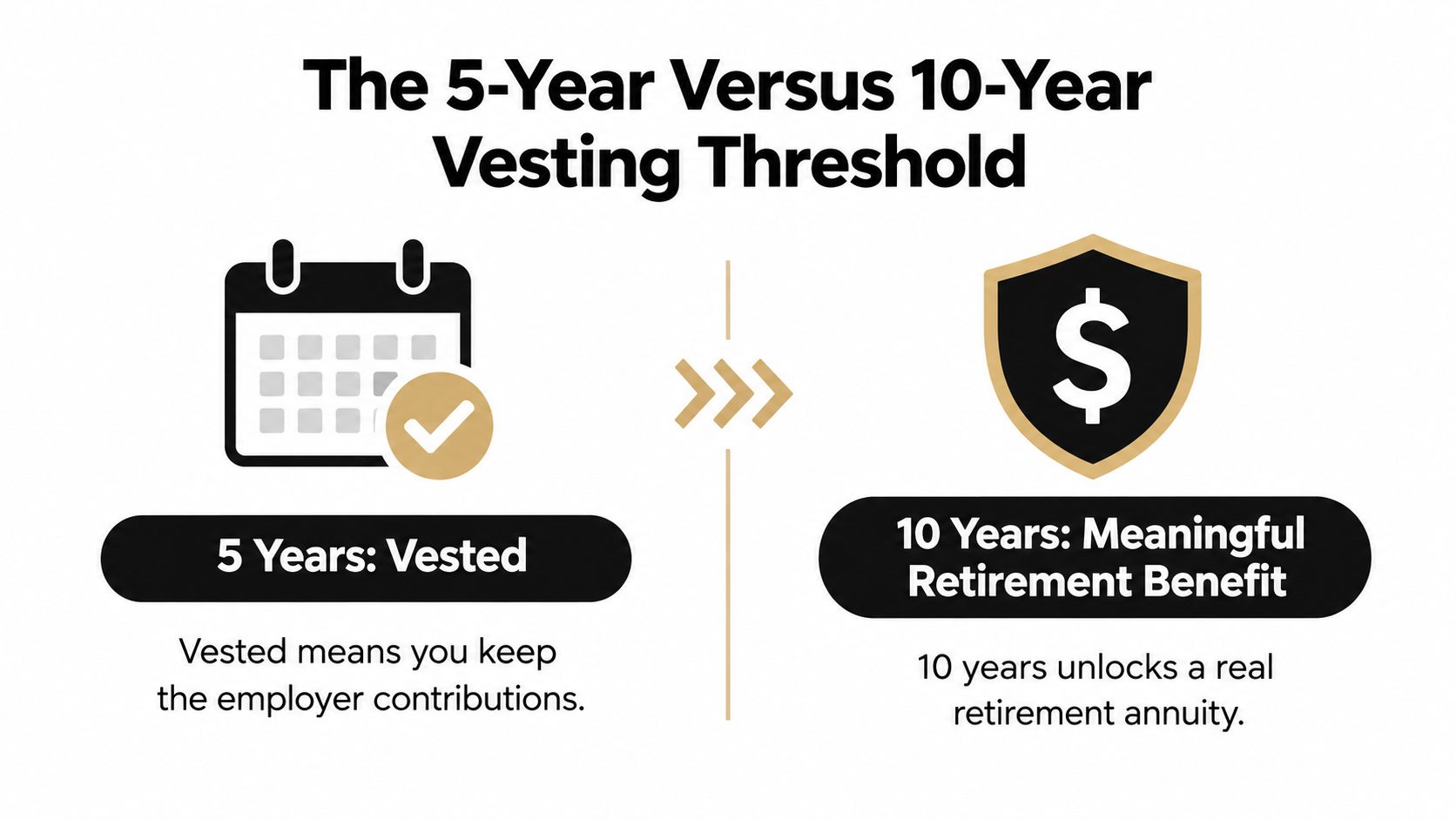
Vesting and immediate retirement eligibility answer different questions. Vesting concerns whether you've established a right to a future benefit under the applicable rules. Immediate retirement concerns whether you can begin receiving an annuity when you leave.
Under the OPM eligibility rules noted above, five years can establish eligibility for a deferred benefit at age 62, while 10 years can support commencement at the MRA, subject to the applicable reduction rules. The earlier door isn't necessarily the better door financially, but having that option can matter to someone planning a mid-career departure.
The infographic provides a visual comparison, with an important qualification explained below.
A pension isn't simply an account balance
Don't read the graphic's shorthand about keeping employer contributions as a literal description of the FERS basic annuity. For this discussion, the useful distinction is eligibility for a future pension, not ownership of an individually withdrawable employer-contribution balance.
Likewise, a vested deferred benefit is already a real retirement benefit. The later milestone expands the timing possibilities; it doesn't make the earlier entitlement meaningless. The guide to federal employee benefits after five years offers additional context for that earlier career checkpoint.
Consider how you would compare the choices:
- Preserve future income: Evaluate the pension you may receive later, rather than looking only at contributions deducted from past paychecks.
- Evaluate a refund carefully: Before requesting a withdrawal, ask your benefits office how it would affect the deferred benefit you're trying to preserve.
- Compare complete alternatives: A new job's salary matters, but so do its health coverage, retirement arrangements, and your expected waiting period.
The central question isn't whether your contributions could be useful today. It's whether accessing them now fits your longer-term plan after you understand the retirement consequences. Make that decision deliberately, not as an automatic part of leaving government.
How Your FERS Annuity Is Calculated
Start with the unreduced basic annuity, then consider adjustments. Otherwise, it's easy to mistake a preliminary pension estimate for the amount you will receive.
For most FERS retirements, the formula is 1% × high-3 average basic pay × creditable years and months of service; the high-3 is the highest average basic pay over three consecutive years, and at exactly 10 years, a $100,000 high-3 produces an estimated $10,000 annual annuity, or about $833 monthly, before applicable adjustments, under OPM's FERS computation rules.
Build your estimate from verified records
Begin with your basic-pay history, not a rough recollection of your highest salary. Next, have your agency verify the service that will count in the calculation. Finally, identify which reductions or elections would apply to your intended retirement arrangement.
FERS Annuity Estimate at 10 Years
The illustration below restates the OPM-based calculation above, rather than a personalized benefit quote.
| High-3 Pay | Annual Annuity (10%) | Monthly Annuity |
|---|---|---|
| $100,000 | $10,000 | About $833 |
An omitted creditable period can lower the service component of the formula. Similarly, leaving before higher-paid years can limit the salary base available for your calculation. That doesn't mean staying is always financially preferable; it means the pension effect belongs in your comparison.
Under the computation rules cited above, the enhanced 1.1% multiplier requires separation at age 62 or later with at least 20 years of service. A decade of service alone doesn't qualify someone for that enhancement.
Compare departure dates, not just salaries
Use the FERS annuity calculation guide to organize your inputs, then request an agency estimate for your circumstances.
Compare your current high-3 with a plausible later high-3, clearly labeling the latter as an assumption. Keep separate lines for the basic calculation, age-related adjustments, survivor elections, and other applicable deductions. That makes it easier to see whether a difference comes from additional service, higher pay, or a different benefit election.
MRA+10 Versus Deferred Retirement
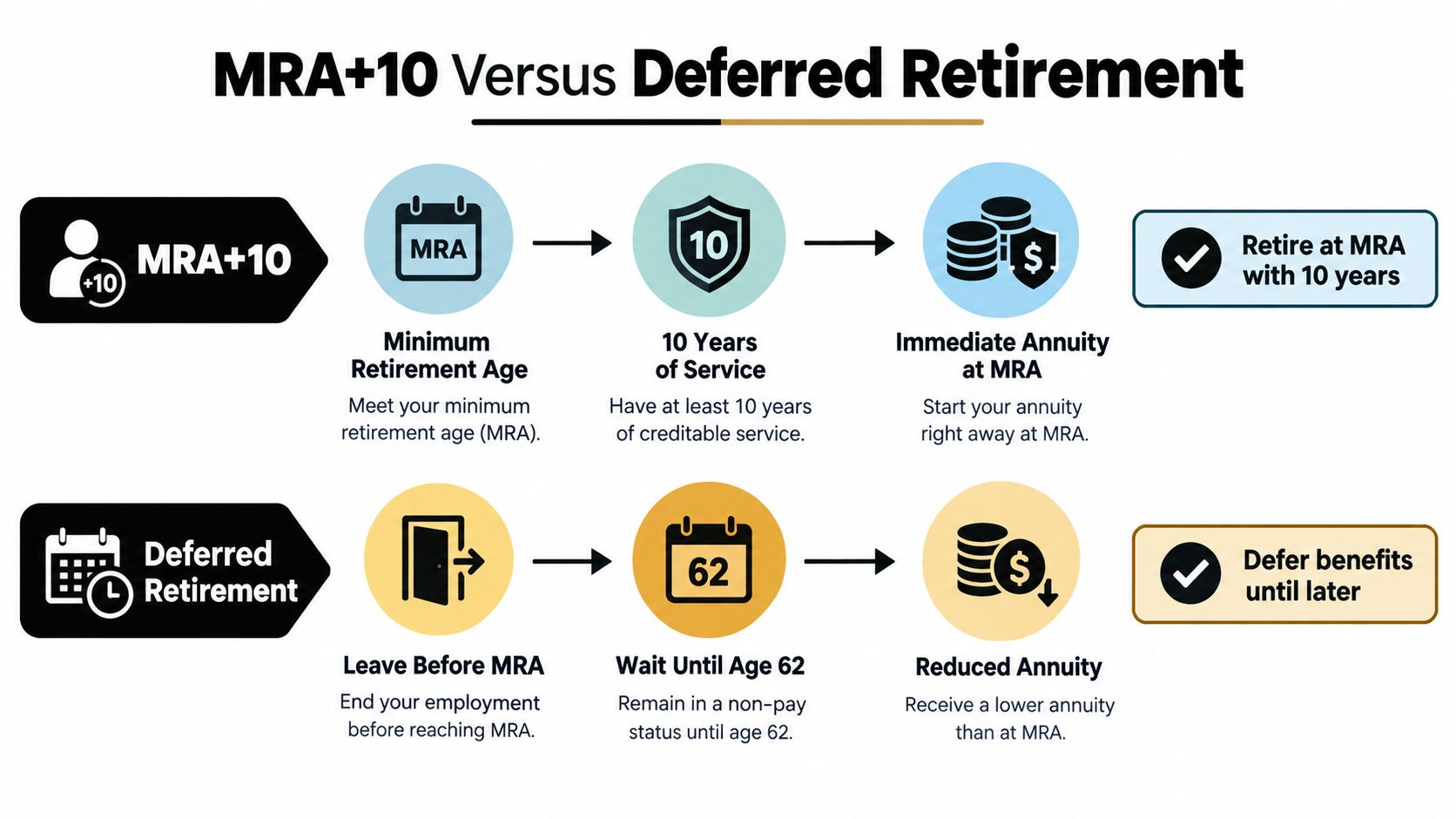
Having enough service doesn't necessarily mean you can retire with an immediate pension. The distinction between MRA+10 and deferred retirement begins with your age when you separate.
An employee who has reached the applicable MRA when separating may qualify for MRA+10 retirement, while someone leaving before that age generally must wait; starting the annuity before 62 can produce a 5% reduction for every year the commencement date precedes that age, and postponing commencement can lower or avoid the reduction, as explained in OPM's retirement-type and timing guidance.
Use the comparison below as an orientation, not as a substitute for checking your individual dates.
Deferred and postponed aren't interchangeable
Deferred retirement describes the situation in which you leave before qualifying for an immediate annuity and later claim the benefit. Postponement concerns delaying commencement after qualifying under the applicable MRA+10 rules. Don't assume these terms have identical consequences for associated benefits.
The graphic's deferred track also needs a qualification: waiting until the later age shown isn't universally required, and an annuity beginning then isn't automatically age-reduced.
Health coverage deserves its own eligibility check. OPM's guidance cited above requires entitlement to an immediate annuity and five years of qualifying FEHB enrollment, or coverage for the entire period since the first opportunity to enroll, to carry Federal Employees Health Benefits coverage into retirement.
Don't assume that preserving a future pension also preserves retiree health coverage. Ask how your exact retirement category and commencement date affect both.
Plan the waiting period explicitly
Compare the income you'd have while waiting, the cost of replacement health insurance, and the later pension under each available start date. A larger eventual payment may be attractive, but you still need a workable household budget before it begins.
For an additional explanation of the retirement-timing decision, consider this video.
What the Workforce Data Tells Us About 10 Years
A decade of service isn't a milestone relevant only to employees approaching retirement. It also helps explain why benefits education belongs in ordinary career planning, including for employees who aren't sure they'll remain in government.
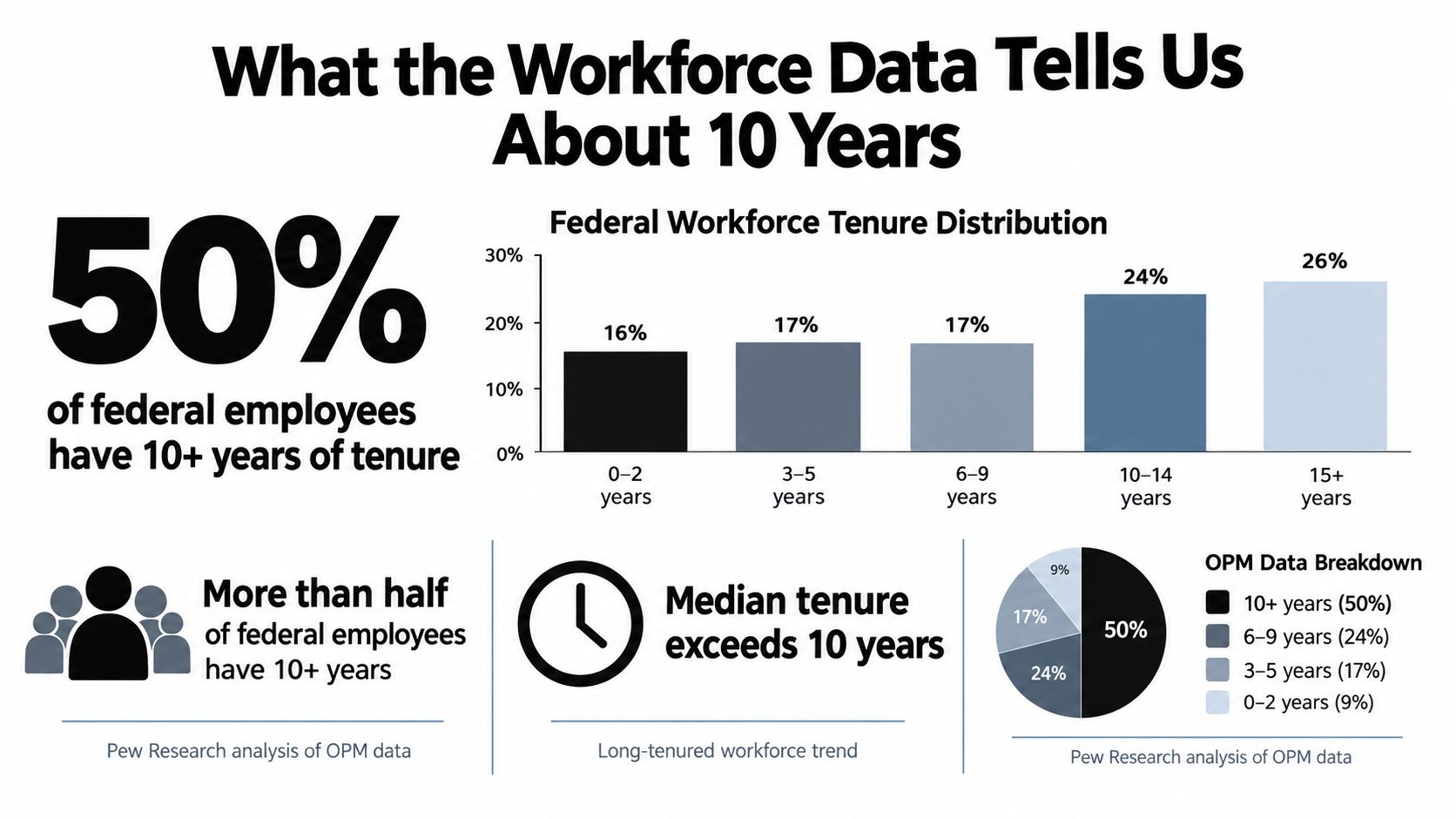
Pew Research Center's analysis of OPM data found that 1.18 million federal civilian employees, or 51.8%, had worked for government in some civilian capacity for fewer than 10 years, while average tenure was 11.8 years, according to Pew's analysis of federal workforce characteristics.
The accompanying graphic should be read with that finding in mind.
Read the statistic carefully
The graphic's labels don't accurately describe Pew's finding. The majority in the cited analysis was below the service threshold, not above it. The reported tenure measure was an average, not a median, and civilian government tenure shouldn't be treated as an individual retirement-credit determination.
Those distinctions matter. Workforce data can describe a population, but it can't tell you whether your own service record supports a particular benefit.
For employees and HR professionals, the practical implications are straightforward:
- Teach benefits before separation: Employees considering career changes need eligibility information while they can still compare departure options.
- Avoid agency-wide assumptions: Pew notes that tenure differs among agencies, so the national average doesn't describe every workplace equally.
- Connect education to decisions: Service-record reviews, contribution-refund questions, and health-coverage planning are useful well before a retirement application.
The broader lesson isn't that everyone should stay until the same anniversary. It's that employees need enough information to understand what staying or leaving would mean for them. A retirement seminar shouldn't be someone's first introduction to these distinctions.
The Survivor Benefit Tradeoff at 10 Years
Your pension decision affects more than your own monthly income. If your spouse depends on that income, you also need to consider what the household would receive after your death.
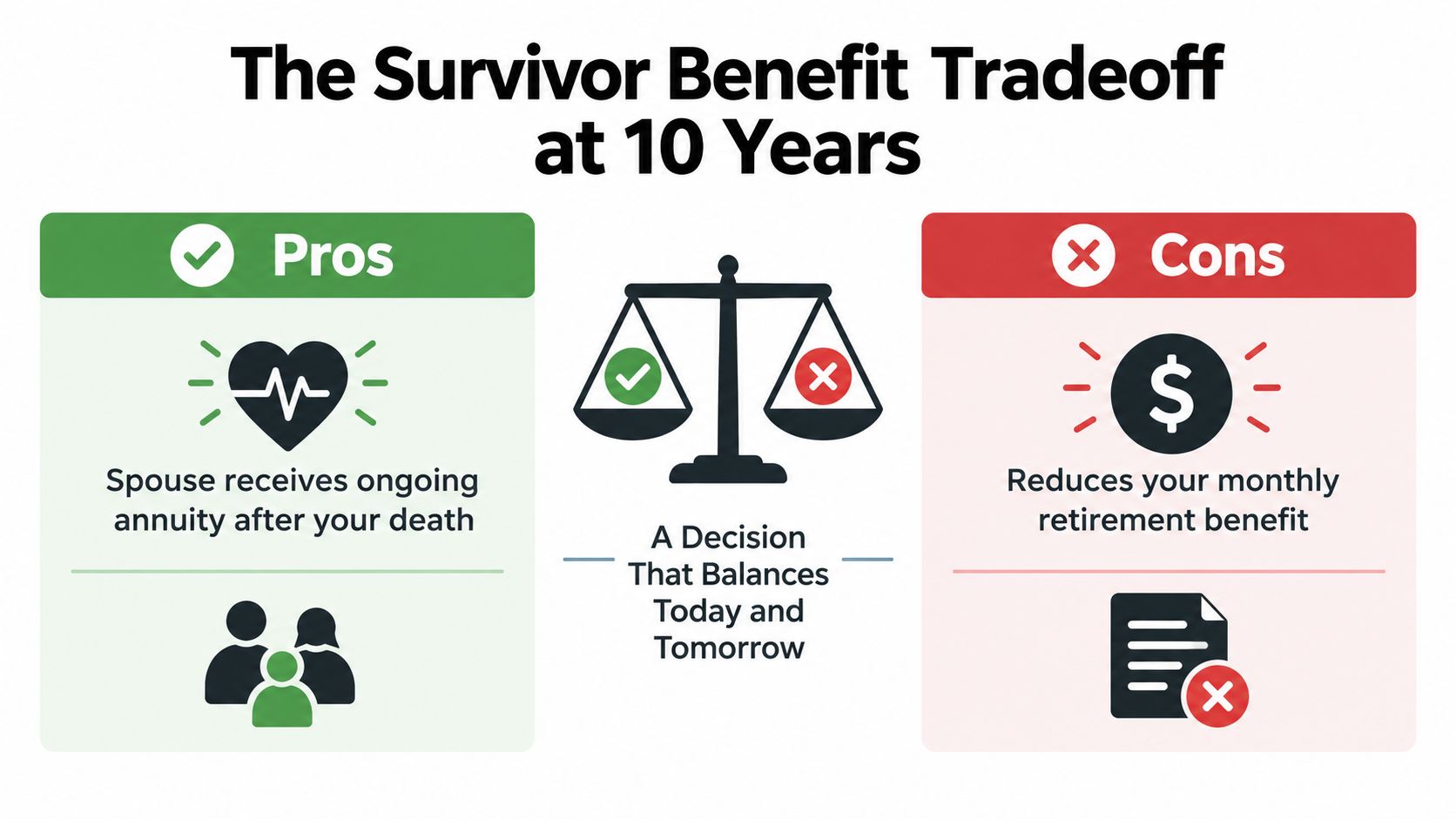
Under FERS, a full survivor election provides 50% of the unreduced annuity and reduces the employee annuity by 10%, while a partial election provides 25% and reduces the employee annuity by 5%; choosing less than full coverage requires the spouse's notarized consent, according to OPM's survivor-benefit guidance.
The visual below highlights the central tradeoff between income during retirement and protection for a surviving spouse.
Compare household outcomes
A full election provides more survivor income but leaves less employee income during retirement. A partial election preserves more of the employee's payment while providing a smaller survivor annuity.
Neither choice should be evaluated only by asking which produces the largest current deposit. Consider the expenses that would remain if either spouse died, the reliability of other income, and whether the surviving spouse could manage the household independently.
| Household consideration | Question to discuss |
|---|---|
| Unequal earnings | Would the lower-earning spouse have sufficient independent income? |
| Health concerns | Could illness reduce savings or increase ongoing expenses? |
| Other resources | Would insurance, savings, or another pension provide dependable support? |
| Health coverage | What separate requirements would apply to continued coverage? |
Keep survivor and health eligibility separate
Creditable service and marriage conditions can affect survivor eligibility. FEHB continuation involves separate requirements, so don't treat a survivor election as proof that every health-coverage condition has been satisfied.
Household planning insight: Compare the budget while you're both living with the budget after either spouse dies. A payment that looks comfortable today may leave a different picture later.
Use the guide to FERS survivor benefits for federal employees to prepare questions for your benefits specialist. Discuss the election together before treating the retirement estimate as settled.
Three Real-World Scenarios at the 10-Year Mark
The following situations are hypothetical illustrations, not employee case studies. Each applies the rules already discussed, but the employee's departure timing changes the decision.
A career change before minimum retirement age
An employee wants to move into the private sector and wonders whether to request a refund of retirement contributions. The immediate temptation is to compare the refund with current expenses or an investment opportunity.
The more useful comparison includes the future pension that could be preserved. Before signing refund paperwork, this employee should confirm deferred eligibility, retain service records, and understand how the new employer's health and retirement benefits fit the waiting period.
The key decision isn't just whether to leave. It's how to leave without unintentionally giving up an option the employee wanted to keep.
Separation after reaching minimum retirement age
Another employee has reached the applicable MRA and wants to stop working. This person's question is whether to begin the available annuity promptly or postpone commencement.
The answer requires a cash-flow comparison, not just a preference for the larger eventual pension. The employee needs to examine savings withdrawals, other household earnings, and health-coverage arrangements during the delay, while asking the agency to confirm the benefit consequences.
A postponement that works comfortably for a household with another reliable income may be difficult for someone relying primarily on the federal pension.
Retirement with a financially dependent spouse
A married employee is preparing to leave and initially focuses on the largest possible monthly payment. During planning, the couple realizes that the spouse would have limited independent retirement income.
Their discussion shifts to survivor protection and separate health-coverage eligibility. They compare their joint budget with a survivor budget and review which expenses would continue.
- Different priorities: The career changer needs to preserve options; the immediate retiree needs a workable commencement decision.
- Shared discipline: Each employee should obtain written estimates and confirm eligibility rather than applying a coworker's experience to a different situation.
The same service milestone can lead to different choices without anyone making a mistake. What matters is matching the retirement arrangement to the household.
Your Next Steps After Reaching 10 Years
Reaching 10 years in service is a useful moment to replace assumptions with a documented plan. You don't need to decide everything immediately, but you should know which questions remain unresolved before choosing a departure date.
Start with your agency's benefits office and your own records. An outside planner can help compare household outcomes, but an attractive projection isn't a substitute for confirming the service and eligibility rules that apply to you.
Build a decision file
Keep the information together so you can compare alternatives without repeatedly reconstructing your history.
- Verify your service: Ask the agency to confirm creditable periods and identify any unresolved deposit or redeposit issues.
- Confirm your category: Establish whether the contemplated departure would involve immediate, postponed, or deferred retirement.
- Request comparable estimates: Use consistent pay and service assumptions, then identify what changes with each departure or commencement date.
- Document coverage questions: Obtain answers about FEHB separately from the pension calculation.
- Review family protection: Compare employee income and survivor income with your spouse's needs and other resources.
Choose only after checking the gaps
Write down how you'd pay ordinary expenses before the annuity begins. Include health insurance, irregular bills, and the possibility that a new job or planned retirement date changes.
Then review the plan with the people affected by it. Your spouse may have different concerns about survivor income, while your benefits office may identify an eligibility issue that a general calculator cannot resolve.
A decade is a milestone, not a finish line. The strongest next step is a clear comparison of the options available to you, supported by verified records and a realistic household budget.
Federal Benefits Sherpa offers personalized retirement planning, benefit reviews, and gap analysis reports to help federal employees understand their benefits and future retirement income. Visit to request a free benefit review and discuss how your departure date, annuity timing, survivor election, and health coverage fit together.
