
Learning Center
TSP Early Withdrawal Calculator Guide for Feds
You've left federal service, an unexpected bill has arrived, or you're considering retirement before traditional retirement age. Your TSP balance looks like the obvious source of cash, but the amount you request isn't the amount you'll necessarily keep. Federal income tax, state tax, the IRS additional tax, withholding, and the retirement growth you give up can all change the decision.
A TSP early withdrawal calculator is useful when you treat it as a planning tool rather than a simple penalty checker. The right result helps you compare taking money now with leaving it in the plan, rolling it over, making a partial withdrawal, or using installments.
What a TSP Early Withdrawal Calculator Actually Tells You
A federal employee separates from service, faces an unexpected bill, and enters a proposed TSP withdrawal into a calculator. The projected deposit appears precise, but it is an estimate built from the amount distributed, account type, tax assumptions, and timing. The tool can show immediate cash flow. It cannot decide whether using that money supports the employee's FERS income, Social Security timing, and long-term retirement plan.
A useful result separates three different effects:
- Estimated federal income tax: A Traditional TSP distribution generally adds taxable income for the year. That added income can affect the tax rate applied to other dollars.
- Estimated state income tax: The amount depends on the state of residence and the assumptions selected in the calculator.
- The 10% additional tax: The Thrift Savings Plan's withdrawal guidance explains that this additional tax may apply to the taxable portion of a distribution taken before age 59½, unless a rollover or exception applies.
Withholding and actual tax are not the same thing. Withholding is money sent in during the distribution, like a deposit toward a later bill. Your final tax depends on total income, deductions, filing status, and the treatment of the withdrawal. A calculator's estimated net payment therefore should not be read as the final amount you owe or keep.
The penalty question is only the first screen. Compare the immediate proceeds with the lost compounding on the amount removed. A withdrawal also uses room in your lifetime tax plan. For example, a lower-income year before FERS or Social Security begins may offer a different tax opportunity than a later year when those income sources are arriving together.
Practical rule: Treat the net-proceeds estimate as the starting point for a withdrawal decision, not as permission to withdraw.
Separation timing can change whether an exception applies. Detailed age-based and public-safety rules belong in the exception analysis, including the qualifying age-50 provision described by the TSP public-safety withdrawal bulletin.
For a broader comparison of partial withdrawals, installments, rollovers, and other distribution choices, review this guide to TSP withdrawal options. Then compare taking all the money now with leaving it invested or withdrawing only what the current need requires.
Inputs You Need Before You Calculate
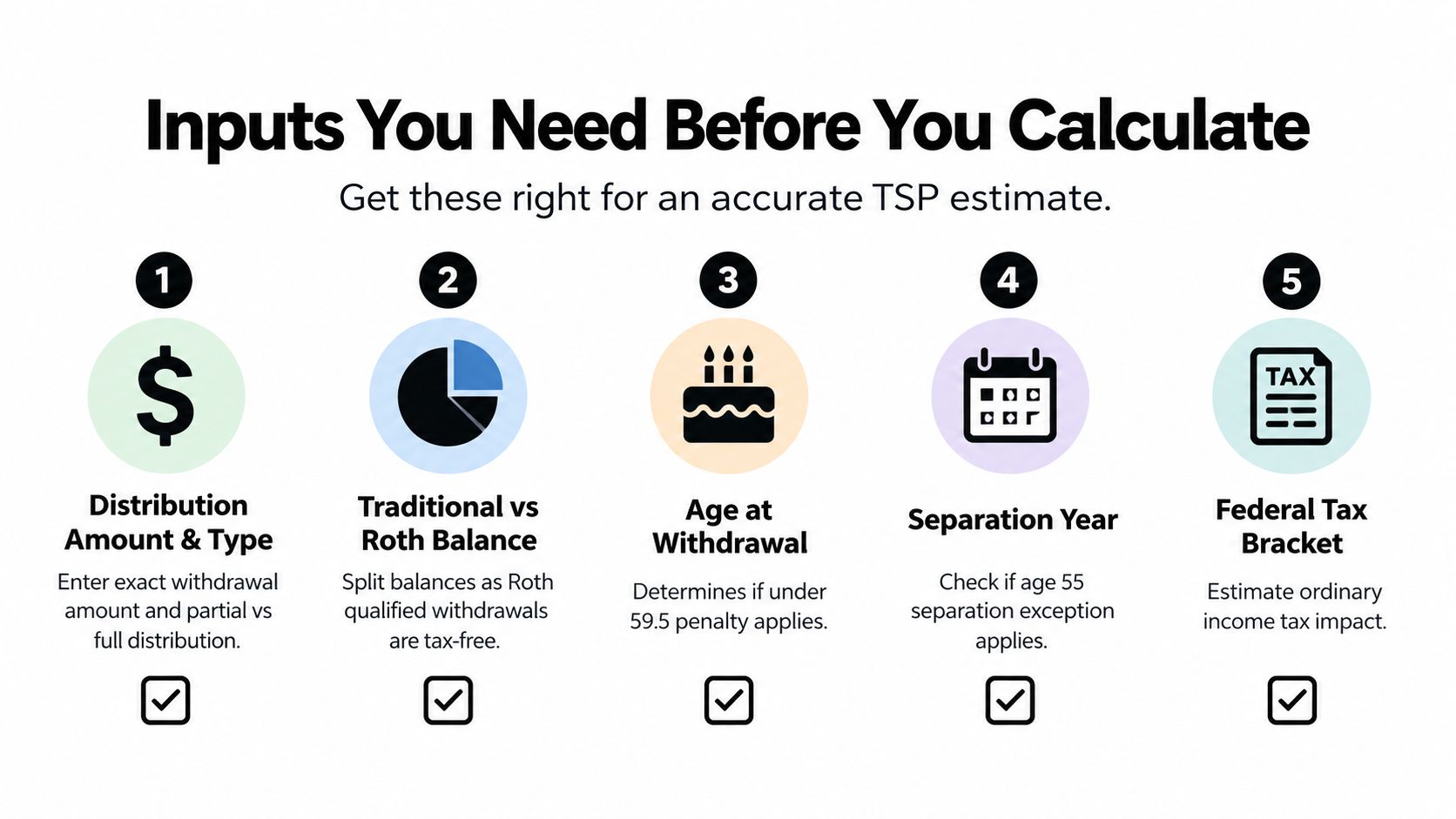
A calculator can't fix incomplete information. Gather the following before entering anything so the estimate reflects your actual situation.
Start with the distribution details
Enter the gross amount you want distributed, not the amount you hope to receive after deductions. Identify whether the request is a full withdrawal, a partial withdrawal, or a series of installments. A one-time distribution can create a different tax result from payments spread across several tax years.
Look at your TSP account information and separate Traditional TSP from Roth TSP. Traditional money is generally treated as taxable income when distributed. Roth treatment depends on whether the withdrawal meets the applicable qualified-distribution requirements, so don't assume every Roth dollar will receive identical treatment.
Add your personal and employment facts
Enter your age on the distribution date and your separation date or separation year. Don't substitute your retirement eligibility date for your separation date. The separation timing is the fact that can determine whether a federal employee qualifies for an exception.
You'll also need your filing status, estimated household income, and state of residence. Include other expected income, such as a FERS pension or Social Security, because a TSP distribution may sit on top of those amounts and change the estimated tax bracket.
The calculator may ask whether you're using a rollover, installments, or a substantially equal payment arrangement. Answer carefully. A rollover generally changes the immediate tax treatment, while a 72(t) arrangement requires the payments to follow strict rules. For a broader account overview, use this complete 2026 TSP guide.
Finally, keep contribution planning separate from withdrawal planning, but recognize that taking funds out can interrupt future saving. The available 2026 retirement contribution limits can help you understand the contribution capacity you may be giving up while rebuilding the account.
How the Calculator Figures Taxes Penalties and Exceptions
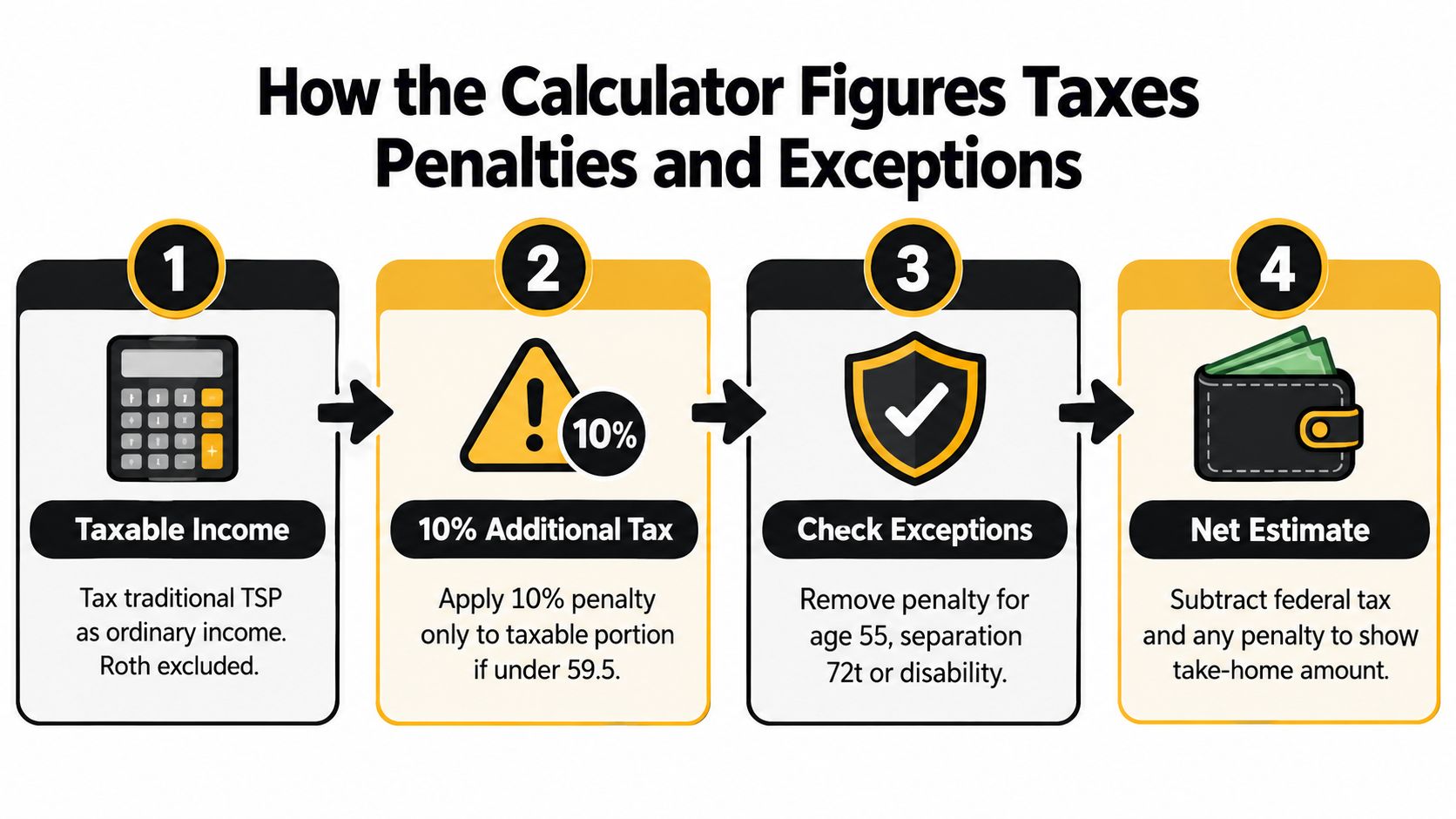
A useful calculator follows the money through several checkpoints. It first separates the distribution into Traditional and Roth sources, then asks whether each portion is taxable. A Traditional TSP distribution generally enters ordinary income. A qualified Roth distribution may be excluded from income, while a nonqualified Roth withdrawal needs more careful treatment. Entering one combined amount can therefore produce a misleading estimate.
The next checkpoint is age 59½. If a taxable portion is distributed before that age and no exception applies, the IRS 10% additional tax may be added to ordinary income tax. These are two separate charges. The additional tax does not replace income tax. It sits on top of the tax estimate.
Exceptions change the output
The calculator then checks separation status and special eligibility. For many federal employees, separating in or after the calendar year they turn 55 can remove the 10% additional tax for qualifying TSP distributions. Certain public safety employees may qualify when separating in or after the year they turn 50, subject to the applicable category and service rules. Review the TSP public-safety guidance before selecting that exception.
Another path uses substantially equal periodic payments, commonly associated with Section 72(t). Payments must continue for the longer of five years or until age 59½. Changing the schedule can create serious tax consequences, so this option is not the same as choosing convenient installments.
The result must also separate withholding from final liability. Some taxable distributions may have mandatory 20% federal withholding, but withholding is money sent in during the year, not a final tax bill. Your return still reflects total income, deductions, credits, and filing status. A payment can look smaller because withholding was taken out, even when your final tax due is different.
A second reading of the result should include retirement timing. A withdrawal may reduce future compounding, while delaying distributions can change the order in which TSP income, a FERS pension, and Social Security fill your tax brackets. That sequencing can matter over a lifetime, not just on the day of withdrawal.
Watch this explanation before relying on a number:
For federal employee tax context, use this TSP and taxes guide. Compare leaving the balance invested, rolling it over, taking a partial distribution, and using installments. Each choice changes tax timing, withholding, available compounding, and retirement income sequencing.
Sample Calculations That Show How Results Change
A calculator result is easiest to understand through a specific scenario. These examples illustrate the calculation logic, not a tax quote. The actual federal and state amounts depend on current income, filing status, state rules, deductions, and whether the distribution comes from Traditional or Roth TSP money.
A 53-year-old FERS employee separates at age 54 and requests a $30,000 Traditional TSP distribution. Because the separation occurred before the calendar year in which the employee reaches age 55, the general separation exception is unavailable. If no other exception applies, the taxable distribution may owe ordinary income tax plus the IRS 10% additional tax described in the TSP tax notice.
If the employee instead separates during the calendar year they turn 55, the calculator may show a different penalty result. Ordinary income tax still applies to the taxable amount, but the qualifying separation exception may remove the 10% additional tax. The gross withdrawal remains $30,000. The projected net proceeds change because one modeled deduction may disappear.
| Scenario | Gross Withdrawal | Estimated Tax and Penalty | Net Proceeds |
|---|---|---|---|
| Separation before qualifying age | $30,000 | Calculator estimates ordinary income tax, state tax, and possible 10% additional tax | Gross amount minus modeled deductions |
| Qualifying separation timing | $30,000 | Calculator estimates ordinary income tax and state tax, with the additional tax potentially removed | Gross amount minus modeled taxes |
| Installment arrangement | Varies by payment schedule | Tax and withholding modeled across payments, with exception requirements tested | Net amount for each payment |
A 52-year-old may also compare a lump sum with substantially equal periodic payments. A lump sum provides immediate access but can place more taxable income in one year. A properly established 72(t) arrangement may avoid the additional tax, though its payment schedule must continue for the required period. The calculator should show the taxable income and withholding effect for each payment, rather than reducing the comparison to one lump-sum net figure.
Read the result beyond the penalty line. Withholding is an amount sent in during the year, while final tax depends on the complete return. The withdrawal also removes money that could have remained invested and compounded. That missed growth is uncertain, so a responsible calculator should present it as a range or qualitative tradeoff, not a guaranteed return. Delaying the withdrawal may also change how TSP income, a FERS pension, and Social Security fill tax brackets over a lifetime.
How to Interpret Results and Choose When to Withdraw
A low penalty does not automatically mean a low-cost choice. Read the estimate through four questions: what do I receive now, which tax year absorbs the income, what retirement income remains, and what flexibility do I give up?
For a Traditional TSP distribution, enter the income you expect from wages, a FERS pension, and Social Security for the same year. Those amounts can stack in one tax year and push more income into higher brackets. A Roth TSP distribution may produce a different result, but qualified-distribution and five-year rules still require review. Traditional distributions also affect required minimum distributions, which generally begin at age 73 under SECURE 2.0. The TSP calculator resources can help you model these inputs.
Compare the strategies instead of chasing one answer
| Choice | Usually fits when | Main question |
|---|---|---|
| Leave money in TSP | You do not need the cash now | Can other resources cover the expense while preserving compounding? |
| Roll over | You need different investment or withdrawal flexibility | Could the rollover affect an exception tied to keeping assets in the TSP? |
| Partial withdrawal | You need limited liquidity | Can you spread income across tax years instead of creating one large spike? |
| Installments | You need recurring cash flow | Can you maintain the payment arrangement and accept its restrictions? |
The result also needs a withholding check. Withholding is money sent to the IRS during the year, not necessarily your final tax bill. Your complete tax return determines the final liability, so compare the calculator's withholding figure with the estimated tax rather than treating the two numbers as interchangeable.
A withdrawal has a second cost that may not appear on the screen: money removed from the account no longer has the opportunity to compound. The missed growth is uncertain, so treat it as a range or tradeoff, not a promised return. If you are still working, withdrawing may also interrupt future agency-match accumulation and leave fewer assets available during unfavorable markets.
Timing can matter more than the penalty line. Compare a withdrawal during a lower-income period before FERS pension or Social Security begins with a withdrawal after those income sources fill more of your tax brackets. The best sequence may use TSP funds to manage lifetime taxable income, while preserving flexibility for later medical costs, survivor needs, or required distributions. A calculator is most useful when it compares these timelines, not just one immediate net amount.
Next Steps After Your Estimate
Treat the calculator result as a draft until you verify the facts behind it. Confirm the separation year, your age on the distribution date, the Traditional and Roth portions, and whether a special exception applies to your employment category. If the tool shows withholding, compare that amount with the estimated final tax rather than treating withholding as the tax bill.
Run at least two additional scenarios. Test the effect of leaving the money invested, and compare a partial withdrawal with a rollover or installment approach. Ask how each option affects your FERS pension income, Social Security timing, future RMDs, and the account balance available for a surviving spouse or other beneficiary.
Before submitting paperwork, document any 72(t) payment schedule and obtain tax advice if the arrangement is complex. A rollover also deserves careful timing review, especially if separation status creates an exception that you may lose after moving the funds. If the estimate affects your retirement date or essential income, a personalized federal benefits review can help connect the TSP decision with FERS, Social Security, healthcare, and survivor planning.
Federal Benefits Sherpa provides federal benefits education, personalized benefit reviews, retirement planning, and gap analysis reports that can help you evaluate a TSP withdrawal alongside FERS and Social Security income. Visit Federal Benefits Sherpa to request a benefits review and turn your calculator estimate into a documented withdrawal strategy.


Dedicated to helping Federal employees nationwide.
“Sherpa” - Someone who guides others through complex challenges, helping them navigate difficult decisions and achieve their goals, much like a trusted advisor in the business world.
Federal Benefits Sherpa, LLC
12724 Gran Bay Parkway West, Suite 410, Jacksonville, FL 32225
Email: [email protected]
Phone: (833) 753-1825
© 2024 Federalbenefitssherpa. All rights reserved
Federal Benefits Sherpa is an independent organization and is not affiliated with or endorsed by the U.S. government or any federal agency.