
Learning Center
Transition Planning and Support for Federal Retirees
You've picked a possible retirement date, opened your latest TSP statement, and started wondering what your pension will cover. Then the practical questions arrive: Who checks your service record? Will your health insurance continue? What pays the mortgage if your first full retirement payment hasn't arrived?
Transition planning and support means answering those questions before your salary stops. Treat retirement as an operational handoff, with named responsibilities, documented decisions, and enough accessible cash to manage the space between leaving work and receiving fully processed benefits.
What Transition Planning Covers for Federal Employees
Transition planning is the work of moving a federal career into retirement income without avoidable gaps, by making linked decisions in the right order. You're not just choosing when to stop working. You're deciding how your household will receive income, maintain coverage, and handle administrative delays.
Think of a relay race. Your FERS Basic Benefit, Social Security, and TSP are the runners, and your household's spending needs are the baton. A strong individual runner doesn't help much if nobody has planned the handoff.

Start with eligibility, not an income estimate
The OPM FERS information guide describes the coordinated retirement structure and lists immediate eligibility combinations including age 62 with 5 years of service, age 60 with 20 years, Minimum Retirement Age with 30 years, or MRA with 10 years, with reductions potentially applying to some MRA-plus-10 retirements.
Those categories determine which planning questions come next. An employee eligible for an immediate annuity faces a different decision from someone separating with a possible future deferred annuity. Don't assume that resigning and retiring are interchangeable, and don't classify yourself without checking whether special provisions apply.
Leaving retirement contributions in the system may preserve a future deferred benefit. Requesting a refund changes that pathway, so obtain an explanation of the consequences before signing refund paperwork.
Model the handoffs together
Your retirement date, Social Security claiming decision, TSP withdrawals, and annuity election belong in the same projection. If you postpone one income source, another source or your cash reserves must cover the difference.
For example, an employee might want to leave federal service before starting Social Security. The useful question isn't whether the pension looks adequate by itself, but whether the pension, planned withdrawals, insurance costs, and available cash work together.
First task: List your employment periods, breaks in service, military service, and supporting records. Ask your benefits office to identify your retirement eligibility category before you compare income options.
A verified service history makes the rest of the plan more dependable. Without it, even a detailed retirement spreadsheet can start from the wrong assumptions.
Retirement Timeline From Ten Years Out to Day One
Use the following windows as planning targets, not universal filing deadlines: each row identifies an action and the office that can help move it forward.
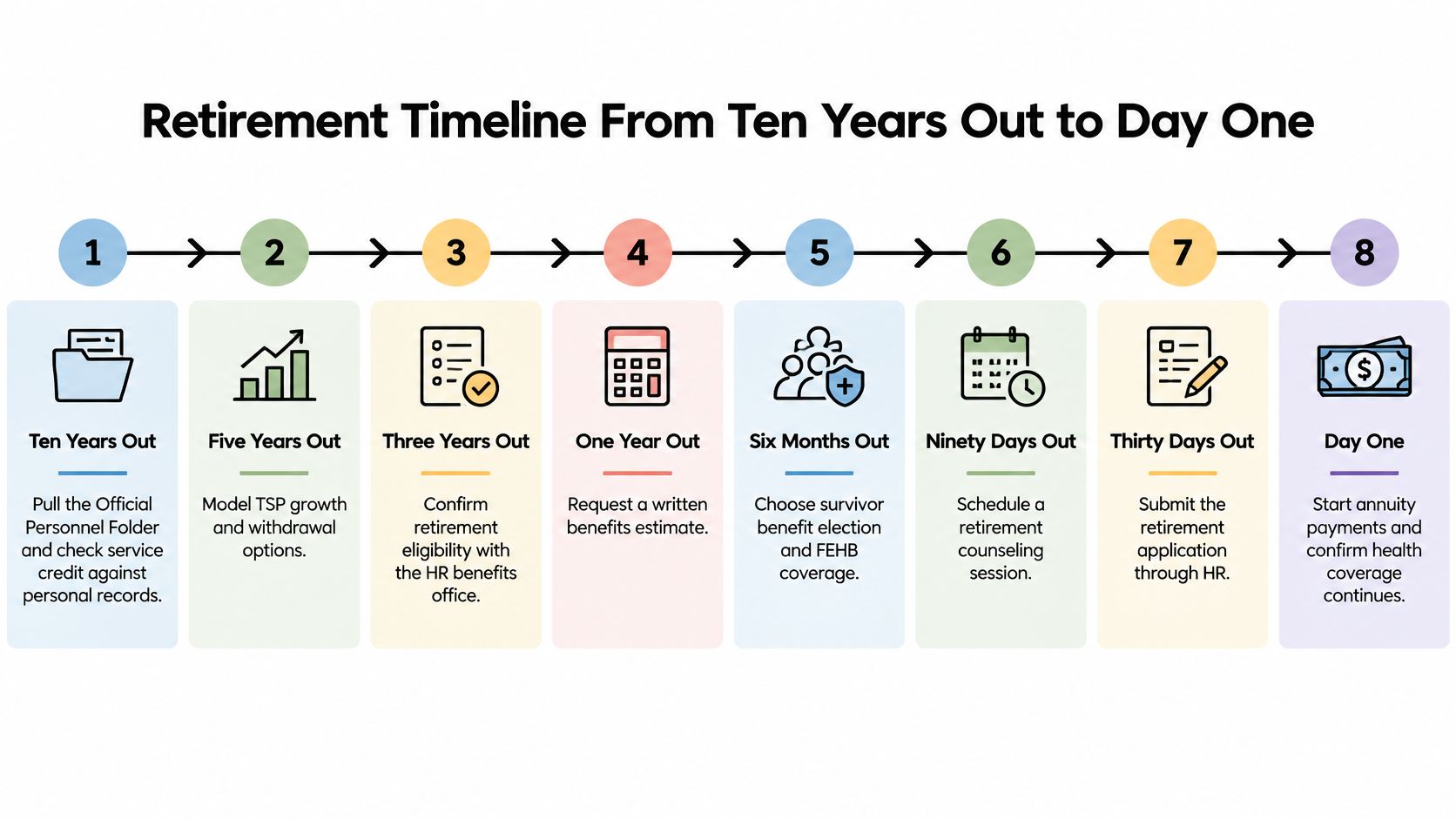
Retirement planning timeline by window
| Window | Key actions | Who handles it |
|---|---|---|
| Ten years out | Pull Official Personnel Folder, check service credit, request a FERS estimate | HR benefits office |
| Five years out | Model TSP withdrawal options, review FEHB and FEGLI enrollment history | TSP and HR benefits office |
| Three years out | Compare candidate dates against immediate eligibility categories | HR benefits office using OPM rules |
| One year out | Audit service, debts, military deposits, Medicare eligibility, and separation date | HR benefits specialist |
| Six months out | Review survivor election, FEGLI coverage, and Social Security claiming strategy | HR and Social Security Administration |
| Ninety days out | Confirm agency submission instructions, application status, and direct deposit | HR retirement processing staff |
| Retirement month | Reconcile final pay and leave payout, finalize TSP withdrawal instructions | Agency payroll, HR, and TSP |
| First six months after | Track processing, verify payments, review beneficiary forms | OPM and TSP |
Build the record before choosing the date
Ten years out, retrieve your Official Personnel Folder and compare it with your own records. Look for missing appointments, unexplained breaks, and service you believe should count.
Five years out, examine your insurance enrollment history alongside potential TSP income. The objective is to discover problems while you still have time to act, rather than discovering them during application preparation.
Three years out, compare candidate separation dates using confirmed eligibility. A preferred calendar date is only useful if it produces the retirement treatment you expect.
One year out, turn the review into an assigned checklist. Give each unresolved item an owner, a requested completion date, and a place to store the response.
Convert decisions into an executable handoff
Six months out, review household elections together and identify any additional documents or consents needed. Separate a provisional preference from a completed election.
Ninety days out, confirm your agency's actual filing requirements and submit according to its instructions. Don't interpret the infographic's later submission marker as permission to wait, and don't interpret Day One as a guaranteed payment date.
During retirement month, reconcile payroll expectations with the income plan. Our guide to choosing the best month to retire as a federal employee can help organize the calendar questions to bring to HR.
After separation, monitor the handoff rather than assuming submission means completion. Check payment details and maintain current contact information.
A late start often appears as an overlooked task rather than a dramatic failure. Put actual dates beside these targets, then replace any generic target with the deadline your agency confirms.
Benefits Checklist for TSP, FERS, FEHB, FEGLI and Social Security
Health coverage eligibility deserves attention before you commit to leaving. The OPM retirement application tips explain that continuing FEHB generally requires entitlement to an immediate annuity and enrollment or qualifying coverage for the five consecutive years immediately before retirement; similar continuity requirements apply to FEGLI.
Don't reduce that review to whether you currently carry insurance. Your benefits specialist needs to examine the enrollment record and the retirement category together, including any applicable exceptions or special circumstances.
Benefits to confirm before and after retirement
| Benefit | Confirm before retirement | What changes at retirement |
|---|---|---|
| FERS basic annuity | Creditable service, high-3 salary inputs, survivor election | Retirement income replaces salary after processing; elections affect household income |
| FERS supplement | Whether your retirement category qualifies | Include only a confirmed entitlement in the income plan |
| Thrift Savings Plan | Balance, fund mix, beneficiary form, withdrawal instructions | Savings become part of the spending plan |
| FEHB | Enrollment history and eligibility to continue | Coverage administration moves into retirement |
| FEGLI | Coverage type, continuity record, retirement election | Coverage may be reduced or declined |
| Social Security | Earnings record and intended claiming strategy | Claiming remains a separate decision from federal separation |
| Medicare | Eligibility, enrollment timing, and coordination with FEHB | Household coverage and premium arrangements may change |
| Survivor benefits | Election documents and applicable spouse consent | The selected protection affects retirement and survivor income |
Verify pension inputs and household elections
For the FERS basic annuity, ask for a written estimate identifying the service and salary assumptions used. If an estimate differs from your expectations, resolve the inputs rather than averaging competing answers.
A survivor election isn't merely an adjustment to your own payment. Ask what your spouse would receive after your death, how the election affects your retirement income, and which changes would remain available afterward. Treat a potentially irreversible choice as a document-review task, not a conversation to finish hurriedly.
Keep the FERS supplement separate from the basic annuity in your worksheet. Don't assume that every immediate retirement category receives it, or that it continues indefinitely. Obtain confirmation of eligibility and its endpoint before counting it toward recurring bills.
Turn account balances into payment instructions
For the TSP, verify the beneficiary form separately from your withdrawal decision. Then compare partial withdrawals, installments, an annuity purchase, and a rollover where available, using current plan instructions and a tax estimate.
A large balance doesn't tell you which payment method fits your household. Ask how much cash you need, when you need it, and what each choice means for access, taxes, and future flexibility.
FEGLI requires a different comparison: the protection your household needs versus the coverage and cost you would retain. Request the retirement-specific coverage information rather than relying on your current payroll deduction.
For Social Security, inspect your earnings record before relying on an estimate. If you have earlier work not covered by Social Security, ask the agency to explain how current law applies instead of using an old worksheet or assuming older offset rules still apply.
Finish with Medicare coordination. Ask which enrollment periods apply to your circumstances, how FEHB would coordinate, and whether postponing enrollment could create a penalty. Get the timing resolved before making a coverage change.
Covering the Gap Before Your First Full Payment
Your separation date is set, but the first full annuity payment may arrive later. OPM retirement processing can take time, so plan for the months when salary has stopped and full retirement income has not yet started. See this guide to OPM retirement processing delays for help organizing questions about your application.
A solid long-term plan can still leave a short-term cash gap. Set aside accessible funds for that interval so you are not forced into a rushed withdrawal or insurance decision.
Bridge budget priorities during the payment gap
| Expense | Priority | Why it matters in the gap |
|---|---|---|
| Housing and utilities | Essential | These bills continue after salary stops |
| Health premium withholding | Essential | Payment arrangements and any outstanding premiums need attention |
| Food and transportation | Essential | Everyday costs continue during processing |
| Minimum debt payments | High | Missed payments can lead to charges and credit problems |
| Estimated income tax | High | Withholding and withdrawals affect the amount due |
| Discretionary spending | Defer | Holding back spending preserves accessible cash until full payments are confirmed |
Test cash availability, not just account totals
Stress-test your budget for a one-month, three-month, and six-month delay. These are planning scenarios, not predictions about how long your own application will take.
For each scenario, multiply essential monthly spending by the assumed delay. Subtract only income you can reasonably expect during that period, then add irregular bills. Do not count a pending payment as cash on hand.
Use actual household bills rather than a percentage of former salary. Mortgage and utility due dates do not change because an application is still being processed.
Transition money must be available when bills come due. An account balance alone does not show whether you can access the funds in time.
Give the household contingency instructions
Write down which account pays each essential bill, what spending can pause, and whom to contact if you are unavailable. Store the instructions securely, and make sure a spouse or caregiver has appropriate access or authorization.
Keep a processing log with submission confirmations, contact dates, outstanding requests, and the next follow-up action. If an interim payment arrives, compare it with the bridge budget before increasing spending, and confirm how deductions and later adjustments will be handled.
Retirement readiness includes covering the handoff between your last paycheck and full retirement income.
Emotional and HR Support Before You Leave
A long-serving employee clears a desk, hands over assignments, and receives congratulations. At home, the same person may feel uncertain about money, daily routine, and who they'll be without the job title. Those feelings can coexist with genuine excitement about retirement.
Practical support works best when you separate the questions. An HR retirement counselor can address paperwork and benefits; a counselor can help with persistent anxiety or low mood; recently retired colleagues can describe the everyday adjustment without becoming substitutes for official guidance.
Match support to the problem
- HR retirement counseling: Bring unresolved elections and ask which documents establish the answer.
- Agency benefits specialist: Request a review of service-credit questions and missing records.
- Employee Assistance Program: Ask about confidential counseling resources and the terms of access.
- Retired colleagues: Discuss routines, social connections, and what they wish they'd organized before leaving.
For readers in Vernon seeking help with depression, Interactive Counselling provides information on how to find depression counselling in Vernon. That's a location-specific mental health resource, not a federal benefits service.
Include your spouse in decisions that affect the household. We encourage spouses to join our calls because survivor benefits and health coverage decisions affect both partners.
Keep a decision log
Record each election, the reason for it, the date, the supporting document, and any unanswered question. A simple spreadsheet with links to securely stored files is more useful than scattered notes across email accounts.
Reserve a fixed weekly review slot during your final working year. Outside that appointment, capture new questions without expecting yourself to solve every issue immediately.
Pause before submitting if you can't explain what an election does, who confirmed it, or what would happen if your circumstances changed.
Seek additional support when offices give conflicting answers, important questions remain unresolved, or you feel rushed into agreeing. Requesting clarification isn't a failure to prepare. It's part of making a defensible decision.
Common Pitfalls That Lock In Costly Choices
The most expensive mistake isn't always a poor investment choice. It can be an administrative election made before the employee understands what it changes. The order below prioritizes potentially lasting consequences, not a universal dollar ranking.
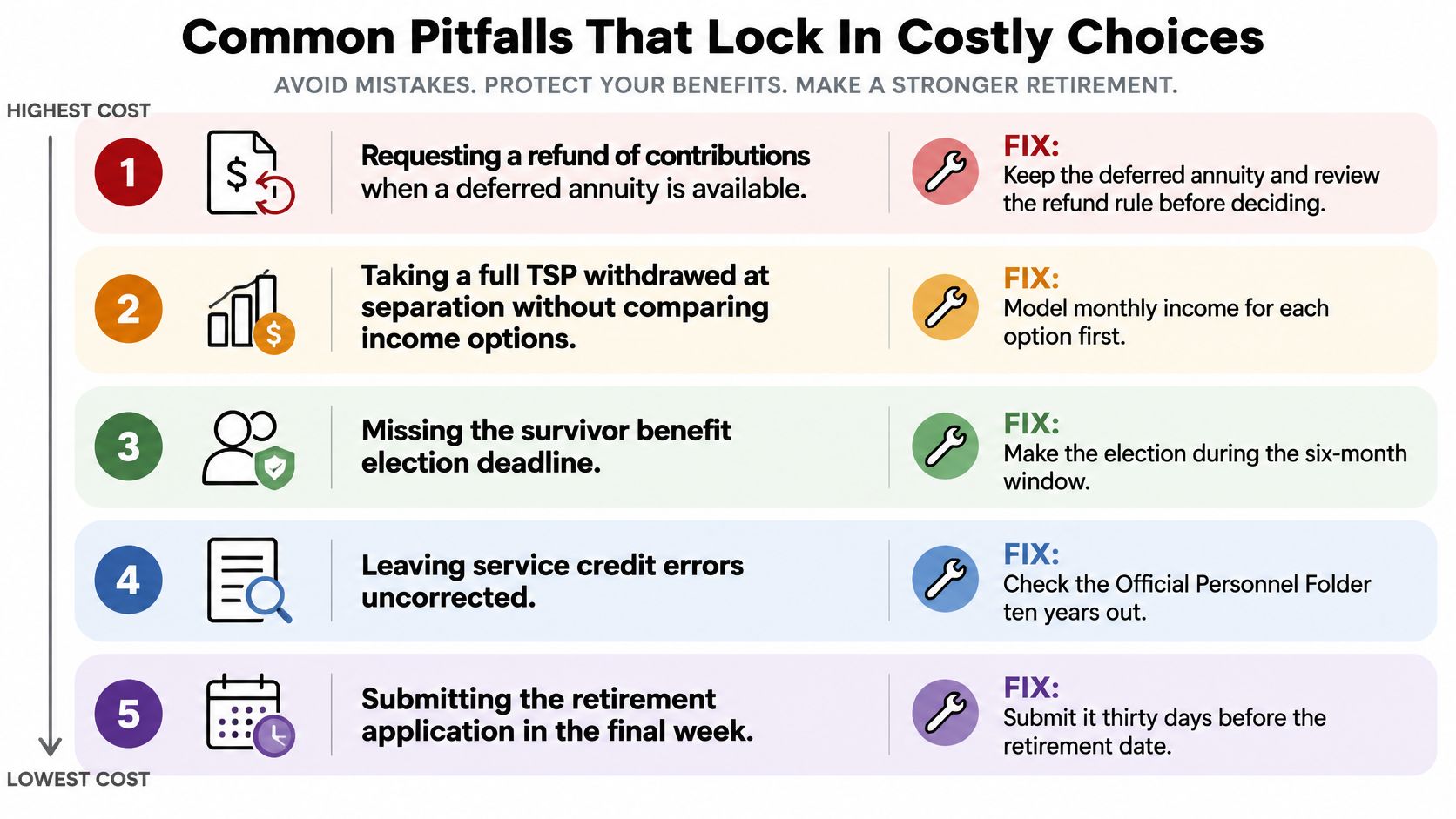
- Requesting a contribution refund too soon: Compare the future-benefit pathway before authorizing the refund.
- Assuming insurance continuity: Have HR verify the enrollment record before changing coverage or finalizing separation.
- Leaving service discrepancies unresolved: Assign each missing record or disputed period a named owner.
- Choosing survivor protection alone: Review household consequences together before signing.
- Taking a full TSP distribution without a tax comparison: Evaluate income alternatives and access needs first.
- Ignoring payroll timing: Confirm final salary, leave treatment, and expected payment dates with payroll.
- Using an outdated Social Security worksheet: Request an estimate based on your earnings record and current law.
Require a second review
Don't treat an infographic's submission target as your agency's deadline. Obtain the actual application instructions and allow time for corrections.
For any election that may be difficult or impossible to reverse, have a second person review the completed document against your written intent. Ask them to identify inconsistencies, rather than just approve the form.
A complete form isn't necessarily a suitable choice. The review should confirm both accuracy and consequences.
Choose Your Help and Start the Benefits Audit
Who should answer the next question on your list? Start with the office responsible for the record or transaction, then use independent education to compare how the decisions fit together.

Who handles each part of the transition
| Question | Go to | Limit to know |
|---|---|---|
| Service credit and retirement application | HR benefits office and OPM | Official determinations govern; projections don't replace records |
| Annuity calculation and processing status | OPM retirement services | Processing time isn't a guaranteed payment date |
| TSP withdrawal and rollover mechanics | TSP participant services | Account instructions don't constitute an integrated household plan |
| Social Security claiming age | Social Security Administration | Estimates rely on the earnings record and applicable rules |
| Combined projection and trade-offs | Independent planner such as Federal Benefits Sherpa | Modeling doesn't replace agency determinations |
Combine official answers with household planning
We're independent and aren't affiliated with or endorsed by OPM, the Social Security Administration, the Federal Retirement Thrift Investment Board, or any government agency. Our guide to finding federal retirement planning consultants helps frame the questions to ask before choosing support.
We offer a free 15-minute benefits review and a free Gap Report, built from your service history and salary, followed by a call to explain the results. You can book without every document, and you decide if and when anything happens afterward.
Keep lifestyle arrangements separate from benefit elections. If travel is part of retirement, Approved Experiences Traveler explains how lifestyle management simplifies travel, a resource to consider after establishing the income and cash-reserve plan.
Take action this week
- Retrieve your records: Pull your Official Personnel Folder and assemble your service history.
- Identify candidate dates: Write down possible retirement dates and the questions each raises.
- Schedule your review: Book the free review and invite your spouse if possible.
Federal Benefits Sherpa offers a free benefits review and Gap Report to help you connect pension income, insurance decisions, TSP withdrawals, and the cash-flow handoff into retirement. Visit Federal Benefits Sherpa to book a conversation, bring the records you have, and start identifying what needs attention before your salary stops.


Dedicated to helping Federal employees nationwide.
“Sherpa” - Someone who guides others through complex challenges, helping them navigate difficult decisions and achieve their goals, much like a trusted advisor in the business world.
Federal Benefits Sherpa, LLC
12724 Gran Bay Parkway West, Suite 410, Jacksonville, FL 32225
Email: [email protected]
Phone: (833) 753-1825
© 2024 Federalbenefitssherpa. All rights reserved
Federal Benefits Sherpa is an independent organization and is not affiliated with or endorsed by the U.S. government or any federal agency.