
Learning Center
Thrift Savings Plan vs 401k: A Federal Employee Guide
You're at the copy machine when a colleague mentions that their private-sector 401(k) offers target-date funds, several index options, company stock, and a brokerage window. You check your own Thrift Savings Plan statement and see a much shorter list of funds. The question arrives quickly: is the TSP holding you back, or is its simplicity one of its strongest features?
That's the core issue behind a thrift savings plan vs 401k comparison. Federal employees may be weighing a spouse's plan, a private-sector job offer, a rollover after separation, or a Roth decision late in their careers. The right answer isn't “always stay in the TSP” or “move everything to a 401(k).” It depends on fees, the investment menu, tax planning, withdrawal needs, creditor protection, and the value of the TSP's unique G Fund.
Why Federal Employees Compare the TSP to a 401k
A FERS employee usually encounters this decision at a transition point. A spouse may have a 401(k) with a long list of investments. A private employer may offer a brokerage window. Or a federal employee leaving government service may wonder whether keeping money in the TSP is still worthwhile after the paycheck and agency contributions stop.
CSRS employees face a different version of the question. They generally don't receive the same TSP matching structure as FERS employees, so the TSP often functions as supplemental savings alongside a CSRS annuity. For FERS employees, the TSP is one part of a three-part retirement system that also includes the FERS annuity and Social Security. That makes the investment decision important, but it also means the TSP shouldn't be judged as if it must replace every other retirement resource.
The comparison usually starts with a trigger
People generally don't compare these plans in the abstract. They compare them because something changed:
- A spouse has a flexible 401(k): The wider fund menu makes the TSP look restrictive.
- A federal employee is changing careers: The new employer may allow a rollover into its 401(k).
- Roth planning has become urgent: The employee wants to coordinate Roth savings with pension income and future taxable withdrawals.
- The TSP balance has become substantial: Fees, diversification, beneficiary planning, and withdrawal flexibility matter more.
- Retirement is approaching: The employee wants to protect assets while deciding how much market risk to keep.
The comparison also gets distorted by the word “choice.” More funds can help an experienced investor, but more funds can also create overlap, indecision, and unnecessary fees. A short menu can make it easier to build a disciplined portfolio, but it may leave an advanced investor looking outside the plan for specific exposures.
Practical rule: Don't roll a TSP balance merely because another plan has more investment names. Move only when the new plan solves a problem you actually have.
Before transferring money, review the mechanics, tax treatment, and investment consequences in this guide to rolling a TSP into a 401(k). A rollover is a permanent account-location decision, not a fund-selection decision.
What the TSP and a 401k Actually Are
The Thrift Savings Plan is a defined-contribution retirement plan for federal employees and members of the uniformed services. Congress created it through the Federal Employees' Retirement System Act of 1986, and it began accepting contributions on April 1, 1987. The Federal Retirement Thrift Investment Board administers it.
By December 31, 2025, the TSP reported approximately $1.07 trillion in assets and about 7.3 million participants, according to the Department of Labor's TSP audit report. That scale matters because it shows the TSP isn't a small workplace benefit. It's a major retirement system with a standardized design and a very large participant base.
A 401(k) is also a defined-contribution plan, but a private employer generally controls its design. The employer chooses the recordkeeper, investment lineup, matching formula, loan provisions, and optional features. The plan must operate within federal tax rules, but two private employers can offer very different 401(k) experiences.
What both plans have in common
Both plans can let workers direct part of their pay into retirement savings. Depending on the plan and election, contributions may receive traditional pre-tax treatment or Roth treatment. Both rely on investment performance, and neither guarantees a specific retirement income from the account itself.
Both plans can sit beside other retirement resources. For a FERS employee, those resources include a federal annuity and Social Security. A private-sector worker may have a pension, Social Security, or neither. The account is only one part of the household retirement-income plan.
The important structural difference is control. The TSP has a centrally designed menu and uniform rules. A 401(k) reflects the choices made by a particular employer and its plan advisers. That's why a 401(k) can offer more customization, but also why its fees and features require individual review.
For a plain-language explanation of employer-sponsored plans, this employee retirement plan overview can help clarify how private workplace plans are typically structured. Federal employees who want the TSP's specific rules should use the complete 2026 TSP account guide as a separate reference.
Side-by-Side Comparison of Key Plan Features
The TSP and a 401(k) share the same basic retirement-account architecture, but the experience can be very different. The TSP emphasizes centralized administration, low-cost index funds, and standardized rules. A 401(k) may provide broader choice, different matching terms, and features that vary by employer.
| Feature | Thrift Savings Plan (TSP) | Typical 401(k) |
|---|---|---|
| Administration | Federal Retirement Thrift Investment Board | Individual employer and its plan provider |
| Core investment design | Five core funds plus Lifecycle funds | Employer-selected lineup, often broader |
| Core fund expense ratios | 0.036% to 0.051% in 2025, about $0.36 to $0.51 per $1,000 invested TSP fund information | Varies significantly by plan and fund |
| Employer contributions | FERS structure includes an automatic contribution and matching contributions, subject to federal rules | Employer-defined formula |
| Tax treatment | Traditional and Roth options | Traditional and Roth options if offered |
| Loans | Available under TSP rules | May be available, subject to plan rules |
| Hardship withdrawals | Available under TSP rules | Available if permitted by the plan |
| Required minimum distributions | Subject to applicable federal rules | Subject to applicable federal rules |
| Portability | Can generally remain in the TSP or move to an eligible plan or IRA | May accept incoming rollovers, depending on plan terms |
Fees favor the TSP
The TSP's 2025 total expense ratios were 0.036% to 0.051% across its core funds, or approximately $0.36 to $0.51 for every $1,000 invested, based on the TSP's published fund information. Those costs are unusually low because the core lineup uses a simple index-based structure.
A private 401(k) can be inexpensive, but you can't assume it is. Review each fund's expense ratio, administrative charges, managed-account fees, and any recordkeeping costs. A plan with a better-looking menu may still be a poor rollover destination if the costs are materially higher.
Matching favors eligible FERS participants
For an eligible FERS employee, agency contributions are a major reason to contribute to the TSP. The matching formula includes an automatic agency contribution and matching contributions tied to the employee's contribution rate. A CSRS employee shouldn't assume the same formula applies to them.
Private employers set their own match. Some are generous, some are limited, and some offer no match. Always read the plan's summary before comparing the account itself with the TSP.
Features require a closer look
Both plans may offer traditional and Roth contributions, loans, hardship withdrawals, and rollover options. The details differ, especially around eligibility, repayment, withdrawal timing, and administrative procedures.
A rollover can also affect future planning. Leaving assets in the TSP may preserve access to its low-cost funds and G Fund. Moving money to a 401(k) may add investment tools, but the receiving plan must accept the rollover and provide enough value to justify the trade-off. Readers comparing retirement income structures can also review this resource on how to compare pension and 401k plans.
Investment Options and the Simplicity Versus Choice Trade-Off
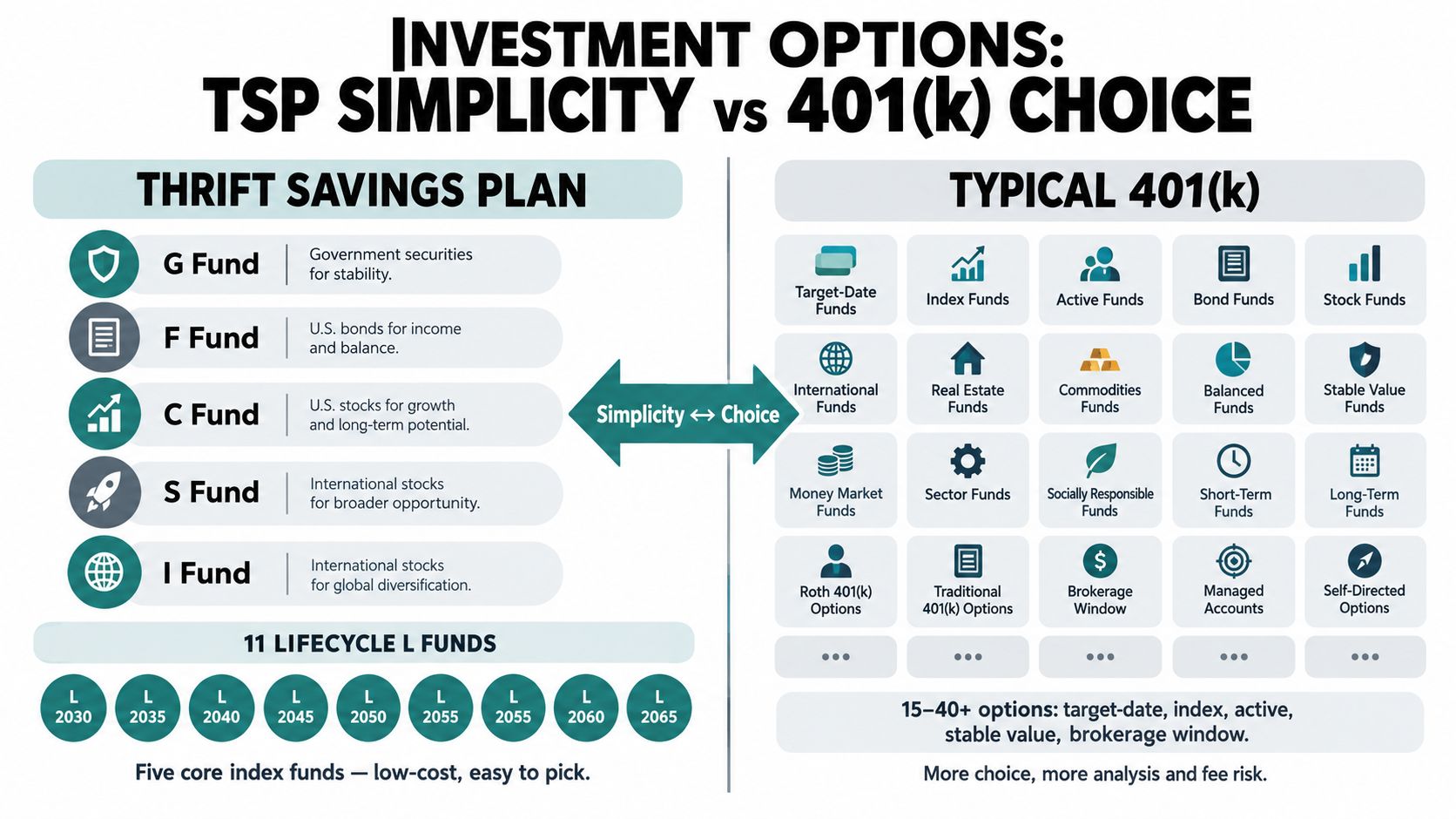
The TSP's narrow menu is intentional. Participants can use five core funds, G, F, C, S, and I, along with Lifecycle funds. A typical 401(k) may offer a wider set of target-date funds, index funds, actively managed funds, stable-value options, company stock, or a brokerage window.
That difference creates two opposite risks. A TSP participant may lack a desired exposure, such as a dedicated real estate, factor, or commodity fund. A 401(k) participant may own several funds that overlap heavily without realizing it.
Why the G Fund changes the comparison
The G Fund is the TSP's most distinctive feature. It invests in special Treasury securities and is designed to provide interest tied to government securities without exposing participants to the same principal fluctuations associated with bond funds. That isn't identical to a money-market fund or stable-value fund in a private 401(k), and you shouldn't treat those options as interchangeable without reviewing their terms.
For a federal employee nearing retirement, the G Fund can make staying in the TSP attractive even when a private plan offers more funds. The account may provide a place for conservative assets without forcing the employee to give up the TSP's low-cost structure.
Who needs more choice
The TSP becomes restrictive when your strategy depends on exposures that its core lineup doesn't provide directly. An investor who wants dedicated real estate, commodities, or specialized factor tilts may need an IRA or another account. That doesn't mean the entire TSP balance should move. A TSP-plus-IRA structure can keep the core retirement allocation inexpensive while using the IRA for targeted diversification.
Three approaches are usually sensible:
- TSP-only: Use a Lifecycle fund or a deliberate mix of core funds when simplicity and low cost matter most.
- TSP plus IRA: Keep the TSP as the low-cost core and use an IRA for investments unavailable in the TSP.
- TSP rollover to 401(k): Move only after confirming that the receiving plan offers a genuine advantage, such as a useful brokerage window, strong institutional funds, or a specific withdrawal feature.
More choice isn't automatically better. If the extra funds cause constant switching or make your allocation difficult to monitor, the larger menu has become a liability.
Tax Treatment, Catch-Up Rules, and the SECURE 2.0 Shift
Traditional and Roth contributions solve different tax problems. Traditional contributions generally seek a tax benefit during the working years, while Roth contributions use after-tax income in exchange for potentially tax-free qualified withdrawals later. The right mix depends on current marginal tax rates, expected retirement income, pension payments, Social Security, and future required distributions.
The TSP and eligible 401(k) plans both support traditional and Roth treatment, but the late-career rules deserve special attention. Under the SECURE 2.0 changes described in the Federal Benefits Sherpa guide to catch-up contributions, the enhanced catch-up window applies to workers ages 60 through 63.
| Age | Standard Elective Deferral in 2025 | Age 50+ Catch-Up | Ages 60-63 Enhanced Catch-Up | Roth Catch-Up Rule for High Earners |
|---|---|---|---|---|
| Under 50 | $23,500 | Not applicable | Not applicable | Not applicable |
| 50-59 | $23,500 | $7,500 | Not applicable | Applies where the rule covers the worker |
| 60-63 | $23,500 | Enhanced catch-up of $11,250 | $11,250 | Certain high earners must make catch-up contributions as Roth |
| 64 and older | $23,500 | $7,500 | Not applicable | Applies where the rule covers the worker |
The figures in the table come from the verified SECURE 2.0 information supplied for this article. The Roth catch-up provision is particularly important for federal employees whose prior-year wages exceed the applicable threshold. Those workers may have to make catch-up contributions as Roth contributions rather than traditional contributions.
Maxing out isn't automatically the answer
A high contribution rate can be smart, but “max it out” is incomplete advice. A FERS employee may need to compare additional traditional savings with Roth savings, an HSA, FEGLI costs, debt repayment, and cash reserves. A worker close to retirement may value lower future taxable income more than a current deduction, while another worker in a temporarily high-income year may prefer traditional contributions.
Don't make a Roth decision based only on the account label. Model the household's future taxable income, including the FERS annuity, Social Security, TSP withdrawals, and other retirement accounts. Also confirm how the plan will administer Roth catch-up contributions, because implementation can affect payroll elections.
Real Scenarios for FERS and CSRS Employees
A young FERS employee at age 28 has time to recover from market declines and can focus on building a repeatable habit. The first priority is capturing the full agency contribution available under the FERS formula. A Lifecycle fund can provide automatic diversification and rebalancing, while a more hands-on employee might combine core funds deliberately.
The employee shouldn't choose the G Fund merely because it feels safe, nor should they choose an aggressive allocation without understanding market declines. At this stage, the strongest decision is usually a sustainable contribution rate, a clear allocation, and annual reviews rather than constant changes.
The mid-career rollover question
Consider a 52-year-old FERS employee at Minimum Retirement Age with 26 years of service, a paid-off home, and a $350,000 TSP balance. A future private-sector employer offers a 401(k) with a brokerage window and access to strategies the TSP doesn't provide.
Rolling the balance could make sense if the employee has a specific reason to use those features and the receiving plan has acceptable expenses. It may be a poor move if the employee mainly wants “more choices” but has no allocation that requires them. The cost of leaving the TSP includes giving up the G Fund and potentially losing the TSP's low-cost structure.
The near-retiree tax decision
A 62-year-old FERS employee within five years of retirement may be deciding whether to increase Roth contributions, continue traditional contributions, or begin a partial withdrawal. That choice requires a tax projection, not a slogan. The employee should model pension income, Social Security timing, future TSP withdrawals, and the effect of taxable balances on later retirement years.
A CSRS employee should evaluate the TSP differently because the matching structure associated with FERS doesn't apply in the same way. The TSP may still be valuable, but the decision centers more on supplemental retirement income, tax diversification, and investment discipline.
Decision Checklist and Recommended Next Steps
Use the account that solves your actual problem. This checklist is more useful than a blanket rule about staying in the TSP or moving to a 401(k).
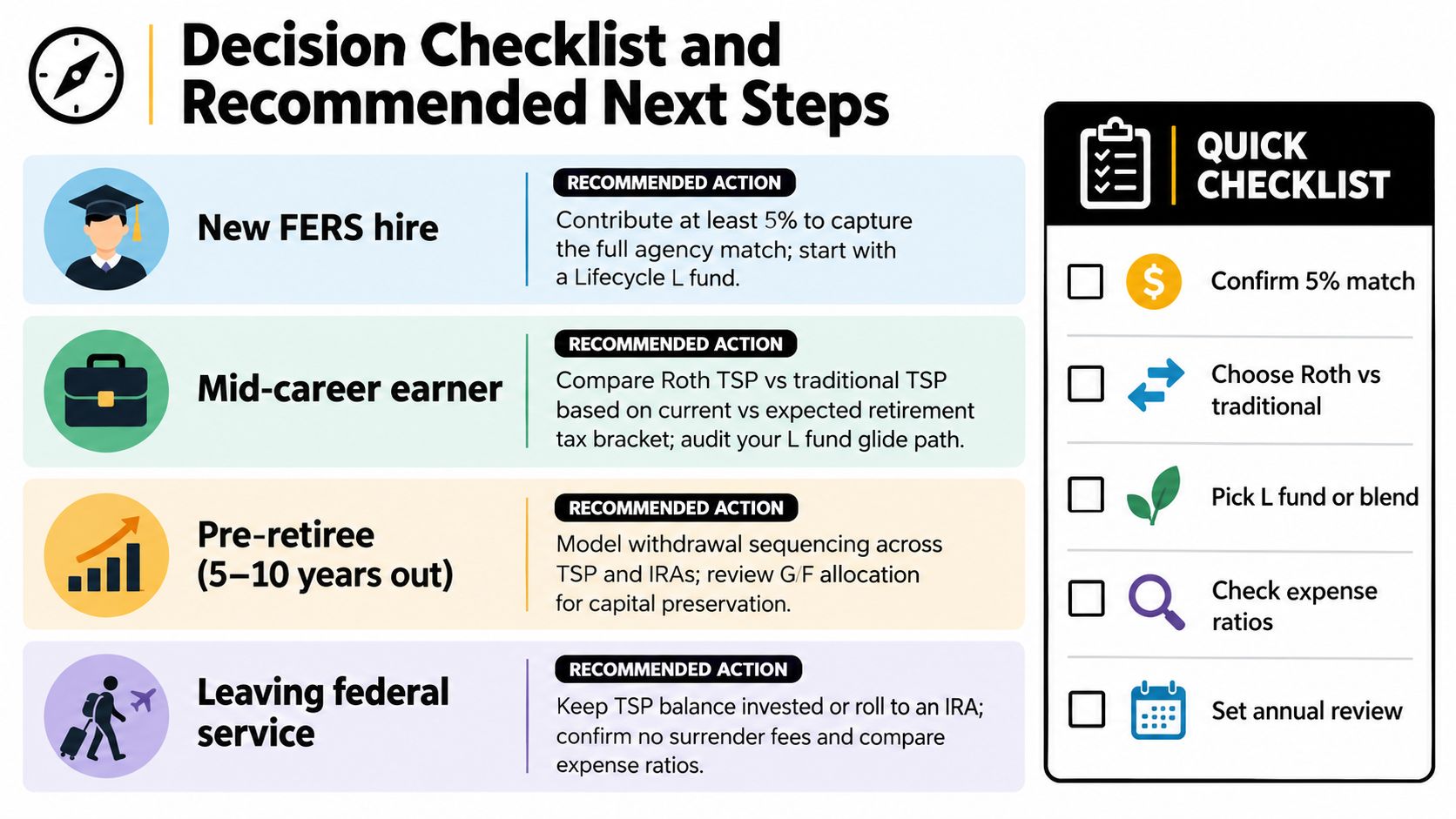
- New FERS hire: Contribute enough to capture the full agency contribution available under your FERS formula, then choose a Lifecycle fund or a disciplined core-fund allocation.
- Mid-career FERS employee: Compare traditional and Roth contributions using current and projected retirement tax rates before changing payroll elections.
- Near-retiree: Model withdrawal sequencing across the TSP, IRAs, pension income, and Social Security before approving a rollover.
- Dual-career household: Treat both spouses' accounts as one portfolio. Don't duplicate the same exposure in every account just because each plan offers it.
- CSRS employee: Use the TSP as supplemental savings and evaluate how its tax treatment and allocation fit beside the CSRS annuity.
- Employee considering a rollover: Request the receiving plan's investment menu, expense disclosures, distribution rules, and rollover procedures before moving assets.
Actions to take this pay cycle
First, confirm your contribution percentage and investment allocation through the TSP's official account tools or ThriftLine. Next, compare traditional and Roth outcomes at your current marginal rate and your expected retirement rate. Then review whether your existing allocation still matches your retirement date and risk capacity.
A free 15-minute benefit review with Federal Benefits Sherpa is worth considering if your projected TSP balance exceeds $500,000, separation is within 10 years, or a rollover from a prior 401(k) is sitting unallocated. Federal Benefits Sherpa offers benefit reviews, retirement planning, and gap analysis reports that connect TSP decisions with broader federal retirement income planning.
Act on this in the next pay cycle, not at retirement.
Federal Benefits Sherpa can help you compare the TSP, a 401(k), and IRA options alongside your FERS or CSRS income picture. Schedule a focused review through Federal Benefits Sherpa to turn your rollover, Roth, and allocation questions into specific next steps.

Dedicated to helping Federal employees nationwide.
“Sherpa” - Someone who guides others through complex challenges, helping them navigate difficult decisions and achieve their goals, much like a trusted advisor in the business world.
Federal Benefits Sherpa, LLC
12724 Gran Bay Parkway West, Suite 410, Jacksonville, FL 32225
Email: [email protected]
Phone: (833) 753-1825
© 2024 Federalbenefitssherpa. All rights reserved
Federal Benefits Sherpa is an independent organization and is not affiliated with or endorsed by the U.S. government or any federal agency.