
Learning Center
Thrift Savings Plan Options: A Federal Employee Guide
The most popular TSP advice is incomplete. “Pick the right fund” sounds like the central retirement decision, but federal employees now face a broader choice: build an allocation from the core funds, delegate the allocation to a Lifecycle Fund, or use the mutual fund window for additional flexibility. For many near-retirees, the more consequential decision may be how much goes into Traditional versus Roth contributions.
The right strategy depends on your career stage, tax position, retirement income needs, and willingness to manage the account. Treating every TSP participant as if they needs the same fund mix is how allocation and tax mistakes begin.
The Three-Tiered Thrift Savings Plan Structure
Many federal employees still describe the TSP as a menu of five funds. That description is no longer sufficient. The modern Thrift Savings Plan structure has three investing frameworks, each serving a different kind of decision-maker: the five individual index funds, the Lifecycle Funds, and the mutual fund window. The official TSP overview of investment options confirms that broader structure.
The plan itself has evolved over time. Congress created the TSP through the Federal Employees' Retirement System Act of 1986, and the plan began accepting contributions on April 1, 1987. It opened with the G Fund, F Fund, and C Fund. The S Fund and I Fund joined in 2001, while the L Funds arrived in 2005 as target-date choices built from the five core funds. The Congressional Research Service history of the TSP documents that progression.
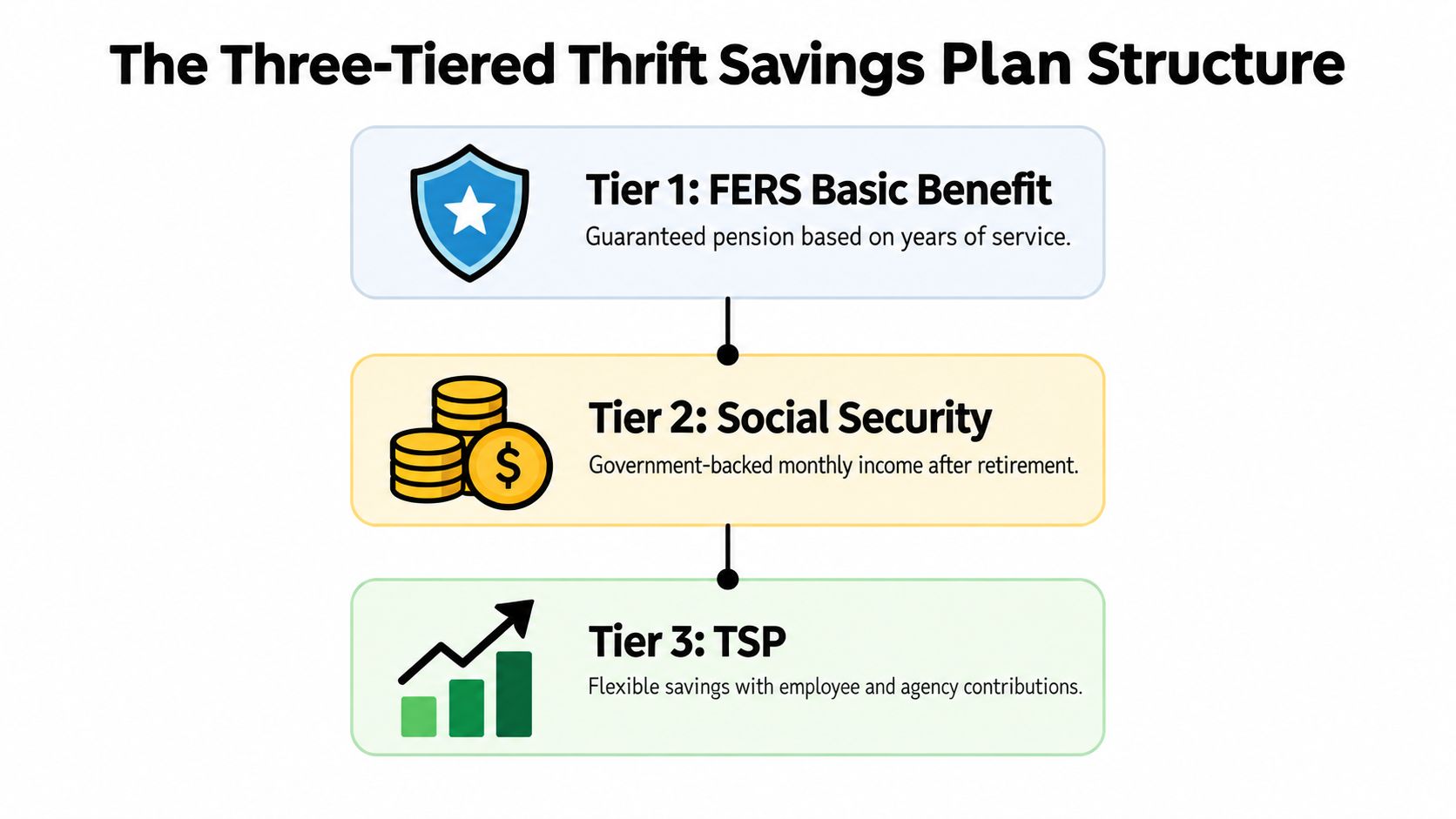
Tier one means building your own allocation
The five individual funds give you direct control over the building blocks of your portfolio. You decide how much exposure you want to government securities, bonds, large U.S. companies, smaller U.S. companies, and international stocks. This route can work well if you understand your risk tolerance and will review the allocation without making emotional changes during market declines.
It also places responsibility on you. A portfolio that looks diversified on paper can still be poorly matched to your retirement date, pension income, or spending needs.
Tier two delegates the glide path
The eleven Lifecycle Funds combine the five core funds and adjust their intended allocation as the target date approaches. You give up some control in exchange for an integrated strategy that handles allocation decisions inside one fund.
Tier three expands the menu
The mutual fund window allows eligible participants to invest part of their balance in outside mutual funds, subject to eligibility conditions, fees, and minimums. That makes “more options” a poor reason to use it. The key question is whether a specific outside fund solves a problem that the core funds and L Funds don't already address.
For a plain-language explanation of the account itself, see this guide to how the Thrift Savings Plan works. Start with the three tiers, then choose the simplest tier that can meet your needs.
Contribution Types and SECURE 2.0 Tax Strategies
Choosing a fund first is backwards. The three-tiered TSP structure determines how you invest, but your contribution type determines when taxes affect the money. Traditional and Roth contributions can change your retirement tax bill long after you change an investment allocation.
The 2026 rules make this decision more important for older and higher-paid federal employees. The elective deferral limit is $24,500 in 2026, as reported in the IRS announcement on 2026 retirement plan limits. Participants age 50 and older face updated catch-up rules, including a higher catch-up limit for ages 60 through 63. Participants whose prior-year FICA wages exceeded $150,000 must use Roth treatment for catch-up contributions under the applicable conditions, according to this SECURE 2.0 guide for federal employees.
Traditional and Roth answer different tax questions
Traditional contributions generally provide the tax benefit during your working years. Roth contributions generally provide the benefit through tax-free qualified withdrawals in retirement. Choose between them by comparing your current marginal tax rate, expected retirement income, other taxable income, and the amount of tax flexibility you want later.
Near-retirees should not automatically default to Traditional contributions. A federal pension, Social Security income, investment withdrawals, and required distributions can produce a retirement tax bill that differs from the final working years. Roth contributions can also reduce current tax flexibility when your income is high and the immediate deduction has significant value.
Practical rule: Treat Roth versus Traditional as an allocation of future tax exposure, not as a permanent identity.
Catch-up contributions change the decision
Workers subject to the Roth-only catch-up rule cannot use Traditional contributions for that catch-up portion. Review prior-year FICA wages, age, contribution type, and expected retirement income together before setting payroll elections. A mistake here can limit your intended tax strategy.
The TSP's Roth in-plan conversion option became available in 2026. Review the TSP Roth in-plan conversion guidance before converting. A conversion does not automatically turn every Traditional balance into Roth money, and the converted amount can create taxable income. Model the tax impact before acting.
For practical detail, read this guide to SECURE 2.0 catch-up contributions. For many near-retirees, the highest-value TSP adjustment is a better Traditional and Roth mix, not a more complicated portfolio.
Navigating the Five Core Individual Funds
The five core funds work best as portfolio components, not as five unrelated choices. They occupy the investment tier of the TSP structure, while your contribution type determines whether the money is Traditional or Roth and how taxes enter the plan. SECURE 2.0 makes that separation especially important for near-retirees. A sound fund allocation cannot correct a poorly chosen tax mix, and a thoughtful Roth or Traditional decision still needs an allocation that matches your retirement income plan.
The TSP investment framework identifies the five individual funds. Use the table to assign each fund a job before choosing percentages.
| Fund | Asset Class | Primary Risk Factor |
|---|---|---|
| G Fund | Government securities | Inflation and reinvestment risk |
| F Fund | Bonds | Interest-rate and credit-market risk |
| C Fund | U.S. large-company stocks | Stock-market and concentration risk |
| S Fund | U.S. smaller-company stocks | Higher equity volatility and company-size risk |
| I Fund | International stocks | Foreign-market, currency, and geopolitical risk |
The practical question is not which fund is “best.” It is whether the combination provides enough growth, stability, and diversification to support withdrawals without forcing avoidable decisions during market stress.
Use the G Fund deliberately
The G Fund can anchor the conservative portion of your allocation and reduce exposure to ordinary market swings. It should not automatically receive every dollar intended for retirement spending. Excessive conservatism can weaken purchasing power over a long retirement, particularly when withdrawals continue and inflation erodes fixed amounts.
Assign the G Fund a specific purpose. It may support near-term withdrawals, balance a stock-heavy allocation, or complement dependable income from a federal pension and Social Security. Those income sources can affect how much stability your TSP needs. For a closer examination of its role, use this guide to the TSP G Fund for federal employees.
Understand what the F Fund adds
The F Fund supplies bond exposure, but it does not function like cash. Interest-rate changes can reduce bond values, and the fund may perform differently from the G Fund as market conditions change. Treat it as a distinct risk and return source. Do not move a large balance into the F Fund only because you want stability.
Separate the three stock exposures
The C Fund focuses on large U.S. companies, the S Fund emphasizes smaller U.S. companies, and the I Fund adds international stocks. All three can support long-term growth, but their risks differ. Combining them can broaden equity exposure beyond a single market segment.
Write down the role and target weight for every fund before you invest. If you cannot explain why a fund belongs in the portfolio, do not add it. A written allocation turns fund selection into a retirement strategy instead of a collection of preferences.
Lifecycle Funds and the Mutual Fund Window
Lifecycle Funds are designed for employees who want one integrated allocation rather than a set of individual fund decisions. The TSP offers eleven L Funds built from the five core funds, according to the official TSP Lifecycle Fund information. Their value lies less in novelty than in delegation.
The L Funds are not static target-date wrappers. Each fund is rebalanced daily to restore its target weights, while its allocation targets are adjusted quarterly. That means the portfolio's intended risk profile changes on a predictable schedule instead of drifting with market prices.
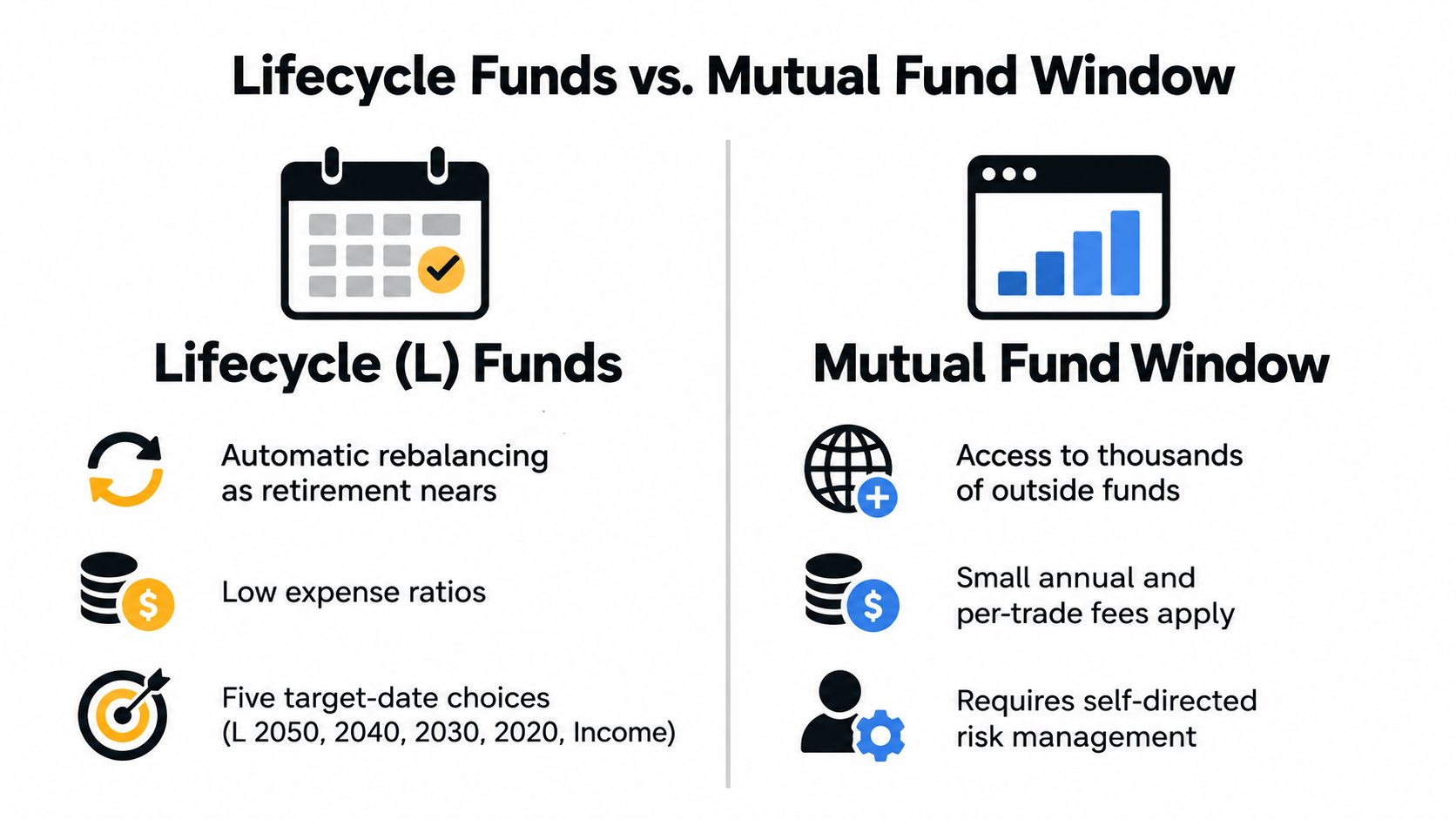
Choose an L Fund when delegation is the priority
An L Fund can suit an employee who wants a retirement-date-oriented approach and doesn't want to maintain a custom allocation. It can also help prevent a common behavioral mistake, selling a long-term allocation after a market decline and then waiting too long to reinvest.
The tradeoff is control. You can't independently decide that one component should be more aggressive or more defensive while remaining fully inside the L Fund's intended allocation. The fund follows its design, including its regular rebalancing and scheduled target changes.
Treat the mutual fund window as a specialist tool
The mutual fund window changes the meaning of “TSP options.” Eligible participants may invest part of their balance in outside mutual funds if they satisfy the plan's balance and fee requirements. The window can provide flexibility, but it also introduces additional evaluation, costs, and responsibility.
A long list of funds isn't automatically better diversification. The core TSP lineup already gives participants access to the major building blocks used in many retirement portfolios. An outside fund should earn its place by addressing a specific gap, not by adding complexity for its own sake.
The right question isn't “What else can I buy?” It's “What problem does this option solve?”
Watch the following explanation before deciding whether automation or customization better fits your situation.
For most participants, an L Fund is the better default when they want simplicity and a clear glide path. Consider the mutual fund window only after identifying a specific need, confirming eligibility and costs, and accepting the responsibility to manage the added choices.
Interfund Transfers and Distribution Rules
A good allocation can still fail if you change it impulsively or withdraw from it without understanding the tax result. TSP account management has two separate jobs: maintaining the investment mix and creating retirement income. Keep those decisions connected, but don't confuse them.
Follow a written transfer process
Before making an interfund transfer, write down four items:
- The reason for the change. Is the transfer correcting an allocation, responding to a planned retirement milestone, or reacting to fear?
- The destination allocation. Decide the full mix before moving money. A transfer into one fund can unintentionally make the overall account unbalanced.
- The payroll contribution setting. Existing money and future contributions are separate instructions. Check both.
- The review date. Choose a future date to reassess rather than monitoring the account every day.
The plan's operational limits and current transaction rules can change, so verify them through your TSP account before submitting a transfer. Don't assume a transfer request changes payroll contributions, and don't use frequent transactions as a substitute for an investment policy.
Plan distributions before you need them
At retirement, decide whether you need a partial withdrawal, a full withdrawal, scheduled payments, or another distribution approach. The right answer depends on spending needs, tax treatment, cash reserves, pension income, Social Security timing, and beneficiary goals.
A partial withdrawal can preserve continued access to the account, while a full withdrawal can create a larger tax event depending on the account type and transaction. Required minimum distributions also need to be incorporated into the retirement-income calendar. Confirm the applicable rules and withholding treatment before requesting money.
Avoid preventable tax surprises
Ask these questions before taking a distribution:
- Which balance is being distributed? Traditional and Roth money don't carry the same tax treatment.
- How much income will the distribution create? Include pension and other taxable income in the estimate.
- What withholding applies? A distribution's withholding may not equal your final tax liability.
- Does the withdrawal support the plan? A large one-time payment can disrupt an otherwise manageable income strategy.
Your TSP isn't a checking account. Create a distribution policy before the first withdrawal, then coordinate it with the rest of your federal benefits.
Decision Frameworks for Different Career Stages
A new federal employee, a mid-career specialist, and a near-retiree can all use the same TSP menu and still need completely different decisions. Career stage determines how long the money may remain invested, but it isn't the only variable. Pension coverage, household income, debt, emergency reserves, and tolerance for losses also matter.
The newly hired employee
A newly hired employee usually has time to recover from market declines, but that doesn't justify choosing the most aggressive mix without understanding the volatility. A reasonable starting point is to learn the role of the C, S, and I Funds, compare that with an L Fund appropriate to the employee's intended retirement horizon, and choose a contribution tax mix deliberately.
The most important habit is consistency. Set an allocation that can be maintained through both strong and weak markets. If the employee can't explain why the allocation is changing, the change probably shouldn't happen.
The established mid-career employee
A mid-career employee should stop treating the TSP in isolation. Review the account alongside the expected FERS benefit, Social Security planning, outside retirement assets, and current tax bracket. The employee may need more growth than a near-retiree, but the allocation should reflect the household's complete balance sheet rather than an age-based slogan.
This is also the stage to correct drift in contribution types. If every contribution has gone into one tax treatment without a review, model whether a different Traditional and Roth balance would create better flexibility later.
The near-retiree
A near-retiree should focus on sequence risk, spending needs, and the amount of dependable income already available. The G Fund may have a meaningful role in money intended for near-term withdrawals, while the remaining account can retain growth exposure for later retirement years. An L Income Fund may appeal to someone who wants a delegated, conservative approach, but it still needs to fit the actual withdrawal plan.
Don't move the entire account into a conservative position merely because retirement is approaching. First identify the amount needed for planned withdrawals and the income supplied by the pension and Social Security. Then decide how much of the remaining balance needs continued growth.
Retirement allocation is not a contest to eliminate risk. It's a decision about which risks you can afford to keep.
The CSRS and FERS systems also create different income contexts. A worker with a larger CSRS annuity may view TSP withdrawals differently from a FERS employee who expects the TSP to supplement a pension and Social Security. That distinction belongs in the allocation conversation from the beginning.
Next Steps for Optimizing Your Federal Retirement
TSP fund selection is only one part of a federal retirement decision. A sound plan must connect contributions, investment risk, tax treatment, pension income, Social Security timing, healthcare costs, and withdrawals. Generic fund rankings can't perform that coordination.
Start with a written retirement-income gap analysis. Identify expected fixed income, essential expenses, discretionary spending, account balances, and the years in which withdrawals may be needed. Then model different retirement dates and contribution mixes instead of relying on one projected outcome.
Check the decisions that interact
Review these items together:
- Retirement date: Test how an earlier or later departure changes income and account withdrawals.
- Tax treatment: Compare Traditional and Roth contributions under current rules and expected retirement income.
- Investment allocation: Match the TSP mix to the amount of growth your overall plan requires.
- Social Security timing: Coordinate claiming decisions with pension income and TSP withdrawals.
- Healthcare costs: Include premiums and out-of-pocket expenses in the retirement-income estimate.
- Distribution sequence: Decide which accounts to draw from first and how required distributions affect the plan.
A professional review is most useful when it produces decisions, not just information. Ask for a clear explanation of the assumptions, the tradeoffs, and the actions that should happen now versus later.
Federal Benefits Sherpa offers a free 15-minute benefit review, personalized retirement planning, and gap analysis reports for federal employees who need to connect TSP decisions with their wider benefits package. Schedule the review with your current TSP statement, retirement estimate, contribution elections, and questions about Traditional versus Roth treatment.
Federal Benefits Sherpa can review your TSP allocation, contribution tax mix, and retirement-income gap alongside your federal benefits. Visit Federal Benefits Sherpa to request the free 15-minute benefit review and turn your TSP options into an actionable retirement plan.

Dedicated to helping Federal employees nationwide.
“Sherpa” - Someone who guides others through complex challenges, helping them navigate difficult decisions and achieve their goals, much like a trusted advisor in the business world.
Federal Benefits Sherpa, LLC
12724 Gran Bay Parkway West, Suite 410, Jacksonville, FL 32225
Email: [email protected]
Phone: (833) 753-1825
© 2024 Federalbenefitssherpa. All rights reserved
Federal Benefits Sherpa is an independent organization and is not affiliated with or endorsed by the U.S. government or any federal agency.