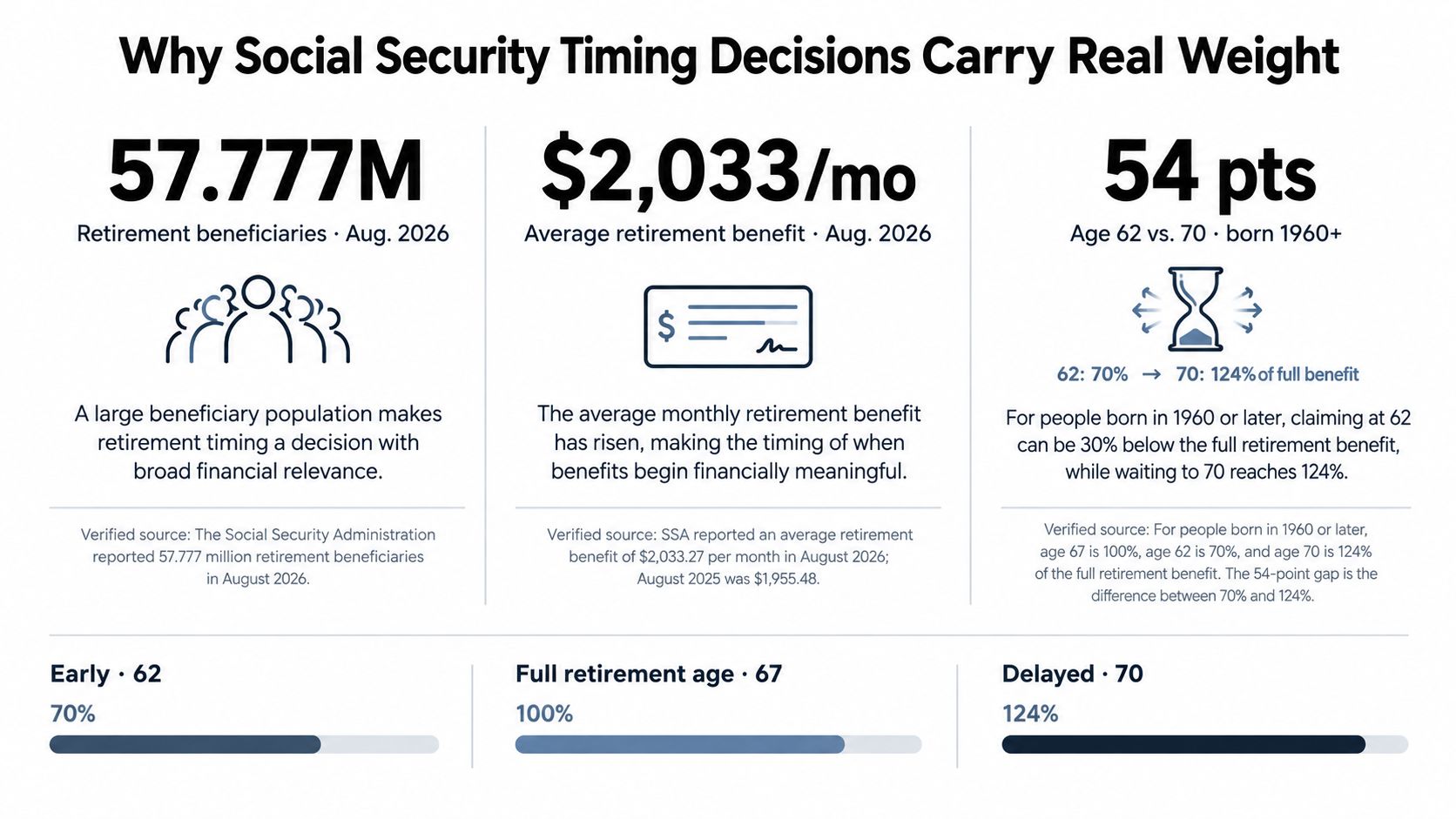
In August 2026, 57.777 million Social Security retirement beneficiaries received an average monthly benefit of approximately $2,033. Even a modest change in claiming age can alter lifetime household income by tens of thousands of dollars.
That's why a Social Security benefits planner deserves more attention than a quick online estimate. A federal employee approaching retirement may be weighing a FERS or CSRS annuity, TSP withdrawals, FEHB coverage, continued employment, and a spouse's future income at the same time. The planner can clarify one important piece of the decision, but it can't make the complete decision for you.
Why Social Security Timing Decisions Carry Real Weight
Social Security timing decisions can move tens of thousands of dollars in lifetime household income. In August 2026, the Social Security Administration reported 57.777 million retirement beneficiaries, representing 80.8% of all beneficiaries. Monthly retirement benefit payments totaled $117.476 billion, according to the SSA's monthly statistical snapshot. For federal employees, the calculation must also account for the FERS or CSRS annuity, TSP liquidity, FEHB continuation, and any phased-retirement arrangement.
The timing rules have changed over time. The Full Retirement Age, or FRA, was 65 when Social Security began. Congress raised it through the 1983 amendments, reaching 67 for workers born in 1960 or later. Workers can still claim as early as 62, but claiming before FRA permanently reduces the monthly retirement benefit. The Congressional Research Service summary of claiming-age trends documents this history and the changing pattern of claims.
The historical shift in claiming behavior
Recent filing patterns show that workers are choosing different starting ages. In 2024, about 3.3 million new retired-worker beneficiaries filed claims. Of those, 26% claimed at 62, 25% at 66, and 21% at 67 or older, compared with 52% claiming at 62 in 2010, according to the Congressional Research Service analysis.
Those figures do not establish one correct claiming age. Health, employment income, pension coverage, liquid savings, and a spouse's needs can change the outcome. A federal employee may use TSP withdrawals to cover an early-retirement gap, preserve FEHB coverage through an eligible retirement path, or coordinate Social Security with a FERS or CSRS annuity. Each choice affects cash flow and the amount of income protected later in retirement.
Practical rule: Treat your claiming age as an income-design decision. Run three scenarios, early, at FRA, and delayed, then compare each cash-flow profile with your pension start date, TSP withdrawal schedule, FEHB costs, employment income, and expected expenses. Record which resources fund the gap before Social Security begins and how much flexibility remains for health or family needs.
How to Use a Social Security Benefits Planner Correctly
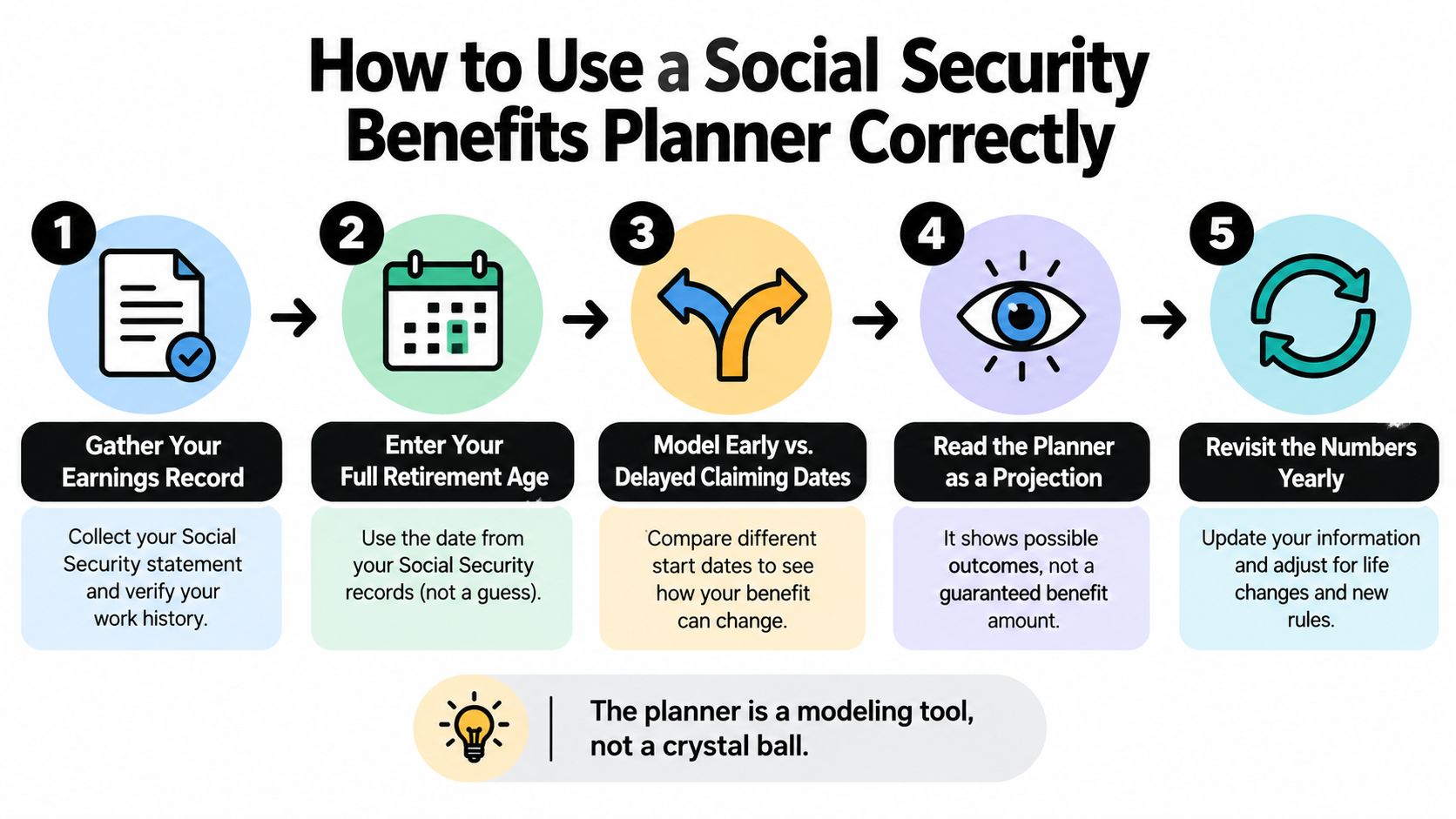
A Social Security benefits planner models scenarios. It does not predict your personal outcome. Start by confirming your Full Retirement Age, then compare the permanent reduction for claiming before FRA with the delayed retirement credit available after FRA, through age 70. The SSA explanation of benefit claiming age explains the basic trade-off: claiming early permanently reduces the monthly benefit, while delaying increases it.
Build three useful scenarios
Enter several claiming ages rather than accepting the first result as a recommendation. Run at least these three versions:
- Early claiming: Model the cash flow from claiming at 62 or another early date. Include the permanent reduction and the bridge income required before other resources begin.
- FRA claiming: Test a start date at Full Retirement Age. Compare the resulting benefit with your pension, savings, employment income, and expected expenses.
- Delayed claiming: Model waiting until 70. Identify which resources would fund the gap and whether that withdrawal plan remains workable.
For a federal employee, the planner is one input in a larger retirement decision network. A FERS or CSRS annuity, TSP liquidity, FEHB continuation, and phased retirement can change whether delaying Social Security is practical. Record the pension start date, available TSP withdrawals, healthcare costs, and any continued earnings before judging the claiming result. The government retirement calculator guidance from Federal Benefits Sherpa provides additional guidance for placing the Social Security estimate within a broader federal retirement calculation.
Test the result against real life
Claiming patterns provide context, not a personal recommendation. About 22% of retirees claim at 62, while only about 8.5% wait until 70 (SSA claiming-age explainer, SSA explanation of benefit claiming age). The figures show that the longest delay is uncommon. They do not establish the right choice for a federal household.
Check whether each scenario covers housing, healthcare, taxes, and discretionary spending. Then test an earlier-than-planned retirement, longer life, reduced work income, or greater support for a spouse. Use the planner to expose which assumptions, including longevity, health, and work income, shift the optimal claiming age. A result that looks attractive on a monthly-benefit screen may create pressure on TSP withdrawals, pension timing, or FEHB costs.
Federal Retirement Coordination that Generic Planners Miss
A federal employee's claiming age cannot be evaluated from earnings history alone. The decision sits inside a retirement network that includes the FERS or CSRS annuity, TSP access, FEHB costs, continued employment, and household income needs.
Generic calculators model a single earnings record. Federal employees need a planner that incorporates annuity timing, TSP liquidity, FEHB premiums, and work-income changes into the same cash-flow model.
Add the federal inputs
Use the Social Security benefits planner as one part of the analysis. Review its estimate against:
- FERS or CSRS annuity timing: Record when the pension begins and how much dependable income it supplies during the years before Social Security.
- TSP liquidity: Test whether withdrawals can fund that period without creating a later shortfall. For example, a plan that uses a fixed annual TSP withdrawal rate to delay Social Security may work while expenses are moderate, then fail when FEHB premiums, taxes, or other income changes raise the required withdrawal.
- FEHB continuity: Include premiums and coverage decisions in the cash-flow model, particularly as retirement and Medicare eligibility approach each other.
- Continued employment: Enter part-time work, consulting, or phased retirement rather than assuming employment ends on one date.
A TSP withdrawal plan can change the preferred claiming age. If the account can cover near-term spending at a sustainable rate, delaying Social Security may reduce pressure on lifetime guaranteed income. If withdrawals would consume too much of the account, an earlier claim may protect liquidity. The planner should show both paths.
The official Social Security rules distinguish earnings before and after FRA. There's no earnings limit starting in the month you reach FRA, and only wages or net self-employment profit count in the deduction test, according to the SSA guidance for people who keep working. That rule matters for federal employees who continue working part time or use phased retirement.
Avoid the pension interaction blind spot
Previous government employment can affect Social Security-related planning. Review the Federal Benefits Sherpa guide to the Windfall Elimination Provision and Government Pension Offset when a federal pension and Social Security-covered work history overlap. A basic claiming calculator may not surface those interactions.
The practical test is straightforward. The model should accept the pension start date, TSP withdrawals, FEHB costs, work income, and spouse-related outcomes. Without those inputs, the output describes one Social Security benefit, not the federal household's retirement cash flow.
Real Federal Employee Scenarios and Claiming Strategies
A FERS employee approaching 62 may see an appealing immediate Social Security benefit in a planner. The same employee may also have a federal annuity, partial TSP withdrawals, and the option to continue working through phased retirement. The decision turns on whether those resources can fund the transition while Social Security grows, and how the household values current liquidity against higher later income.
Consider an employee reducing hours rather than leaving work entirely. Early claiming can provide cash during that change, while also creating a permanent reduction in the monthly benefit. The model should combine wages, the earnings test, the FERS annuity, and TSP withdrawals. A projection based only on Social Security can make early claiming appear manageable, even though it may reduce income that would otherwise be higher in later years.

Two different federal retirement decisions
A CSRS employee with a strong civil service annuity and substantial FEHB premiums faces a different cash-flow problem. Pension income may cover regular expenses during a Social Security delay, while healthcare premiums and other obligations still need to fit within the household budget. Planned withdrawals can fill part of the gap, although using TSP assets earlier may leave fewer resources for later expenses.
The timing decision also affects the spouse. Review survivor income if the higher earner dies first, and test how each filing sequence interacts with the pension, TSP withdrawals, work income, and FEHB costs. These details can change the preferred claiming age even when two employees have similar Social Security estimates.
Federal employee scenarios often require a plan that treats Social Security as one part of a larger retirement network. FERS or CSRS income, TSP liquidity, continued FEHB coverage, phased retirement, and household filing choices should be modeled together. A federal employee Social Security claiming strategy resource can support that review, provided its guidance is tested against the employee's actual pension start date and spending needs.
Map each scenario against your pension start date, TSP schedule, and FEHB premium trajectory. The optimal age emerges from those constraints, not from the most common claiming pattern.
Building a Federal Social Security Implementation Checklist
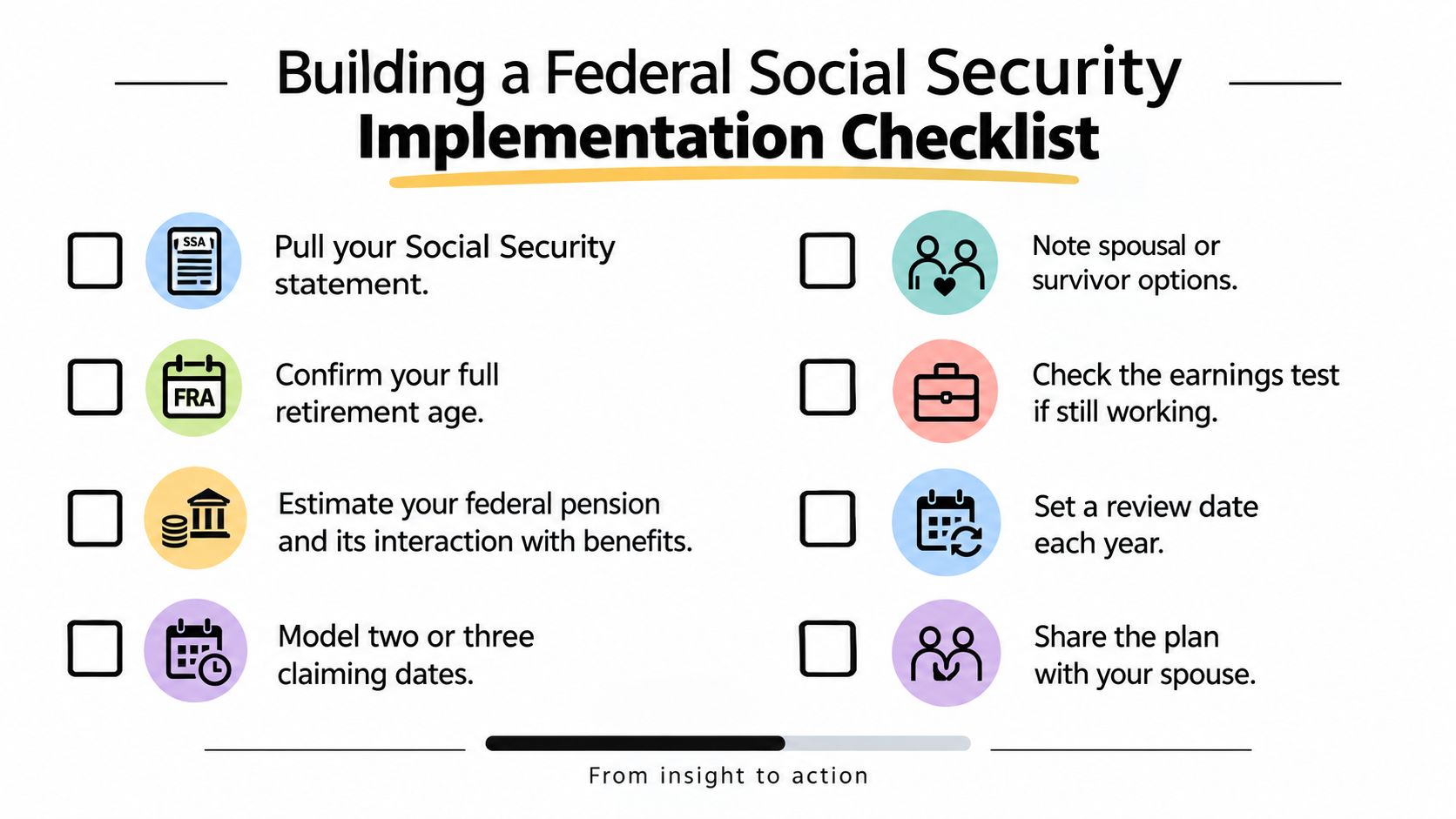
A federal retirement plan becomes actionable when each assumption has an owner, a document, and a review date. Complete the records first, then connect the Social Security estimate to the pension, healthcare coverage, TSP access, and household income plan.
Complete these checks before choosing a filing date
- Pull your Social Security statement: Verify the earnings record through your personal SSA account and flag any years that need correction before relying on the estimate.
- Check the Windfall Elimination Provision: If you have a CSRS pension or other work not covered by Social Security, calculate how the WEP may affect the estimate. Review whether you have 30 or more years of substantial government earnings.
- Confirm the FERS or CSRS annuity election: Record the pension start date, survivor election, and expected monthly income. Test whether the selected survivor benefit changes the amount available while Social Security is delayed.
- Confirm your FEHB coverage plan: Document whether FEHB continues through the annuity, whether it coordinates with Medicare as a supplement, or whether coverage remains active under your retirement arrangement. Include the premium in each cash-flow version.
- Map phased retirement and work status: Identify when a phased retirement period begins or ends, which income continues during that period, and when the full annuity becomes available.
- Set the TSP liquidity rules: Specify which TSP withdrawals can fund the gap before Social Security, how often they occur, and which assets must remain available for later healthcare or survivor needs.
- Record household and survivor instructions: List the filing sequence, income that continues after the first death, and documents your spouse or survivor would need to carry out the plan.
- Set a review date: Recheck the assumptions when pension timing, health, work plans, FEHB costs, or household income changes. Save the final version before filing.
The checklist keeps the planner's projection in its proper role. An estimate can be accurate under its inputs and still produce a poor decision if those inputs omit FEHB premiums, consulting income, pension timing, WEP effects, or survivor needs.
Before filing: Save the assumptions behind the selected strategy, including pension, FEHB, TSP, and household income inputs. That record makes changes easier to identify if your retirement date shifts.
A professional review can help before you commit to an irreversible claiming decision. The reviewer should address Social Security alongside the federal annuity, TSP, healthcare coverage, taxation, and household income, rather than evaluating the benefit alone.
When Maximizing Your Own Benefit Is Not the Best Household Strategy
A federal couple may have one spouse delay Social Security while the other claims earlier. That sequence can preserve cash flow during the transition from work to retirement and strengthen the surviving spouse's future income. The right decision depends on the household's pension structure, TSP liquidity, health outlook, and need for income now.
For many federal couples, the optimal claiming strategy protects the survivor, not the individual maximum benefit. Model survivor income under each claiming sequence before filing. A person with limited liquid assets may reasonably claim earlier, while a household with a strong FERS or CSRS annuity may have more room to delay the higher earner's benefit.
Retirement can last for decades. Beneficiaries age 65 and older grew from about 48.7 million in 2019 to about 55.1 million in 2024, and the 85-and-older group also increased, according to the Center for Retirement Initiatives research on claiming behavior and longevity. A planner focused only on one worker's monthly payment can miss the income risk created by a long survivor period.
Ask the questions single-worker tools skip
Review the couple's filing sequence as one household decision. Ask:
- If the higher earner delays, how does the survivor's monthly income change?
- If one spouse claims early, does that provide needed liquidity while preserving the stronger long-term benefit?
- Which income sources continue after the first death, and which stop?
- Can the federal annuity, TSP, or other savings support the household before the larger Social Security benefit begins?
- Does the sequence remain workable if either spouse lives well beyond the original retirement projection?
Federal households require this analysis because FERS or CSRS income, TSP assets, and FEHB coverage may follow different continuation and survivor rules. The planner should display household income under different claiming sequences, death dates, and longevity assumptions. That view exposes whether a larger benefit later creates an affordable bridge today.
One spouse may claim earlier while the other delays. TSP withdrawals can fund that gap, provided the withdrawal plan does not undermine later income or survivor needs. Evaluate each sequence against cash requirements, survivor protection, and the federal benefit package instead of applying a universal filing rule.
Next Steps for Federal Employees Ready to Plan
A federal employee can be ready to retire on paper and still lack a workable Social Security decision. A FERS annuity may begin at one date, TSP withdrawals at another, and FEHB premiums may continue through each phase. The claiming choice has to fit that income sequence, not stand apart from it.
Set a decision date for the retirement plan, then record the assumptions behind it. Include the Social Security statement, earnings history, FRA, planned retirement dates, FERS or CSRS annuity timing, TSP withdrawal approach, FEHB costs, and expected employment income. These details give the planner a usable picture of the federal benefit package.
Use the planner as an annual decision tool
A first projection is a baseline, not a permanent answer. Revisit it when you change your retirement date, move from full-time to part-time work, adjust TSP withdrawals, or experience a major household change. Each change can alter the order in which income arrives and the amount of liquidity available during the transition.
Run three scenarios before filing: early access to income, claiming at FRA, and delayed claiming. For each one, test whether the household can cover regular expenses, retain a suitable cash reserve, and respond to a change in work or health. The strongest result is the one that remains workable under the federal retirement constraints, not merely the one with the largest projected monthly benefit.
Review the survivor outcome separately. A higher monthly benefit may provide more protection after the higher earner dies, while an earlier claim may supply needed cash during the transition. The right choice depends on how Social Security interacts with the annuity, TSP assets, FEHB obligations, and the spouse's income needs.
Before filing, run your three scenarios through a tool that accepts your FERS annuity start date, TSP balance, and FEHB premium schedule. If your current planner rejects those inputs, it cannot model your federal retirement accurately.
Compare the output with an independent federal benefits review before submitting a claim. Federal Benefits Sherpa offers a free 15-minute benefit review, along with personalized retirement planning and gap analysis covering Social Security, federal pension, TSP, and healthcare considerations. A review can identify an omitted assumption or coordination issue while leaving the filing decision with you.
Visit Federal Benefits Sherpa to request a review and stress-test your claiming strategy before you file.


Social Security Benefits Planner: A Complete Guide
In August 2026, 57.777 million Social Security retirement beneficiaries received an average monthly benefit of approximately $2,033. Even a modest change in claiming age can alter lifetime household income by tens of thousands of dollars.
That's why a Social Security benefits planner deserves more attention than a quick online estimate. A federal employee approaching retirement may be weighing a FERS or CSRS annuity, TSP withdrawals, FEHB coverage, continued employment, and a spouse's future income at the same time. The planner can clarify one important piece of the decision, but it can't make the complete decision for you.
Why Social Security Timing Decisions Carry Real Weight
Social Security timing decisions can move tens of thousands of dollars in lifetime household income. In August 2026, the Social Security Administration reported 57.777 million retirement beneficiaries, representing 80.8% of all beneficiaries. Monthly retirement benefit payments totaled $117.476 billion, according to the SSA's monthly statistical snapshot. For federal employees, the calculation must also account for the FERS or CSRS annuity, TSP liquidity, FEHB continuation, and any phased-retirement arrangement.
The timing rules have changed over time. The Full Retirement Age, or FRA, was 65 when Social Security began. Congress raised it through the 1983 amendments, reaching 67 for workers born in 1960 or later. Workers can still claim as early as 62, but claiming before FRA permanently reduces the monthly retirement benefit. The Congressional Research Service summary of claiming-age trends documents this history and the changing pattern of claims.
The historical shift in claiming behavior
Recent filing patterns show that workers are choosing different starting ages. In 2024, about 3.3 million new retired-worker beneficiaries filed claims. Of those, 26% claimed at 62, 25% at 66, and 21% at 67 or older, compared with 52% claiming at 62 in 2010, according to the Congressional Research Service analysis.
Those figures do not establish one correct claiming age. Health, employment income, pension coverage, liquid savings, and a spouse's needs can change the outcome. A federal employee may use TSP withdrawals to cover an early-retirement gap, preserve FEHB coverage through an eligible retirement path, or coordinate Social Security with a FERS or CSRS annuity. Each choice affects cash flow and the amount of income protected later in retirement.
How to Use a Social Security Benefits Planner Correctly
A Social Security benefits planner models scenarios. It does not predict your personal outcome. Start by confirming your Full Retirement Age, then compare the permanent reduction for claiming before FRA with the delayed retirement credit available after FRA, through age 70. The SSA explanation of benefit claiming age explains the basic trade-off: claiming early permanently reduces the monthly benefit, while delaying increases it.
Build three useful scenarios
Enter several claiming ages rather than accepting the first result as a recommendation. Run at least these three versions:
For a federal employee, the planner is one input in a larger retirement decision network. A FERS or CSRS annuity, TSP liquidity, FEHB continuation, and phased retirement can change whether delaying Social Security is practical. Record the pension start date, available TSP withdrawals, healthcare costs, and any continued earnings before judging the claiming result. The government retirement calculator guidance from Federal Benefits Sherpa provides additional guidance for placing the Social Security estimate within a broader federal retirement calculation.
Test the result against real life
Claiming patterns provide context, not a personal recommendation. About 22% of retirees claim at 62, while only about 8.5% wait until 70 (SSA claiming-age explainer, SSA explanation of benefit claiming age). The figures show that the longest delay is uncommon. They do not establish the right choice for a federal household.
Check whether each scenario covers housing, healthcare, taxes, and discretionary spending. Then test an earlier-than-planned retirement, longer life, reduced work income, or greater support for a spouse. Use the planner to expose which assumptions, including longevity, health, and work income, shift the optimal claiming age. A result that looks attractive on a monthly-benefit screen may create pressure on TSP withdrawals, pension timing, or FEHB costs.
Federal Retirement Coordination that Generic Planners Miss
A federal employee's claiming age cannot be evaluated from earnings history alone. The decision sits inside a retirement network that includes the FERS or CSRS annuity, TSP access, FEHB costs, continued employment, and household income needs.
Generic calculators model a single earnings record. Federal employees need a planner that incorporates annuity timing, TSP liquidity, FEHB premiums, and work-income changes into the same cash-flow model.
Add the federal inputs
Use the Social Security benefits planner as one part of the analysis. Review its estimate against:
A TSP withdrawal plan can change the preferred claiming age. If the account can cover near-term spending at a sustainable rate, delaying Social Security may reduce pressure on lifetime guaranteed income. If withdrawals would consume too much of the account, an earlier claim may protect liquidity. The planner should show both paths.
The official Social Security rules distinguish earnings before and after FRA. There's no earnings limit starting in the month you reach FRA, and only wages or net self-employment profit count in the deduction test, according to the SSA guidance for people who keep working. That rule matters for federal employees who continue working part time or use phased retirement.
Avoid the pension interaction blind spot
Previous government employment can affect Social Security-related planning. Review the Federal Benefits Sherpa guide to the Windfall Elimination Provision and Government Pension Offset when a federal pension and Social Security-covered work history overlap. A basic claiming calculator may not surface those interactions.
The practical test is straightforward. The model should accept the pension start date, TSP withdrawals, FEHB costs, work income, and spouse-related outcomes. Without those inputs, the output describes one Social Security benefit, not the federal household's retirement cash flow.
Real Federal Employee Scenarios and Claiming Strategies
A FERS employee approaching 62 may see an appealing immediate Social Security benefit in a planner. The same employee may also have a federal annuity, partial TSP withdrawals, and the option to continue working through phased retirement. The decision turns on whether those resources can fund the transition while Social Security grows, and how the household values current liquidity against higher later income.
Consider an employee reducing hours rather than leaving work entirely. Early claiming can provide cash during that change, while also creating a permanent reduction in the monthly benefit. The model should combine wages, the earnings test, the FERS annuity, and TSP withdrawals. A projection based only on Social Security can make early claiming appear manageable, even though it may reduce income that would otherwise be higher in later years.
Two different federal retirement decisions
A CSRS employee with a strong civil service annuity and substantial FEHB premiums faces a different cash-flow problem. Pension income may cover regular expenses during a Social Security delay, while healthcare premiums and other obligations still need to fit within the household budget. Planned withdrawals can fill part of the gap, although using TSP assets earlier may leave fewer resources for later expenses.
The timing decision also affects the spouse. Review survivor income if the higher earner dies first, and test how each filing sequence interacts with the pension, TSP withdrawals, work income, and FEHB costs. These details can change the preferred claiming age even when two employees have similar Social Security estimates.
Federal employee scenarios often require a plan that treats Social Security as one part of a larger retirement network. FERS or CSRS income, TSP liquidity, continued FEHB coverage, phased retirement, and household filing choices should be modeled together. A federal employee Social Security claiming strategy resource can support that review, provided its guidance is tested against the employee's actual pension start date and spending needs.
Map each scenario against your pension start date, TSP schedule, and FEHB premium trajectory. The optimal age emerges from those constraints, not from the most common claiming pattern.
Building a Federal Social Security Implementation Checklist
A federal retirement plan becomes actionable when each assumption has an owner, a document, and a review date. Complete the records first, then connect the Social Security estimate to the pension, healthcare coverage, TSP access, and household income plan.
Complete these checks before choosing a filing date
The checklist keeps the planner's projection in its proper role. An estimate can be accurate under its inputs and still produce a poor decision if those inputs omit FEHB premiums, consulting income, pension timing, WEP effects, or survivor needs.
A professional review can help before you commit to an irreversible claiming decision. The reviewer should address Social Security alongside the federal annuity, TSP, healthcare coverage, taxation, and household income, rather than evaluating the benefit alone.
When Maximizing Your Own Benefit Is Not the Best Household Strategy
A federal couple may have one spouse delay Social Security while the other claims earlier. That sequence can preserve cash flow during the transition from work to retirement and strengthen the surviving spouse's future income. The right decision depends on the household's pension structure, TSP liquidity, health outlook, and need for income now.
For many federal couples, the optimal claiming strategy protects the survivor, not the individual maximum benefit. Model survivor income under each claiming sequence before filing. A person with limited liquid assets may reasonably claim earlier, while a household with a strong FERS or CSRS annuity may have more room to delay the higher earner's benefit.
Retirement can last for decades. Beneficiaries age 65 and older grew from about 48.7 million in 2019 to about 55.1 million in 2024, and the 85-and-older group also increased, according to the Center for Retirement Initiatives research on claiming behavior and longevity. A planner focused only on one worker's monthly payment can miss the income risk created by a long survivor period.
Ask the questions single-worker tools skip
Review the couple's filing sequence as one household decision. Ask:
Federal households require this analysis because FERS or CSRS income, TSP assets, and FEHB coverage may follow different continuation and survivor rules. The planner should display household income under different claiming sequences, death dates, and longevity assumptions. That view exposes whether a larger benefit later creates an affordable bridge today.
One spouse may claim earlier while the other delays. TSP withdrawals can fund that gap, provided the withdrawal plan does not undermine later income or survivor needs. Evaluate each sequence against cash requirements, survivor protection, and the federal benefit package instead of applying a universal filing rule.
Next Steps for Federal Employees Ready to Plan
A federal employee can be ready to retire on paper and still lack a workable Social Security decision. A FERS annuity may begin at one date, TSP withdrawals at another, and FEHB premiums may continue through each phase. The claiming choice has to fit that income sequence, not stand apart from it.
Set a decision date for the retirement plan, then record the assumptions behind it. Include the Social Security statement, earnings history, FRA, planned retirement dates, FERS or CSRS annuity timing, TSP withdrawal approach, FEHB costs, and expected employment income. These details give the planner a usable picture of the federal benefit package.
Use the planner as an annual decision tool
A first projection is a baseline, not a permanent answer. Revisit it when you change your retirement date, move from full-time to part-time work, adjust TSP withdrawals, or experience a major household change. Each change can alter the order in which income arrives and the amount of liquidity available during the transition.
Run three scenarios before filing: early access to income, claiming at FRA, and delayed claiming. For each one, test whether the household can cover regular expenses, retain a suitable cash reserve, and respond to a change in work or health. The strongest result is the one that remains workable under the federal retirement constraints, not merely the one with the largest projected monthly benefit.
Review the survivor outcome separately. A higher monthly benefit may provide more protection after the higher earner dies, while an earlier claim may supply needed cash during the transition. The right choice depends on how Social Security interacts with the annuity, TSP assets, FEHB obligations, and the spouse's income needs.
Before filing, run your three scenarios through a tool that accepts your FERS annuity start date, TSP balance, and FEHB premium schedule. If your current planner rejects those inputs, it cannot model your federal retirement accurately.
Compare the output with an independent federal benefits review before submitting a claim. Federal Benefits Sherpa offers a free 15-minute benefit review, along with personalized retirement planning and gap analysis covering Social Security, federal pension, TSP, and healthcare considerations. A review can identify an omitted assumption or coordination issue while leaving the filing decision with you.
Visit Federal Benefits Sherpa to request a review and stress-test your claiming strategy before you file.
Fed Benefit