
Learning Center
How to Calculate FERS Annuity
You've spent years building a federal career, and retirement is now close enough that a single question keeps returning: what will my monthly FERS annuity be? A rough estimate can help, but the number you need is the one that accounts for your high-3 pay, creditable service, sick leave, military deposits, survivor election, and any supplement.
Consider a near-retiree who is 61, works as a GS-13 step 10 in Washington, D.C., and has 24 years of service. The choice to retire at 62, continue working, or coordinate the annuity with TSP withdrawals affects far more than a pension estimate. It also shapes cash flow for FEHB premiums, FEGLI decisions, survivor protection, and Social Security planning.
Why Your FERS Annuity Estimate Matters Before You Retire
Suppose your estimate shows a comfortable monthly annuity, but it leaves out unused sick leave, a military deposit, or the reduction for survivor coverage. The error does not stay inside a spreadsheet. It can change how quickly you draw from TSP, whether your retirement income covers FEHB and FEGLI premiums, and how much reaches your bank account after taxes and other deductions.
A sound estimate begins with the three figures used in the basic FERS calculation: your high-3 average salary, creditable service, and the applicable multiplier. OPM's published FERS computation rules provide the framework, but your personnel records determine whether the figures entered into it are correct.
The basic formula is only the starting point. A simple calculator may produce the right arithmetic while still missing service credit or an election that changes the payment.
Practical rule: Use the annuity estimate as the foundation of your retirement income plan, then test the result against the choices you will actually make.
Your retirement age can change the multiplier. For most retirees, the standard factor is 1% for each year of service. An employee who separates at age 62 or older with at least 20 years of service uses 1.1%, which produces an annuity 10% higher than the result from the standard 1% factor, assuming the same high-3 pay and service.
The complete estimate should bring several pieces together:
- Accurate inputs establish the correct high-3 pay and service period.
- The core formula converts those figures into a gross annual annuity.
- Service-credit adjustments may include unused sick leave, military service after a required deposit, or eligible prior civilian service.
- A survivor election lowers your payment in exchange for continuing protection for an eligible survivor.
- The special retirement supplement may support cash flow before Social Security eligibility, but it uses a separate Social Security-based method.
- Verification can expose mismatched records before you submit the retirement application.
OPM generally does not provide the final adjudicated calculation before you apply. Build a documented estimate from your personnel records, include each adjustment and election, and compare it with the official figures available through your agency and OPM.
The Inputs Every FERS Annuity Calculation Starts With
A reliable estimate begins with four inputs. Each one answers a different question, and mixing them together is a common reason employees get an answer that looks plausible but is wrong.
High-3 average pay
Your high-3 average salary is your highest average basic pay over three consecutive years. For many employees, that period is near the end of the career, but it isn't automatically the final three years. Basic pay generally includes locality pay, while overtime, bonuses, and other premium payments generally aren't part of the high-3 calculation.
Use your official personnel records rather than a current pay stub alone. A GS pay table snapshot and two recent SF-50s can help confirm the pay history, but you should verify the full three-year period when your salary changed, your locality changed, or you moved between positions.
Creditable service
Next, identify the service period that may be used in the formula. Start with actual civilian FERS service, then investigate additions such as unused sick leave, eligible prior civilian service, and military service for which a required deposit has been paid. These additions don't all work the same way, and some affect the annuity calculation without establishing retirement eligibility.
Multiplier and retirement age
The multiplier depends on age and service. Before age 62, the ordinary FERS factor is 1%. At age 62 or older, an employee with at least 20 years of service may qualify for 1.1%. An employee separating at 62 with fewer than 20 years generally remains under the 1% factor.
For a practical explanation of the pay component, see this guide to calculating the FERS high-3. Keep the high-3 figure separate from deductions. FEHB premiums and tax withholding reduce your net payment, but they don't change the gross annuity formula.
FERS annuity inputs at a glance
| Input | What It Means | Where to Find It |
|---|---|---|
| High-3 average pay | Highest three consecutive years of basic pay | SF-50s, agency records, pay history |
| Creditable service | Service used in the annuity computation | Annual statement, service computation records |
| Multiplier | The applicable percentage factor | OPM rules and retirement estimate |
| Retirement age | Age at separation, which can affect the multiplier | Birth record and retirement application |
The calculation is only as dependable as these inputs. If one is estimated from memory, the final result may be materially different from OPM's computation.
The Core FERS Annuity Formula With a Worked Example
A FERS estimate becomes easier when you treat it like a three-part calculation. Start with your high-3 average salary, multiply by creditable service, then apply the correct multiplier:
High-3 average salary × creditable years of service × multiplier = annual gross FERS annuity
For many retirees, the multiplier is 1%. An employee who separates at age 62 or older with at least 20 years of service may use 1.1% under OPM's computation rules. This factor changes the basic annuity, while survivor elections, deductions, sick leave, military deposits, and any special-retirement supplement require separate adjustments.
A 62-year-old example
Suppose an employee has:
- A high-3 average salary of $110,000
- 24 years of creditable service
- Retirement at age 62
- At least 20 years of service
The calculation is:
$110,000 × 24 × 1.1% = $29,040 annual gross annuity
Dividing by 12 gives a rough monthly gross amount:
$29,040 ÷ 12 = $2,420 per month
This is the gross figure before FEHB, FEGLI, taxes, survivor coverage, or other deductions. It also excludes a special-retirement supplement.
The same employee retiring at 58
Keep the same high-3 and service history, then apply the standard 1% factor:
$110,000 × 24 × 1% = $26,400 annual gross annuity
The rough monthly gross amount becomes:
$26,400 ÷ 12 = $2,200 per month
The difference between the two examples is $29,040 minus $26,400, or $2,640 per year before other adjustments. The comparison shows why retirement age, service, and high-3 pay belong in one estimate rather than separate decisions.
| Scenario | Multiplier | High-3 | Years of Service | Annual Annuity |
|---|---|---|---|---|
| Retire at 62 with at least 20 years | 1.1% | $110,000 | 24 | $29,040 |
| Retire at 58 | 1% | $110,000 | 24 | $26,400 |
These examples use whole-year service. An OPM estimate may also account for months, sick-leave credit, military deposits, prior service, part-time proration, and survivor reductions. Add those factors after confirming the basic formula.
Service Credit That Changes the Final Annuity Number
The service figure on your records isn't always the same as the raw number of calendar years you remember working. A service computation date may reflect qualifying periods, deposits, leave conversions, and rounding rules. OPM's historical overview explains that FERS was created by statute in 1986 and replaced the older civil-service framework with a three-part model consisting of a basic annuity, Social Security, and the Thrift Savings Plan. The same official framework recognizes service-computation details involving civilian service, certain military deposits, and unused sick leave. See OPM's FERS history and mission overview.
Start with actual service
Begin with the civilian service that was covered by the retirement system. Then review whether prior civilian service was refunded or whether military service requires a deposit. Don't add either category automatically. The documentation and payment status determine whether it belongs in the calculation.
Unused sick leave is different. Once you qualify for retirement, eligible unused sick leave can be converted into additional service credit for the annuity calculation. It generally doesn't substitute for the service needed to become eligible for retirement.
A service-credit example
Assume an employee has 24 years and 3 months of actual service and 8 months of eligible unused sick-leave credit. The combined service becomes:
24 years 3 months + 8 months = 24 years 11 months
Using the requested month-rounding example, that may be expressed as 25 years minus 20/12 of a year, or approximately 24.83 years for the formula. The added service increases the annuity because the service factor is larger, although the exact payment still depends on the high-3 and multiplier.
Military service can require a separate deposit before it counts. Prior civilian service or refunded service may also require a redeposit or other payment under the applicable rules. Confirm these items with your agency's human-resources office and retain proof of payment.
Common errors include:
- Counting sick leave as eligibility service: It can increase the annuity calculation, but it generally doesn't create retirement eligibility by itself.
- Waiting on a military deposit: A deposit requirement can affect whether the military period is included.
- Ignoring part-time history: Mixed full-time and part-time service may require proration.
- Double-counting service: A period can't be added twice because it appears in more than one record.
Survivor Benefit Elections and How They Reduce Your Annuity
A survivor election trades part of your own annuity for continuing income protection. The choice should be made alongside the household budget, life insurance, other retirement income, and estate documents, not as an afterthought.
For a spouse, the full survivor benefit generally reduces the retiree's gross annuity by 10% and provides a survivor annuity equal to 50% of the unreduced annuity. The partial option reduces the retiree's annuity by 5% and provides a survivor annuity equal to 25% of the unreduced annuity, under the FERS survivor annuity calculation guide.
Using a $40,000 annual annuity only to illustrate the deduction:
- Full election: 10% of $40,000 = $4,000 annual reduction
- Partial election: 5% of $40,000 = $2,000 annual reduction
The actual survivor payment can be limited by the applicable FERS rules. For a surviving spouse, the maximum is generally the lesser of 50% of the unreduced annuity or the applicable high-3-based limit, which includes 55% of the high-3 plus $3,600, minus 80% of the survivor's own earned annuity. That limit requires a separate review of the survivor's earnings and benefit history.
| Election | Cost to Retiree | Annual Deduction on $40,000 | Survivor Annuity |
|---|---|---|---|
| Full spouse benefit | 10% of gross annuity | $4,000 | 50% of unreduced annuity, subject to limits |
| Partial spouse benefit | 5% of gross annuity | $2,000 | 25% of unreduced annuity, subject to limits |
| Former-spouse coverage | Based on the qualifying election or order | Depends on the election | Determined by the election or court order |
A former spouse may need to be offered coverage when a qualifying court order or written agreement requires it. Divorce-related retirement rights can involve procedural issues outside the annuity formula, so a resource such as Probate Code §55.001 explained may help explain how a probate objection framework works, although it isn't a substitute for federal retirement advice.
The election generally takes effect when the annuity begins. OPM rules provide a limited period for changing the election, and after the applicable window closes, the choice is generally irrevocable unless a qualifying event, such as the spouse's death, applies. Get the election documented before submitting the retirement application.
The FERS Supplement and 2026 COLA Behavior
A retiring employee may receive two different streams of income before age 62: the regular FERS annuity and, if eligible, the FERS Special Retirement Supplement. The supplement is separate from the basic annuity and generally applies to an immediate, unreduced FERS retirement before Social Security retirement age. Eligibility depends on the retirement category, minimum retirement age, and creditable service.
The supplement does not use the high-3 formula. Under OPM's retirement-type guidance, the estimate begins with the employee's projected Social Security benefit at age 62, then prorates that amount for FERS civilian service. The detailed calculation may also account for earnings history, inflation adjustments, an early-retirement reduction, and earnings-related offsets.
A planning formula is:
Estimated Social Security benefit at age 62 × FERS civilian service ÷ 40
For a full walkthrough of the proration method, see our guide to calculating the FERS annuity supplement for 2026. The expression is an estimate, not a guarantee of OPM's final payment. A basic annuity estimate can be accurate while the supplement estimate is wrong because the two calculations use different inputs.
Why the supplement and annuity behave differently
The supplement is taxable, ends at age 62, and does not receive FERS COLAs. The basic annuity follows a separate COLA schedule. Eligible FERS annuitants generally do not receive that adjustment before age 62.
According to GovExec's 2026 federal benefits coverage, the FERS COLA for eligible annuitants was 2.0%, and the adjustment generally does not apply before age 62 or increase the FERS annuity supplement. The result is a two-stage income pattern: the supplement can support cash flow before age 62, while the basic annuity follows its own adjustment rules.
Keep these figures separate:
- Gross basic annuity
- Supplement before age 62, if eligible
- Basic annuity after the supplement ends
Do not treat the supplement as lifetime pension income. Estimate it separately, with its own tax and Social Security assumptions.
Verifying Your Estimate Before You Submit
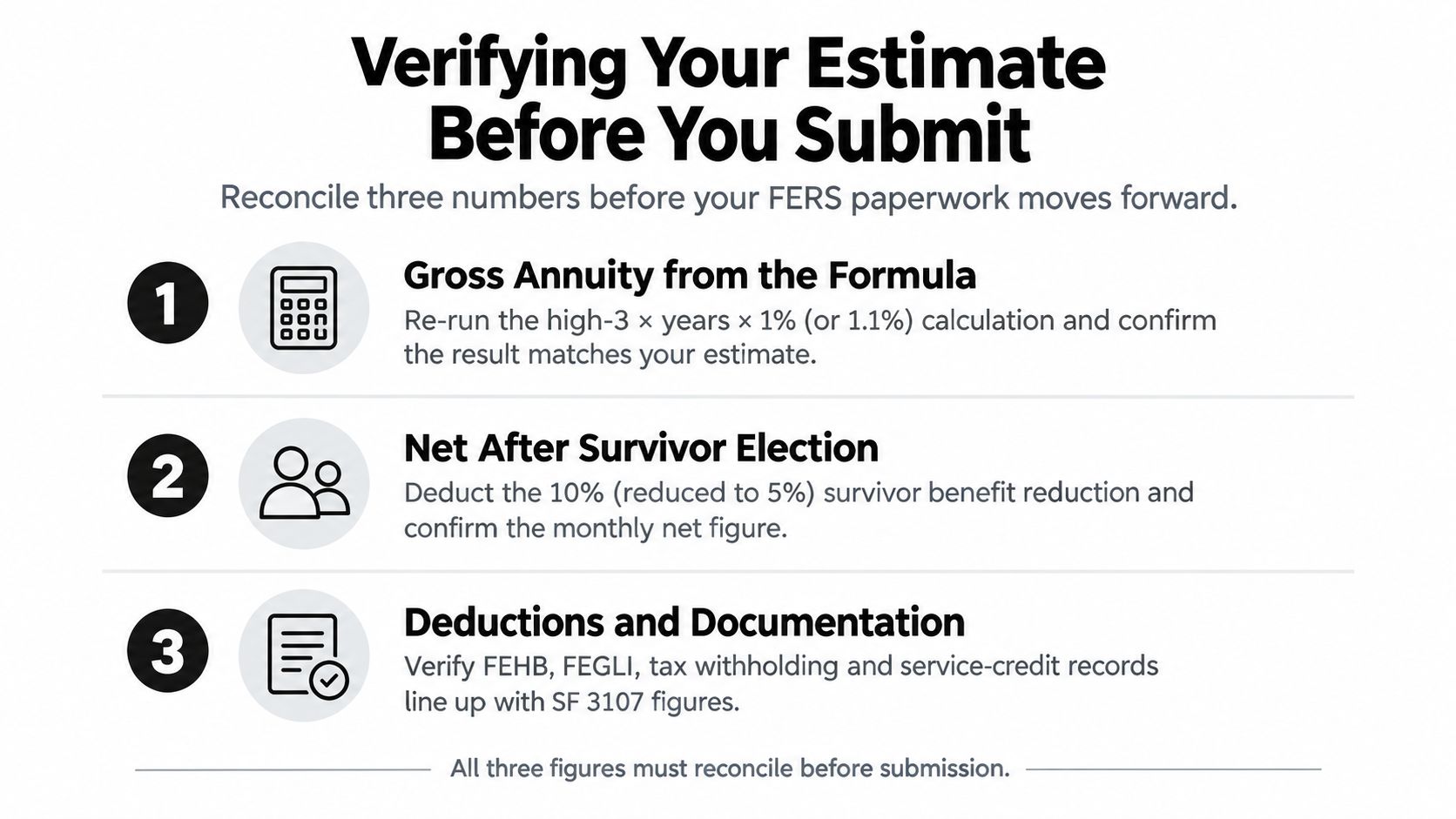
Before submitting retirement paperwork, reconcile three numbers: the gross FERS annuity, the net amount after the survivor election, and the projected supplement through age 62 if you qualify. A spreadsheet can do the arithmetic, but it can't correct an incorrect service date or an unpaid deposit.
A practical verification sequence
- Confirm the high-3. Pull the most recent three SF-50s and review the full three-year period used in your estimate. Check basic pay and locality treatment, and exclude overtime or bonuses that don't belong in the high-3.
- Confirm service dates. Compare your service computation date with your latest annual statement. Look for prior civilian service, refunded service, military time, and any deposit documentation.
- Add sick-leave credit correctly. Use the official conversion records and add the resulting service only after confirming retirement eligibility independently.
- Verify military deposits. Ask HR or your payroll office to confirm that the deposit is posted and that the period is included in the retirement record.
- Run the formula again. Calculate high-3 × creditable service × 1% or 1.1%, then compare the result with your agency estimate or a recent OPM statement.
- Model the net payment. Apply the survivor election, then account for FEHB, FEGLI, tax withholding, and other deductions.
The most frequent formula errors are easy to describe. One is forgetting part-time proration when the high-3 or service history includes mixed tour hours. Another is using the 1.1% factor when the employee retires before age 62 or reaches age 62 with fewer than 20 years of service.
Before filing: Don't approve the retirement application until the high-3, service credit, survivor election, and supplement estimate agree across your records.
The most consequential personal choice may be the survivor election. It permanently changes the annuity paid during your lifetime, so compare the full and partial options with your household's needs before you submit. If you need help organizing the inputs, Federal Benefits Sherpa offers personalized benefit reviews, retirement planning, gap analysis reports, educational resources, and guidance on coordinating federal benefits with TSP and Social Security. Visit Federal Benefits Sherpa to review your FERS estimate and identify the records or decisions that still need attention.


Dedicated to helping Federal employees nationwide.
“Sherpa” - Someone who guides others through complex challenges, helping them navigate difficult decisions and achieve their goals, much like a trusted advisor in the business world.
Federal Benefits Sherpa, LLC
12724 Gran Bay Parkway West, Suite 410, Jacksonville, FL 32225
Email: [email protected]
Phone: (833) 753-1825
© 2024 Federalbenefitssherpa. All rights reserved
Federal Benefits Sherpa is an independent organization and is not affiliated with or endorsed by the U.S. government or any federal agency.