Learning Center
FERS Retirement Health Insurance Explained
You've spent years building a FERS annuity and may assume your federal health insurance will follow you into retirement. Then, during a retirement review, someone asks whether you've been continuously covered by FEHB for the required period, whether your retirement qualifies as immediate, and whether Medicare Part B will reduce your household costs. That's when a straightforward benefit can start to feel like a maze.
FERS retirement health insurance depends on two separate decisions. First, you must protect your right to carry FEHB into retirement. Second, you must coordinate FEHB with Medicare carefully, because the payer order changes after you leave federal employment. A missed enrollment requirement or an automatic Medicare decision can affect both coverage and retirement cash flow.
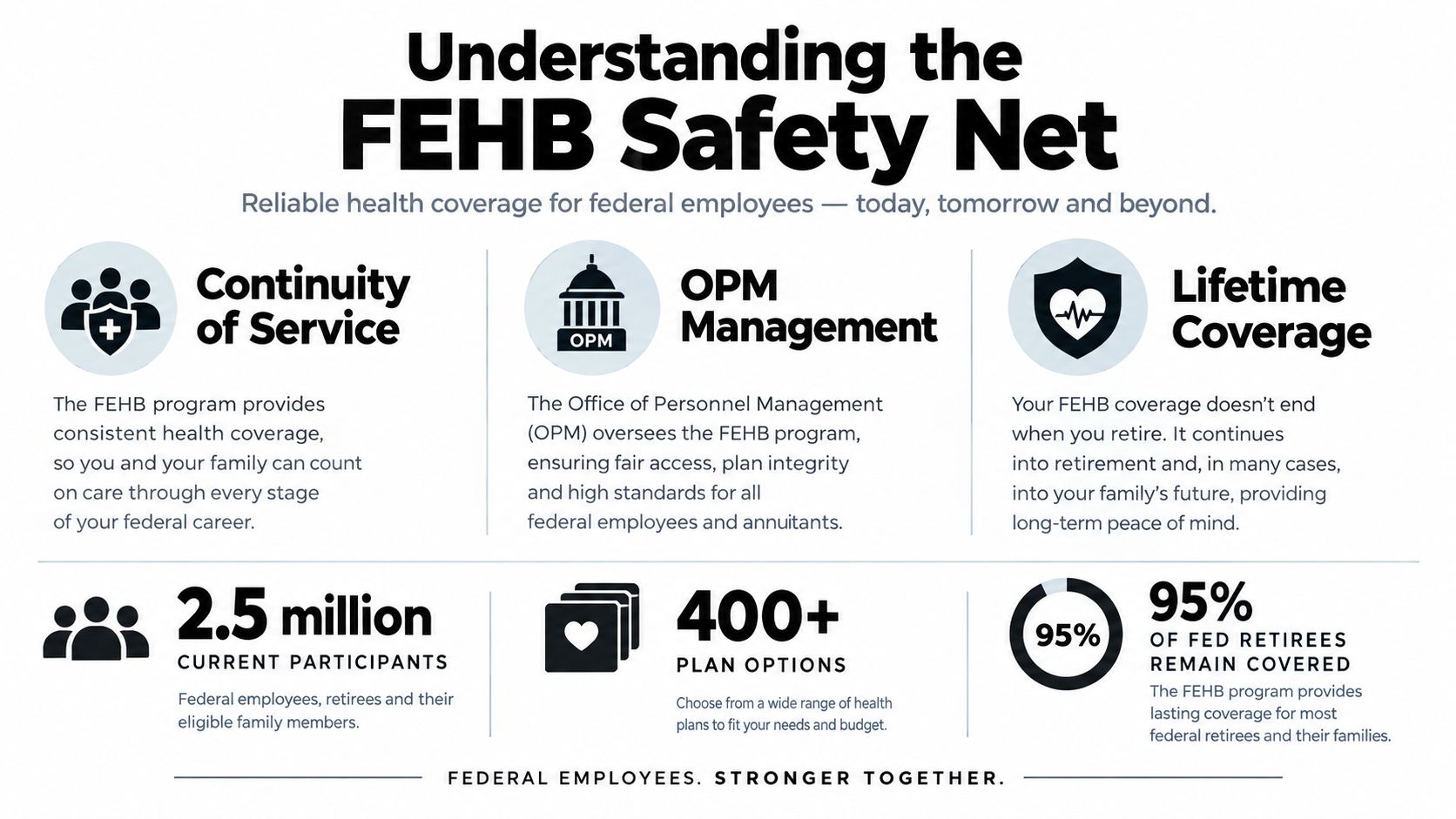
Understanding the FEHB Safety Net
A federal employee named David recently reviewed his retirement paperwork and discovered an uncomfortable assumption. He had always treated FEHB as part of his paycheck, not as a benefit requiring a separate retirement eligibility test. He knew he could retire with a FERS annuity, but he hadn't confirmed whether his health coverage would continue afterward.
That distinction matters. FEHB isn't an individual policy that you convert when you leave government service. It's a federal group-insurance program with specific eligibility rules, enrollment categories, premium arrangements, and coordination provisions. OPM manages retiree coverage after retirement, while your agency generally handles the benefit during active employment.
The program's scale helps explain why protecting FEHB access deserves a place on your retirement checklist. The Government Accountability Office reports that FEHB covered approximately 8.2 million people in fiscal year 2024, including about 1.9 million annuitants, and describes it as the largest employer-sponsored health-insurance program in the United States. The same source reports combined government and enrollee costs of approximately $70 billion in fiscal year 2024. The GAO overview of FEHB provides the program context behind those figures.
Why group coverage affects retirement income
Medical expenses are difficult to predict. A broad group plan can give a retiree access to established coverage rules and eligible family enrollment instead of forcing an immediate move to an individual-market policy. That doesn't make every FEHB plan equally suitable, but it does make continued eligibility financially meaningful.
FEHB also covers more than the employee alone. In fiscal year 2024, family members represented nearly half of covered individuals, while annuitants represented roughly 23% of all covered people, based on the GAO figures. Those proportions show why a retirement health review must include spouses and dependents, not just the employee's own expected medical needs.
You can review the program's structure in this guide to the Federal Employees Health Benefits Program. The central question is simple: will your retirement date and enrollment history satisfy OPM's requirements? If you haven't verified that answer, don't assume your current payroll enrollment guarantees future coverage.
Qualifying for Lifelong Coverage
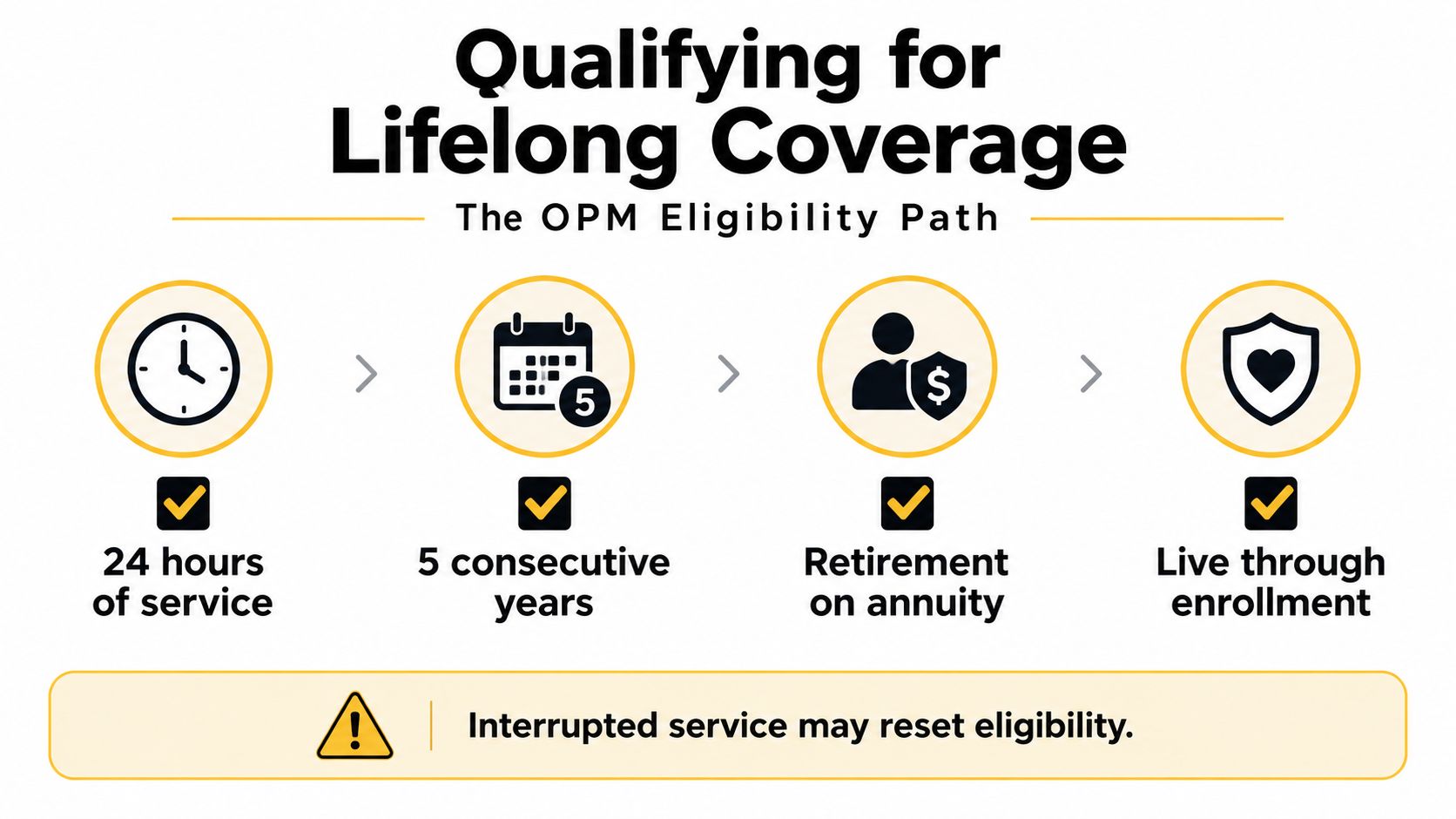
FEHB continuation requires two gates to open. You need an immediate FERS annuity, and you need the required history of FEHB coverage before retirement. Meeting only one of those conditions isn't enough.
OPM's rule requires an employee to be enrolled in FEHB, or covered as an eligible family member, for the five years of service immediately before retirement, or for the entire period since the first opportunity to enroll when that period is shorter. OPM's FEHB eligibility rules explain the requirement and the qualifying coverage arrangements.
Apply the five-year rule carefully
Use this sequence when checking your own record:
- Identify your proposed retirement date. The relevant period runs immediately before retirement, so a small timing difference can matter if your FEHB enrollment began late.
- Review every period of coverage. Coverage in your own FEHB enrollment can count. Qualifying coverage as a family member under another FEHB enrollment can also count.
- Check eligible TRICARE periods. OPM recognizes certain periods under TRICARE, provided you're covered by FEHB when you retire.
- Look for interruptions. A gap, waiver, or change in enrollment status should be documented rather than guessed away.
- Confirm the result with your agency and OPM materials. Keep enrollment records, election forms, and correspondence with your retirement file.
Suppose your first opportunity to enroll came less than five years before retirement. You may satisfy the rule by maintaining coverage for the entire period since that first opportunity. That exception doesn't create permission to skip enrollment. It measures the full available period instead of imposing five years that weren't possible.
Immediate annuity is a separate requirement
FERS immediate-retirement pathways include age 62 with at least five years of service, age 60 with at least 20 years, and Minimum Retirement Age with at least 30 years. MRA plus 10 is also an immediate-annuity pathway, although the annuity may be reduced.
A deferred annuity is different. Leaving federal employment before qualifying for an immediate annuity can jeopardize FEHB continuation even if you later become entitled to a FERS benefit. A postponed retirement arrangement also needs careful review because the timing of annuity eligibility and health coverage can differ.
Practical rule: Don't approve a retirement date until you've verified both the immediate-annuity path and the FEHB continuity period in writing.
The safest formula is: immediate annuity plus qualifying continuous coverage through retirement. If either part remains uncertain, ask your benefits office to review the record before you separate from service.
Managing Premiums and Plan Costs
Qualifying for retiree FEHB doesn't mean coverage becomes free. It means the government generally continues paying its share of the premium, preserving the employee-versus-government premium structure that applied during employment once your annuity begins.
During active service, your agency generally administers enrollment and payroll deductions. After retirement, OPM retirement services handles retiree enrollment and premium deductions from the annuity. That administrative change can create confusion, especially if your retirement claim takes time to finalize or you receive interim payments.
Build a retirement premium budget
Your budget should separate three categories:
- FEHB premium: Estimate the ongoing deduction for your selected plan and enrollment category.
- Medicare premium: If you elect Medicare coverage, account for its separate charges and any income-related adjustment.
- Cost sharing: Include deductibles, coinsurance, copayments, prescription expenses, and the plan's out-of-pocket structure.
Don't choose a plan solely because its premium is lower. A lower premium may come with a network that doesn't include your preferred doctors, different prescription rules, or higher costs when you use care. Conversely, a broader plan may be unnecessary if your providers, prescriptions, and expected services fit comfortably within a less expensive option.
Open Season gives retirees an opportunity to reassess their plan. Compare the available FEHB options against your actual household needs, not the plan you selected years ago. A change in doctors, prescriptions, residence, or family enrollment can make a previously sensible choice less suitable.
Watch the transition after separation
If your annuity is in interim status, keep copies of every FEHB election and premium record. Confirm how deductions are being handled, monitor correspondence from OPM, and contact the appropriate retirement-services office if a premium appears missing or incorrect.
Your enrollment category also deserves attention. Self Only, Self Plus One, and Self and Family serve different households. Choosing a lower-cost category can make sense only when you've confirmed that every person who needs continuation rights is properly covered.
The financial objective isn't just to minimize the deduction. It's to keep dependable coverage while matching premiums and out-of-pocket exposure to the income your FERS annuity can support.
Coordinating FEHB with Medicare
The payer order changes when you retire. Medicare generally pays first for a retired federal employee, while FEHB becomes secondary under the coordination rules of the selected plan. While you're still an active federal employee, FEHB generally pays first.
| Employment Status | Primary Payer | Secondary Payer | Part B Requirement |
|---|---|---|---|
| Active federal employee | FEHB generally pays first | Medicare may pay second | Deferral may be available while covered by active-employment FEHB |
| Retired federal employee | Medicare generally pays first | FEHB generally coordinates second | Evaluate based on plan design, household needs, and cost |
The Office of Personnel Management states that the standard monthly Medicare Part B premium rises from $185.00 in 2025 to $202.90 in 2026. OPM's Medicare guidance for active federal employees also explains that FEHB remains primary for an employee who continues working past 65, which is different from the retired-employee arrangement.
Part A, Part B, and Part D require different decisions
Part A and Part B don't serve the same role. Part B carries a separate premium and generally covers outpatient medical services. The value of enrolling depends on your FEHB plan's coordination provisions, provider arrangements, expected utilization, and household income.
Higher-income retirees may face Income-Related Monthly Adjustment Amounts, or IRMAA, which can increase Medicare premiums. Couples also need a household analysis. One spouse may be eligible for Medicare while the other remains under 65, leaving the household with different payer arrangements and enrollment needs.
Most FEHB plans include creditable prescription-drug coverage. That means you generally don't need Part D solely to preserve prescription coverage, although you may choose Part D while keeping FEHB. Review the actual drug formularies, pharmacy rules, premiums, and coordination terms before enrolling.
Compare the incremental value of Part B
Don't treat Part B as an automatic money-saving choice. Compare:
- The Part B premium, including any IRMAA exposure.
- FEHB deductibles, copayments, coinsurance, and out-of-pocket limits.
- Whether your doctors accept Medicare and participate in your FEHB plan.
- The plan's rules for claims coordination and secondary payments.
- Your prescriptions and likely pattern of medical use.
- Whether one spouse needs Medicare while the other remains on FEHB alone.
For a plain-language explanation of Medicare's role in broader care costs, including what Medicare actually pays, use a resource that distinguishes covered medical services from expenses Medicare generally doesn't cover.
After Medicare begins, notify your FEHB plan and verify that the correct primary-insurance information is on file. Incorrect payer records can delay claims or send them to the wrong insurer. The FEHB and Medicare guide for federal retirees can help you organize the questions to ask before making a permanent enrollment decision.
Navigating Enrollment Windows
Retirement doesn't give you unlimited opportunities to redesign your coverage. The annual FEHB Open Season is the main opportunity to compare plans and change enrollment when no qualifying event applies. Retirees should also understand which household changes create a Qualifying Life Event, or QLE, and what documentation the carrier or OPM may request.
Use each window deliberately
During Open Season, compare the plan brochure, provider directory, prescription list, premiums, deductibles, and out-of-pocket limits. Don't assume that remaining enrolled is always the safest administrative choice. Review whether the plan still serves your doctors, location, prescriptions, and family members.
A QLE may allow a change outside Open Season. Marriage, birth, adoption, loss of other coverage, and death in the family can affect eligibility, but the event must fit the applicable FEHB rules and the request must be submitted within the required window. Keep the supporting documents with your confirmation.
Retirement itself isn't a reason to ignore the timing rules. If you retire mid-year, verify how your enrollment transfers from agency administration to OPM retirement services and how premiums will be deducted while your annuity claim is processed.
Administrative safeguard: When Medicare starts, tell the FEHB plan directly. A Medicare card alone doesn't update every payer record or guarantee correct claims coordination.
Treat suspension as a documented transaction
If you join a Medicare Advantage plan and want to suspend FEHB, follow OPM's process. You must provide the required documentation. Showing only a Medicare card isn't enough, and an informal request to a carrier may not protect your right to return to FEHB.
Use this complete guide to the FEHB health benefits election form when preparing an enrollment change or checking whether your paperwork is complete.
Securing Survivor Health Benefits
A retirement health plan must protect the household after the retiree dies, not only while the retiree is alive. A surviving spouse's ability to continue FEHB depends on the coverage and survivor-benefit arrangements in place before death.
The most common planning mistake is treating Self Only as a harmless cost-saving choice when a spouse may eventually need federal coverage. If your spouse isn't enrolled under your FEHB Self Plus One or Self and Family enrollment when you die, that spouse may not have the same path to continuation, even if you intended to provide a survivor annuity.
Coordinate two separate elections
A spousal survivor annuity and FEHB family enrollment are related, but they aren't interchangeable. The survivor election addresses income from the FERS annuity. The FEHB enrollment category addresses whether the spouse is covered under the health plan.
Review both decisions together:
- Survivor annuity: Confirm the election provides the intended protection for your spouse.
- FEHB enrollment: Confirm the spouse is included under the appropriate family category.
- Timing: Don't wait until a later retirement year if your spouse could need coverage sooner.
- Records: Keep the election confirmation and enrollment documentation with your retirement papers.
A spouse might have private employer coverage today and plan to join FEHB later. That strategy carries risk if the federal employee dies before the spouse is added. The surviving spouse may then face a difficult search for replacement coverage at the same time the household is processing a loss.
Make the household decision before retirement
Ask whether the current enrollment category matches the survivor plan. If it doesn't, identify the earliest valid opportunity to change it and learn what evidence OPM or the plan will require.
The right choice depends on your family's other coverage, income needs, and retirement objectives. But the decision shouldn't be left to assumptions. A survivor annuity without eligible FEHB family coverage may not produce the protection you expect.
Your Pre-Retirement Health Strategy
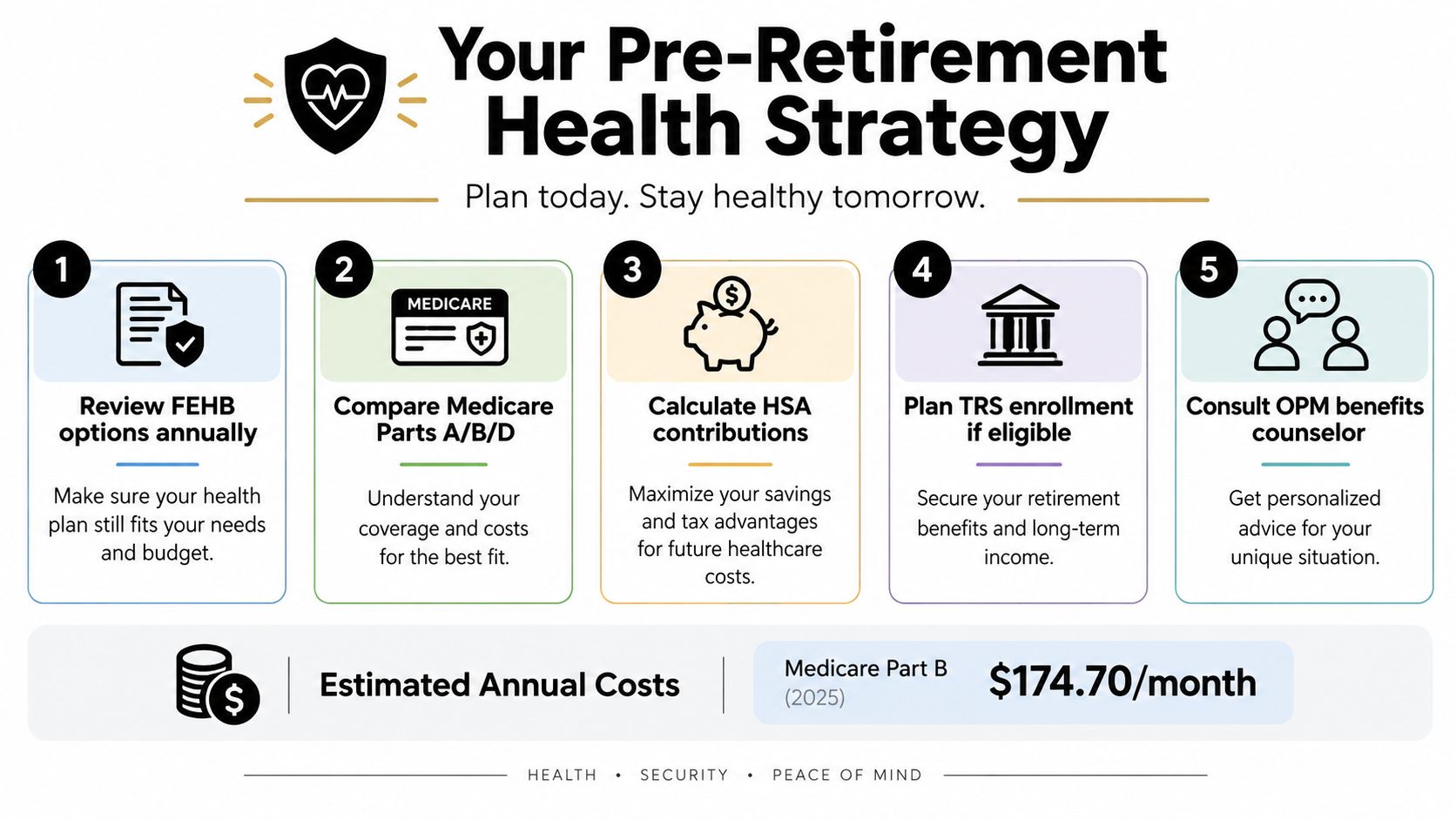
Treat health insurance as a multi-year retirement project, not a form you complete at separation. The strongest plan connects your FEHB continuity record, immediate-annuity eligibility, Medicare decision, premium budget, and survivor protection.
Start with a personal gap analysis. Mark the date your current FEHB enrollment began, identify any periods covered as a family member, and document any qualifying TRICARE coverage. Then compare that record with your intended retirement date and immediate-annuity pathway.
Use a practical review sequence
- Confirm continuity. Ask your agency benefits office to verify whether your coverage satisfies the required period immediately before retirement.
- Validate the annuity path. Make sure your retirement is immediate rather than deferred, and understand whether an MRA plus 10 election affects your annuity.
- Model Medicare. Compare Part A, Part B, and Part D choices with your FEHB plan, expected medical use, provider network, prescriptions, and possible IRMAA.
- Protect the household. Confirm your spouse's enrollment status and survivor annuity election separately.
- Review annually. Recheck FEHB options during Open Season as your health needs, providers, prescriptions, and residence change.
Your questions should be specific. Ask who will administer your enrollment after separation, how premiums will be deducted during interim annuity payments, when to notify the FEHB carrier about Medicare, and what documents are required for a suspension or reinstatement.
For broader retirement-planning topics, Coveredly's retirement-planning resources can provide additional context. Federal Benefits Sherpa also offers personalized benefit reviews, retirement planning, and gap-analysis reports that address FERS and FEHB decisions in an individual household context.
Federal Benefits Sherpa can review your FEHB continuity, Medicare coordination, premium assumptions, and survivor coverage as part of a personalized federal benefits review. Visit Federal Benefits Sherpa to request a review and turn your health insurance questions into a documented retirement strategy.

Dedicated to helping Federal employees nationwide.
“Sherpa” - Someone who guides others through complex challenges, helping them navigate difficult decisions and achieve their goals, much like a trusted advisor in the business world.
Federal Benefits Sherpa, LLC
12724 Gran Bay Parkway West, Suite 410, Jacksonville, FL 32225
Email: [email protected]
Phone: (833) 753-1825
© 2024 Federalbenefitssherpa. All rights reserved
Federal Benefits Sherpa is an independent organization and is not affiliated with or endorsed by the U.S. government or any federal agency.