Learning Center
FEHB Premium Conversion: What It Means for Your Paycheck
You're looking at your Leave and Earnings Statement after a long day, checking whether the FEHB deduction matches the plan you selected. The amount may look like an ordinary payroll deduction, but its position on the statement matters. If premium conversion applies, your share of the FEHB premium is taken from pay before federal income tax, Social Security, and Medicare tax calculations.
That arrangement can increase your take-home pay without changing your FEHB plan, carrier, or premium rate. The important point for employees approaching retirement is that the tax treatment follows employee status, not just FEHB enrollment. When payroll ends, the deduction process changes too.
How FEHB Premium Conversion Shows Up on Your Pay Stub
A new federal employee might first notice FEHB premium conversion while reviewing a first Leave and Earnings Statement. The health insurance line appears among deductions, but the taxable wage figures are calculated after the eligible FEHB contribution has been removed. That ordering is the practical meaning of paying the employee share with pre-tax dollars.
The statement may show several details that are easy to confuse:
- The FEHB deduction code identifies the payroll treatment used by the agency.
- The plan or enrollment reference identifies the coverage selected.
- The current-period amount shows what was withheld for that pay period.
- The year-to-date column accumulates deductions across the year.
The FEHB premium itself hasn't become cheaper. Instead, the employee contribution is excluded from the wage amount used for federal income tax, OASDI, and Medicare calculations when premium conversion applies. OPM describes the arrangement as a salary-allotment mechanism that withholds the eligible contribution before those federal taxes are calculated. OPM's explanation of state and local tax treatment also notes that federal taxation is excluded nationwide, while state and local treatment generally follows the federal exclusion in most jurisdictions.

Read the statement in the right order
Start with gross pay, then identify the FEHB deduction, and then compare the taxable wage figures with the amount you expected from basic pay. Don't assume that a lower taxable wage means your salary was reduced. It usually means the payroll office removed an eligible pre-tax contribution before calculating the applicable taxes.
A pay stub can also make the premium look confusing because the deduction is displayed alongside other benefits, while the tax calculations appear elsewhere. The line item still represents your employee share. The difference is that the government calculates certain taxes on a lower wage base.
Employees comparing their health coverage options may also find it useful to review broader employer health insurance guidance, such as the resources on Duncan & Associates health benefits. That kind of comparison can help separate the plan decision, which determines coverage, from the payroll decision, which determines how your share is treated for tax purposes. For a federal-specific explanation of an unfamiliar payroll label, see this guide to the special FEHB payroll code.
What Premium Conversion Actually Does to Your Withholdings
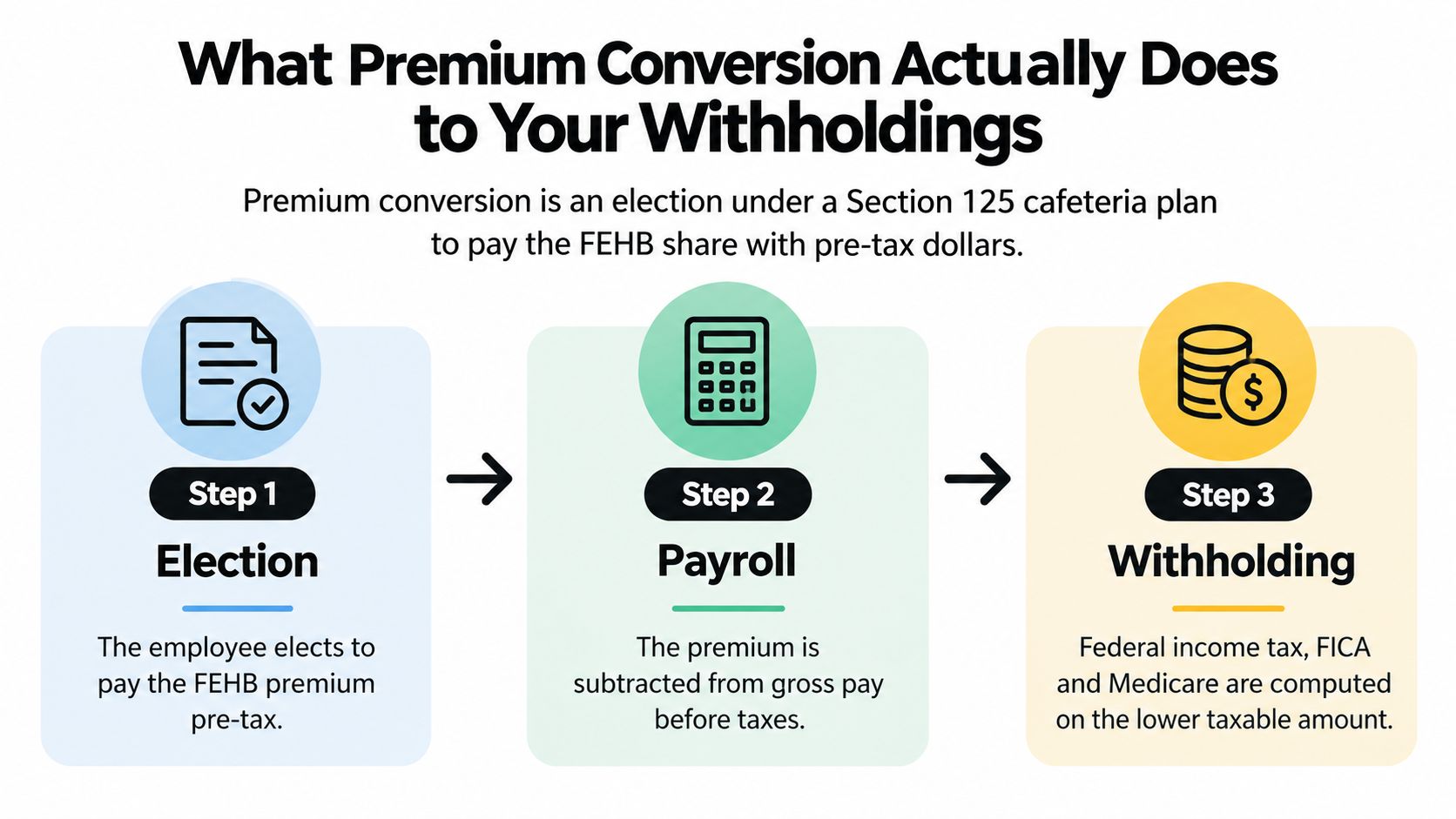
FEHB premium conversion is an election under a Section 125 cafeteria plan. In plain language, it allows an eligible employee to use pre-tax pay for the employee share of an FEHB premium.
The process has three parts:
- Election: You participate in the agency's premium conversion arrangement unless you make an applicable election not to participate.
- Payroll treatment: The eligible FEHB contribution is withheld before certain taxes are calculated.
- Tax calculation: Federal income tax, OASDI, and Medicare calculations use the reduced wage amount.
Three taxes, one payroll change
Federal income tax is calculated after the converted FEHB amount has been excluded from taxable wages. That generally means less federal income tax is withheld from the affected pay.
OASDI, the Social Security portion of payroll tax, also excludes the converted amount. The exclusion applies within the OASDI wage rules, including the annual wage base. Medicare tax is calculated on wages under its own rules, and the converted amount is excluded from the Medicare calculation as well.
State and local treatment requires more care. OPM states that federal taxation is excluded nationwide, while state and local treatment generally follows the federal exclusion in 49 states and most localities, with New Jersey and Puerto Rico identified as exceptions. OPM's state and local tax guidance is the right reference for the treatment that applies where you live and work.
Practical distinction: Premium conversion changes the tax treatment of your FEHB contribution. It doesn't reduce the carrier's premium, change your enrollment code, or increase the government's share.
Your plan, carrier, and coverage tier remain the same. The federal government's contribution also isn't changed merely because you participate. What changes is the amount of your pay exposed to the relevant taxes.
Employees who want broader background on withholding mechanics can compare this topic with general tax withholding tips for small businesses, but federal employees still need to apply the specific FEHB and Section 125 rules to their own payroll records.
Who Is Eligible and How the Default Election Works
Eligibility starts with two conditions: you must have FEHB coverage, and your agency or payroll office must operate the applicable premium conversion arrangement. The arrangement is tied to active employment and payroll processing. It isn't a separate health plan and doesn't create a second form of insurance.
For most employees, the practical question isn't whether the plan premium exists. It's whether the employee contribution is being processed through the Section 125 arrangement. A newly hired employee should review the first Leave and Earnings Statement and confirm how the FEHB line affects taxable wages. A current employee should check the same information after an enrollment change, a payroll transfer, or another administrative update.
The broader guide to the Federal Employees Health Benefits Program can help distinguish enrollment eligibility from payroll treatment. Those are related decisions, but they aren't identical.
Don't confuse two separate elections
Changing your FEHB plan and changing the tax treatment of your employee premium are different actions. You can select a different carrier or coverage tier while remaining in premium conversion. Conversely, declining premium conversion doesn't cancel FEHB coverage. It changes how your contribution is deducted and taxed.
Section 125 rules limit when an employee can change a cafeteria-plan election after making it. A qualifying life event, such as marriage, divorce, birth, adoption, or loss of other coverage, may create an opportunity to change an election. Open Season may also provide an election period, depending on the applicable rules and agency process.
That restriction is the point many explanations leave out. An employee may waive premium conversion because the immediate tax difference seems unimportant, then discover that the choice can't be reversed whenever they want. The election usually isn't freely adjustable from one pay period to the next.
What to verify with payroll or human resources
Before waiving or changing the election, ask for written confirmation of:
- The effective date: When will the new tax treatment begin?
- The reversal rule: Can you change the decision only during Open Season or after a qualifying life event?
- The payroll impact: Which taxable wage fields will change?
- The retirement treatment: What happens to FEHB deductions when your employee status ends?
The answers should come from your agency's benefits or payroll office and should match the governing Section 125 process. Keep the confirmation with your retirement records. Election timing can matter just as much as the tax calculation itself.
The Paycheck Difference for a Working Federal Employee
A working federal employee reviewing a pay statement can compare two lines of the same cash-flow picture: the FEHB deduction and the taxable wage figures used for withholding. No made-up salary or premium is needed. The premium amount stays the same in either comparison. Payroll applies that amount at a different point in the calculation.
| Pay Item | With Premium Conversion, Pre-Tax | Without Premium Conversion, After-Tax |
|---|---|---|
| Basic pay | Pay received for the period | Pay received for the period |
| FEHB employee contribution | Removed before applicable tax calculations | Removed after applicable tax calculations |
| Federal taxable wages | Lower by the eligible FEHB contribution | Not reduced by that contribution |
| OASDI wage base | Lower by the converted amount | Includes the FEHB amount |
| Medicare wage base | Lower by the converted amount | Includes the FEHB amount |
| FEHB deduction | Same employee premium | Same employee premium |
| Take-home pay | Generally higher because applicable taxes are lower | Generally lower because applicable taxes are higher |
How to reproduce the comparison
Start with one pay statement. Record the current FEHB deduction, then compare the federal taxable wages, OASDI wages, and Medicare wages with the figures that would apply if the contribution were treated after tax.
The change in take-home pay depends on your federal marginal tax treatment, applicable payroll tax rules, coverage tier, and state or local treatment. These factors vary by employee, so a precise dollar estimate requires your payroll data.
For a FERS employee, premium conversion can increase take-home pay when the eligible contribution is excluded before applicable calculations. Neither the employee nor the agency changed their contribution amount; what changed was only the tax treatment applied to the eligible contribution.
Read the pay stub, not just the deduction line. Compare the taxable wage fields, the FEHB current-period amount, and the resulting net pay.
The timing matters because the paycheck benefit belongs to the active-employee payroll arrangement. While you are working, the FEHB deduction can make each pay period feel more efficient. At retirement, the enrollment may continue while the deduction moves to the annuity system and the active payroll treatment generally ends.
That handoff is why an active-paycheck estimate should not become a retirement cash-flow forecast. The plan and premium may remain familiar, while the source and tax treatment of the deduction change. A year-25 employee should treat the final employee pay period as a separate financial checkpoint, then examine how the retirement system will withhold the premium.
What Changes When You Retire or Return to Work
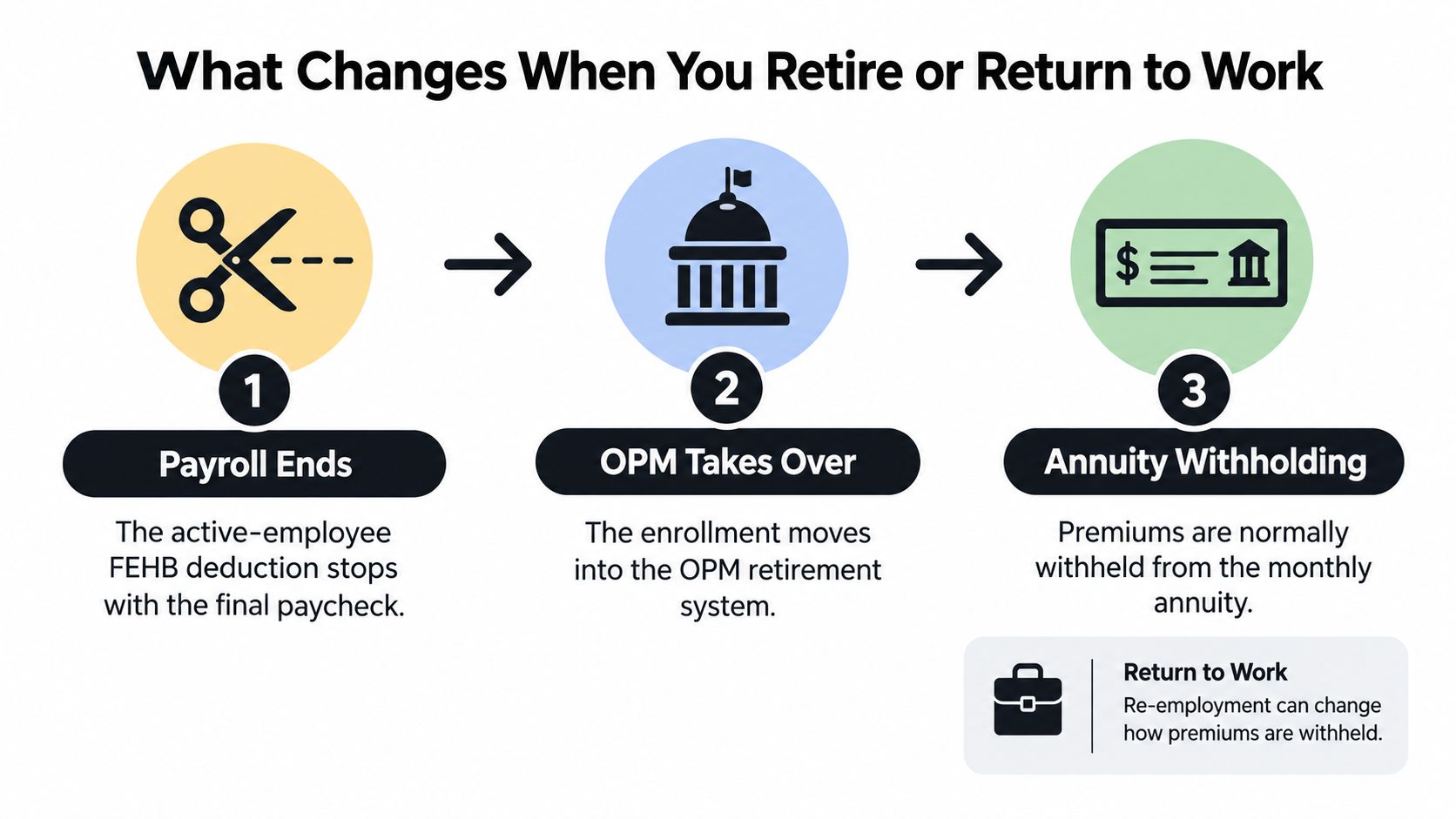
Retirement is the point where the mechanics change for most FEHB enrollees. Your active employee payroll deduction ends with the final employee pay period, and FEHB administration moves from the agency payroll system to the retirement system.
Federal retirees generally can't pay FEHB premiums through payroll on a pre-tax basis. Instead, the premium is normally withheld from the retirement benefit after tax. The underlying FEHB coverage and premium aren't necessarily changing, but the deduction is now being taken from an annuity rather than from active wages under premium conversion.
The handoff after separation
The transition involves more than watching one deduction disappear from a final LES. The enrollment must be administered through the retirement system, and the premium must be withheld from the annuity after tax under the normal retiree arrangement.
That can make retirement income appear lower than expected even when the FEHB plan and premium remain familiar. The difference comes from the loss of the active-employee tax treatment, not necessarily from a change in coverage.
OPM's reference for annuitants and reemployed annuitants explains the administrative path and the exception for a person who returns to a position conveying FEHB eligibility.
What happens if an annuitant returns
A reemployed annuitant may move FEHB enrollment from the retirement system back to the employing agency when the new position is eligible and the agency is covered by premium conversion. The employee can then have FEHB premiums deducted pre-tax from salary again.
Participation is automatic for the reemployed employee unless waived, and the person has 60 calendar days to submit a waiver under the applicable process. If the employee waives participation, FEHB remains administered as an annuitant, and premiums are deducted from the annuity after tax.
When reemployment ends, enrollment must transfer back to the retirement system. Premium conversion then terminates with the final employee pay period. The FEHB retiree health insurance guide provides additional context for reviewing coverage during this handoff.
Retirement checkpoint: Confirm who will administer the enrollment, which payment will carry the deduction, and when the last pre-tax payroll deduction will occur.
The Trade-Off Most Articles Skip Over
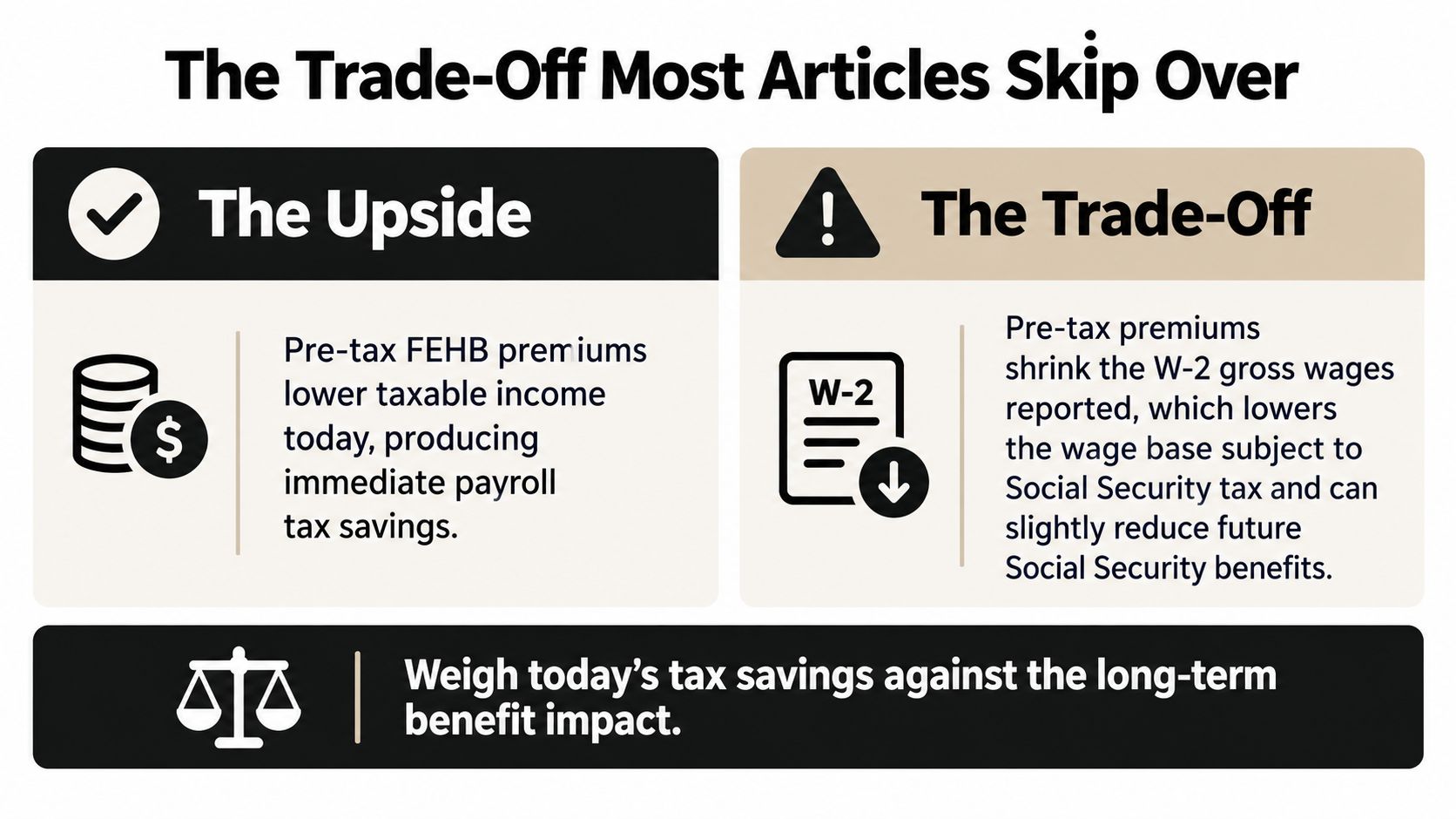
Pre-tax FEHB premiums reduce the wages reported for Social Security tax purposes. That creates an immediate payroll benefit, but it also means the converted amount isn't included in Social Security-covered wages for that period.
The long-term issue is not that FEHB coverage disappears or that your federal retirement calculation is automatically reduced. OPM clarifies that participating in premium conversion doesn't, by itself, change federal retirement, TSP, or life-insurance benefits. The narrower trade-off concerns wage-based calculations that use Social Security-covered earnings.
Why the effect differs by employee
The possible Social Security effect depends on your earnings history and where your wages fall under the OASDI rules. An employee whose covered wages are already at or above the applicable wage base may experience a different marginal effect from an employee whose earnings remain below it.
That doesn't turn premium conversion into a universal bad choice. It means the employee should compare the immediate tax savings with the possibility that lower reported Social Security wages could affect a wage-based benefit calculation.
Medicare requires separate treatment. The converted amount is excluded from the Medicare calculation, but Medicare's wage rules don't use the same capped structure as OASDI. The result is that the Social Security-covered wage issue deserves more attention than an assumption that every payroll tax behaves identically.
A decision to measure, not fear
For many employees, the current cash-flow benefit will be more concrete than a possible marginal effect on future wage-based benefits. For others, especially those reviewing earnings near the OASDI wage base, the interaction deserves a closer calculation.
Use your earnings record, current FEHB deduction, retirement horizon, and expected tax situation. Don't assume that a lower W-2 wage automatically changes your FERS annuity, and don't assume that the Social Security consequence is irrelevant just because the amount is not visible in your net-pay line.
The right question isn't “Is pre-tax always better?” It's “What do I gain today, and what wage-based benefit calculation could use the lower reported earnings?”
Deciding Whether Premium Conversion Fits Your Situation
For an active FERS employee, keeping premium conversion is often the practical starting position because the employee can reduce the wages used for federal income tax, OASDI, and Medicare calculations. That default still deserves a personal review, especially when retirement or a major household change is close.
Start with the timeline. An employee early in a career has more future pay periods to evaluate, while someone close to retirement needs to focus on the final active-payroll transition and the expected change from payroll withholding to annuity withholding.
Signals that point toward keeping it
- You rely on current take-home pay: The tax treatment creates an immediate cash-flow benefit while you're actively employed.
- Your FEHB coverage is necessary: Premium conversion affects the deduction method, not whether the plan provides coverage.
- Your household coverage is settled: If there isn't a pending change involving a spouse or other coverage, leaving the election in place may avoid unnecessary administrative work.
Situations that call for a closer review
An employee near retirement may want to model the change in cash flow when the pre-tax payroll deduction ends. The key question isn't only whether the FEHB premium continues. It also asks whether the annuity withholding will be after tax and how that affects monthly available income.
A household with overlapping coverage should review the underlying FEHB elections separately from premium conversion. Marriage, divorce, birth, adoption, or loss of other coverage may create a qualifying life event, but the event doesn't automatically answer whether changing coverage or changing tax treatment is appropriate.
Employees concerned about Social Security-covered wages should examine their earnings history and proximity to the applicable OASDI wage base. A person may decide that the immediate tax benefit is worth keeping, but that conclusion should follow a review rather than an assumption.
Three questions before you waive
- How long is it until retirement, and when will payroll deductions end?
- Which FEHB coverage tier and employee contribution apply to your household?
- Is your current tax situation likely to differ materially from your expected retirement tax situation?
Waiving premium conversion can have a lasting administrative effect because Section 125 rules generally restrict changes outside Open Season or a qualifying life event. Don't treat the default election as invisible, but don't waive it casually either. Record the decision, identify the next permitted review point, and ask your benefits office how the choice will be documented.
Federal Benefits Sherpa offers federal employees personalized benefit reviews, retirement planning, and gap analysis reports that can connect FEHB payroll treatment with TSP, Social Security, and retirement-income decisions. Visit Federal Benefits Sherpa to request a review of how your premium conversion election may fit into your retirement timeline.

Dedicated to helping Federal employees nationwide.
“Sherpa” - Someone who guides others through complex challenges, helping them navigate difficult decisions and achieve their goals, much like a trusted advisor in the business world.
Federal Benefits Sherpa, LLC
12724 Gran Bay Parkway West, Suite 410, Jacksonville, FL 32225
Email: [email protected]
Phone: (833) 753-1825
© 2024 Federalbenefitssherpa. All rights reserved
Federal Benefits Sherpa is an independent organization and is not affiliated with or endorsed by the U.S. government or any federal agency.