
Learning Center
Federal Employees Cost of Living Adjustment: A 2026 Guide
Maria, a GS-12 federal employee in her late fifties, studies her pay stub after noticing that groceries have become much more expensive. Her paycheck moved, but not enough to make the month feel easier. She starts asking a question many federal employees eventually face: Why doesn't my pay change with inflation, and will my retirement annuity work differently?
That question matters because active federal pay and retiree income follow separate rules. A federal employee's annual pay adjustment comes through the pay-setting process, including General Schedule and locality decisions. A federal retiree's cost-of-living adjustment, or COLA, is tied to an inflation index and then modified by the retirement system's formula.
For January 2026, the official adjustment was 2.8% for CSRS annuitants and 2.0% for FERS annuitants, based on a 2.8% increase in CPI-W from the third quarter of 2024 to the third quarter of 2025, as explained in the Congressional Research Service overview of federal retirement COLAs. Understanding that difference can help you read your pay stub today and plan your retirement income more realistically.
Why Your Paycheck and Your Annuity Move Differently
Maria's frustration is understandable. She sees prices at the supermarket, utility bills, housing costs, and insurance premiums rise at different speeds. Her annual federal pay adjustment, however, doesn't directly mirror the price movement she feels in her household budget.
Active pay follows a separate decision
For a current federal employee, annual pay changes come through the federal pay-setting process. General Schedule base pay and locality pay are handled separately from the COLA applied to retirement annuities. The two systems may respond to economic conditions, but they don't use the same measure or produce the same result.
That means Maria shouldn't expect her paycheck to track the price of every item in her shopping cart. A pay adjustment may reflect broader wage and policy decisions, while her personal inflation rate depends on where she lives, what she buys, and which costs dominate her budget.
For a useful explanation of the distinction between active-worker pay and retiree adjustments, review this 2026 guide to federal pay and COLA rules.
Retirement changes the measuring stick
After Maria retires, her annuity won't be adjusted through the annual employee pay process. Instead, an eligible CSRS or FERS annuity receives a COLA determined under federal retirement rules. The calculation uses the Consumer Price Index for Urban Wage Earners and Clerical Workers, known as CPI-W, rather than her agency's pay table or locality adjustment.
That distinction is easy to miss. Maria's working salary is compensation for current service. Her retirement annuity is income intended to continue after service ends. One is adjusted through a pay-setting process, and the other is recalculated through an inflation-indexing formula.
Practical rule: Don't use your annual employee raise as a forecast for your future annuity COLA. They answer different questions and follow different rules.
The timing of retirement can matter, too. OPM guidance states that the 2026 COLA applies to annuitants who have received benefits for at least one year, so the date benefits begin can affect when a retiree first receives the full adjustment. That makes the federal employees cost of living adjustment more than a headline percentage. It's part of the income timing picture you'll need to examine before leaving service.
What a Federal Employee COLA Actually Measures
Start with an ordinary grocery basket. It includes food, transportation, housing-related expenses, utilities, and other goods and services that urban wage earners and clerical workers purchase. Economists track how the prices of those items change, then combine the movements into an index.
The basket isn't a personal budget. It doesn't know whether you rent, own a home, live in a high-cost locality, or spend more on prescriptions than another retiree. It provides a standardized way to measure price movement across a broad consumer population.
From household purchases to CPI-W
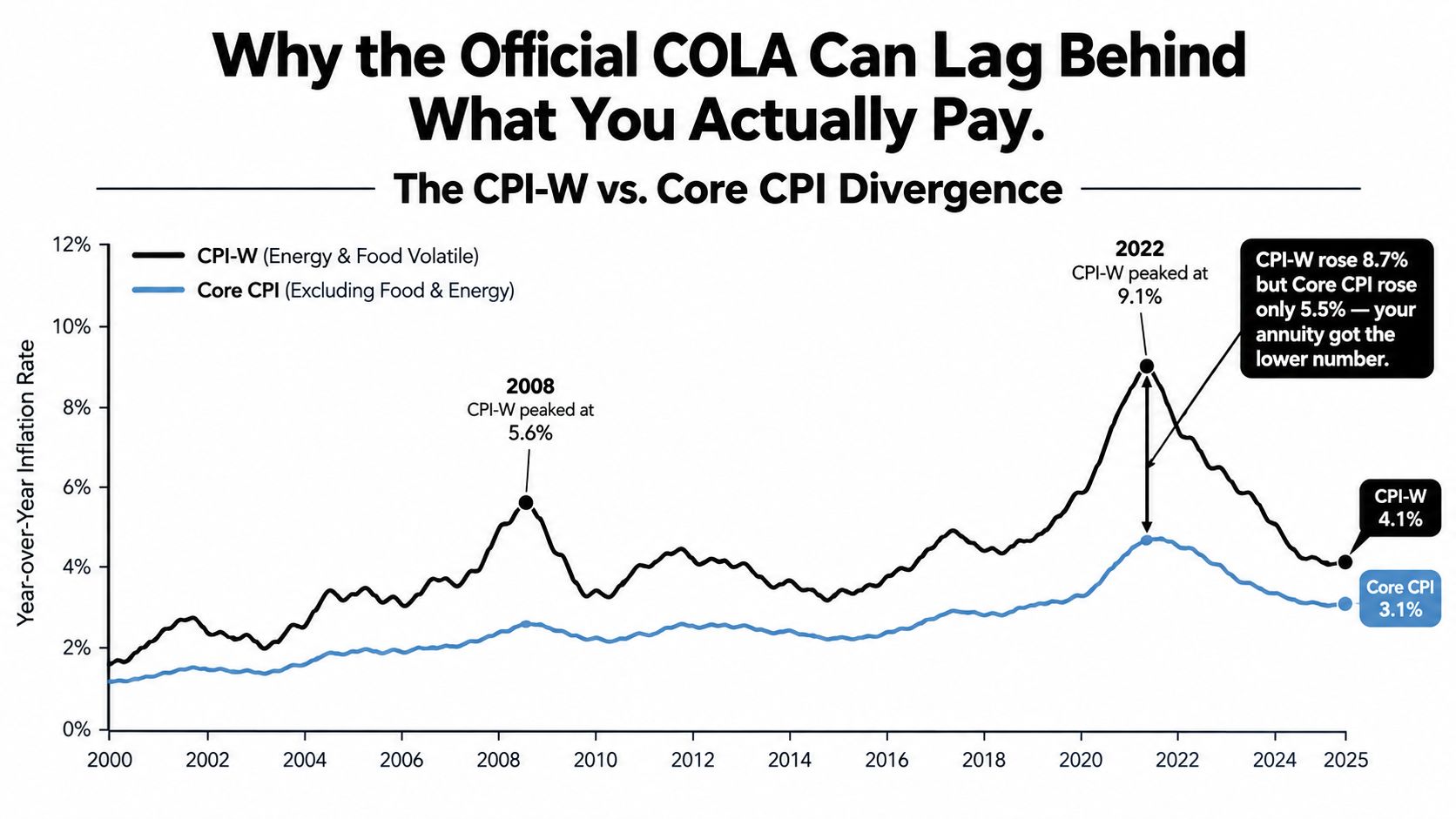
The formal name is Consumer Price Index for Urban Wage Earners and Clerical Workers, or CPI-W. Federal civil service COLAs compare average CPI-W readings for the third calendar quarter of the relevant years, with the result rounded to the nearest tenth of a percent, according to OPM's CSRS and FERS retirement handbook.
That timing creates a built-in lag. The adjustment doesn't measure your expenses on the day your annuity deposit arrives. It uses a defined historical comparison, which makes the calculation consistent but less responsive to sudden changes in a particular household's costs.
Why your basket may feel different
CPI-W is not a custom retiree index. Your actual expenses may include healthcare costs, Medicare premiums, housing costs, or energy bills that behave differently from the CPI-W basket. When those categories rise faster than the broader index, your personal inflation rate can feel higher than the adjustment applied to your annuity.
The key point is simple: CSRS and FERS COLAs start with the CPI-W reading, not with a survey of each retiree's expenses. The same index then produces different outcomes because CSRS generally receives the full CPI-based increase, while FERS applies a separate formula.
You can think of CPI-W as the measuring tape and the retirement system as the rulebook. The tape supplies the inflation reading. The rulebook determines how much of that reading reaches your monthly benefit.
How the FERS COLA Formula Caps Inflation
FERS uses a tiered formula. It gives full CPI-W protection when inflation is low, holds the adjustment at a middle level when inflation moves above a threshold, and reduces the adjustment by a percentage point when inflation is higher.
OPM describes the structure in its official explanation of how the FERS COLA is determined.
The three decision points
Use this sequence:
- CPI-W is 2.0% or less. The FERS COLA equals the CPI-W increase.
- CPI-W is above 2.0% but below 3.0%. The FERS COLA is fixed at 2.0%.
- CPI-W exceeds 3.0%. The FERS COLA equals CPI-W minus 1 percentage point.
A negative inflation reading doesn't create a negative annuity adjustment. But a period without an increase doesn't create an automatic catch-up for purchasing power lost elsewhere.
The following examples use a hypothetical $2,000 monthly FERS annuity. The source for the formula is the OPM guidance linked above.
| CPI-W Reading | Full COLA Amount | FERS COLA Amount | Annual Shortfall |
|---|---|---|---|
| 1.5% | $30 monthly | $30 monthly | $0 |
| 3.0% | $60 monthly | $40 monthly | $240 |
| 7.0% | $140 monthly | $120 monthly | $240 |
At 1.5% inflation, the full adjustment and the FERS adjustment match. At 3.0%, a full CPI increase would add $60 per month, but the FERS formula adds $40. At 7.0%, the full increase would add $140 per month, while the FERS formula produces $120.
The annual shortfall column compares the full CPI-based increase with the FERS increase over a year. These examples show why a one-point reduction matters. Once the smaller increase becomes part of the annuity base, later adjustments build on that lower amount.
That issue belongs in a broader retirement conversation. Rising expenses can affect not only monthly spending but also decisions about beneficiaries, liquidity, and inheritance, which is why this resource on rising costs and your estate plan may be useful alongside an annuity review.
CSRS vs FERS in the Same Inflation Year
Take one inflation reading and place it beside two retirement systems. The CPI-W result is the same, but the annuity adjustment may not be.
CSRS generally receives the full CPI-based COLA. FERS applies the tiered formula described above. That difference is the central reason two federal retirees can experience different income changes even when their benefits are exposed to the same prices.
One reading, two outcomes
Consider a hypothetical 4.0% CPI-W year. A CSRS annuitant would receive the full 4.0% COLA. A FERS annuitant would receive CPI-W minus 1 percentage point, producing a 3.0% COLA under the formula. The example uses a $30,000 annual annuity to make the difference visible.
| CPI-W Reading | CSRS COLA | FERS COLA (Tiered Cap) | Annual Gap on a $30,000 Annuity |
|---|---|---|---|
| 1.5% | 1.5% | 1.5% | $0 |
| 2.5% | 2.5% | 2.0% | $150 |
| 4.0% | 4.0% | 3.0% | $300 |
The gap is not a statement about one retiree's needs being more legitimate than another's. It's the direct result of different statutory formulas. A CSRS retiree's annuity follows the full CPI-W reading more closely, while a FERS retiree accepts a smaller adjustment once inflation passes the formula's thresholds.
The difference between CSRS and FERS also reflects how the systems were designed. FERS includes Social Security and the Thrift Savings Plan as parts of the retirement package, while CSRS was built without Social Security coverage for the same federal retirement structure.
Why compounding changes the picture
A one-year difference may look manageable. The more important question is what happens when the lower adjusted annuity becomes the starting point for future increases. The CSRS benefit can pull farther ahead when full inflation adjustments continue and the FERS formula repeatedly reduces the passthrough.
That doesn't mean every FERS retiree will experience the same outcome. The effect depends on inflation, the size of the annuity, other income sources, and spending patterns. It does mean FERS planning should treat COLA protection as a specific feature to model, not as an assumption that every federal annuity rises with the full inflation rate.
A Decade of Federal COLAs and What the Numbers Reveal
The history of federal COLAs reads like an inflation story. Quiet years produced modest adjustments. The sharp inflation surge of the early 2020s created a dramatic increase, followed by a return toward more moderate readings.
The historical record below comes from Congressional Research Service COLA tables. It includes the verified figures available for the period.
| Year | CPI-W Change | CSRS COLA | FERS COLA | Effective Gap |
|---|---|---|---|---|
| 2017 | 0.3% | 0.3% | 0.3% | 0.0 percentage points |
| 2018 | 2.0% | 2.0% | 2.0% | 0.0 percentage points |
| 2019 | 2.8% | 2.8% | 2.0% | 0.8 percentage points |
| 2023 | 8.7% | 8.7% | 7.7% | 1.0 percentage point |
| 2024 | 3.2% | 3.2% | 2.2% | 1.0 percentage point |
| 2025 | 2.5% | 2.5% | 2.0% | 0.5 percentage points |
| 2026 | 2.8% | 2.8% | 2.0% | 0.8 percentage points |
The outlier year
The 2023 COLA reached 8.7% for CSRS and 7.7% for FERS, the highest adjustment in decades, according to the CRS historical record. The size of that increase reflected the sharp inflation surge that preceded it.
CSRS retirees received the full CPI-based increase. FERS retirees also received a large adjustment, but the formula still left them one percentage point below the CPI-W reading. That difference arrived during a period when households were already confronting unusually fast price changes.
The following years show why a single dramatic COLA doesn't settle the long-term question. 2024 produced 3.2% for CSRS and 2.2% for FERS, while 2025 produced 2.5% for CSRS and 2.0% for FERS. In 2026, the figures were 2.8% and 2.0%, respectively.
What volatility teaches
Averages can hide the planning risk. A retiree may experience several moderate adjustments, then encounter a year when the FERS formula reduces inflation passthrough just as essential expenses rise quickly. Partial relief in later years doesn't automatically restore the purchasing power missed during the earlier gap.
The size of the COLA matters, but the sequence of COLAs matters more for a retiree who spends from a fixed annuity.
That sequence affects withdrawal decisions, emergency reserves, and the amount of flexibility a retiree needs from other assets. The federal employees cost of living adjustment is therefore not just an annual announcement. It's a recurring input into a retirement-income plan.
The Quiet Purchasing Power Gap Most Retirees Miss
Many people assume that a FERS annuity and Social Security benefit with the same starting value will remain comparable if both receive annual inflation adjustments. That assumption breaks down in years when CPI-W falls into the range where FERS is limited to a 2.0% COLA.
Social Security and CSRS follow the full CPI-W reading, while FERS uses the tiered formula. The gap can appear modest in one year, but each future increase starts from the adjusted benefit produced by the prior year.
A controlled illustration
Consider a planning illustration beginning with a $30,000 annual benefit and assuming 3.0% annual inflation for a decade. Under that assumption, a full CPI-linked benefit would grow by roughly 34%, while a FERS benefit receiving a 2.0% adjustment in those years would grow by roughly 27%. The difference would leave the FERS benefit several thousand dollars below the Social Security comparison by the end of the illustration.
Those figures are an illustration of compounding, not a forecast of any individual retiree's benefit. Actual outcomes depend on the CPI-W readings that occur, the timing of retirement, eligibility rules, and the composition of each person's income.
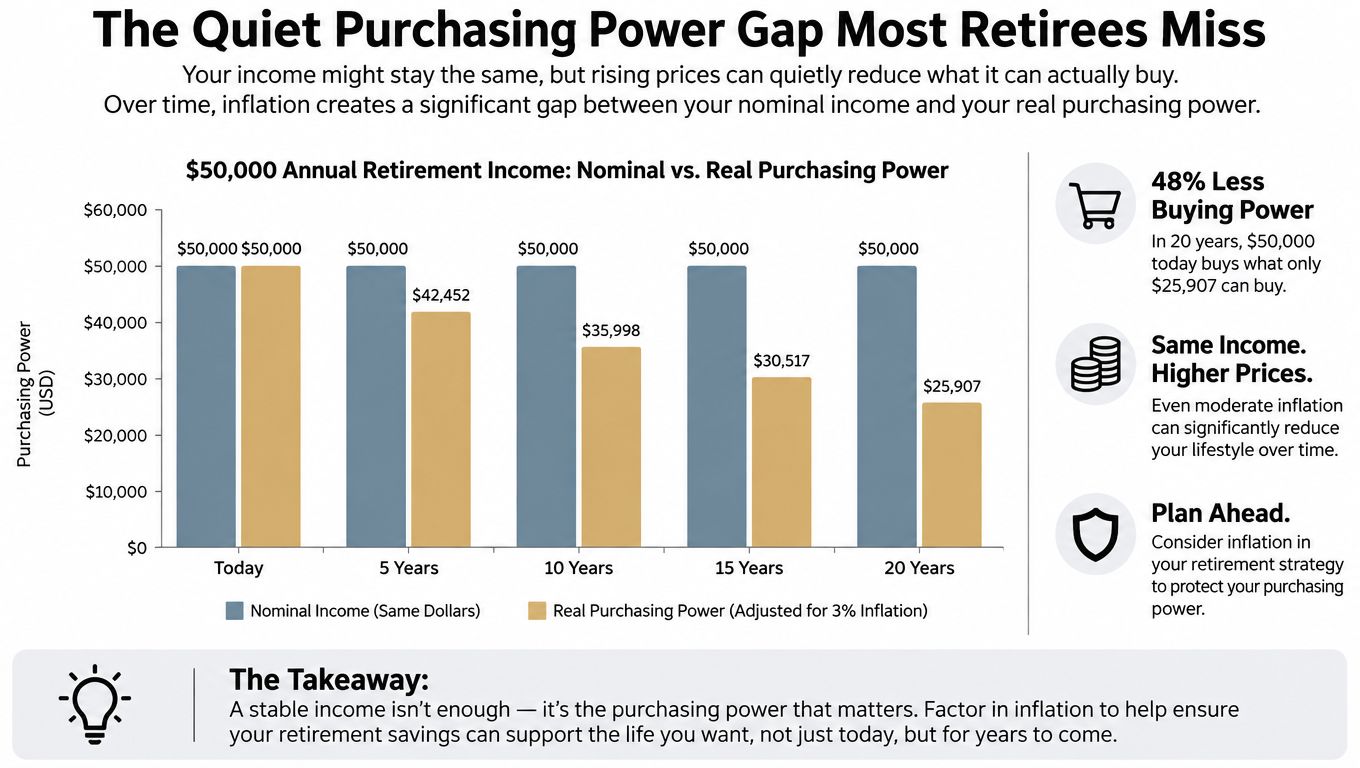
The planning lesson is more useful than the comparison itself. A FERS retiree shouldn't assume that Social Security's inflation adjustment will automatically compensate for every annuity shortfall. Social Security can provide an important inflation-linked income source, but the two benefits may still grow at different rates depending on the inflation reading.
Turn the gap into a planning variable
You can respond by modeling flexible income rather than treating the annuity as your entire inflation defense. TSP withdrawals, savings reserves, a later Social Security claim, and spending adjustments can all affect how much pressure falls on the FERS annuity.
The goal isn't to predict the exact COLA years in advance. It's to identify how much flexibility your plan has if the FERS adjustment trails the prices that matter most to you.
The embedded presentation below offers another way to think about inflation and retirement income:
Review your TSP growth assumptions, FEGLI choices, healthcare costs, and spending needs together. A gap that looks small on a spreadsheet may become meaningful when it affects recurring expenses over many years.
Planning Your Retirement Income Around COLA Realities
A practical plan starts with your own records, not a national average. Gather the OPM estimate, TSP information, and Social Security projection before you decide how much income you can safely count on.

Five checks for your income model
Start with the OPM record. Download your official CSA Statement or retirement estimate and record the gross monthly annuity, survivor election, and whether the estimate uses CSRS or FERS rules. Those details establish the benefit that will receive future adjustments.
Separate guaranteed income from flexible assets. Pull your latest TSP balance and contribution history. Then model how withdrawals might supplement the annuity during years when inflation protection is weaker.
Stress-test several inflation paths. Run a low scenario at 2.0%, a baseline at 3.0%, and a 5.0% shock scenario. These are planning assumptions, not predictions, so label them clearly in your worksheet and avoid treating any one path as certain.
Compare the income streams. Place your FERS annuity beside your Social Security estimate and examine how each adjustment rule affects the combined income. The FERS pension and Social Security planning guide can help frame that comparison.
Choose a review date. Revisit the model each December after the next COLA is known. Update the following year's withdrawal amount before January deposits begin, and review whether your TSP allocation still matches your time horizon and spending needs.
Use a bridge deliberately
A TSP bridge can provide flexibility when fixed income doesn't keep up with personal expenses, but withdrawals also reduce the assets available for later years. Delaying Social Security may change the timing and size of that income source, while claiming earlier may preserve assets for other goals.
Federal Benefits Sherpa offers personalized benefit reviews, retirement planning, gap analysis reports, and educational resources covering TSP, healthcare coverage, and Social Security. Other retirement planners and federal benefits specialists can provide similar analysis, so compare the scope of any service with the questions you need answered.
Putting It All Together for a Steady Retirement
The federal employees cost of living adjustment becomes easier to plan around when you treat it as one part of a larger income system. First identify whether your annuity follows CSRS or FERS rules. Then model the effect of the formula alongside Social Security, TSP withdrawals, healthcare expenses, and your household's actual spending pattern.
Mark three annual touchpoints on your calendar:
- October: Review the CPI-W information that determines the next COLA.
- December: Revisit your TSP allocation, cash reserve, and planned withdrawals.
- January: Check the first annuity deposit after the adjustment takes effect.
CSRS retirees generally have more direct CPI protection. FERS retirees need to account for the tiered formula and the role of Social Security and TSP in the overall retirement design. Neither system removes the need for a spending plan.
Match essential fixed expenses to the COLA floor you can reasonably count on, and use flexible savings to absorb the inflation years you can't predict.
If you're nearing retirement, gather your OPM estimate, TSP statement, Social Security record, and household spending plan this quarter. Federal Benefits Sherpa can help you review those pieces through a benefit review, retirement plan, or gap analysis, so visit Federal Benefits Sherpa to explore the available options.

Dedicated to helping Federal employees nationwide.
“Sherpa” - Someone who guides others through complex challenges, helping them navigate difficult decisions and achieve their goals, much like a trusted advisor in the business world.
Federal Benefits Sherpa, LLC
12724 Gran Bay Parkway West, Suite 410, Jacksonville, FL 32225
Email: [email protected]
Phone: (833) 753-1825
© 2024 Federalbenefitssherpa. All rights reserved
Federal Benefits Sherpa is an independent organization and is not affiliated with or endorsed by the U.S. government or any federal agency.