
Learning Center
Born 1964 When Can I Retire Your Timeline Explained
If you were born in 1964, you can claim reduced Social Security retirement benefits at 62, but your full retirement age is 67. If you're a federal employee covered by FERS, your minimum retirement age is 56, so you may be able to leave federal service well before Social Security pays your full scheduled benefit.
That difference matters in 2026. A federal employee born in 1964 may be deciding whether to leave work, begin a FERS annuity, claim Social Security, or use savings to connect those dates. Those are separate decisions, and treating them as one retirement date can create an avoidable income gap.
Introduction for Anyone Born in 1964 Wondering When to Retire
Consider a federal employee born in 1964 who turns 62 in 2026. The employee has reached the earliest age for Social Security retirement benefits, but the monthly payment will be permanently reduced if benefits begin immediately. At the same time, the employee may already have been eligible to retire under FERS for years, depending on age, service, and the specific retirement option.
That's why the question “born 1964 when can I retire” has more than one answer. Leaving federal service, starting a federal annuity, and starting Social Security may happen on different dates. Your best choice depends on which income source you need first and whether other resources can cover the time between those dates.
For Social Security, the main planning window runs from age 62 through age 67, a five-year span. Claiming at the beginning of that window provides income sooner but locks in the largest early-claim reduction. Waiting until full retirement age provides the full scheduled benefit, while delaying beyond full retirement age can increase the benefit under Social Security's delayed-claiming rules. The Social Security Administration's full retirement age guidance confirms that people born in 1960 or later have an FRA of 67.
The practical question isn't only “When can I stop working?” It's “Which income source will support me at each stage after I stop?”
The pages ahead translate the timeline into plain English. You'll see how the Social Security clock works, why FERS uses a different minimum retirement age, and how a bridge funded by a TSP account or other assets can change the decision. You'll also see examples that separate eligibility from affordability, because being allowed to retire doesn't automatically mean the timing is financially comfortable.
Understanding Your Social Security Timeline at Age 67
Social Security uses a specific milestone called full retirement age, or FRA. For anyone born in 1960 or later, including someone born in 1964, FRA is 67. At that age, a worker becomes eligible for 100% of the scheduled retirement benefit shown by the Social Security formula, subject to the worker's earnings record and other eligibility factors. The SSA normal retirement age table places the 1964 cohort in this same FRA group as workers born in 1960, 1961, 1962, and 1963.
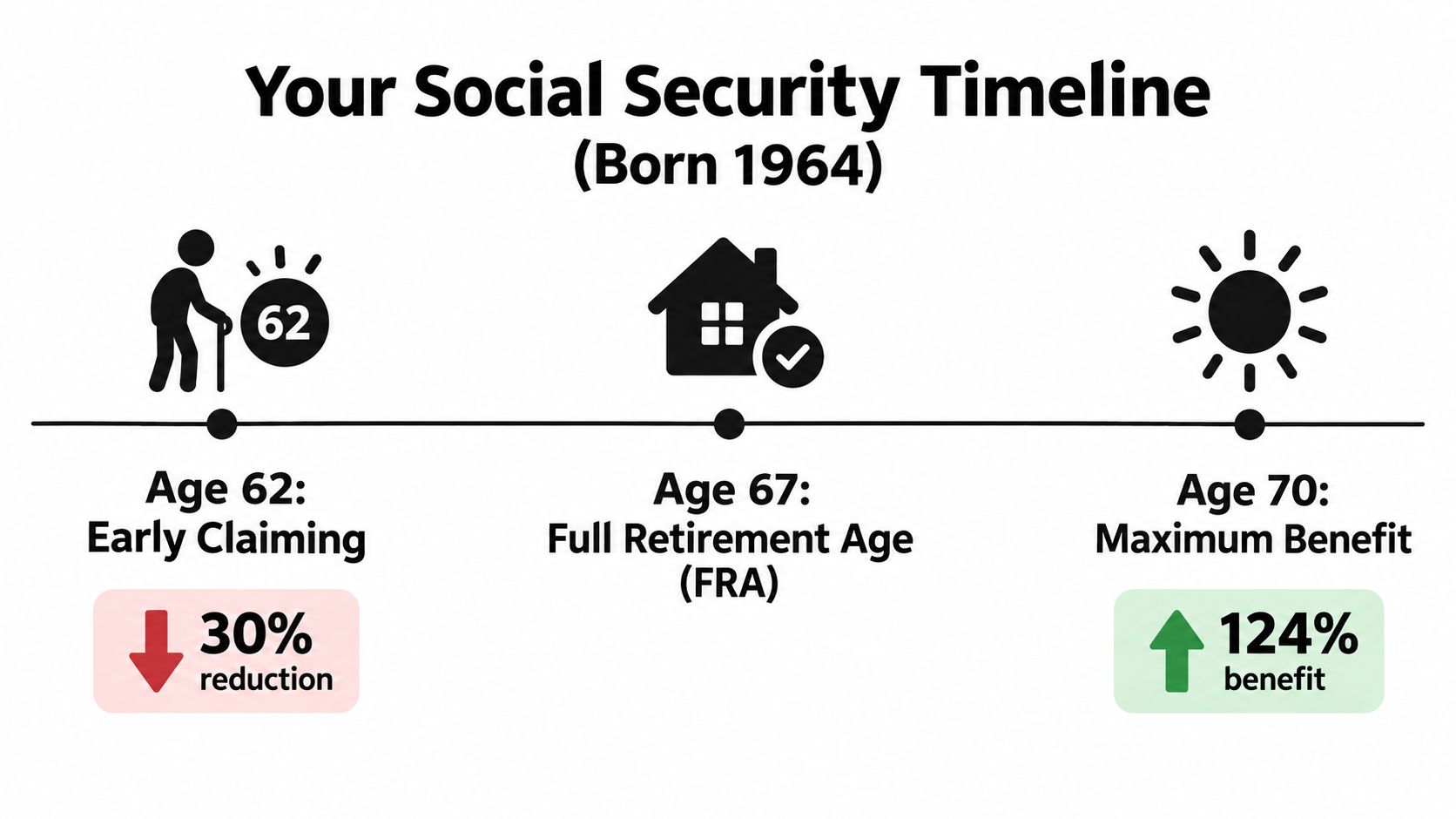
Think of the timeline as a three-stop road:
- Age 62: The earliest age for retirement benefits, with a permanent reduction for claiming before FRA.
- Age 67: Full retirement age, when the scheduled benefit is payable without the early-claim reduction.
- Age 70: A later claiming point that may produce a higher monthly benefit than claiming at FRA.
The early eligibility age and FRA serve different purposes. Age 62 answers, “When may I begin retirement benefits?” Age 67 answers, “When may I receive the full scheduled benefit?” The gap exists because Social Security rules gradually increased the normal retirement age under changes associated with the 1983 amendments, leaving this cohort with a five-year planning window between early eligibility and full retirement age.
Why the timeline affects your lifetime income
A decision at 62 doesn't merely cover the first month of retirement. The early-claim reduction generally continues for life, so the choice affects future monthly cash flow as well. A person who can cover expenses from a FERS annuity, TSP withdrawals, or other assets may decide that waiting offers stronger long-term income. Someone with immediate health or cash-flow needs may value starting earlier despite the reduction.
Federal employees often need to coordinate this timeline with a separate benefits review. The 2026 guide to when federal employees should start Social Security can help frame that decision alongside federal retirement planning.
Retirement planning also requires caution about identity theft and benefit scams. Before sharing personal information, review how Gini Help stops Social Security fraud and use official SSA channels for claims and account questions.
What Happens If You Claim Social Security at 62
For a person born in 1964, claiming at 62 means starting benefits 60 months before the age-67 FRA. The SSA reduction schedule makes the monthly payment substantially lower than the full scheduled amount. The commonly cited result for this cohort is about 70% of the full benefit, or roughly a 30% reduction, when benefits start at 62. The SSA age reduction explanation provides the governing schedule.
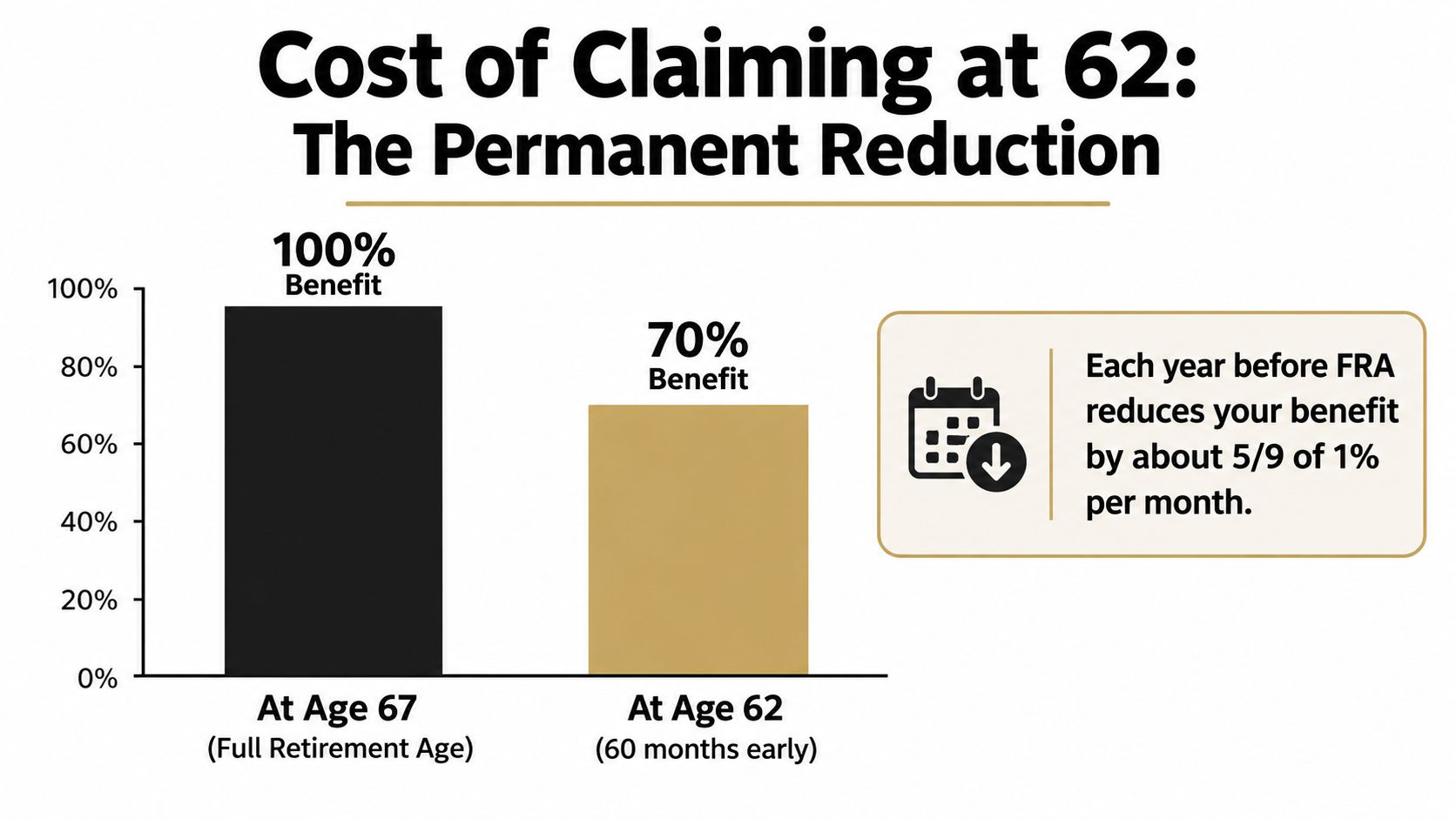
The easiest way to understand the trade-off is to use a hypothetical full scheduled benefit of $2,000 per month. A benefit at about 70% would be approximately $1,400 per month. The difference is $600 every month, and the reduced amount generally remains the starting basis for the retirement benefit rather than disappearing when you reach 67.
That example isn't a personal estimate. Your actual amount depends on your Social Security earnings record, claiming month, and other circumstances. Use the percentages to understand the structure, then obtain your individualized estimate from SSA.
The cash-flow question comes first
Claiming early can solve an immediate income need. It can also reduce the amount available for recurring expenses for the rest of retirement. A person with limited savings, high medical costs, or no other income may place a higher value on immediate payments. A person with a FERS annuity and accessible TSP assets may have more flexibility to wait.
A bridge strategy uses another income source during the period before Social Security begins. The bridge might come from:
- A FERS annuity: A federal pension can provide recurring income after an eligible retirement.
- TSP withdrawals: TSP assets may help cover expenses while Social Security is postponed, but withdrawals need a sustainable distribution plan.
- Other savings: Cash and taxable investment accounts may offer flexibility without starting Social Security immediately.
- Part-time work: Continuing to earn income can reduce the amount needed from retirement assets, though the effect on Social Security claiming requires careful review.
Waiting until 67 doesn't guarantee the highest lifetime result for every person. Health, longevity expectations, survivor needs, taxes, household income, and investment risk all matter. The right comparison isn't just “more money later” versus “less money now.” It's whether your other resources can reliably fund the bridge without creating a different problem.
Federal Employee Retirement Ages for Those Born in 1964
FERS uses a separate milestone called minimum retirement age, or MRA. For someone born in 1964, the MRA is 56. Workers born from 1953 through 1964 share this MRA before the schedule rises for later birth years.
Reaching MRA doesn't automatically create an unreduced retirement benefit. Your eligibility also depends on years of creditable service and the retirement option you choose. The most important distinction is between leaving under MRA+10 and qualifying for an immediate unreduced retirement under another age-and-service combination.
MRA+10 and its permanent reduction
A 1964-born employee who reaches 56 and has at least 10 years of service may qualify for the MRA+10 option. If the employee retires under MRA+10 before age 62, the annuity is permanently reduced by 5% for each year under age 62, unless the employee postpones the annuity or another rule changes the result.
Postponement can affect when the annuity begins and whether the age-based reduction applies. That makes the decision more complex than choosing the earliest permissible departure date. A retirement estimate should show the immediate annuity, the postponed alternative, and the impact of the reduction.
Other FERS thresholds
FERS also provides an immediate unreduced retirement at age 62 with at least 5 years of service. Earlier unreduced options may apply when an employee meets particular combinations of age and service, which is why a federal employee can have several meaningful retirement dates.
| FERS milestone | What it means |
|---|---|
| Age 56 | MRA for a worker born in 1964 |
| MRA+10 | Possible retirement at MRA with at least 10 years of service, subject to applicable reduction rules |
| Age 60 | May support an unreduced retirement with the required service combination |
| Age 62 | Immediate unreduced retirement with at least 5 years of service |
The FERS eligibility guide for 2026 can help you organize these thresholds before requesting an official estimate.
The central point is simple: FERS MRA answers when you may qualify to leave under a federal retirement rule, while Social Security FRA answers when full Social Security benefits are payable. Those ages don't replace one another.
How Federal Annuity and Social Security Timing Work Together
A federal employee may have three different dates on the calendar:
- The date employment ends.
- The date the FERS annuity begins.
- The date Social Security begins.
Those dates can align, but they don't have to. An employee might leave federal service at MRA, postpone an annuity, begin an annuity immediately with a reduction, or continue working until a later FERS threshold. Social Security can then begin at 62, 67, or a later age independently of the federal retirement decision.
| Decision point | Earliest age for 1964-born worker | Benefit impact |
|---|---|---|
| FERS minimum retirement age | 56 | May permit federal retirement eligibility, but the annuity can be reduced under MRA+10 |
| Social Security retirement benefits | 62 | Benefits may begin early, with the largest early-claim reduction for this cohort |
| Social Security full retirement age | 67 | 100% of the scheduled Social Security retirement benefit is payable |
| Later Social Security claiming | 70 | May provide a higher monthly benefit than claiming at FRA |
A “retire now” answer can therefore be incomplete. Leaving service may be possible, but the employee still needs to identify how expenses will be paid before Social Security starts and whether a postponed annuity creates a period without federal pension income.
Building a bridge without losing the sequence
Suppose a 1964-born employee leaves federal service at 62 and delays Social Security until 67. The employee must fund the five-year bridge from the FERS annuity, TSP withdrawals, other assets, work income, or a combination. The bridge should be tested against essential expenses, healthcare costs, taxes, and the possibility that markets perform poorly during the withdrawal period.
The reverse sequence can also create issues. Starting Social Security at 62 may reduce the need for TSP withdrawals, but it permanently establishes a lower monthly Social Security amount. A federal annuity may provide stability while the employee delays Social Security, but the annuity's own start date and reduction rules must be modeled separately.
The FERS pension and Social Security planning guide is a useful resource for examining these income streams together. The key is to compare complete cash-flow timelines, not isolated benefit estimates.
Choosing Your Best Retirement Date With Real Examples
A 1964-born federal employee at 56 or 57 might qualify for MRA+10 with at least 10 years of service. Leaving immediately could provide freedom from work, but the annuity may be permanently reduced if it starts before 62. Postponing the annuity may avoid or reduce that age-based penalty, yet the employee must cover living costs during the postponement. Health insurance, household income, and available savings can make the difference between a workable plan and a fragile one.
A second employee reaches 62 in 2026. Social Security can begin immediately at about 70% of the full scheduled benefit, or the employee can use TSP withdrawals as a bridge to 67. The bridge approach may preserve a higher Social Security payment, but it draws down retirement assets sooner. The employee should compare the projected TSP balance, withdrawal rate, tax treatment, and essential spending needs rather than assuming that delaying is automatically affordable.
A third employee can continue working or use other income until 67 or later. This may support a larger lifetime Social Security payment and give the TSP more time to remain invested, but it also means postponing the lifestyle change that retirement promises. The employee's health, job satisfaction, spouse's needs, and desire for guaranteed income should be part of the decision.
A practical decision framework
Start with the date you want to leave work, then work forward through each income source:
- At departure: Identify whether FERS starts immediately, is postponed, or isn't available under the selected option.
- Before Social Security: Calculate the amount needed from the annuity, TSP, savings, or earnings.
- At Social Security claiming: Compare age 62, age 67, and later claiming using your personal SSA estimates.
- After claiming: Check whether the combined income supports essential expenses and leaves room for healthcare and unexpected costs.
The best date is the one that fits both your eligibility and your cash-flow capacity. A retirement date that looks attractive on a calendar may be unsuitable if it depends on an optimistic TSP withdrawal plan or ignores a reduced annuity.
Your Next Steps to Lock In a Stress Free Retirement Date
Begin by writing down the three clocks that apply to your situation:
- FERS clock: Your MRA is 56, but service years and the selected retirement option determine whether the annuity is reduced.
- Social Security clock: Benefits may begin at 62, while your FRA is 67.
- Bridge clock: Your savings and other income must cover the period between leaving work and starting each benefit.
Then request or organize the documents needed for a side-by-side review. Check your creditable FERS service, compare immediate and postponed annuity estimates, review your SSA benefit estimate, and identify how much of your TSP or other savings could support a bridge. Include your spouse's income and survivor priorities if they apply.
A useful checklist includes:
- Eligibility: Confirm the FERS retirement option available at your target departure age.
- Reduction: Identify any MRA+10 annuity reduction and the permanent Social Security reduction associated with early claiming.
- Cash flow: Match essential monthly expenses to reliable income before age 67.
- TSP strategy: Test withdrawals under conservative assumptions rather than relying on a single market outcome.
- Healthcare: Include premiums and out-of-pocket costs in the bridge calculation.
- Timing: Compare leaving service, starting the annuity, and claiming Social Security as separate choices.
You don't need to solve every variable at once. Start with an official benefits review, build a year-by-year income timeline, and change one assumption at a time until the plan remains workable under realistic conditions.
Federal Benefits Sherpa offers personalized federal benefits reviews, retirement planning, gap analysis reports, and education on TSP, healthcare coverage, and Social Security coordination. Visit Federal Benefits Sherpa to review your retirement dates and build a clearer income sequence before you submit a retirement application.


Dedicated to helping Federal employees nationwide.
“Sherpa” - Someone who guides others through complex challenges, helping them navigate difficult decisions and achieve their goals, much like a trusted advisor in the business world.
Federal Benefits Sherpa, LLC
12724 Gran Bay Parkway West, Suite 410, Jacksonville, FL 32225
Email: [email protected]
Phone: (833) 753-1825
© 2024 Federalbenefitssherpa. All rights reserved
Federal Benefits Sherpa is an independent organization and is not affiliated with or endorsed by the U.S. government or any federal agency.