Your Guide to Using a Retirement Calculator FERS for Pension Planning
A FERS retirement calculator is a powerful tool designed to project your future federal income by weaving together your Basic Benefit annuity, Social Security estimates, and your Thrift Savings Plan (TSP) balance. It’s more than just a number-cruncher; it allows you to model different scenarios—like retiring earlier or later, or adjusting your TSP contributions—to see how those decisions impact your financial future.
How to Use a FERS Retirement Calculator Correctly
Think of a FERS retirement calculator as your financial GPS. Its real value isn’t just in spitting out a final number. Instead, it’s about telling the complete story of your retirement income by bringing together the three distinct parts of your federal benefits. Getting a firm grip on how these pieces fit together is the first step toward making sound, confident plans.
At its heart, the calculator models what are often called the "three pillars" of your FERS retirement. These pillars are designed to work together, and a good calculator shows you how they combine to create your total financial picture after you leave federal service.
The Three Pillars of FERS
The Federal Employees Retirement System is a three-legged stool. Each component has a specific job to do, and a reliable calculator needs to account for all of them to give you a clear, holistic projection.
Here's a quick breakdown of how these pillars support your retirement and what the calculator is actually doing with your information.
| Retirement Pillar | What It Represents | How a Calculator Models It |
|---|---|---|
| Basic Benefit Annuity | Your federal pension—a defined benefit based on your years of service and salary. | It applies the official FERS pension formula to your service time and "High-3" average salary to estimate this guaranteed lifetime income. |
| Social Security | Your earned benefit from paying into the Social Security system throughout your career. | It projects your future Social Security payments based on your full earnings history, not just your federal service. |
| Thrift Savings Plan (TSP) | Your defined contribution plan, much like a private-sector 401(k). | It forecasts the future value of your account based on your current balance, contribution rates, and assumed investment returns over time. |
Seeing these three components laid out makes it clear why you can't just focus on one piece of the puzzle. A calculator helps you visualize the entire structure.
The chart below gives you a great visual of how these three income streams form the foundation of your FERS retirement.

This just reinforces the point: your long-term financial security really depends on understanding how your pension, Social Security, and personal TSP savings will work in concert.
Why Small Changes Matter
A retirement calculator built for federal employees is far more than a simple estimator; it’s a dynamic scenario-planning tool. You can see, almost instantly, how seemingly small adjustments today can create huge ripples in your retirement income down the road.
For example, what happens if you push your retirement date back by just one or two years? You might unlock a more favorable pension multiplier or give your TSP that much more time to compound and grow. A calculator makes those trade-offs tangible.
A calculator transforms abstract concepts like "High-3 salary" and "creditable service" into tangible dollar amounts, showing you the direct financial impact of your career choices.
While this guide is zeroed in on FERS, the core principles of using calculators to gather data and make accurate projections are universal. In fact, exploring other general financial calculators can give you a broader perspective on financial planning. The key is to stop being a passive observer and start actively experimenting. Treat the calculator as your sandbox for building the future you want.
Getting Your Numbers Straight for an Accurate Calculation
Any retirement calculator is only as good as the numbers you plug into it. Think of it like a GPS—if you type in the wrong starting address, you're not going to get a reliable route to your destination. The same exact principle applies here.
The old saying "garbage in, garbage out" couldn't be more true for retirement planning. To get a projection you can actually trust, you need to pull a few key pieces of information from your official records first. Taking a few minutes to do this now will save you from major headaches and miscalculations down the road.

Core Personal and Service Data
First things first, let's lock down the foundational details of your federal career. These are the non-negotiable data points that form the bedrock of your FERS pension calculation.
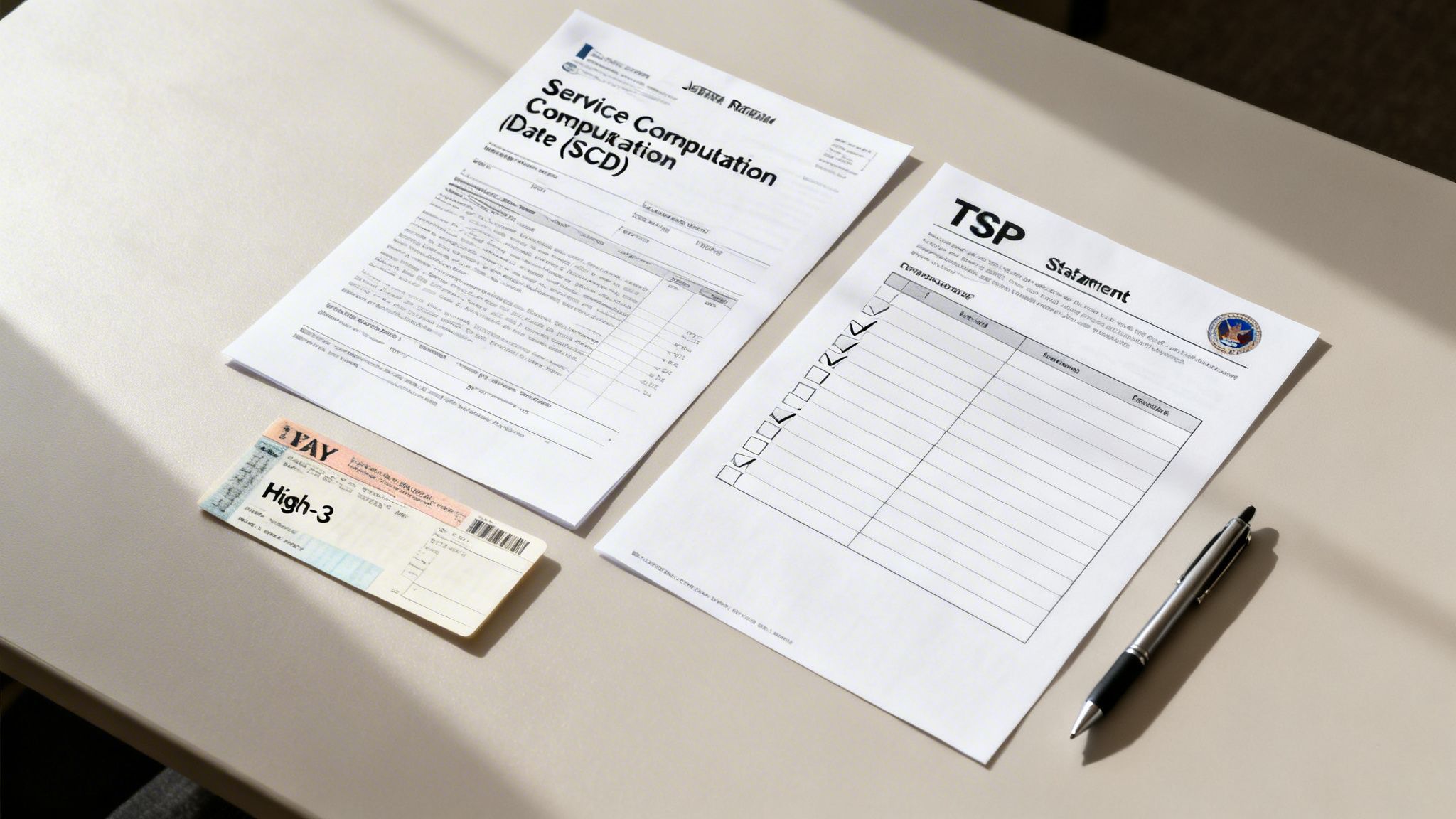
Service Computation Date (SCD): This is more than just your start date. Your SCD for retirement purposes includes all your creditable civilian and military service, including any time you might have "bought back." You can find this on your Standard Form 50 (SF-50) or your Leave and Earnings Statement (LES).
Date of Birth: Simple, but absolutely critical. Your birth date determines your Minimum Retirement Age (MRA), which dictates when you’re eligible for an immediate, unreduced pension. For most folks under FERS, that MRA is between age 55 and 57.
Anticipated Retirement Date: This is your target date for leaving federal service. A good calculator will let you play with different dates, which is a great way to see how working a little longer might significantly boost your final pension.
Calculating Your High-3 Average Salary
This is one of the most important—and most frequently misunderstood—parts of the formula. Your "High-3" average salary is not your final salary or simply the average of your last three years of pay.
Your High-3 is the average of your highest basic pay over any 36 consecutive months of your career. While this is often the last three years, it isn't always, especially if you took a lower-paying position late in your career.
To figure this out, you'll need your salary history. Dust off those old SF-50s that show your promotions and pay bumps. For instance, if you earned $90,000 for 12 months, then got a raise to $95,000 for the next 12, and finished at $100,000 for the final 12, your High-3 would be $95,000. The best calculators will handle the math for you if you can provide your salary history.
Your Thrift Savings Plan Information
The third leg of your FERS retirement stool is your TSP, and it needs its own set of data for a complete picture. You'll want to log into your TSP account and find the following:
- Current TSP Balance: Grab the total value of your account across all the funds you're invested in (G, F, C, S, I, and the L funds).
- Contribution Rate: How much are you contributing each paycheck? Remember, if you're not putting in at least 5%, you're leaving free money on the table—the government's matching contribution.
- Future Growth Assumptions: A good retirement calculator fers will ask for an estimated annual rate of return. This is an educated guess, of course, but you can base it on your risk tolerance and long-term market averages. A range of 5% to 7% is a common assumption for planning purposes.
Once you have your SF-50 for service dates, your salary history for the High-3, and your latest TSP statement, you’re ready to go. With this accurate information in hand, you can finally run a calculation that gives you a realistic glimpse into your financial future, not just a shot in the dark.
Understanding the FERS Annuity Formula
At the heart of every FERS retirement calculator is one surprisingly simple piece of math: the basic annuity formula. This isn't some mystical black box; it's a straightforward equation that determines the size of your guaranteed pension for life. Once you pull back the curtain on this formula, you’ll see exactly how your career decisions translate into retirement income.
The whole thing boils down to just three key ingredients: your High-3 average salary, your total years of creditable service, and a special percentage multiplier. When you plug your numbers into a calculator, it’s just running this core calculation. The real power comes from understanding how these pieces fit together, especially that multiplier.
The Standard 1% Multiplier
For most FERS employees, the pension calculation starts with a simple 1% multiplier. This means for every year you've worked, you earn 1% of your High-3 average salary as an annual pension. It’s the foundational number for FERS.
Here’s what the formula looks like in action:
1% x High-3 Average Salary x Years of Creditable Service = Annual FERS Annuity
Let's walk through an example. We’ll call our federal employee Alex. If Alex retires at age 60 with exactly 30 years of service and a High-3 salary of $100,000, the math is easy.
- 1% Multiplier
- $100,000 High-3 Salary
- 30 Years of Service
Plugging those into the formula, Alex’s calculation is 0.01 x $100,000 x 30 = $30,000 per year. That breaks down to a pension of $2,500 per month—guaranteed for life. This is the baseline scenario for most FERS retirees.
Unlocking the Powerful 1.1% Multiplier
Now, this is where a little strategic planning can make a huge difference in your financial future. FERS includes a major incentive for employees who work a bit longer. If you retire at age 62 or older with 20 or more years of service, your multiplier gets a permanent 10% boost, jumping from 1% to 1.1%.
That extra 0.1% might not look like much on paper, but over a long retirement, its impact is massive. It's a built-in reward for your long-term commitment to federal service.
Think of the 1.1% multiplier as a reward for hitting a key career milestone. By meeting both the age and service requirements, you permanently increase the value of every single year you've worked.
Let’s go back to Alex. Instead of retiring at 60, what if Alex decides to work just two more years and retires at age 62 with 32 years of service? We'll keep the High-3 salary at $100,000 to see the direct impact of the multiplier. Since Alex now meets the criteria (age 62+ with 20+ years), the whole calculation changes.
- 1.1% Multiplier
- $100,000 High-3 Salary
- 32 Years of Service
The new formula is: 0.011 x $100,000 x 32 = $35,200 per year. By working just two extra years, Alex increased their annual pension by $5,200. Over a 20-year retirement, that "small" change adds up to an extra $104,000—and that’s before any cost-of-living adjustments. This is exactly why a good retirement calculator for fers is so vital for modeling different scenarios.
The Office of Personnel Management's official guidelines confirm this structure. For employees under 62 or those with fewer than 20 years of service, the annuity is set at 1% of the high-3 for each year. Hit age 62 with 20+ years, and it jumps to 1.1%. It’s a system where timing really is everything, and a slight shift in your retirement date can lock in a significantly higher benefit for the rest of your life. You can read more about the official FERS computation on the OPM's website.
Factoring in Special Scenarios for a Better Estimate
Basic retirement calculators can give you a decent starting point, but they often miss the very details that can make or break your final pension amount. For a truly accurate picture, you need to account for the unique situations that come with a federal career. These aren't just minor adjustments; they can add up to thousands of dollars over your lifetime.
Think of a standard calculator as giving you the blueprint for a basic house. It's a good foundation, but it doesn't include the custom upgrades—the finished basement, the deck, the high-end fixtures—that turn it into your dream home. Overlooking these special scenarios means you're planning your future with an incomplete picture.
Converting Unused Sick Leave into Service Time
One of the most powerful, and often misunderstood, perks for FERS employees is your unused sick leave. When you retire, every last hour you’ve saved is converted directly into more creditable service time, which in turn boosts your FERS pension.
The math is simple: OPM takes your total sick leave hours and divides them by 2,087 (the number of work hours in a year). This gives you the extra years, months, and days to add to your service record. If you retire with a full year of sick leave saved—all 2,087 hours—that adds one full year to the service time used in your pension formula.
This isn't a one-time cash payment. It's a permanent increase to your monthly pension check that you'll receive for the rest of your life. It's a massive incentive to be mindful of your sick leave throughout your career.
The Impact of Military Service Buyback
Did you serve in the military before becoming a federal civilian? You might be able to "buy back" that military time by making a deposit to the FERS system. Once you do, that time counts as if it were civilian service.
This can be an absolute game-changer for both your retirement date and your final pension.
- Retire Sooner: Buying back a few years of military service could push you over the line to meet the age and service requirements for an immediate retirement.
- Get a Bigger Pension: Every year of service you buy back is another year added to your total service time, increasing your final annuity calculation.
If you don't factor in your bought-back military time, any estimate you run will be significantly lower than what you’re actually entitled to.
Other Important Scenarios to Consider
Beyond sick leave and military time, a few other common situations can dramatically change your retirement numbers. A good retirement calculator fers should give you options to model these scenarios.
FERS Annuity Supplement: Often called the "Social Security bridge," this supplement is for those who retire before age 62. It's designed to provide an income stream that approximates the Social Security benefit you earned during your FERS career until your actual Social Security kicks in.
Special Provisions Employees: If you're a federal law enforcement officer, firefighter, or air traffic controller, the standard rules don't apply to you. You have different retirement ages and a much more generous pension formula—often using a 1.7% multiplier for the first 20 years. A generic calculator will be completely wrong for you.
Prior Civilian Service: Maybe you worked for the government years ago, left for the private sector, and then came back. You may be able to get credit for that prior service, but the rules for redepositing any refunded contributions can be tricky.
Accounting for these variables is what separates a vague guess from a reliable projection. This is how you move from just hoping you have enough to building a solid plan you can actually count on.
What Will Your Retirement Income Look Like in 20 Years?
Getting that first pension estimate from a retirement calculator is exciting. It gives you a solid number to anchor your plans. But let's be honest, that number is just a snapshot of your first year in retirement. The real question is, what will that income feel like 10, 20, or even 30 years down the road?
To answer that, you have to look beyond a single, static number. A truly solid retirement plan accounts for the one thing we can all count on: change. We're talking about the slow but powerful creep of inflation and the inevitable ups and downs of the market. Your FERS annuity is designed to help with this, but it has some unique rules you absolutely need to know.
Understanding the "FERS Diet COLA"
Your FERS pension isn't meant to stay flat forever. It comes with Cost-of-Living Adjustments, or COLAs, to help you keep up with rising prices. But—and this is a big "but"—the FERS COLA doesn't always match the full rate of inflation. Federal employees often call it the "diet COLA" for a reason.
Here’s a quick breakdown of how it works:
- If inflation is 2% or less, your COLA matches it.
- If inflation is between 2% and 3%, your COLA is fixed at 2%.
- If inflation is over 3%, your COLA is the inflation rate minus 1%.
In years with even moderate inflation, this formula means your FERS pension won't quite keep pace with the actual cost of living. That small, persistent gap is precisely why your TSP is so critical to your long-term financial security.
This isn't just a theoretical problem. For instance, in 2026, the FERS COLA was 2.0%, while folks on Social Security saw their benefits increase by 2.8%. That difference may seem small, but over two decades of retirement, that kind of gap can seriously erode your purchasing power. You can read more about the impact of COLA on federal retiree benefits on GovExec.com.
How Your TSP Fills the Gaps
Since your pension might lag behind inflation, your Thrift Savings Plan (TSP) has to do the heavy lifting. It’s your primary tool for growth and provides the flexibility you'll need to navigate your retirement years. A good retirement calculator fers will let you map out your TSP's future, but you need to be strategic.
The goal here is to figure out a sustainable withdrawal strategy. In other words, how much can you take out each year without draining your account too soon? A well-known rule of thumb is the 4% rule, which suggests taking out 4% of your starting balance in your first year and then adjusting that dollar amount for inflation each year after.
But that's just a guideline. A powerful calculator lets you run the numbers on different possibilities.
- Play with withdrawal rates: What happens to your balance over 30 years if you take out 3%? Or 5%?
- Change your investment assumptions: See how your plan holds up with a conservative 5% annual return versus a more optimistic 7%.
When you combine a realistic FERS pension estimate—one that accounts for the diet COLA—with a thoughtfully planned TSP withdrawal strategy, you're no longer just looking at a number. You're building a dynamic, long-term income plan designed to last as long as you do.
Turning Your Calculation into a Confident Retirement Plan
You've crunched the numbers and played with a few scenarios in a retirement calculator FERS. That's a huge step forward. But it's important to see that calculator for what it is: an incredible tool, but still just a tool.
Think of it like getting a detailed architectural blueprint for a house. It gives you the dimensions, the structure, and the layout—the bones of the building. But it doesn't pick out the furniture, the paint colors, or how you'll actually live in the space.

Your FERS calculation works the same way. It gives you the financial framework, but it can't see the full picture of your life. The numbers on the screen don't automatically account for the very personal side of retirement.
Looking Beyond the Numbers
A genuinely solid retirement plan weaves your financial projections together with your real-world goals and needs. The calculator tells you what you might have, but you still need to figure out the how and the why of your retirement lifestyle.
There are several crucial pieces that fall outside a standard calculation:
- Healthcare Costs (FEHB): How much will your Federal Employees Health Benefits premiums really cost in retirement? And what about potential out-of-pocket medical bills that can pop up?
- Life Insurance Needs (FEGLI): Your life insurance needs will likely change once you're no longer working. You'll have to decide which parts of your Federal Employees' Group Life Insurance, if any, make sense to carry into retirement.
- Long-Term Family Goals: Are you dreaming of traveling the world? Maybe you want to help your grandkids with college or finally downsize your home. These goals come with price tags that need to be planned for.
- Estate Planning: A truly confident plan doesn't just stop at generating income; it also considers how to protect your assets and pass them on smoothly. This is a complex but vital area, and you can learn more by exploring Estate Planning for Retirement.
Your Next Step Toward Confidence
The data you’ve gathered is pure gold. It’s the foundation for building a detailed, actionable roadmap. So, what’s next? The logical move is to sit down with an expert who lives and breathes the nuances of federal benefits to validate your findings.
A calculator gives you knowledge, but a comprehensive plan gives you confidence. The goal is to bridge the gap between your calculations and your real-life retirement aspirations.
By reviewing your specific situation, you can double-check your assumptions, spot any potential gaps, and build a strategy that covers your entire financial world—not just your pension. This is how you transform that hard-earned knowledge into a secure, stress-free retirement.
Ready to turn those numbers into a concrete plan? Schedule a free 15-minute benefit review with our team. We'll help you make sure your retirement roadmap is as solid as your years of federal service.
Common Questions About FERS Retirement Calculators
Even the best retirement calculator can leave you with a few nagging questions. That's completely normal. When you're planning for your future, you need answers you can trust. Let's dig into some of the most common questions federal employees ask when they're running their numbers.
Getting these details right is the key to turning a rough guess into a reliable retirement forecast.
How Accurate Are Online FERS Retirement Calculators?
A good online calculator is remarkably accurate, but only if the information you feed it is spot on. If you nail down your service computation date and your High-3 salary, you'll get a very solid pension estimate.
But remember, they are still estimation tools. They have to make educated guesses about things like future TSP growth rates and inflation, and nobody has a perfect crystal ball.
Calculators provide an excellent baseline for planning but should be verified by a professional review to account for unique factors like unused sick leave or special provision rules.
Think of it like a GPS. It gives you the best route based on what it knows right now, but it can't predict a sudden roadblock a few miles ahead.
Can I Include Prior Military Service in the Calculator?
Yes, but with a big caveat: you can only include military time if you've officially "bought it back" by making a deposit to the FERS system. Once you've done that, those years absolutely count toward your creditable service and can make a huge difference in your retirement date and pension amount.
If you haven't made that deposit yet, do not include the time. Adding military service you haven't paid for will lead to a wildly inaccurate pension calculation and a false sense of security about your retirement income.
What Is the Biggest Mistake People Make with These Calculators?
Hands down, the most common error is getting the High-3 average salary wrong. Many people just plug in their current salary, but FERS uses the average of your highest 36 consecutive months of basic pay. Making this one mistake can throw your entire pension calculation off by thousands of dollars.
Another major pitfall is blindly accepting the calculator's default assumptions. Things like TSP returns and inflation rates are often set to a generic standard. If you don't adjust them to reflect your own investment strategy and expectations, you could end up with a plan that looks much rosier than reality. Always look for the "assumptions" or "settings" tab and customize it.
Ready to move beyond estimates and get a plan built for your specific career? The experts at Federal Benefits Sherpa can validate your numbers and build a clear roadmap. Schedule your free 15-minute benefit review today.
