Your Guide to Federal Employee Retirement Benefits
Thinking about retirement can feel like trying to assemble a complicated piece of furniture without the instructions. But for federal employees, the system is designed with a clear blueprint for stability.
The best way to picture your federal retirement benefits is as a sturdy, three-legged stool. Each leg represents a core part of your financial future: your FERS annuity, Social Security, and your Thrift Savings Plan (TSP). When all three are strong, your retirement is secure. Getting a handle on how they work together is the first, most important step toward a comfortable life after your career ends.
Securing Your Future with Federal Retirement Benefits
This guide is designed to be your set of instructions. We're going to walk through each piece of your federal retirement, breaking down the complex rules into simple, practical steps you can take. We'll start with the basics and build from there, showing you exactly how to get the most out of your benefits and navigate the system with real confidence. My goal is to trade that feeling of uncertainty for a clear roadmap, so you can make smart decisions for your future.
This is about more than just crunching numbers; it's about building a future you can actually enjoy. The government’s retirement system is specifically structured to provide a reliable stream of income, making sure your years of public service pay off with genuine peace of mind.
The Stability of Your Benefits
One of the biggest perks of a federal career is the rock-solid financial security of its retirement system. In fact, federal employee retirement benefits in the U.S. are some of the most secure and well-funded you can find anywhere.
As of 2025, the federal employee retirement trust fund is fully funded. That means it has all the money it needs to meet its promises to current and future retirees, without needing a bailout or borrowing. It's a system built to last. You can dig into more of the data on federal benefit funding on the AFGE website.
A well-planned retirement doesn't happen by accident. It's the direct result of understanding the tools you have. Your FERS annuity, Social Security, and TSP aren't just separate accounts; they're interconnected pillars designed to hold up your financial future.
This stability gives you an incredible foundation to build on, but getting the best possible outcome still requires you to be proactive. Throughout this guide, we’ll focus on practical strategies you can start using right away, no matter where you are in your career.
Building Your Retirement Roadmap
To build a retirement that’s truly stress-free, you first have to know what you’re working with. We'll cover the three main parts of your benefits package:
The FERS Basic Benefit: This is your core pension—a guaranteed monthly check for the rest of your life.
Social Security: We’ll look at how your federal service fits into this national program.
The Thrift Savings Plan (TSP): Think of this as the government’s version of a 401(k), a powerful savings and investment tool that you control.
By taking the mystery out of each of these, we’ll give you the clarity you need to make strategic choices. We'll cover everything from picking the right TSP funds to hitting the key milestones for keeping your health insurance after you retire. Your proactive planning starts right here.
The Three Pillars of Your Federal Retirement Plan
When you look at your federal employee retirement benefits, it's not one single program. It’s a complete package built on three distinct but interconnected pillars. The best way to think about it is like a sturdy tripod supporting your financial future. Each leg provides a different kind of stability, and when they work together, they create a reliable foundation for a comfortable life after your federal career.

These three pillars are the FERS Basic Benefit (your pension), Social Security, and the Thrift Savings Plan (TSP). Understanding how they harmonize is the real key to maximizing your income down the road. Let's break down each one.
Pillar 1: The FERS Basic Benefit Annuity
The first and most foundational pillar is your FERS Basic Benefit, which you’ll often hear called the annuity or pension. This is a defined-benefit plan, meaning it provides a predictable, guaranteed monthly payment for the rest of your life once you retire. It’s the bedrock of your retirement income.
How much you get isn't pulled out of thin air; it’s calculated with a precise formula based on two key factors: your years of creditable service and your "High-3" average salary. Your High-3 is simply the average of your basic pay from the 36 consecutive months you earned the most—which, for most feds, is their last three years of service.
For instance, an employee retiring under FERS with 30 years of service will typically see a benefit of about 30% of their High-3. If your High-3 average salary was $100,000, your annual pension would be around $30,000. That's before we even touch your other retirement benefits. For a deeper dive, you can explore how retirement benefits are calculated on OPM.gov.
Pillar 2: Social Security Benefits
The second pillar is Social Security, the national retirement program that nearly every American worker pays into. As a federal employee, you contribute to Social Security through payroll deductions, just like your friends in the private sector.
These contributions earn you "credits" that build toward your future benefits. When you retire, you’ll receive monthly payments from Social Security based on your entire lifetime of earnings, both inside and outside of federal service.
Social Security was never designed to be your only source of retirement income. Instead, it acts as a crucial supplement to your FERS pension, giving you a powerful one-two punch of guaranteed income streams.
The FERS system was specifically created to work hand-in-glove with Social Security. This ensures a much more complete income replacement that covers a larger chunk of your pre-retirement salary.
Pillar 3: The Thrift Savings Plan
The third and most flexible pillar is the Thrift Savings Plan, or TSP. Think of it as the government's version of a 401(k). It’s a defined-contribution plan that puts you in the driver’s seat for a significant portion of your retirement savings. This is the component you can most actively influence to build wealth.
Here’s how it works for you:
Your Contributions: You get to decide how much of each paycheck to contribute, all the way up to the annual IRS limit.
Government Matching: This is the TSP’s superpower. Your agency automatically contributes 1% of your basic pay to your account, even if you contribute nothing. On top of that, it will match your contributions dollar-for-dollar on the first 3% you put in, and 50 cents on the dollar for the next 2%.
Total "Free Money": To get the full 5% government contribution, you only need to contribute 5% of your own pay. Not doing this is literally turning down a 5% raise every single year.
This potent mix of automatic and matching contributions gives your savings a massive head start. Once the money is in your TSP, you choose how to invest it across a variety of funds, from the ultra-safe G Fund to stock funds like the C, S, and I Funds that offer higher growth potential.
To see it all in one place, here’s a quick summary of how these three pillars work together to form your comprehensive federal retirement benefits.
The Three Pillars of FERS Retirement Income
ComponentWhat It IsHow It's FundedKey FeatureFERS PensionA guaranteed lifetime monthly annuity.Small payroll deductions and significant agency contributions.Predictable, stable income based on your salary and service.Social SecurityA federal insurance program providing retirement benefits.Payroll taxes (FICA) paid by you and your agency.Provides a foundational income stream based on lifetime earnings.TSPA tax-advantaged retirement savings and investment plan.Your voluntary contributions and government matching funds.Gives you control to grow your savings through investments.
Each pillar serves a unique purpose, but their combined strength is what provides true financial security in retirement. By understanding and maximizing each one, you can build a future you can count on.
How to Get the Most Out of Your Thrift Savings Plan
Of the three pillars holding up your federal retirement, the Thrift Savings Plan (TSP) is the one where you're firmly in the driver's seat. While your FERS annuity and Social Security are mostly driven by formulas, the TSP is your personal wealth-building engine. Making smart, deliberate choices here can radically change your financial future, giving you the freedom and security you want when you finally hang up your hat.

Think of your TSP like a garden. You can’t just toss some seeds in the dirt and hope for a bumper crop. It needs consistent attention—the right amount of water, good fertilizer, and a little care along the way. The strategies we're about to cover are your tools for cultivating some serious growth over your career.
First Things First: Secure the Full Government Match
Before you even glance at which funds to pick, your number one priority must be to capture every last penny of the government match. This is, without a doubt, the most powerful perk in your entire federal employee retirement benefits package. Failing to grab it is like turning down a guaranteed 100% return on your money. It’s a no-brainer.
To get the full match, you must contribute at least 5% of your basic pay every single pay period.
Here’s the breakdown of how that "free money" adds up:
The Automatic 1%: Your agency automatically deposits 1% of your salary into your TSP, even if you don't contribute a dime yourself.
The Dollar-for-Dollar Match: The government matches your contributions dollar-for-dollar on the first 3% you put in.
The 50-Cent Match: For the next 2% you contribute, the government adds 50 cents for every dollar.
So, by putting in 5% of your own money, you get a full 5% from the government. Over a 30-year career, skipping this could easily cost you hundreds of thousands of dollars in lost contributions and compounding growth. This is the bedrock of a healthy TSP.
Choosing Your Investment Strategy
Once you’re getting the full match, it's time to decide where that money should go. The TSP gives you two main paths: a simple, hands-off approach using Lifecycle (L) Funds, or a more hands-on method where you build your own portfolio from the five core funds.
There’s no single right answer here. The best choice really depends on your comfort level with investing, how close you are to retirement, and what your long-term goals look like.
The "Set-It-and-Forget-It" L Funds
The Lifecycle (L) Funds are all about simplicity. You just pick the fund with a target date closest to when you think you'll need the money (usually around age 60-65). For instance, if you plan to retire around 2050, the L 2050 Fund is probably your best bet.
L Funds are brilliant because they automatically adjust your investment mix over the years. When you're young and retirement is decades away, they are more aggressive, holding more stocks for higher growth potential. As you get closer to that target date, they gradually shift toward safer government securities to lock in your gains.
This approach is perfect for federal employees who’d rather not spend their time managing a portfolio. It’s a simple way to stay diversified and manage risk without having to make constant changes yourself.
Building Your Own Portfolio
If you’re someone who likes to be more hands-on, you can create a custom investment mix using the five individual funds. This gives you the power to fine-tune your portfolio to match your personal risk tolerance.
Here’s a quick rundown of your building blocks:
G Fund: Government securities. This fund is unique to the TSP and protects your principal, but don't expect much growth.
F Fund: A fixed-income index fund that mirrors the U.S. bond market. It's a low-risk option.
C Fund: A stock index fund that tracks the S&P 500, which is made up of America's largest companies.
S Fund: A stock index fund for small- and mid-sized U.S. companies that aren't in the S&P 500.
I Fund: An international stock index fund invested in companies from developed countries outside the U.S.
A younger fed might go with an aggressive mix, something like 80% in the stock funds (C, S, and I) and 20% in the bond funds (F and G). On the other hand, someone getting close to retirement might want a more conservative split, like 60% in the G and F funds to protect what they’ve built. This path requires a bit more homework and occasional rebalancing, but it offers complete control.
Traditional vs. Roth Contributions
The final piece of the strategy puzzle is deciding between a Traditional TSP and a Roth TSP. It all boils down to a simple question: would you rather pay taxes now or pay them later?
Contribution TypeHow It WorksTax AdvantageBest For Employees Who...Traditional TSPContributions are made pre-tax, which lowers your taxable income today.You get a tax break right now. Your withdrawals in retirement are taxed as regular income.Expect to be in a lower tax bracket when they retire.Roth TSPContributions are made post-tax, meaning no immediate tax deduction.Qualified withdrawals in retirement—including all the earnings—are 100% tax-free.Expect to be in the same or even a higher tax bracket in retirement.
The good news is, you don't have to pick just one. You can contribute to both at the same time. Splitting your contributions between Traditional and Roth gives you incredible tax flexibility in retirement. You’ll be able to pull money from a taxable account or a tax-free one, helping you manage your income more strategically.
For expert help sorting this out, a resource like Federal Benefits Sherpa can provide guidance tailored to your specific situation.
Your Health and Insurance Benefits After You Retire
A comfortable retirement isn't just about the money coming in; it's also about keeping your expenses in check. And for most of us, healthcare is the biggest, most unpredictable wildcard. Thankfully, as a federal employee, you have some powerful tools at your disposal: the Federal Employees Health Benefits (FEHB) program and the Federal Employees' Group Life Insurance (FEGLI) program.
Knowing how to carry these benefits with you into retirement is non-negotiable. One small mistake can mean losing this crucial coverage right when you need it the most. Let's walk through the rules and smart moves to keep your health and life insurance locked in for the long run.
Keeping Your Health Insurance: The FEHB 5-Year Rule
Being able to keep your FEHB coverage after you hang up your hat is easily one of the most valuable perks of a federal career. But it's not a given. To qualify, you have to meet a very strict requirement known as the "5-year rule."
The rule itself is simple, but there's no wiggle room. You must be continuously enrolled in any FEHB plan for the five years immediately before your retirement date. You don’t have to stick with the same plan—you can absolutely switch from, say, Blue Cross to GEHA during Open Season—but you cannot have any gap in your coverage.
Think of the 5-year rule as your golden ticket. Missing this requirement means you forfeit your right to keep FEHB in retirement, a benefit that could literally save you tens of thousands of dollars over your lifetime.
Once you retire, it's a smooth process. Your FEHB premiums are simply taken out of your monthly FERS annuity payment. You’ll also continue to participate in the annual Open Season, so you can change your plan each year just like you did when you were working.
How FEHB and Medicare Play Together
One of the biggest questions federal retirees have is how their FEHB plan works with Medicare once they turn 65. The good news is they're designed to coordinate, not to compete, giving you a really comprehensive safety net.
Here’s the basic breakdown of how it works:
Medicare Steps Up: Once you hit 65, Medicare becomes your primary insurer. That means your doctors and hospitals will bill Medicare first for any care you receive.
FEHB Fills the Gaps: After Medicare pays its portion, the leftover bill goes to your FEHB plan. Your FEHB then typically covers most, if not all, of what's left, like deductibles and copayments.
Because Medicare handles the heavy lifting, many federal retirees find they can switch to a less expensive FEHB plan and still have fantastic coverage. This one-two punch can dramatically lower what you pay out-of-pocket for medical care. The key is to make sure you enroll in Medicare Part A (which is usually free) and seriously consider Part B (which has a monthly premium) to make this coordination work seamlessly.
Sorting Out Your Life Insurance with FEGLI
While health insurance tackles your medical bills, life insurance is there to provide a financial backstop for your family. The Federal Employees' Group Life Insurance (FEGLI) program offers several options that can follow you into retirement, but this is where the rules—and especially the costs—change dramatically.
When you retire, you have to make a choice about your FEGLI Basic insurance. Here are your main options:
75% Reduction: This is the default choice for most people. Your Basic life insurance amount starts to drop by 2% each month until it's worth just 25% of its original value. The upside? You stop paying premiums for this reduced coverage.
50% Reduction: With this option, your coverage goes down by 1% per month until it hits 50% of its original value. You'll pay a higher premium for this than you would for the 75% reduction.
No Reduction: You can elect to keep 100% of your Basic coverage. Be warned, though: the premiums for this get incredibly expensive as you get older, and it's often not a good financial move.
You'll face similar choices for any optional FEGLI coverage you have (Option A, B, or C). It is absolutely critical to sit down with the cost tables from OPM before you decide. For many retirees, the sky-high cost of keeping full FEGLI coverage makes a private term life insurance policy a much more sensible alternative. For a helping hand with these tricky decisions, an expert review from a service like Federal Benefits Sherpa can bring some much-needed clarity.
Your Step-by-Step Retirement Application Guide
Figuring out the final steps toward federal retirement can feel like trying to solve a puzzle with a thousand pieces. But if you know which pieces to put together first, it becomes a much more manageable process. The secret is to start early and understand the milestones ahead.
Your eligibility for federal employee retirement benefits comes down to two main things: your Minimum Retirement Age (MRA) and your years of creditable service. These two factors are what decide when you can pull the trigger on a standard voluntary retirement or even an early out. Let's break down the timeline into a simple, practical roadmap to get you from federal service to a smooth retirement.
Your Retirement Countdown: One to Two Years Out
The best time to really start your formal retirement prep is about one to two years before you plan to leave. This gives you plenty of breathing room to gather information and make smart decisions without the stress of a looming deadline. Think of this as the "information gathering" phase.
Here’s what you should be focused on during this period:
Attend a Pre-Retirement Seminar: Your agency puts on detailed seminars that walk you through every part of the retirement process. Getting to one early is one of the most valuable things you can do.
Request an Official Benefits Estimate: Ask your HR department for a formal annuity estimate. This isn't just a ballpark figure; it's a projection of your FERS pension that gives you a hard number to build your financial plan around.
Gather Your Essential Documents: Start a folder for all the important paperwork you'll need. This includes things like your marriage certificate, any divorce decrees, and military service records (your DD-214, for example) if that applies to you.
This is also the time to get a clear picture of how your health benefits will work after you leave your job.
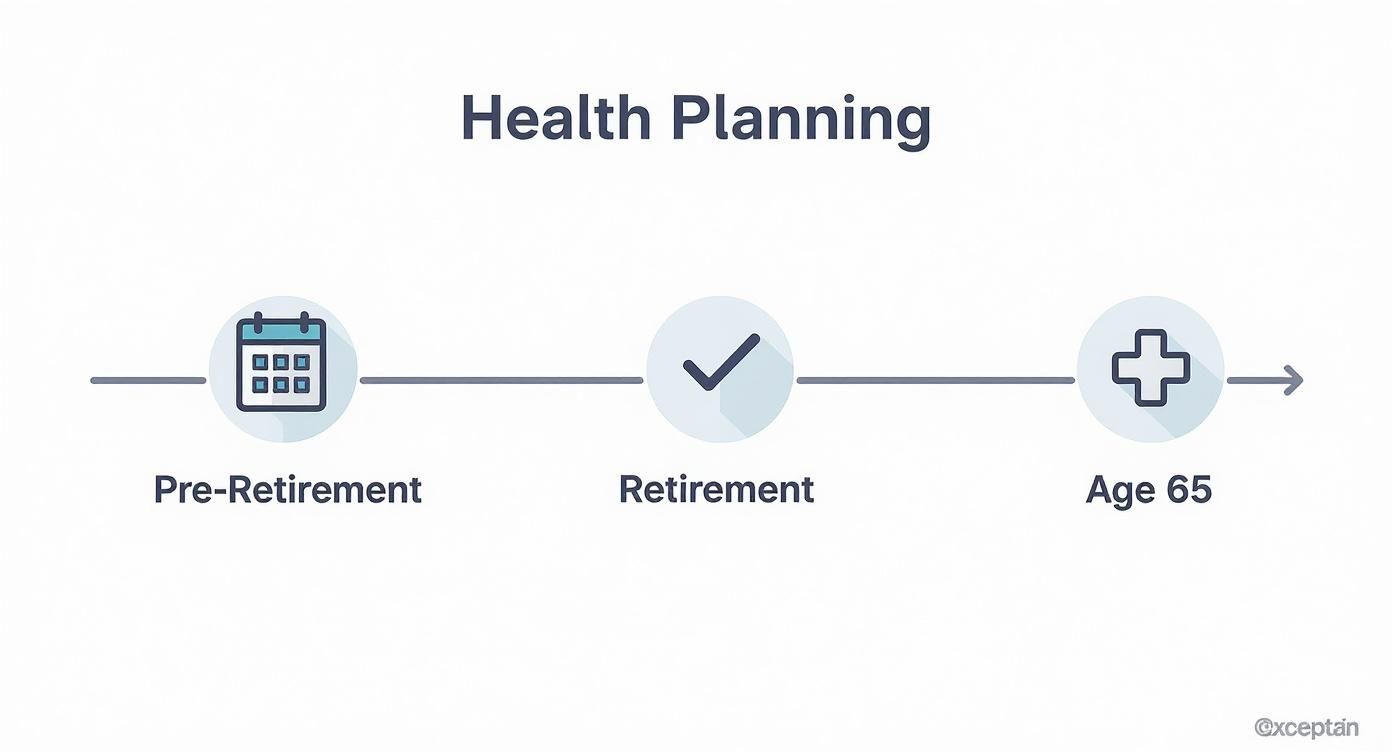
The timeline above shows how your FEHB transitions with you into retirement and highlights the critical point at age 65 when you'll need to coordinate it with Medicare. Getting this right is a huge part of managing your healthcare costs down the road.
Six Months Before Your Retirement Date
Once you hit the six-month mark, your focus should pivot from learning to doing. Now it’s time to lock in your decisions and start tackling the official paperwork. This is the moment your plan starts to feel real.
Your checklist for this phase is all about verification and final choices. You'll need to double-check that all your service time is accounted for and make final decisions on things like survivor benefits and insurance. This is also when you’ll decide how you want to handle your lump-sum payout for unused annual leave. A common mistake I see is people waiting too long to get started here, which just creates unnecessary stress.
Your retirement application isn't just another form. It’s the final summary of your entire federal career. Double-checking every single detail for accuracy is the most important thing you can do to avoid frustrating delays in getting that first annuity check.
Take the time to carefully review your Official Personnel Folder (OPF). You want to make sure every period of your service is correctly documented. It's so much easier to fix a discrepancy now than it is after you've already sent your package off to OPM.
Submitting Your Application and Avoiding Delays
Your final retirement application package should land on your agency's HR desk between 60 and 90 days before your last day. Hitting this window is a huge factor in ensuring a smooth handoff and getting your first payment on time.
But it’s also important to be realistic about what’s happening outside your control. The number of federal employees retiring has shot up recently, as a large wave of long-time feds has become eligible. This has created a massive backlog at the Office of Personnel Management (OPM). Average processing times hit 70 days in August 2025, and some folks are waiting even longer. You can get the full story on this trend by reading the report on the spike in federal retirements at GovExec.com.
To avoid the common mistakes that can push your application to the back of the line, be meticulous:
Complete All Forms Thoroughly: Don't leave a single required field blank on your SF 3107 (FERS) or SF 2801 (CSRS) application.
Attach All Required Documentation: Make sure copies of your marriage certificate, military records, and any relevant court orders are included.
Sign and Date Everything: A missing signature is one of the top reasons an application gets bounced back. Don't let it be yours.
By following this timeline, you can turn what feels like an intimidating mountain of bureaucracy into a clear and predictable path forward.
Common Questions About Federal Retirement Answered
https://www.youtube.com/embed/hM4rro-W6qo
As you get deeper into planning your federal retirement, the big picture starts to come into focus, but it's the specific, practical questions that often pop up. While we've covered the cornerstones like FERS, Social Security, and the TSP, real-world planning is all about the details. This section tackles some of the most common questions we hear from federal employees just like you, providing straight-up answers to help you navigate your own journey.
What Happens to My Unused Sick Leave When I Retire?
You’ve been diligent about saving up your sick leave for years, and now it’s time for that discipline to pay off. When you retire under either FERS or CSRS, your bank of unused sick leave is converted directly into additional time that counts toward your service history. That extra time is then tacked onto your total service record before your pension is calculated, giving your final annuity a nice little bump.
The math is pretty simple: every 2,087 hours of sick leave you've saved equals one full year of service credit. It’s a great reward for staying healthy and dedicated throughout your career. One crucial point to remember, though: while this extra service credit increases your pension payment, it cannot be used to meet the minimum age or service requirements to qualify for retirement in the first place.
Can I Work After I Start My Federal Retirement?
For most people, the answer is a resounding yes. If you retire from your federal job and decide to work in the private sector, your new paycheck will have zero impact on your FERS or CSRS annuity. You can earn as much as you'd like without seeing a penny less from your federal pension.
That said, there are a few important exceptions you need to be aware of:
Returning to Federal Service: If you decide to go back to work for the government as a "reemployed annuitant," your new salary is typically offset by the amount of your annuity.
Social Security Earnings Test: If you start drawing your Social Security benefits before you hit your full retirement age, you'll face an annual earnings limit. Make more than that limit, and your Social Security checks can be temporarily reduced.
Special Retirement Supplement: If you’re eligible for the FERS Special Retirement Supplement (which we’ll cover next), it also has an earnings test that can shrink or even eliminate this particular benefit.
How Are Federal Retirement Benefits Taxed?
This is a big one. Understanding how your retirement income will be taxed is essential for building an accurate financial plan. Your federal benefits are not all taxed the same way by the IRS and your state, so let's break it down.
Your FERS or CSRS annuity is considered ordinary income and is fully taxable at the federal level. When it comes to state taxes, though, the rules are all over the map. Some states, like Pennsylvania and Illinois, won't tax your pension income at all. Others, like California, will tax it fully. The good news is that any portion of your annuity that came from your own post-tax contributions to the retirement fund is returned to you tax-free.
The Thrift Savings Plan (TSP) plays by its own set of tax rules. Qualified withdrawals from a Roth TSP are 100% tax-free in retirement—what you see is what you get. On the flip side, every dollar you pull from a Traditional TSP is taxed as ordinary income because you got the tax break on the way in.
This split between Traditional and Roth gives you a powerful tool for managing your tax bill once you’ve stopped working.
What Is the FERS Special Retirement Supplement?
The FERS Special Retirement Supplement, often just called the SRS, is a fantastic benefit for FERS employees who retire before they're eligible for Social Security at age 62. It's designed to bridge that income gap by paying you an amount that approximates the Social Security benefit you earned during your time as a federal employee.
To get it, you have to be eligible for an immediate, unreduced retirement. That usually means retiring at your Minimum Retirement Age (MRA) with at least 30 years of service, or at age 60 with 20 years. The supplement provides a steady stream of income until you hit age 62, and then it stops—whether you decide to file for your actual Social Security benefits then or not.
Mapping out your retirement can feel like a huge undertaking, but you don't have to figure it all out on your own. Federal Benefits Sherpa is here to guide you through every decision, from your TSP investments to your healthcare options. Our team lives and breathes federal benefits, and we’re dedicated to helping you build a retirement that’s secure and free of stress. Schedule your free 15-minute benefit review today at the Federal Benefits Sherpa website.
