TSP Withdrawal for Home Purchase: Loan Rules and Costs
“Use your TSP for the down payment because you're paying yourself back” is incomplete advice. It treats access to retirement savings as the main benefit and leaves out the harder question: Will buying this home leave you better prepared for retirement after the borrowing costs, investment trade-offs, and payroll deductions?
If you're searching for a TSP withdrawal for home purchase, separate the account rules from the financial decision. A purchase can fit TSP requirements and still strain your retirement plan. The right comparison isn't whether you can get the cash. It's whether using that cash improves your overall position compared with leaving it invested and funding the home another way.
What TSP Offers Instead of a Home Purchase Withdrawal
A TSP home purchase is a retirement cost calculation, not just a way to cover a down payment. The TSP doesn't offer a special withdrawal for buying a house. Eligible active federal employees and uniformed-service members may instead consider a TSP residential loan for a qualifying purchase, as described in the TSP's homebuying guidance.
A withdrawal and a loan affect the account differently. A withdrawal distributes money under TSP rules. A residential loan must be repaid to your account, with payments taken from your pay. The practical question is whether the home's value to you justifies the loan's repayment burden and the investment growth you may miss while the borrowed funds are out of your account.
Match the loan to the property and purpose
A residential loan is for the future purchase or construction of a primary residence, a home you expect to occupy for most of the year. Its repayment term is 61 to 180 months, while a general-purpose loan runs 12 to 60 months, according to the TSP's residential-loan rules. A longer term can make payroll deductions easier to manage, but it keeps repayment in your budget for more years.
The permitted purpose is specific. Residential loans aren't available for:
- Secondary properties: A vacation home or second home doesn't qualify.
- Existing mortgage obligations: Refinancing or prepaying a mortgage isn't an eligible purpose.
- Property improvements: Renovations don't qualify under this loan category.
- Land by itself: Buying land alone doesn't meet the requirement.
- Completed spending: You can't use the loan to reimburse earnest money already paid or fund a purchase after closing.
Practical rule: Confirm the loan's permitted use before counting on it for a transaction.
Meeting the TSP's rules doesn't establish that a home is affordable. Before committing, compare the planned repayments with your budget and consider whether the home's expected benefit can justify the retirement cost. The break-even question is whether that value outweighs the repayment strain and potential lost investment growth over the loan term.
A residential loan may fit someone arranging a future purchase or construction for a home they'll occupy. It won't solve a need for reimbursement, renovation money, or funds for an investment property. Focus on the intended use of the money and the costs to your retirement account, not just the cash available at closing.
Who Qualifies for a TSP Residential Loan
A TSP balance is not the same as available borrowing capacity. Eligibility depends on which contributions make up the balance and whether you are still employed and in pay status. Check those details before relying on a loan in your home-purchase budget.
TSP requires at least $1,000 in personal contributions and associated earnings. Agency or service contributions and their earnings aren't available to borrow. The residential-loan processing fee is $100, compared with $50 for a general-purpose loan. These costs affect the cash you receive, so include them when assessing the purchase's total financing cost.
Check the account and employment requirements
Before estimating how much you can borrow, confirm each of these points:
- Identify your own contributions: Check eligible contribution sources, not just the total balance shown in your account.
- Confirm your participant status: Separated or retired participants and beneficiary participants can't initiate new TSP loans.
- Verify pay status: You must be in pay status so repayments can be deducted from pay.
- Account for the processing fee: Include it as a transaction cost in your cash calculation.
Employment timing can determine whether a loan is available at all. Leaving federal service does not preserve the ability to start a new loan just because your money remains in TSP. If retirement is near, confirm your status and timing before counting on these funds.
A coworker's experience may not apply to your situation. Similar account totals can contain different contribution sources, and employment circumstances can differ.
Separate eligibility from borrowing capacity
Meeting the requirements only means a loan may be available. It does not establish that borrowing is a sound retirement decision. Compare the repayment commitment with your household budget and expected retirement income, then test whether the home purchase still works after the loan cost is included.
For a fuller explanation of the loan mechanics, read this guide to how a TSP loan works. Use it alongside your account information, not as a personal eligibility determination.
You can also compare resources outside your retirement account. California Loans for Heroes offers information about housing assistance for public sector workers. Reviewing that information does not establish that you qualify or that assistance will meet your needs.
If your employment status or eligible contribution balance prevents a new loan, revise your funding plan before making a purchase commitment. Don't base an offer on an exception you haven't confirmed.
Comparing a TSP Loan and an Outright Withdrawal
A home purchase funded from TSP is a retirement-cost decision, not just a way to cover cash needed at closing. Compare the cost of repayment and lost investment exposure with the permanent reduction in retirement assets and any tax due. The better choice depends on how each option affects your household now and your retirement income later.
A withdrawal isn't automatically available because you're buying a home. You must qualify under an applicable withdrawal provision. Check the TSP withdrawal options guide before counting a distribution as part of your purchase funds.
TSP Residential Loan Versus Outright Withdrawal
| Feature | TSP Residential Loan | Outright Withdrawal |
|---|---|---|
| Purpose limits | Restricted to a qualifying future primary-residence purchase or construction | Governed by applicable withdrawal rules, with no special homebuyer provision |
| Repayment structure | Requires repayment to the account | Doesn't create a loan repayment schedule |
| Where interest goes | Loan interest is credited to your TSP account | No loan interest is credited through repayment |
| Tax treatment when funds leave | Generally avoids the immediate taxable distribution associated with a traditional-account withdrawal | A traditional-account withdrawal may create immediate tax exposure |
| Retirement investment effect | Borrowed money isn't invested in your selected TSP funds while outstanding | Withdrawn money no longer participates in future account investment growth |
| Main household commitment | Repay the loan while covering the home's ongoing expenses | Accept fewer retirement assets and any applicable tax cost |
The loan creates a repayment obligation and takes the borrowed amount out of your selected TSP investments while it remains outstanding. A withdrawal avoids loan payments, but the money leaves the account permanently. Tax treatment depends on the type of funds withdrawn and the rules that apply to your distribution.
Read the comparison as a decision aid
The central trade-off is repayment pressure versus permanent asset removal. If your cash flow can support loan payments, compare those deductions with the investment growth the borrowed funds might otherwise have earned. That growth is uncertain, so it isn't appropriate to treat lost returns as a guaranteed cost.
A withdrawal has a different break-even question: would avoiding loan payments justify the taxes, if applicable, and the retirement growth those funds could have produced? Estimate both choices against the same time horizon and consider how much retirement income may be lost. The cash needed for closing is only one part of the calculation.
Married FERS and uniformed-services participants generally need written spousal consent for a partial withdrawal, regardless of account balance or withdrawal amount, according to the TSP Annual Report. A loan and a withdrawal can have different paperwork requirements, so confirm which apply before relying on either option.
A withdrawal isn't a loan without payments. It's a different retirement decision.
Discuss the trade-off with your spouse before settling on a funding source. Agree on the housing costs the household can carry and the retirement resources you're prepared to give up.
Understanding Interest, Taxes, and Retirement Trade-Offs
A TSP loan can return interest to your account, but that does not make borrowing economically free. The key question is whether keeping the home purchase moving is worth the possible cost to retirement growth and household flexibility.
While you're employed, principal and interest are repaid through payroll deductions. The interest is credited at the applicable G Fund interest rate. TSP residential-loan interest is not tax-deductible like mortgage or home-equity-loan interest may be.
Separate account interest from investment opportunity
Loan interest and investment returns are different. Repayments come from household cash flow, while invested assets may grow based on market performance. The amount you borrow is out of your chosen TSP investments during the loan period, so the outcome depends on how those investments perform. That is a risk, not a guaranteed loss.
Set a break-even test before borrowing: compare the value of the repayment schedule and the investment growth you might forgo with the cost of a purchase that cannot proceed without the loan. Include the practical effect on your budget. If repayments leave less room for saving or reserves, that cost belongs in the calculation too.
- Measure spendable cash: Add the mortgage payment and TSP deduction to your monthly budget.
- Protect flexibility: Check whether the remaining cash can cover an interruption or unexpected expense.
- Track retirement saving: Account for any reduction in planned contributions.
- Test employment changes: Consider how repayment would fit if your federal employment ended sooner than expected.
Calculate the withdrawal on an after-tax basis
A withdrawal creates a separate retirement cost. It permanently reduces the amount available for tax-deferred compounding and may result in federal and state tax. The amount you can use for the purchase is cash after applicable taxes, not the amount requested from your account.
Estimate taxes based on your circumstances rather than relying on a generic withholding assumption. The guide to TSP withdrawal tax rules and worked examples can help you frame that estimate. A tax projection should account for the applicable federal and state effects.
Build separate projections for borrowing and withdrawing. For a loan, include payroll repayments and the balance remaining invested. For a withdrawal, include the tax cost and the smaller account balance. Then compare both choices with leaving the TSP untouched. That gives you a break-even point: whether the home purchase justifies the retirement cost of accessing these funds at all.
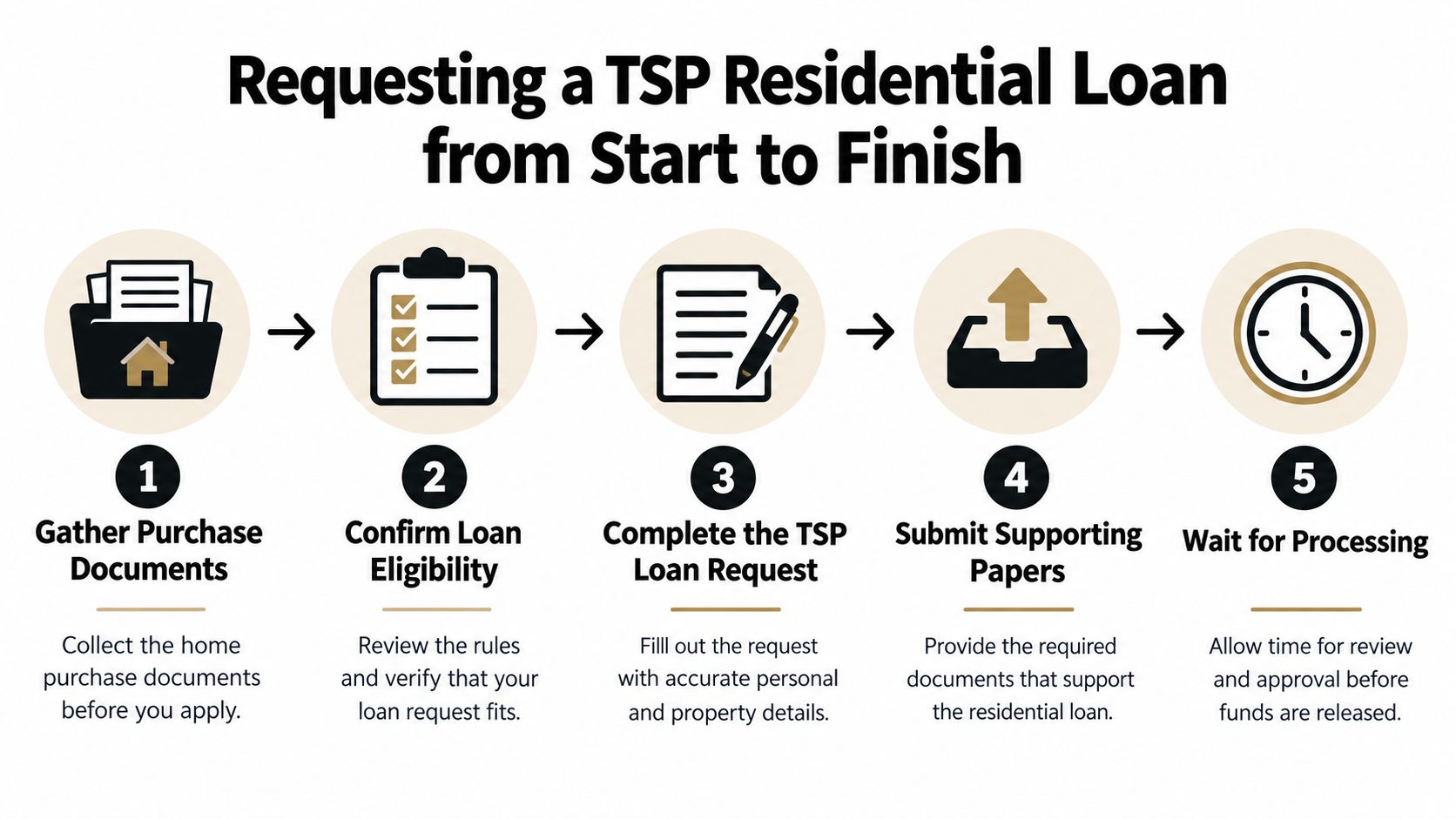
Requesting a TSP Residential Loan from Start to Finish
The paperwork can affect both approval and the purchase timeline. Gather documents that support the residential purpose before submitting your request, and check that they describe the same transaction.
Prepare the transaction documents
A sales agreement or settlement offer should generally show the expected closing date, property address, purchase price, buyer information, and remaining cash needed to close. TSP requires supporting purchase or construction documents within 30 days of submitting the request. Check its home-purchase documentation guidance before filing.
Review the paperwork as a set. A contract alone may not establish that the property, borrower, and amount requested all match the transaction.
- Check the date: The documents should reflect a future transaction, not a completed purchase.
- Check the buyer information: Keep identifying details accurate and consistent across forms.
- Check the cash requirement: Separate funds still needed from amounts already paid.
- Check intended occupancy: Your plans must meet the primary-residence requirement.
Submit with the closing timeline in mind
Enter accurate personal and property details on the loan request, then send the required documents within the documentation window. Keep copies, so you can respond efficiently if TSP asks for clarification.
The document deadline does not guarantee that funds will arrive by your preferred closing date. Confirm timing with your lender and closing professionals, and agree on what happens if the money is delayed. A purchase can carry costs beyond the loan itself if funding arrives late, so account for that risk when deciding whether borrowing still makes financial sense.
Timing safeguard: Build the purchase around a verified funding plan, not an assumed processing date.
If the contract changes, make sure the submitted paperwork still reflects the current transaction. A revised closing date or cash requirement may affect whether the original documents remain accurate.
After the loan is established, check your pay statement to confirm payroll repayment is being handled as expected. Review the deduction alongside your household budget. The purchase decision is also a retirement cost calculation: compare the value of using TSP funds now with repayment obligations and the retirement growth those funds could otherwise earn. A break-even assessment should account for both, not just whether the loan gets you to closing.
Alternatives to Weigh Before Borrowing From TSP
Using TSP funds can make a home purchase possible, but the down payment is only part of the cost. The decision also affects retirement assets, cash flow, and the investments those funds might otherwise support. Compare those costs with what the purchase changes financially before choosing a funding source.

Define what breaking even means
Break-even means the purchase-related financial benefits justify the retirement and cash-flow costs under reasonable assumptions. Being able to make loan payments, or eventually repay the principal, does not by itself mean the decision breaks even.
Ask a planner to compare the same purchase with and without TSP funding. Include potential mortgage-interest savings, processing costs, loan interest paid from earnings, any withdrawal taxes, and alternative investment outcomes. Treat principal repayment as a return of borrowed funds, not an investment gain.
Test more than one investment assumption. If the decision only works under favorable results, the trade-off may leave too little margin for uncertainty.
Retirement timing changes the calculation. For a FERS employee, assess the remaining TSP alongside the pension and Social Security income expected to support household spending. The useful question is whether the purchase improves the overall plan enough to justify its effect on future resources.
Compare changes to the purchase itself
A different funding source is not the only alternative. Changing the transaction may reduce the amount you need to take from retirement savings.
- Save outside TSP: Build a dedicated purchase fund while preserving retirement assets.
- Adjust the price: Compare a less expensive property with the full cost of accessing TSP funds.
- Delay the commitment: Consider whether waiting could strengthen reserves and reduce dependence on retirement money.
- Review other resources: Investigate assistance and financing options, without assuming you qualify or will save money.
Waiting carries trade-offs too. Housing costs and personal circumstances can change, so compare the possible benefits of delay with the risks rather than treating it as a cost-free choice.
A retirement review and gap analysis can connect the purchase to future income needs. Look for a clear comparison of how using TSP funds changes the plan, what assumptions drive the result, and whether the retirement cost is one you can accept.
Taking Your Next Step Before Signing a Purchase Contract
Before committing to the house, establish that your financing plan is both permitted and financially workable. Those are separate approvals: TSP eligibility addresses the program rules, while retirement planning addresses whether the decision fits your life.
Confirm your participant eligibility, intended occupancy, and documentation timeline. Then have a planner compare the funding alternatives using your actual account information and purchase assumptions.
Ask for a decision you can explain
A useful analysis should let you explain why you chose the funding method without relying on slogans such as paying yourself back. You should understand the expected effect on spendable pay, invested retirement assets, and future income.
Ask what would change the recommendation. An earlier retirement, a revised purchase price, or a different closing timeline may affect the decision. Identifying those conditions makes the plan more useful than a single projection that assumes everything proceeds exactly as expected.
A follow-up gap analysis should connect the home purchase to the retirement spending you want to support. For employees nearing retirement, that means examining the TSP as part of the broader income plan rather than as an isolated balance.
Bring the information that drives the answer
Prepare these materials for the planning conversation:
- Purchase paperwork: Bring available agreements, property details, and the amount still needed to close.
- TSP balance details: Include contribution-source information, current investments, and any existing account obligations.
- Planned closing date: Identify the purchase timeline and any unresolved funding dependencies.
- Household cash flow: Show current expenses, expected housing costs, and available reserves.
- Retirement expectations: Bring your intended retirement timing and available pension and Social Security estimates.
If you haven't selected a property, use a proposed purchase budget and clearly label the assumptions. You can evaluate affordability before you have a final contract.
The finish line is a documented choice you understand, not access to cash alone. Proceed when the purchase plan and retirement plan work together, and revise the transaction when they don't.
Federal Benefits Sherpa offers a free benefit review, retirement planning, and gap analysis reports to help federal employees understand their benefits and future retirement income. Visit Federal Benefits Sherpa to request a review and discuss how funding a home purchase from TSP could affect your cash flow and retirement plans.
