TSP Withdrawal After Retirement: A Practical Guide
You've filed the retirement paperwork, started thinking about your pension, and may already be picturing what you'll do with the first days away from work. Then the TSP question lands: take the money, set up payments, or leave it alone? The tempting answer is to choose something quickly and move on. That's a mistake. Your withdrawal choices shape how retirement savings support your income over time, and the right move depends on taxes, liquidity, and the rest of your retirement plan.
Treat a TSP withdrawal after retirement as an income-planning decision, not an exit formality. OPM advises employees to evaluate the monetary and tax effects of their options and consider withdrawal choices at least six months before retiring (OPM's retirement guidance). Use that lead time to decide what job the TSP needs to do alongside your pension and Social Security.
The First Decision Most Retirees Get Wrong
Many employees approach retirement as though the TSP is a single pot that must be cashed out when federal service ends. It isn't. You can choose how and when to draw from the account, and, if it meets the applicable minimum-balance requirements, you may be able to leave the money in the plan. That makes your first decision less about where to send a balance and more about how the balance should support your retirement.
Start by writing down the income you expect from your pension and any other sources. Then separate your spending into needs you'll cover regularly and expenses that might call for cash on demand. This simple distinction helps you see whether you're looking for predictable payments, a reserve for occasional costs, or a way to keep savings invested while you make other decisions.
Practical rule: Don't submit a withdrawal request until you can explain what the money is for, when you'll need it, and how the choice affects taxes.
The form of a withdrawal matters as much as its timing. A lump sum, recurring installments, and an annuity don't create the same cash flow or leave you with the same access to your remaining balance. Traditional TSP distributions are generally taxable as ordinary federal income in the year you receive them, so taking more than you need at once can affect your tax planning.
OPM's advice to look at the options well before retirement is useful because it gives you time to coordinate the TSP with your other income, rather than making a rushed decision after separation. Use the months before you leave to compare alternatives, talk through the tax consequences, and decide what you want your TSP to accomplish. Don't assume that retiring means you have to cash out.
Your Four TSP Distribution Options Explained
The TSP provides four ways to distribute money after separation: installments, a partial withdrawal, a total withdrawal, or an annuity purchase (TSP withdrawal options). They're different ways to turn savings into cash flow, and you can think about them in terms of what they do in everyday life.

Installments as a self-directed paycheck
Installments are recurring payments from your account, a little like setting up a salary you control. You can select a fixed dollar amount, or structure installments using a life-expectancy calculation or a required-minimum-distribution amount. The trade-off is that the money left invested remains exposed to market risk, and a fixed payment may not keep pace with changing needs.
A partial withdrawal as a cash reserve
A partial withdrawal takes some money out while leaving the rest in the plan. Think of it as drawing from savings for a particular need, rather than closing the account. It can suit a one-time expense or a cash-flow gap, but you should decide in advance how much liquidity you need.
A total withdrawal as leaving the plan
A total withdrawal takes the entire balance out of the TSP. That's a decisive move, not just a larger partial withdrawal. Before choosing it, consider the tax impact and where the money will go next. A direct transfer to an IRA or another eligible retirement plan may defer current taxation when handled under applicable rollover rules.
An annuity as buying a pension
An annuity purchase converts some or all of your balance into life-annuity payments. In practical terms, you're using savings to buy a stream of income rather than keeping the same access to the underlying money. That can help provide lifetime income, but it comes at the cost of liquidity.
There's also a choice that doesn't require taking a distribution: leave eligible money in the TSP. Keeping the account preserves access to the plan's investment options and structure. Treat that as an active choice, not as a failure to decide.
Taxes, Penalties, and Age Milestones
Traditional TSP distributions are generally taxable as ordinary federal income in the year you receive them. That rule drives your whole withdrawal sequence, because every partial withdrawal and installment stacks on top of your other income for that year. A direct rollover to an IRA or another eligible retirement plan can defer the tax if you follow the applicable rollover rules. A rollover changes where the money sits, not whether it gets taxed.
The 10% early-distribution penalty is a separate charge on top of income tax. OPM's TSP transfers and rollovers presentation describes a withdrawal after leaving an employer between ages 55 and 59½ as potentially qualifying for an exception to the penalty. The same presentation describes TSP-calculated monthly payments and TSP life-annuity payments as penalty-free regardless of age. Don't assume every payout fits an exception. Whether it applies depends on the distribution type and your circumstances, so confirm the treatment before you lock in a schedule.

Watch the installment method
Life-expectancy installments can qualify for the exception, but that treatment can be reversed if you stop the schedule or take additional distributions within five years of starting it or before age 59½. That creates a real sequencing constraint. Once you rely on the exception, an ad hoc partial withdrawal can undo it, so commit to the schedule before you start and don't treat it as interchangeable with one-time withdrawals.
Penalty-free doesn't mean tax-free. A payment method that escapes the penalty can still add to your ordinary income, and stacking a large installment in the same year as a partial withdrawal can push you into a higher bracket. Check both the penalty rules and the tax treatment before choosing a payment method.
For worked examples of how the timing and size of each distribution interact with federal tax brackets, see this guide to TSP withdrawal tax rates and rules. If you want a professional to model your payout year by year, distribution tax help from Blue Sage is one resource to consider. Bring the expected payment amount, timing, and account type to the discussion so the advice addresses your actual situation.
RMD Rules and the Traditional Versus Roth Split
RMDs set the pace for the traditional balance whether you need the income or not. TSP's rules tie the start age to birth date: born from January 1, 1951 through December 31, 1959 generally means 73, born after December 31, 1959 generally means 75 once separated; the same TSP notice says distributions are reported on Form 1099-R and that 10% federal income tax is generally withheld from applicable payments unless you provide different instructions (TSP guidance on RMD ages and withholding).
Your first RMD is generally due by April 1 of the year after the later of reaching the applicable age and separating from service. Later RMDs come due annually. Treat that first April 1 date as a one-time extension, then set a recurring reminder, because every later year has its own deadline.
The split drives the sequencing decision. TSP calculates the RMD from the traditional balance only, and traditional withdrawals count toward it. Roth TSP withdrawals do not, because Roth money has no lifetime RMD. If you spend from Roth first to keep taxes low, the traditional RMD is still waiting, and it arrives as taxable ordinary income.
If an RMD applies, plan for it even in a year when you'd rather leave the account untouched.
A cleaner sequence is usually to satisfy the traditional RMD first, then decide whether extra spending should come from Roth or more traditional withdrawals based on that year's bracket. Withholding is a deposit, not the final bill, and the TSP does not automatically withhold state or local tax. For the income-tax mechanics, use this federal employee guide to RMD taxation.
TSP Versus IRA Versus Annuity Trade-offs
Where your savings live affects your options as well as the way you draw income. A separated participant may keep a TSP account with at least $200, retain the plan's investment-management and low-fee features, and use partial withdrawals, total withdrawals, installments, annuities, or combinations of these choices (TSP guidance on taking money from your account).

| Choice | What you retain | Main trade-off |
|---|---|---|
| Keep money in the TSP | The plan's structure, investment management, and low-fee features. | You keep the plan's investment menu and rules rather than gaining an IRA's broader choices. |
| Roll money to an IRA | Access to a broader investment menu, depending on the provider and account. | You'll need to compare fees and manage the new account's investment and withdrawal decisions. |
| Buy an annuity | A stream of lifetime income from the amount used to purchase it. | You give up access to that principal in exchange for the annuity's income structure. |
I wouldn't roll everything to an IRA just because someone describes an IRA as more flexible. Flexibility can be useful, but it doesn't automatically make a rollover the better choice. Compare the IRA's costs and investment choices with what you'd give up by leaving the TSP, and consider whether you want the responsibility of managing a broader menu.
An annuity can help cover essential expenses with lifetime income, but it reduces your access to the money used to buy it. Keeping assets in the TSP or an IRA generally leaves more of the account available for other uses, while installments keep the remaining balance exposed to market risk. Your choice should reflect how much income certainty you need and how much liquidity you want to preserve.
A divorce or court order can also affect how retirement accounts are divided, so don't treat ownership questions as a routine withdrawal issue. This overview of splitting retirement accounts in divorce can help explain why legal guidance matters when a separation involves retirement assets. For a deeper look at the income trade-offs, read this discussion of whether a TSP annuity fits federal retirement.
Building a Sustainable Withdrawal Sequence
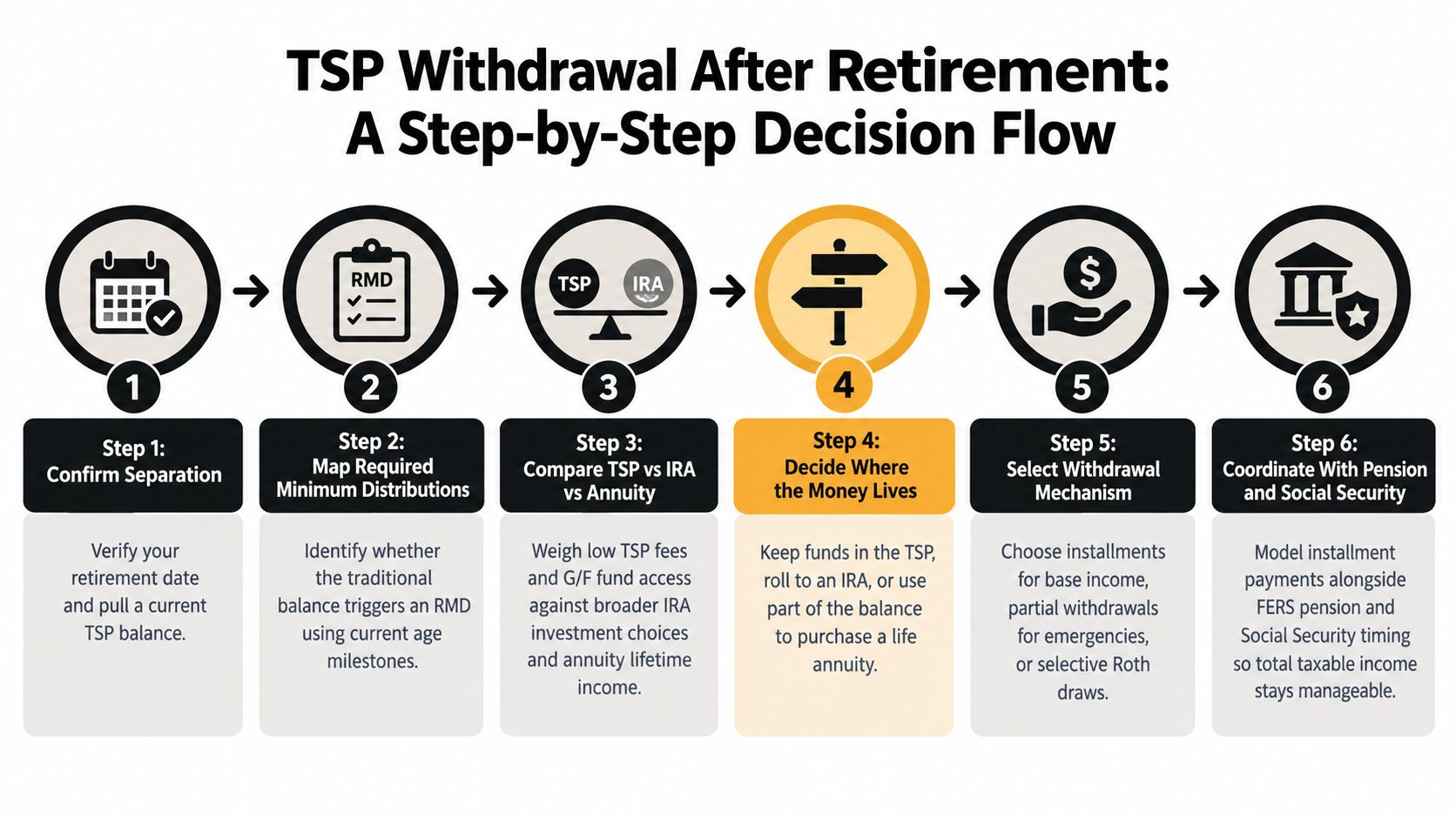
A sustainable plan is a sequence, not a single selection on a form. Start with the income you can count on, decide which TSP payments can cover regular spending, and preserve a reserve for expenses that won't arrive on a schedule. Then fit those choices around RMDs, taxes, and the timing of Social Security.
A practical framework looks like this:
- Set the income floor: List your pension and other expected income, then identify the amount of regular spending the TSP needs to support.
- Choose a base payment: If you need recurring cash flow, consider installments. Select a structure that fits your spending and understand that the remaining account stays exposed to market risk.
- Keep a reserve: Consider whether a partial withdrawal could provide cash for a planned expense or an emergency, rather than increasing regular installments to cover every possibility.
- Map the tax sequence: Look at traditional and Roth balances separately. Traditional withdrawals can count toward an RMD; Roth withdrawals don't satisfy that requirement.
- Coordinate with Social Security: Model how the timing of Social Security affects the income you need from your TSP, rather than choosing withdrawals in isolation.
The TSP permits a partial distribution while installments are already being received. That can let you maintain a regular payment while drawing a separate amount for a specific need. But if you're using life-expectancy installments to rely on the early-distribution penalty exception, additional withdrawals can disrupt that strategy. Decide which goal matters more before you combine methods.
Don't build the plan around a smooth market path. If the account falls during a downturn, withdrawals still take money out, so a large, automatic payment may leave you with less flexibility later. A reserve can help you avoid treating every unexpected bill as a reason to change your base income plan.
The right sequence depends on your pension, spending, survivor needs, account fees, and comfort with market risk. Use a written plan that says which account funds regular spending, which is reserved for one-time needs, and how you'll handle required distributions. Revisit the plan when income, expenses, or your household's priorities change.
Why Leaving Money in the TSP Often Wins
A rollover isn't a retirement requirement. If your TSP account meets the applicable minimum-balance rules, leaving it in place can preserve its investment-management and low-fee features while keeping access to the TSP's withdrawal mechanisms. For retirees who value a straightforward structure and don't need a broader investment menu, staying put can be a sensible choice.
I would question a rollover pitch that focuses only on the IRA's flexibility. Ask what the IRA will cost, which investments you will use, and who will manage the account. If the answer is vague, you do not yet have a reason to move the money.
When staying fits
Keeping assets in the TSP may suit you if you want to use the plan's existing structure, prefer to limit account complexity, or value its low-fee features. It can also be easier to retain a familiar account than to move money and then build a new investment and withdrawal process.
When a move may make sense
An IRA may appeal if you need investment choices the TSP doesn't offer or want to consolidate accounts. But a broader menu can bring more decisions and costs, and you should compare them before acting. An annuity may fit if lifetime income is a priority, but it trades liquidity for that income structure.
Check tax withholding, too. The TSP generally withholds federal tax from applicable payments under its rules, but it doesn't automatically withhold state or local tax. A payment that looks sufficient after federal withholding may still leave you with a state-tax bill or a need to make an estimated payment. Don't confuse the convenience of a familiar account with a complete tax plan.
Your Pre-Retirement Checklist and Next Steps
Begin planning well before your separation date. OPM advises employees to consider withdrawal options at least six months before retirement and evaluate the monetary and tax effects of their alternatives (OPM retirement planning guidance). Use that time to compare options, rather than waiting until the paperwork is in front of you.
- About six months out: Confirm your expected retirement date, review your current TSP balance, and list the income you expect from your pension and other sources. Decide what you need the TSP to cover.
- Before you separate: Compare installments, partial withdrawals, total withdrawals, an annuity, and leaving eligible money in the plan. Check how each option affects taxes, liquidity, and access to the remaining balance.
- As you set up income: Coordinate your TSP payment choice with pension income and your Social Security plans. Keep a separate plan for one-time expenses so your regular payment isn't doing every job.
- As RMDs approach: Confirm the applicable age and due dates for your situation. Keep traditional and Roth balances distinct in your planning, because Roth withdrawals don't satisfy a traditional-balance RMD.
A checklist can clarify the decisions, but it can't choose the right sequence for you. If you want another set of eyes on how your TSP fits with federal retirement income, Federal Benefits Sherpa offers a free 15-minute benefit review, along with customized retirement planning and gap analysis reports. Bring your current account information and your questions so the conversation can focus on the choices that affect your plan.
Federal Benefits Sherpa helps federal employees review benefits and plan retirement income, including decisions about TSP withdrawals, healthcare coverage, and Social Security. If you're nearing retirement and want help connecting those choices, visit Federal Benefits Sherpa to request a free 15-minute benefit review.
