TSP I Fund: A Strategic Guide for Federal Employees
Most advice about the TSP I Fund is lazy. It tells federal employees to chase whatever looks strongest right now, as if a good 12-month stretch is a strategy. It isn't. The I Fund belongs in a federal portfolio as a permanent international sleeve, not a mood ring for recent market headlines.
The question isn't whether the I Fund can beat U.S. stocks in a hot streak. The question is whether you want your retirement savings exposed to only one country's market. If the answer is no, then the I Fund deserves a solid allocation, and it deserves to be judged on structure, not noise.
Understanding the TSP I Fund and Its Purpose
U.S. stocks get most of the attention because they're familiar and easy to track. That comfort breeds home-country bias, and it pushes too many federal employees into a narrow view of diversification. The TSP I Fund exists to break that pattern by giving you direct exposure to non-U.S. equities inside the Thrift Savings Plan.
What the I Fund is doing in your portfolio
The fund's job is simple. It gives federal employees a way to own international stocks without opening a separate brokerage account or building a custom foreign stock sleeve. The TSP itself describes the index as a broad international market index made up of large, medium, and small companies across more than 40 developed and emerging market countries, which is exactly why the I Fund matters as a diversifier. That broader construction is what makes it different from a domestic equity fund and why it should be treated as a core strategic holding rather than an optional side bet. TSP I Fund details
The old habit was to treat the TSP like a two-fund story, mostly C and S. That leaves your retirement tied too tightly to U.S. market leadership, U.S. sector concentration, and U.S. economic conditions. The I Fund is the cleanest way to reduce that concentration inside the plan.
Practical rule: If your TSP has no international stock exposure, your portfolio is not globally diversified. It's just U.S.-heavy.
Why the fund exists at all
The I Fund gives you a different set of return drivers than domestic stocks. That matters because long-term retirement portfolios don't need more excitement, they need fewer single-point failures. International equities can lag for stretches, but they can also protect you from building an all-in bet on one market regime.
The fund's historical record supports that role. Since inception, the TSP publication reports a trailing annualized return of 5.01% through June 30, 2025, compared with 4.85% for its benchmark over the same period, which tells you the fund has delivered moderate long-term growth without pretending to be a rocket ship. The right way to use it is as part of a balanced retirement design, not as a short-term performance chase. TSP publication on I Fund returns
How the New Benchmark Changes International Exposure
The I Fund is no longer the fund many participants remember. In 2024, the Federal Retirement Thrift Investment Board completed its transition from the MSCI EAFE Index to the MSCI ACWI IMI ex USA ex China ex Hong Kong Index, creating a broader international allocation. Fedweek on the transition
From developed markets only to a broader global sleeve
Under the old benchmark, the I Fund covered developed international markets. That made it a useful counterweight to U.S. stocks, but it left out emerging markets and smaller companies. The new benchmark adds small-cap, mid-cap, and emerging-market exposure, giving the fund access to a wider portion of non-U.S. equities.
Benchmark design affects both diversification and risk. The former EAFE approach placed greater emphasis on large companies in developed markets. The current index includes large, medium, and small companies across more than 40 developed and emerging market countries. The TSP's benchmark description supports treating the I Fund as a global ex-U.S. equity sleeve, not as a developed-markets-only fund. TSP I Fund benchmark description
Why that structural change matters to you
This change affects geographic reach, company size, and the way the fund may behave relative to older I Fund results. The broader holdings can improve diversification, while the added markets and smaller companies can produce greater variation in returns. Do not judge the current fund against an outdated picture of EAFE.
The board's 2023 rationale cited historical analysis showing that the new benchmark produced higher risk-adjusted returns than MSCI EAFE over the prior 20 years. The purpose was to represent the global equity universe more effectively, not to preserve familiar limits. Treat the I Fund as a permanent strategic sleeve in your retirement portfolio. Do not increase it only because international stocks recently look stronger, and do not abandon it after a weak period. The benchmark change supports a durable allocation, not a short-term trade.
Evaluating Historical Performance Across Market Cycles
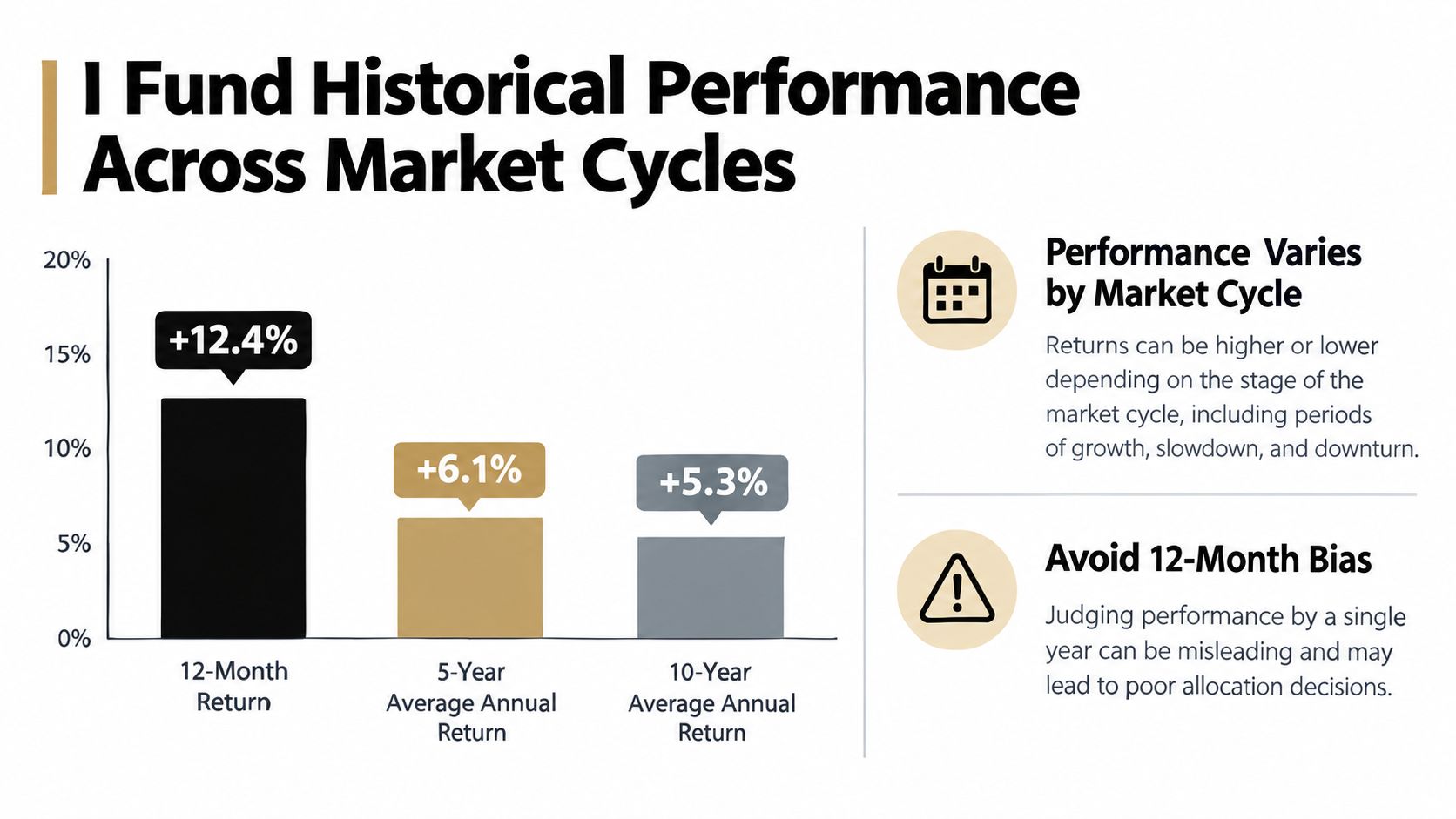
International equities rarely announce their turning points in advance. Their impact appears later on quarterly statements, which makes recent performance a poor basis for judging the I Fund. Across market cycles, the fund has produced moderate long-term growth with meaningful variation across different holding periods.
The numbers that matter
The official TSP publication reports trailing annualized I Fund returns through June 30, 2025 of 4.27% over 1 year, 2.03% over 3 years, 5.07% over 5 years, and 5.63% over 10 years. TSP publication on I Fund returns Those results offer no reason for hype or panic. They show an equity fund that can compound over time while delivering uneven results along the way.
For additional share-price context, review this guide to TSP share price history. A short-term return snapshot can distort your view of an international fund, especially after a sharp move in either direction.
What those returns actually tell you
The 1-year figure describes one market window. It does not establish whether the I Fund belongs in your retirement portfolio. The 5-year and 10-year figures provide a better test because they reduce the influence of temporary market conditions and show how patient ownership has been rewarded.
The new MSCI ACWI IMI benchmark also changes how you should interpret future results. The I Fund now represents a broader global ex-U.S. equity sleeve, so comparing every result with the old developed-markets-only version creates the wrong standard. Recent international strength is not a signal to make a tactical purchase. Keep the I Fund as a permanent strategic sleeve and set its allocation deliberately.
The right question is not “Did it win lately?” It is “Does it fill a lasting role in my retirement mix?”
Use this discipline:
- Use long horizons: Judge the I Fund over several years, not one hot streak or slump.
- Expect rotation: International leadership changes, just as U.S. leadership does.
- Ignore emotional headlines: A sound allocation does not need daily confirmation.
The record across cycles supports the I Fund's role as a diversifier. It will not lead every period, but it can provide return from markets driven by forces different from those affecting U.S. large-cap stocks. That strategic role matters more than its latest statement.
Navigating Currency Risks and Diversification Benefits
Currency risk deserves attention, but it should not drive you away from international equities. The I Fund's return has three sources: local stock price movement, dividend income, and currency translation against the U.S. dollar. The TSP fund overview on return components explains how these pieces work together.
Currency is part of the deal
Foreign stocks can rise in their local markets while a stronger U.S. dollar reduces your dollar-denominated return. A weaker dollar can increase it. International equity ownership works this way by design, so currency movement belongs in your expectations from the start.
Treating currency as an unexpected problem leads to poor decisions. It explains why the I Fund can diverge from domestic equities even when overseas companies are performing well. The dollar's effect can help or hurt in any given year, and you cannot select the outcome in advance.
Why that volatility is useful
Currency variation also supports diversification. A portfolio concentrated in U.S. stocks depends heavily on one economic system, one central bank, and one dominant market narrative. The I Fund spreads equity exposure across a broader set of countries, reducing reliance on U.S. conditions alone.
That broader exposure matters even when international markets have recently lagged. The new MSCI ACWI IMI benchmark makes the I Fund a wider global ex-U.S. sleeve, so a recent breakout should never become a reason to chase performance. Set the allocation, then keep it as a permanent strategic sleeve through changing market leadership.
Bottom line: The I Fund's differences from the C Fund are the reason to own it.
Use the I Fund for the hedge-diversifier tradeoff, not for a market forecast. It can reduce dependence on U.S. stocks while introducing currency and regional fluctuations. Accept both features, review the allocation on a deliberate schedule, and ignore short-term comparisons. A retirement portfolio benefits from fewer single-country assumptions, not from constantly switching toward whichever market has just performed best.
Building a Retirement Portfolio With International Equities
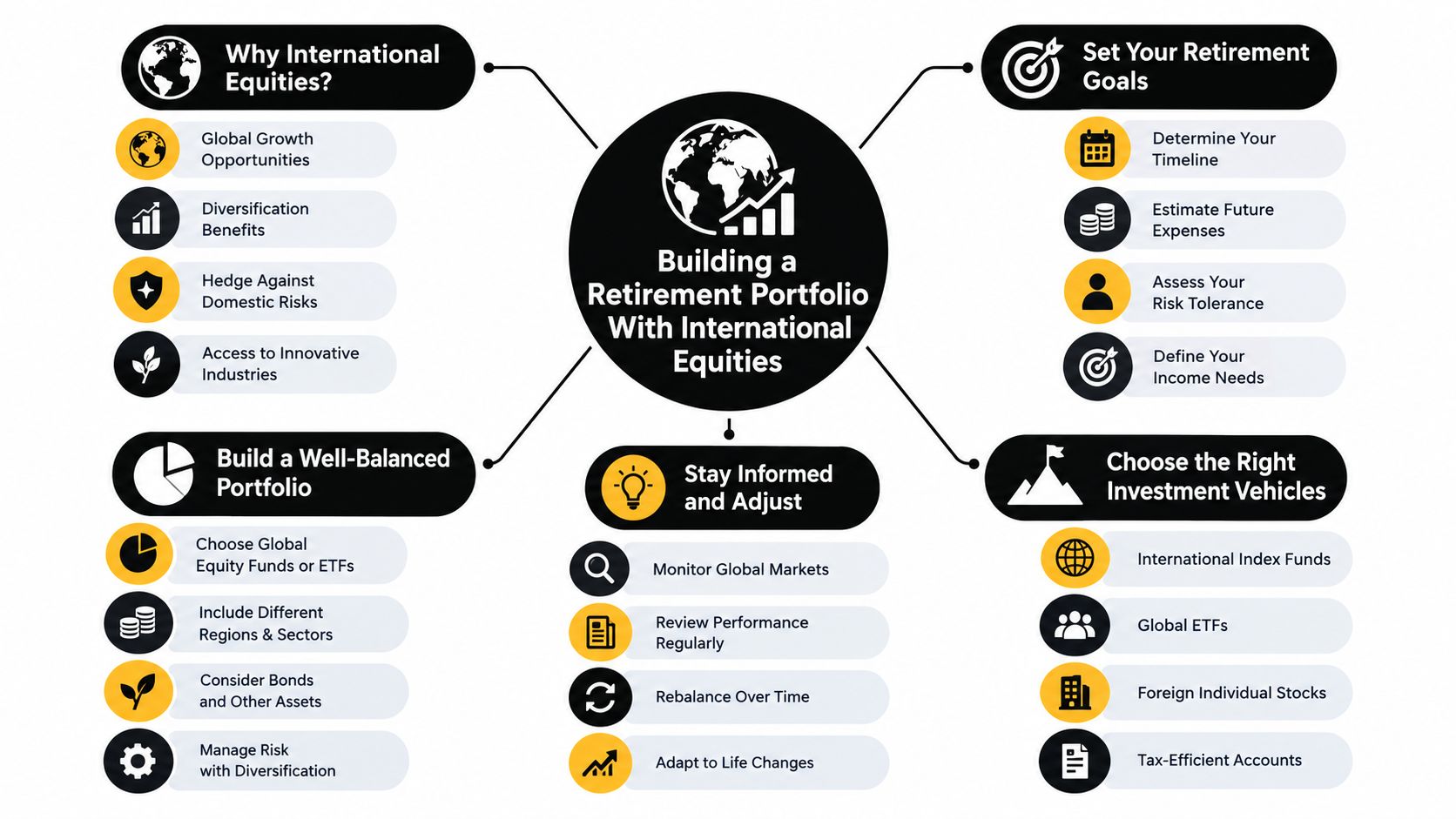
The core decision isn't whether the I Fund is useful. It is. The core decision is how much of your TSP belongs there. That answer depends on your time horizon, your tolerance for volatility, and how close you are to needing withdrawals. For a clean discussion of broader TSP mix design, this guide on TSP allocation for federal employees is relevant context.
Size it as a strategic sleeve
If you're early in your career, the I Fund can sit alongside the C and S funds as part of a growth-oriented equity core. If retirement is closer, the same fund still belongs in the mix, but it should sit inside a portfolio that uses the G and F funds to protect upcoming spending needs. The point is not to maximize excitement. The point is to make sure you don't overcommit to one market.
A practical portfolio mindset looks like this:
- Younger federal employee: Keep the I Fund as part of a broader stock allocation, not as a standalone bet.
- Mid-career employee: Use it to reduce U.S. concentration while keeping enough equity exposure to grow.
- Near-retiree: Hold it if it fits your plan, but don't let it crowd out stability assets you'll need soon.
Pair it with the rest of the TSP, not against it
The I Fund is strongest when it works with the other core TSP funds. The C Fund gives you large-cap U.S. exposure. The S Fund adds smaller U.S. companies. The I Fund rounds out the stock side with international exposure. Then the G and F funds give you ballast.
That mix matters because the I Fund is not a substitute for the rest of the portfolio. It's a complement. If you're trying to build a retirement portfolio that can survive market rotation, inflation noise, and policy changes, you need assets that don't all move the same way. The I Fund helps with that, and it should stay in the plan as a permanent allocation, not a temporary experiment.
Avoiding Performance Chasing and Allocation Mistakes
Recent international strength is a poor reason to redesign your TSP. The I Fund should serve as a permanent allocation, not a trade based on whichever fund currently leads. Chasing returns usually means buying after a major move, then selling when volatility tests your conviction.
Breakout returns are not a plan
Coverage in early 2026 showed the I Fund leading the TSP for multiple months, reaching 19.18% year-to-date by August. It also reported 42.22% 12-month performance by late February, followed by greater monthly volatility. Large February 2026 inflows from the C and S funds into the I Fund showed how quickly participants reacted to recent results. Fedsmith on I Fund inflows and 2026 performance
That pattern creates a predictable risk. Investors often enter after the strongest part of a move, absorb the correction, and sell when the narrative turns negative. The result is a portfolio shaped by headlines instead of retirement needs.
The new MSCI ACWI IMI benchmark makes the I Fund a broader international sleeve, which strengthens its strategic role. It does not turn recent performance into a reliable timing signal. Set the allocation from your retirement plan, then judge it against that plan.
Discipline beats the urge to react
A durable allocation decision differs from a tactical bet. If international exposure belongs in your design, keep it through weak periods. If market movements push the I Fund above or below its target, rebalance rather than predict which region will lead next.
Use a step-by-step TSP investment strategy to define your target mix, review schedule, and rebalancing rules before market headlines pressure you into action.
Ask one direct question: are you holding the I Fund because it belongs in your retirement design, or because it is hot now? Keep the allocation steady, review it on schedule, and let market rotations occur without rewriting your strategy.
Do not let a strong run replace a retirement plan. Build the allocation before headlines move.
Taking Action on Your Federal Retirement Strategy
Replace assumptions with three concrete checks. Review your current TSP allocation, measure how much international stock exposure you hold, and schedule a benefits review before changing funds. Compare the result with your retirement timeline, withdrawal needs, and tolerance for market declines.
Do not increase the I Fund just because international markets recently broke out. The new MSCI ACWI IMI benchmark gives the fund a broader strategic role, but recent performance remains a poor timing signal. Set an allocation you can maintain through strong and weak periods, then rebalance when it moves materially from target.
A structured review can connect your TSP choices with FERS, Social Security, and retirement income needs. Federal Benefits Sherpa provides personalized guidance, including a free 15-minute benefit review and gap analysis reports. Schedule that review at Federal Benefits Sherpa to determine whether your I Fund allocation matches your retirement timeline and planned withdrawals.
