TSP Early Withdrawal Options, Taxes, and Penalties
You're 54, you need cash now, and your Thrift Savings Plan is the biggest account you own. Before you request a TSP early withdrawal, run the actual tax math, check your separation year, and confirm which exception, if any, you can document.
The Moment Most Federal Employees Consider an Early Withdrawal
Our example employee is 54, three years from pension eligibility, and staring at a bill that savings won't cover. She's thinking about pulling $40,000 from her TSP and assuming the only question is whether she can. It isn't. The question is what she keeps after ordinary income tax and the possible 10% early-distribution tax, and whether waiting months changes that answer completely.
That decision turns on three forks, and many individuals only see one of them. First, are you still on the federal payroll, or have you separated? Second, do you separate during or after the calendar year you turn 55? Third, are you a qualified public safety employee with an earlier exception that general employees typically do not have?
Why Timing Beats Intent
A genuine need doesn't erase a penalty. The IRS doesn't ask whether your reason feels reasonable, it asks whether your age, employment status, and distribution type fit a listed exception. Two employees can take the same dollar amount for the same reason and owe very different federal tax because one separated in the wrong calendar year.
My rule: Don't price a withdrawal by the amount you request. Price it by the net cash after withholding, marginal tax, any state tax, and any penalty.
If you're that 54-year-old, don't start in My Account. Start with a calendar. Pin down your birth year, your planned separation date, and whether you're still employed when the money leaves the plan. Those three facts drive everything that follows, and getting one wrong turns a manageable tax bill into an avoidable one.
How the TSP Works Before Withdrawal Becomes Possible
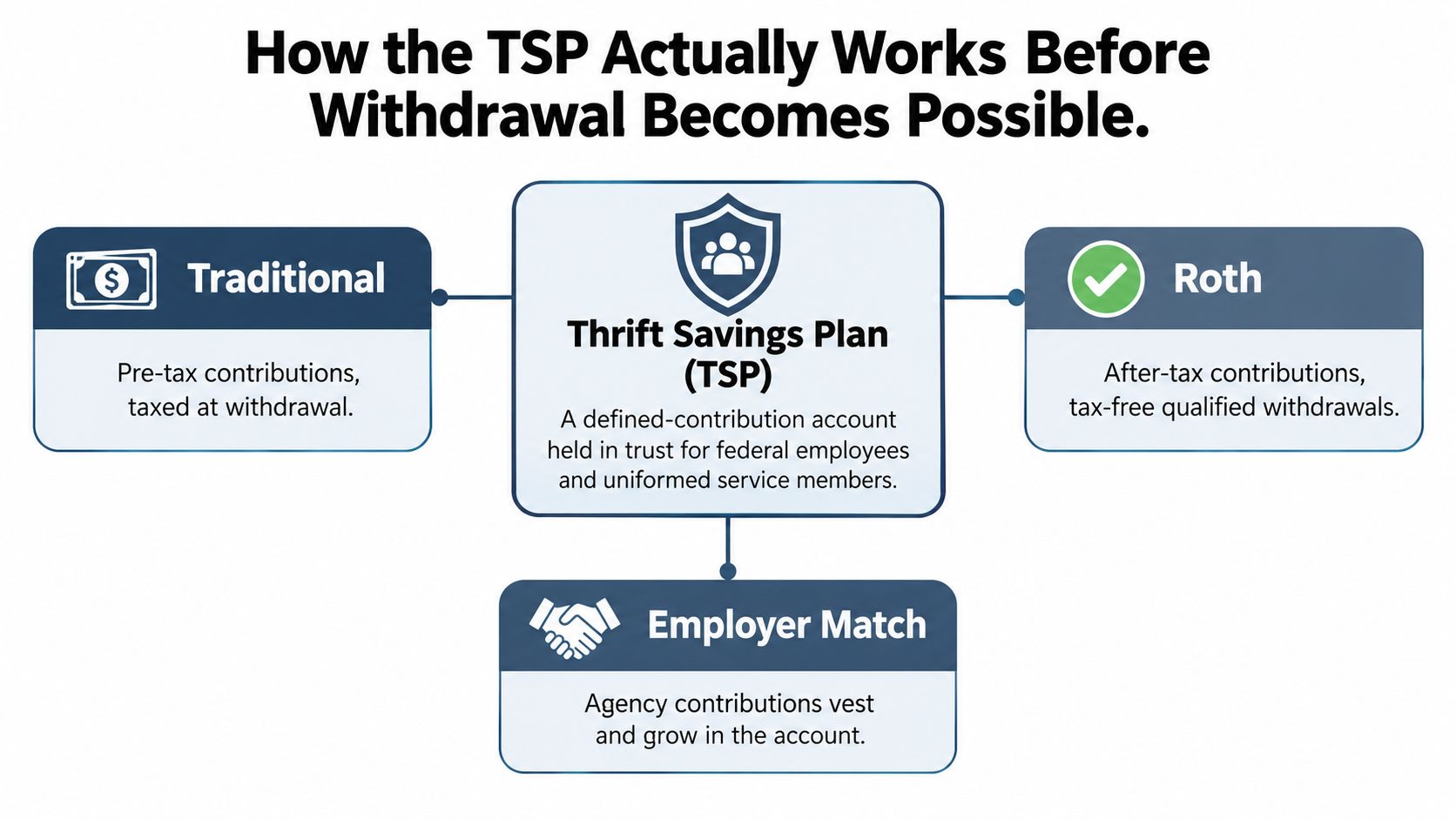
The Thrift Savings Plan is a defined-contribution account held in trust for federal employees and uniformed service members. Your contributions, any agency contributions, and investment results determine the account balance. That balance is separate from your pension, and pension timing rules do not govern TSP withdrawals.
Traditional Money Versus Roth Money
Traditional TSP contributions generally went in before tax, so the taxable portion is taxed when withdrawn. Roth TSP contributions went in after tax, and qualified Roth distributions receive different tax treatment. Check which source the money will come from before requesting a withdrawal. The same amount can have different tax consequences depending on whether it comes from traditional or Roth funds.
Agency contributions are part of your account and can grow with it. Their presence does not determine the tax treatment of an early withdrawal. Your employment status and the tax rules do.
The Three Moments Money Can Leave
- Financial hardship while employed: An in-service option that requires a genuine financial need.
- Age 59½ while employed: A separate in-service option with different penalty and withholding treatment.
- After separation: Post-separation options include partial distributions, installments, and rollovers.
These are distinct paths, not interchangeable ways to access the same money. A 62-year-old who is still working has a different set of TSP options from a 54-year-old who has separated. The TSP determines which distributions it allows; the IRS determines the tax consequences. TSP guidance explains that a withdrawal before age 59½ may be subject to ordinary income tax and a 10% additional tax on the taxable portion. A qualifying separation at 55 can remove the additional tax, but not the income tax.
The Two Tax Costs That Stack on Every Early Withdrawal
A TSP withdrawal can create two separate tax bills. Ordinary income tax applies to the taxable portion of a traditional TSP distribution. The 10% additional early-distribution tax may also apply to that portion if you are under 59½ and no exception qualifies. Avoiding the additional tax does not erase the income tax.
For example, a $40,000 fully taxable traditional TSP withdrawal could incur a $4,000 additional tax before ordinary income tax, unless an exception applies. Federal income tax still applies, and state tax may also apply depending on where you live and the type of distribution. Estimate the full tax impact before deciding how much cash to take. For more on the tax treatment, review understanding TSP taxes before you move money.
Penalty-Free Does Not Mean Tax-Free
An exception removes the additional 10% charge, not the ordinary income tax on traditional TSP money. If you need a specific amount of spendable cash, the withdrawal may need to be larger to cover taxes. That larger distribution can increase your taxable income.
Penalty-free is a narrow claim. It says nothing about your marginal bracket, your state bill, or what you'll owe when you file.
A direct rollover has a different result. Amounts rolled into an eligible retirement account or plan are not included in current gross income, so the 10% charge does not apply to the rolled-over amount. Spending a distribution and rolling it over are different tax events, so decide which applies before requesting the money.
Withholding is an advance payment toward your final tax liability, not a quote or a cap. If too little is withheld, you may owe the difference when you file. If too much is withheld, less cash is available to you now, and the excess is settled on your tax return. Check the expected withholding against your likely tax bill before setting the withdrawal amount.
Exceptions That Remove the 10% Penalty - And What Each One Really Requires
Exceptions are narrow, documented, and unforgiving about timing. The workhorse for federal employees is separation from service during or after the calendar year you reach age 55. Separate in that year or later, take the distribution from the TSP, and the additional 10% tax generally doesn't apply to that distribution. Separate too early, and you don't get to borrow the rule from a future birthday.
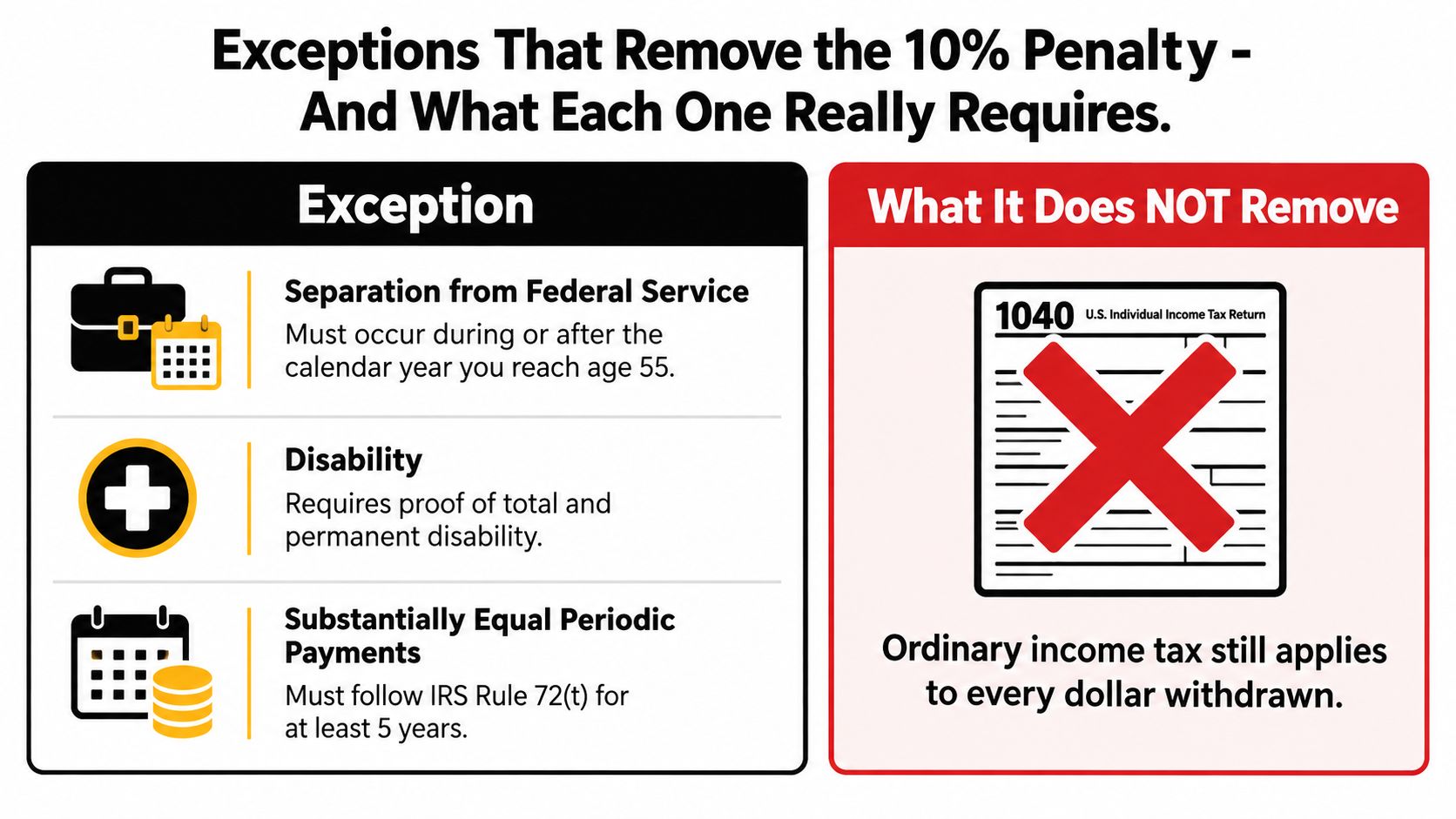
That age 55 rule is tied to distributions from the employer plan after qualifying separation. It doesn't automatically follow every retirement account you own. If you roll TSP money to an IRA first and then withdraw from the IRA, don't assume the same exception protects you. That sequencing mistake is expensive and common.
Other Exceptions Employees Ask About
- Substantially equal periodic payments: Payments based on life expectancy under IRS rules. This is a commitment, not a flexible cash tap, and bad execution can undo the benefit.
- Total and permanent disability: The standard is specific. A difficult medical situation isn't enough by itself, you need to meet the tax definition and document it.
- Certain emergency distributions: Narrow relief exists for specific emergency personal expenses. For broader context on newer emergency access rules in workplace plans, Allied Tax Advisors tax planning insight is a useful starting point before you assume your situation qualifies.
- Qualified public safety employees: A separate, earlier exception covered in its own section below because the paperwork risk is different.
Age 59½ in-service withdrawals belong in a different category. At that age, the additional 10% penalty doesn't apply merely because you're taking money while still employed. Ordinary income tax on traditional funds still does.
In-Service Hardship Versus Age 59½ In-Service Withdrawals
If you're still employed, you don't have general access to your TSP just because it's your money. You generally have two in-service paths, and they shouldn't be confused. One is built for documented hardship at any age. The other is built for age, not need.
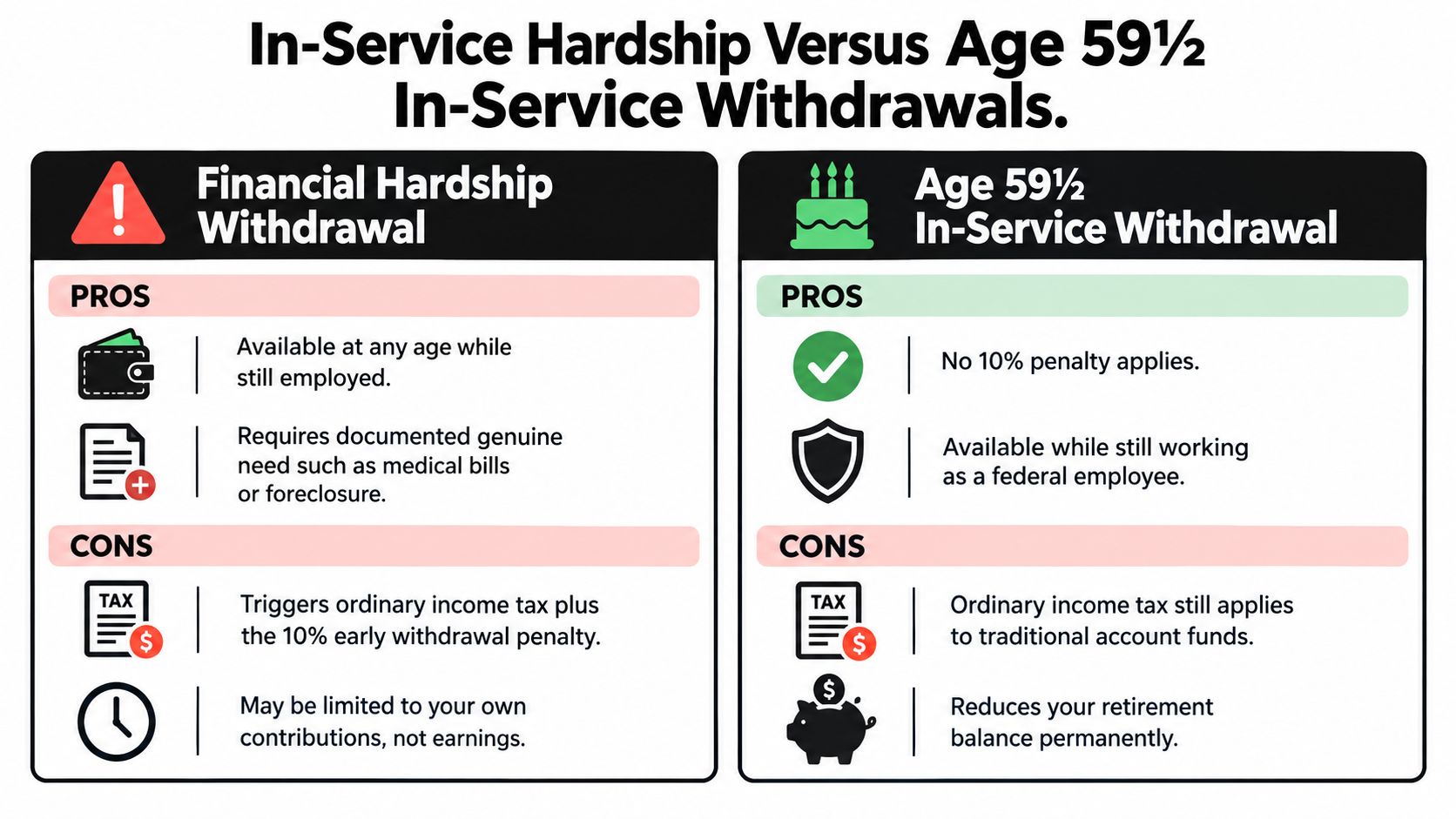
A financial hardship withdrawal is an in-service withdrawal supported by a genuine financial need. Its taxable portion is subject to federal income tax and, in some cases, state income tax. If you're younger than 59½, it may also incur the additional 10% penalty unless an IRS exception applies. Our detailed breakdown of TSP hardship withdrawal rules and eligibility walks through that process separately.
Run the smaller example before you submit anything. A $20,000 fully taxable hardship withdrawal before 59½ could produce a $2,000 additional federal penalty, in addition to ordinary income tax, according to TSP guidance on in-service withdrawal taxation and withholding. That's the cost before you count lost future growth on money that permanently leaves the account.
What Changes at Age 59½
An age 59½ in-service withdrawal is generally taxable on its taxable portion, but the additional 10% penalty doesn't apply merely because you take it at that age. If the taxable amount is paid directly to you rather than rolled over, a 20% federal withholding requirement generally applies. That withholding may be more or less than your final tax, so don't treat the net deposit as your final answer.
Before choosing either path, price a TSP loan if you're eligible. A loan isn't a withdrawal, but it carries repayment risk, especially if your employment status changes. Compare net cash, tax cost, and what happens if you separate, not just speed.
The Public-Safety Age-50 Exception and the Documentation Trap
Qualified federal law enforcement officers, firefighters, and similar public safety employees get an exception other employees don't. Under SECURE 2.0, the exception expanded for qualified public safety employees who separate after reaching age 50 or completing 25 years of qualifying service, as described in TSP information on SECURE 2.0 public safety changes. That can open penalty-free TSP access years before the general age 55 rule.
Eligibility under the law doesn't guarantee clean tax reporting. That's the trap.
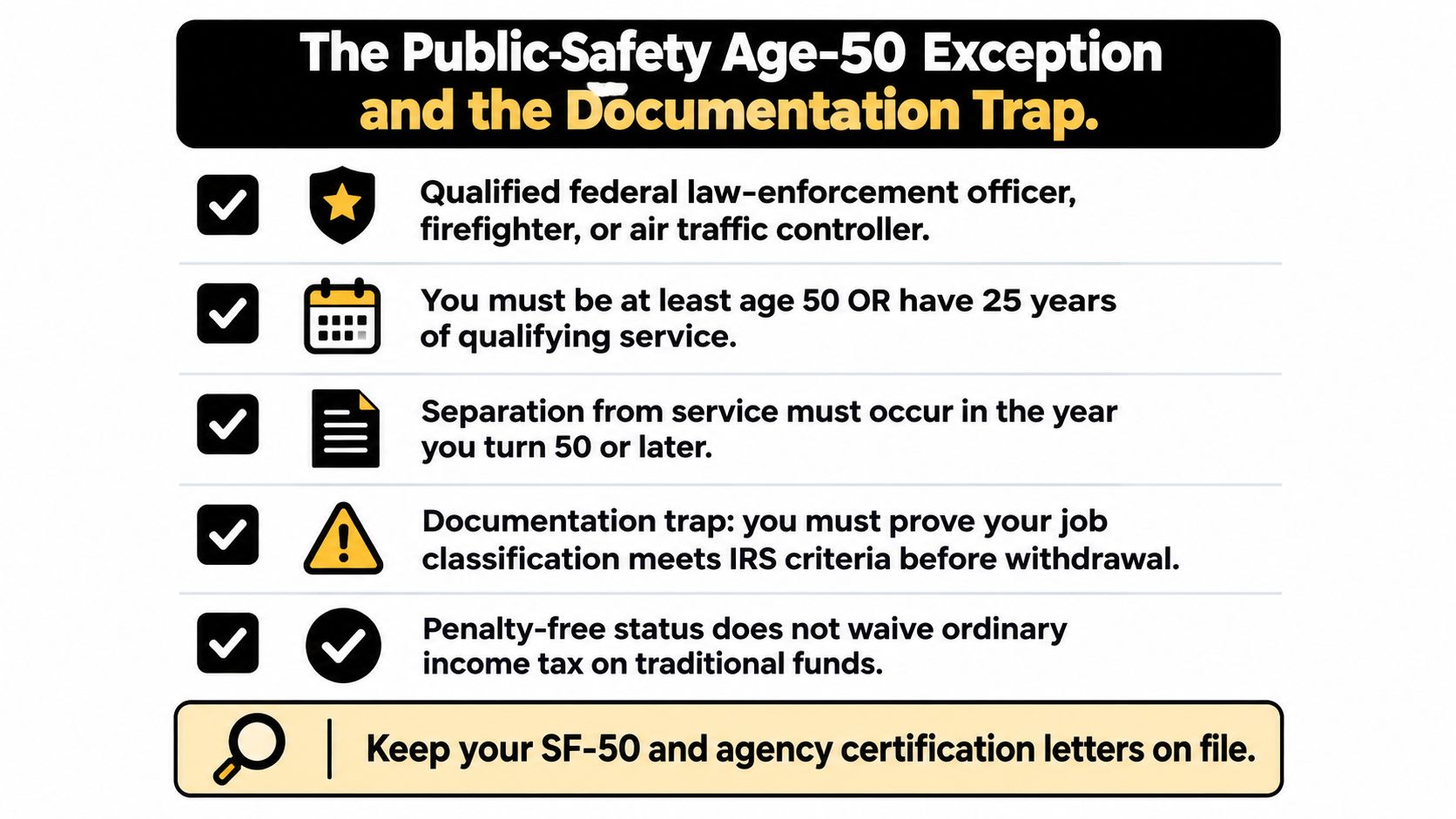
Your employing agency must transmit a "P" employment code and the correct separation-date information. If that data is missing, your Form 1099-R may not automatically reflect the exemption, and you may need to claim it with IRS Form 5329. You can be legally right and still spend tax season proving it.
Verify Before You Separate
- Confirm the payroll code: Ask your agency to verify the "P" code before your final separation processes.
- Secure service records: Keep documentation that proves qualifying service and your separation date.
- Review the 1099-R immediately: If it doesn't reflect the exemption, prepare to address it on your return instead of assuming the TSP will fix it unprompted.
Watch this walkthrough before you rely on the exception, then check your own agency record against it.
Don't mix this up with the broader age 55 separation exception. They're different rules, for different groups, with different proof. Know which one you're counting on.
Requesting a TSP Withdrawal Without Missing the Quiet Details
Start in TSP My Account, but don't treat the screens as a formality. The elections you make there decide withholding, rollover treatment, and how much friction you'll face later. Slow down at the payment destination screen.
The Click Path That Matters
- Log in and choose withdrawals: Confirm whether you're requesting an in-service withdrawal or a post-separation distribution.
- Choose partial or total: A partial distribution preserves the remaining account. A total distribution ends that flexibility.
- Elect rollover or direct payment: This is the consequential click. A direct rollover to an eligible plan or IRA keeps rolled-over amounts out of current income. Payment to you puts taxable traditional money into the tax calculation.
- Confirm withholding: Where mandatory withholding applies to a taxable amount paid directly to you, plan for it in your cash need. Where you can make elections, don't default blindly.
For hardship requests, expect to support genuine need. For the public safety exception, verify agency data before you rely on penalty-free reporting, as covered in the section above. Processing isn't instant, so don't build a plan that requires same-week cash without confirming timing.
Withdrawal Decision Matrix - Penalty, Tax, and Withholding at a Glance
| Scenario | 10% Penalty | Ordinary Income Tax | 20% Withholding | Rollover Eligible |
|---|---|---|---|---|
| Hardship before 59½, no exception | May apply to taxable portion | Applies to taxable portion | Depends on payment type | Generally no for hardship amounts |
| Age 59½ in-service, paid to you | Does not apply merely due to age | Applies to taxable portion | Generally applies to taxable amount | Yes, if rolled over instead |
| Separation in or after age 55 year | Exception can remove it | Still applies | Depends on payment type | Yes |
| Direct rollover | Does not apply to rolled-over amount | Not included in current income | Avoided on direct rollover | Yes |
Smart Alternatives and Your Next Move
A TSP early withdrawal should be the last lever you pull, not the first. Once traditional money leaves and tax is paid, you can't rewind the lost compounding or the taxable income you created. Rank the alternatives by tax cost, cash you receive, and damage to future retirement income.
Rank the Alternatives Before You Withdraw
First, price a TSP loan. If you're still employed and eligible, a loan can provide cash without treating the amount as a withdrawal. The risk is repayment, especially around separation, so read the rules for borrowing from your TSP before you assume it's the safe option. A loan you can't repay on schedule isn't a solution, it's a delayed problem.
Second, bridge with taxable savings if you have them. Spending cash outside the TSP feels painful, but it often preserves tax-advantaged space you'll never get back. If you're trying to judge whether you can afford to separate early, learning how to find your FIRE number gives you a clearer target than guessing from your TSP balance alone.
Third, consider a Roth conversion ladder only as a planned strategy. Done over time, conversions can create future flexibility, but each conversion is a tax decision in the year it happens. Don't improvise this in the same month you need emergency cash.
Fourth, leave the money invested and delay separation if the calendar helps you. For our 54-year-old, separating in the wrong year can cost the age 55 exception. Waiting until separation occurs during or after the calendar year she reaches 55 can remove the additional 10% tax on a qualifying TSP distribution, while ordinary income tax still applies. That's often the cheapest move available, even when it's the least satisfying.
Advisor's take: If you're close to 55, close to a public safety threshold, or still employed and loan-eligible, withdrawing first and researching later is backwards.
Do three things this week. Confirm your separation year against age 55, confirm whether your position qualifies for the public safety exception and its agency coding, and price a loan against a withdrawal using net cash after tax. Then decide. Federal Benefits Sherpa can be one option for a personalized benefit review and gap analysis if you want your TSP, pension timing, and tax exposure checked together before you submit the request.
If you're weighing a TSP early withdrawal against separating at 55, a public safety exception, or a loan, get your dates, tax buckets, and net cash reviewed before you click submit. Federal Benefits Sherpa offers a free benefit review, targeted retirement planning, and gap analysis reports that connect your TSP decision to your pension and future income. Visit Federal Benefits Sherpa to schedule that review and price your next move with real numbers.
