Thrift Savings Plan Roth: What Federal Employees Should Know
You're a federal employee nearing retirement, and your TSP statement shows years of traditional contributions. A colleague suggests switching part of your savings to Roth, while a payroll notice raises questions about the 2026 mandatory Roth catch-up rule. The kitchen-table questions arrive quickly: Does Roth create extra contribution space? Will your take-home pay fall? When can you withdraw the money tax-free?
The answers depend on separating three ideas that often get blended together: tax treatment, contribution limits, and withdrawal rules. Roth TSP can provide valuable tax diversification, but it isn't a second TSP allowance and it doesn't make every withdrawal tax-free automatically.
What the Roth Option Actually Means Inside the TSP
A federal employee who has contributed only to traditional TSP may think Roth means opening an entirely different retirement plan. It doesn't. Roth is a tax treatment inside the Thrift Savings Plan, selected through payroll contributions.
The TSP made Roth contributions available in 2012 to federal civilian employees and uniformed-service members, allowing after-tax retirement contributions within the federal government's defined-contribution plan. The investment menu remains the same. Your money can still use the G, F, C, S, or I Fund, whether the contribution is traditional or Roth. The difference is when taxes apply.
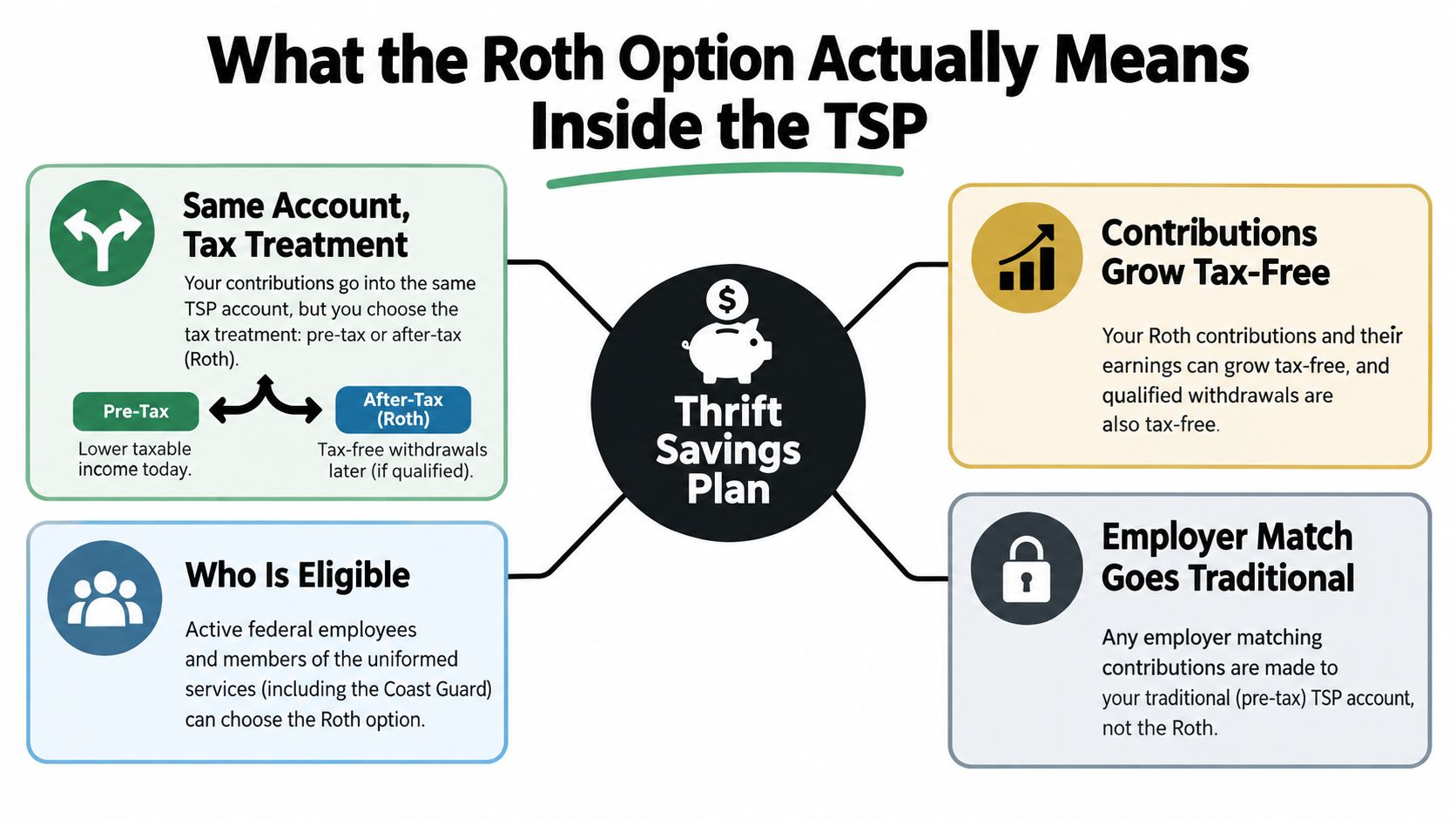
Think of two tax lanes
Traditional contributions generally go into the plan before federal income tax is applied. You receive the tax benefit now, while withdrawals are generally taxable later. Roth contributions go into the plan after federal income-tax withholding. You give up the immediate deduction, but qualified Roth distributions can be tax-free.
That makes Roth a choice about the timing of taxation, not a separate investment account with a separate employee limit. You can divide your employee contributions between the two tax treatments, but the combined amount remains subject to the applicable annual ceiling.
Employer contributions follow their own tax treatment. Your agency or service matching contribution doesn't become Roth just because you selected Roth for your own payroll election. Employer contributions generally remain in the traditional side of the TSP.
Plain-language explanation: Roth TSP means paying the tax before the contribution, then seeking tax-free treatment later when the distribution meets the applicable requirements.
A new employee might use Roth while current income is relatively modest. A late-career employee might use a blend, preserving some current tax relief while building a pool of potentially tax-free retirement income. For a broader overview of the plan's investment and contribution mechanics, see this simplified explanation of how the TSP works.
How Roth TSP Came to Exist and Why It Matters Now
The 2012 launch answered a practical problem in federal retirement planning. Traditional TSP gave employees tax deferral, but it didn't offer a way to pay tax during working years in exchange for potentially tax-free qualified distributions later. Roth TSP added that second tax path without rebuilding the plan's basic contribution system.
The original structure matters because it still answers one of the most common questions: Can I contribute the maximum to traditional TSP and then contribute another maximum to Roth TSP? No. Roth and traditional employee contributions share one annual elective-deferral ceiling.
The historical limits show that the dollar capacity has grown while the combined-limit principle has stayed in place. The regular employee elective-deferral limit rose from $17,000 in 2012 to $23,500 in 2025, an increase of $6,500. The age-50 catch-up limit rose from $5,500 to $7,500 over the same period, according to the official TSP historical contribution schedule.
What changed and what didn't
The changing limits affect how much a participant can save. They don't change the nature of the Roth election.
- The contribution framework stayed combined. Traditional and Roth employee contributions compete for the same regular employee-deferral space.
- The tax choice became more flexible. Employees can decide whether particular dollars receive a tax benefit now or potentially later.
- The planning question became more personal. A participant must compare current marginal tax rates, expected retirement income, and the value of having different tax treatments available.
That history helps explain why Roth TSP is neither a temporary experiment nor an extra savings bucket. It is a permanent-looking feature of the existing plan structure, governed by the same broad contribution architecture that applied when it was introduced.
Roth Versus Traditional TSP at a Glance
The cleanest comparison starts with one question: Do you want the tax benefit today, or do you want to pursue tax-free treatment later?
Traditional TSP may be attractive when reducing current taxable income matters. Roth TSP may be attractive when you expect your future tax rate to be similar or higher, or when you value a retirement balance that doesn't add to taxable income when distributed under qualified-distribution rules. Neither option is automatically better for every employee.
| Feature | Roth TSP | Traditional TSP |
|---|---|---|
| Contribution tax treatment | Contributions are made after federal income-tax withholding. | Contributions generally receive tax-deferred treatment. |
| Immediate tax effect | No current federal income-tax deduction for the contribution. | May reduce current taxable income. |
| Investment growth | Earnings may be tax-free when the distribution is qualified. | Earnings grow tax-deferred and are generally taxable when withdrawn. |
| Qualified withdrawal | Requires the applicable five-year condition and an age, disability, or death condition. | Withdrawals are generally included in taxable income, subject to applicable rules. |
| Required minimum distributions | Roth TSP balances are exempt from IRS required minimum distributions. | Traditional balances are generally subject to required minimum distribution rules. |
| Employer contributions | Your own Roth election doesn't turn employer contributions into Roth money. | Employer contributions generally remain on the traditional side. |
The practical choice often isn't all-or-nothing. A federal employee with a FERS pension may already expect taxable retirement income. Keeping some traditional savings can provide current tax relief, while Roth savings can offer flexibility in years when additional taxable withdrawals would be inconvenient.
A younger employee with many working years ahead may prioritize future tax diversification. A higher-paid employee nearing retirement may place more weight on the immediate value of traditional deductions, unless the expected future tax picture makes Roth more compelling.
For a more detailed side-by-side discussion, review this guide to the difference between Roth and traditional TSP. The important point is not to identify a universal winner. It is to decide which tax treatment fits the dollars you're directing this year.
Contribution Limits and How Roth Fits Inside Them
The operational rule is simple: Roth and traditional employee contributions share the same annual elective-deferral limit. Choosing Roth doesn't create a second allowance, and maintaining separate civilian and uniformed-service TSP accounts doesn't create separate employee limits.
For 2026, the elective-deferral limit is $24,500. Eligible participants age 50 or older can contribute up to $32,500 when the $8,000 catch-up is included, as described in the TSP contribution-limit guidance.
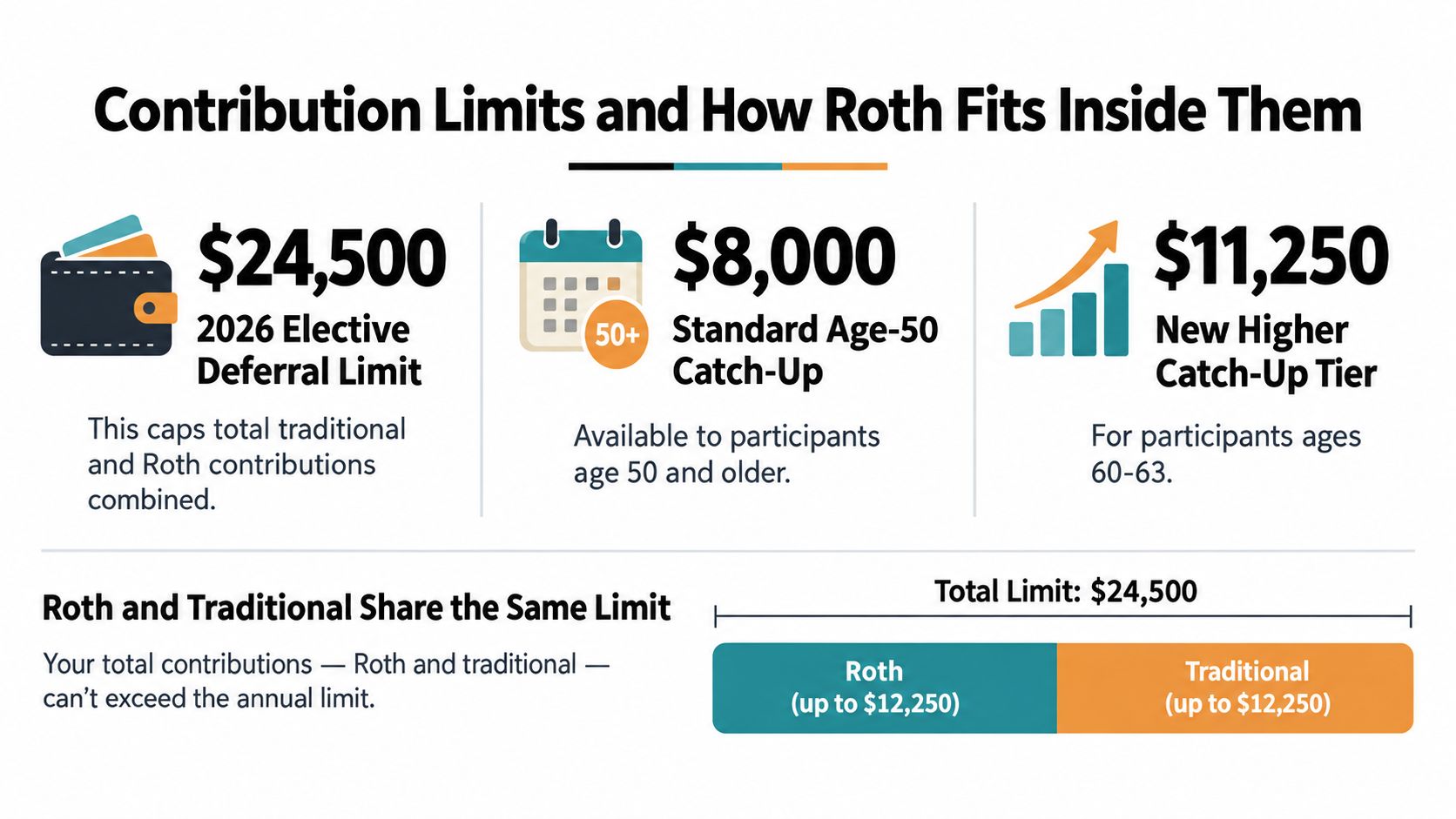
Read the limits as one bucket
Suppose you contribute part of your annual amount as traditional and the rest as Roth. Both amounts count toward the same regular employee limit. The choice changes the tax treatment, not the amount of employee-deferral space available.
Participants ages 60 through 63 may qualify for a higher $11,250 catch-up limit in 2025 under the cited TSP schedule, while the 2026 operational rules also require attention to the applicable current-year guidance. The annual-additions limit, which includes employee and agency contributions under applicable rules, is separate from the employee elective-deferral ceiling.
That distinction prevents two different mistakes:
- Employee-limit mistake: Treating Roth and traditional contributions as separate allowances.
- Annual-additions mistake: Assuming the employee limit is the only limit that matters when agency automatic and matching contributions are included.
Coordinate across payrolls
Calendar-year tracking matters if you change agencies, move between civilian and uniformed service, or contribute through more than one eligible position. Contributions made through civilian and uniformed-service TSP accounts are aggregated for the employee-deferral limit.
A sensible review process is:
- Check year-to-date contributions. Look at the combined employee total, not just the current payroll election.
- Include both tax treatments. Traditional and Roth contributions belong in the same running calculation.
- Review catch-up eligibility. Age-based rules can change the amount available.
- Coordinate payroll elections. A new position or promotion can alter how quickly you approach the annual ceiling.
The number to monitor is your total contribution for the calendar year, not the amount shown on one pay statement.
Withdrawal Rules and the Five-Year Clock
Roth contributions don't become fully tax-free merely because they were labeled Roth when deposited. Roth earnings become tax-free only when the distribution satisfies two conditions. At least five years must have passed since January 1 of the year of your first Roth TSP contribution, and you must be at least age 59½, permanently disabled, or deceased, according to the TSP explanation of traditional and Roth contributions.

The clock uses a calendar year
The five-year period begins with January 1 of the year of your first Roth TSP contribution. It isn't restarted for every later contribution, and it isn't measured from the date each payroll deposit arrives.
Consider a federal employee who makes a first Roth contribution at age 57 and retires at age 62. Reaching retirement doesn't automatically satisfy the five-year condition. The participant must wait until the applicable calendar-year milestone has passed before Roth earnings can receive fully tax-free treatment under the qualified-distribution rules.
That creates an important difference between contributions and earnings. The tax treatment of the contribution itself and the tax treatment of investment earnings aren't identical questions. A distribution can therefore require careful attention to the participant's Roth history, age, and the reason for the distribution.
Don't confuse qualified treatment with penalty questions
Retirement timing can involve separate questions about income tax and early-distribution penalties. If you're evaluating a withdrawal before the ordinary retirement milestones, a resource on avoiding the 10% early withdrawal penalty may help you identify issues to raise with a tax professional.
The five-year rule also matters for partial withdrawals and installment planning. A participant who starts Roth contributions late in a career shouldn't assume that every Roth withdrawal will immediately receive the same treatment. Keep the year of the first Roth contribution in your records, and confirm how the TSP will classify a planned distribution before acting.
The 2026 Mandatory Roth Catch-Up Rule
The most consequential 2026 change for many late-career employees isn't a new investment fund. It's a cash-flow rule. Beginning January 1, 2026, eligible catch-up contributions must be Roth for participants whose wages from TSP-eligible positions exceed an IRS-adjusted threshold. If an affected participant's election includes traditional contributions, contributions automatically switch to Roth once the annual elective-deferral limit is reached, as explained in the TSP guidance on SECURE 2.0 and the TSP.
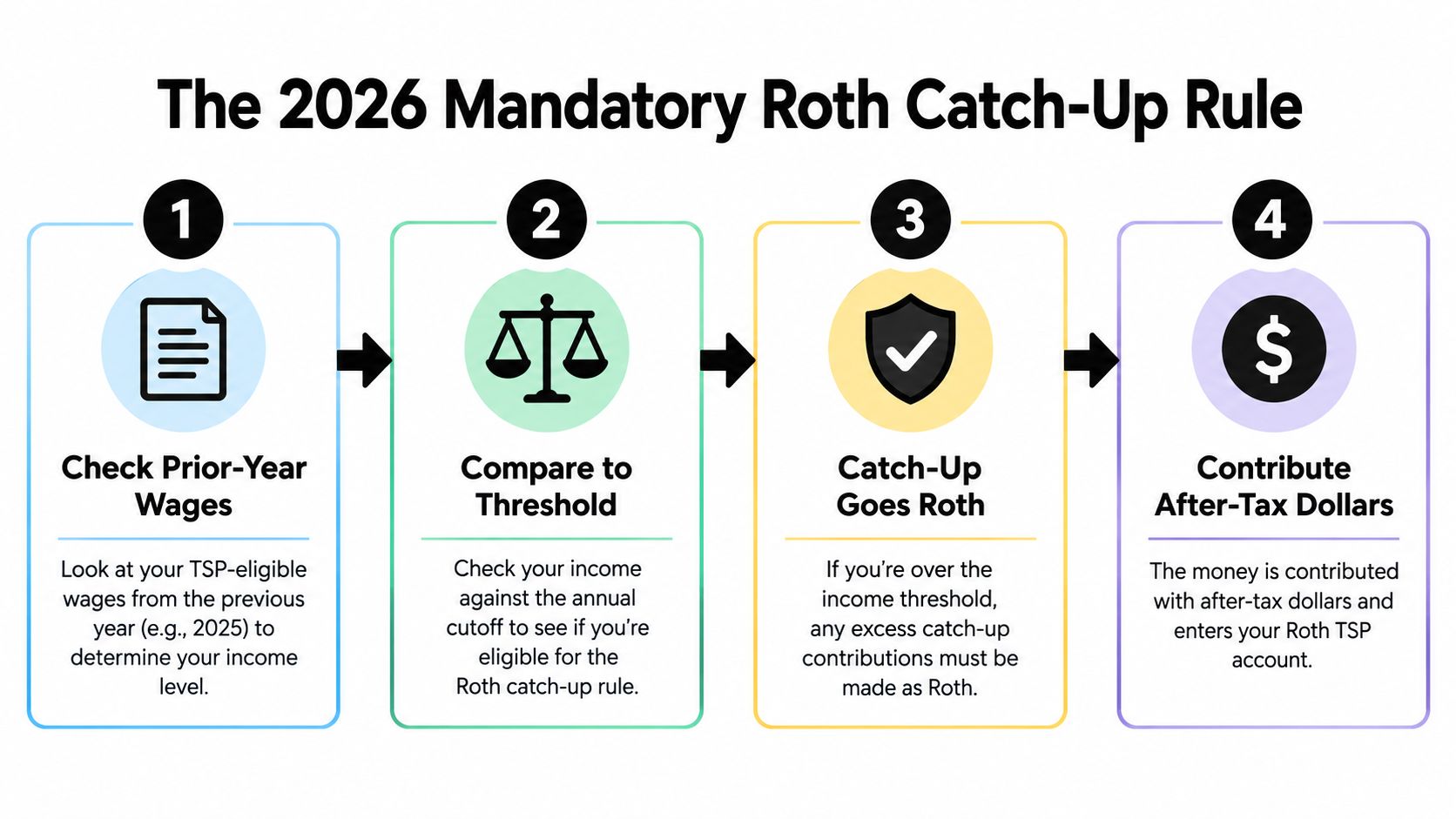
Why the rule can change take-home pay
A traditional catch-up contribution generally receives tax-deferred treatment. A Roth catch-up contribution is made after tax. For an affected higher-paid employee, that means the same intended retirement savings can require more current cash flow because the catch-up dollars are taxed before entering the TSP.
The employee may still want to save the full amount. The issue is that payroll may deliver a different result than the employee expected:
- Before the regular limit is reached, contributions may follow the employee's elected treatment.
- After the regular limit is reached, eligible catch-up contributions must be Roth.
- If the election still points to traditional, the affected contributions automatically switch to Roth under the rule.
This matters most for someone approaching retirement who has built a household budget around a stable net paycheck. A promotion, a late-career salary increase, or variable wages can move someone across the relevant threshold. Multiple federal positions can make the calculation harder because eligible wages and contributions may need to be coordinated.
Questions to ask before the payroll switch
Should you contribute Roth earlier in the year? There isn't one answer. Accelerating Roth contributions could make the tax treatment more predictable, but it may also change the timing of payroll deductions and affect how you manage cash reserves. Reserving cash for the forced Roth catch-up may preserve flexibility, but it requires estimating how much after-tax income the household can give up later.
Use the SECURE 2.0 catch-up contribution guide alongside your payroll information, not instead of it. Review prior-year wages, current elections, year-to-date contributions, and any expected employment change.
The following video provides another way to visualize the rule:
Ask payroll or a qualified benefits professional how the transition will appear on your specific earnings statement. The key planning mistake is treating this as merely an investment preference. For affected employees, it can change when taxes leave the paycheck, even when the annual retirement savings goal stays the same.
Roth TSP Inside a Real Retirement Income Plan
A federal household may enter retirement with several income sources: a FERS pension, Social Security, traditional TSP savings, and Roth TSP savings. Those sources don't all receive the same tax treatment, which is precisely why a Roth balance can be useful even when it isn't the largest account.
Suppose the household uses the FERS pension and Social Security for regular spending. Those sources may create a baseline of taxable income. The household then needs additional money for a major expense, travel, a home repair, or a period when one spouse has unusual expenses.
A traditional TSP withdrawal may increase taxable income in that year. A qualified Roth TSP withdrawal can provide spending money without adding the same type of taxable income. The Roth balance becomes a tax-management reserve, not merely another investment account.
Tax diversification is about choices
A mixed TSP strategy can give the household more control over which account supplies the next dollar. In a year with substantial taxable pension income, Roth money may be attractive. In a year with lower taxable income, a traditional withdrawal may fit better.
Roth TSP balances are also exempt from IRS required minimum distributions. That can help a participant preserve the account for later retirement spending, a surviving spouse, or heirs, although estate and tax planning still require individualized advice.
The decision isn't a prediction that future tax rates will definitely rise. It's a way to avoid placing every retirement dollar under one tax treatment. A household with a pension may value that flexibility differently from a newly hired employee with decades before retirement, but both can ask the same question: Which account gives us better choices when income changes?
A Practical Framework for Deciding Your Roth Mix
Start with the year in front of you. Compare your current marginal tax rate with the tax rate you reasonably expect in retirement, then consider whether your income may change through promotion, retirement, a pension start date, or a spouse's work.
Use these questions:
- Current cash flow: Can your household afford the lower take-home pay that accompanies after-tax Roth contributions?
- Future flexibility: Would a Roth balance help you manage taxable income alongside a FERS pension and Social Security?
- Time horizon: Do you have enough time to satisfy the Roth five-year condition?
- Catch-up planning: If you may be affected by the 2026 rule, have you budgeted for Roth catch-up deductions?
- Recordkeeping: Have you confirmed the year of your first Roth contribution and reviewed your year-to-date totals?
Federal Benefits Sherpa offers personalized benefit reviews and retirement planning that can include TSP allocation, Roth-versus-traditional decisions, and retirement-income analysis. A benefits professional or tax adviser is especially useful when your wages fluctuate, you hold multiple federal positions, or retirement is close.
There's rarely one perfect Roth percentage. There is usually a clearer decision once you separate contribution limits, tax timing, qualified withdrawals, and household cash flow.
Federal Benefits Sherpa can help you review your Roth and traditional TSP choices alongside your FERS pension, Social Security, and broader retirement income plan. Visit Federal Benefits Sherpa to request a personalized benefits review and identify the next planning steps for your situation.
