Thrift Savings Plan for Dummies: A Simple Federal Guide
The Thrift Savings Plan is the federal government's version of a 401(k), created in 1987. If you're a FERS employee, the government provides a 1% automatic contribution plus up to a 4% match, so contributing at least 5% of your salary is the basic step for capturing the full match.
You may be reading this after a benefits orientation filled with unfamiliar terms, fund letters, tax choices, and retirement rules. You're not alone. A new employee can understand the value of saving for retirement and still wonder whether to choose Traditional or Roth, which fund to select, and what “agency matching” really means on a paycheck.
Think of this guide as a patient walk-through rather than a glossary. We'll start with what the TSP is, then move through contributions, investment funds, tax timing, withdrawals, and decisions that change as your federal career progresses.
What Is the Thrift Savings Plan and Why Should You Care
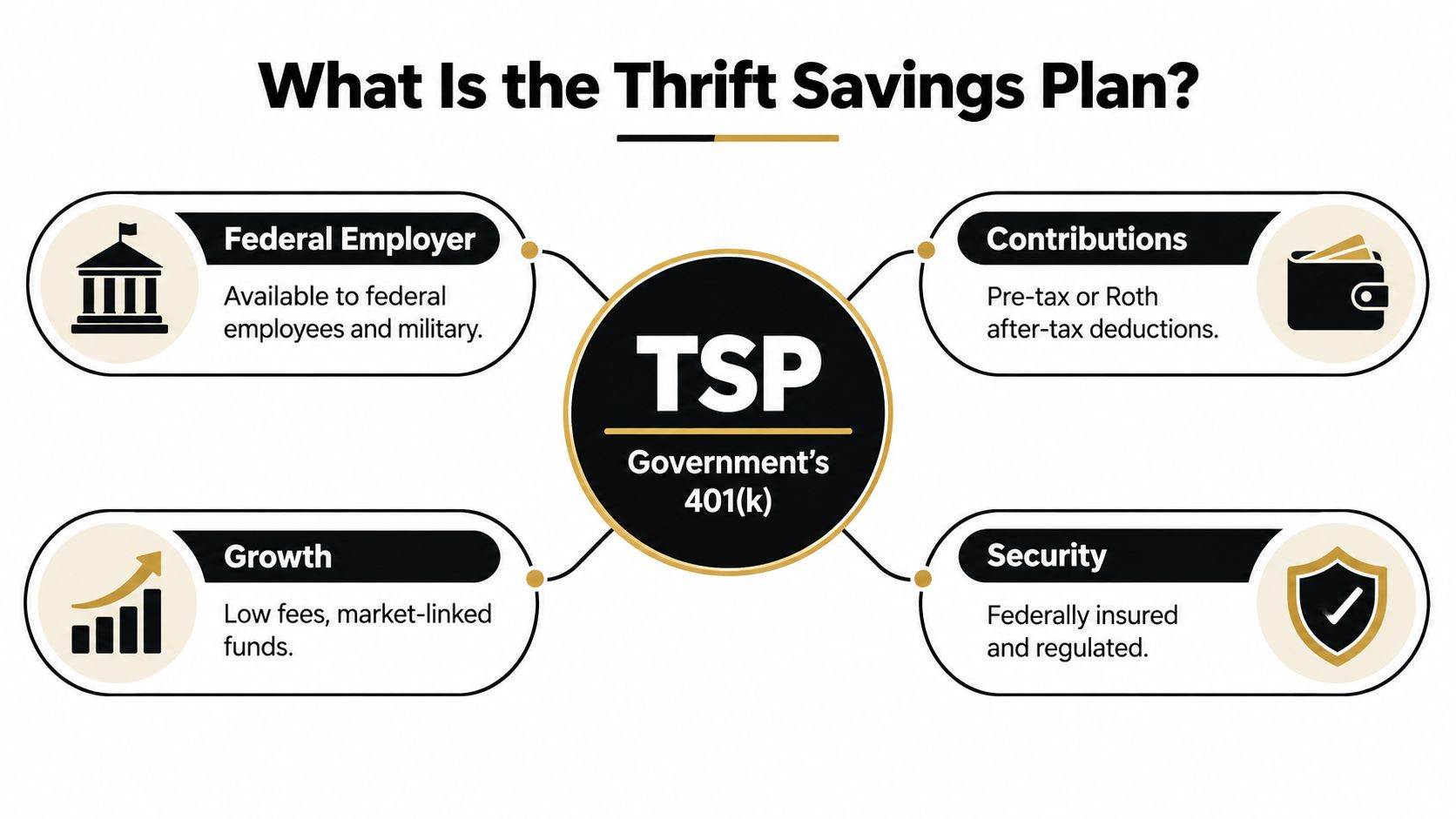
Your first federal paycheck may include a retirement deduction before you fully understand the acronym behind it. The Thrift Savings Plan, or TSP, is an individual workplace retirement account that works alongside your federal pension and Social Security. It gives eligible employees a way to save through payroll deductions and invest those savings.
The plan was created by the Federal Employees' Retirement System Act of 1986 and began operating on April 1, 1987. It was designed as a defined-contribution plan similar to a private-sector 401(k), so your account value depends on contributions, investment results, and time (Government Accountability Office historical overview).
The account behind the acronym
The TSP is individually owned, funded through payroll deductions, and invested in plan funds. Eligible participants may include civilian federal employees, U.S. Postal Service employees, members of Congress, judicial-branch employees, and uniformed-service members, subject to the rules that apply to each group.
The plan grew quickly. By May 1988, roughly one year after operations began, it had more than 1 million accounts with a combined value exceeding $1.6 billion, as documented in the same GAO historical overview cited above. That early growth shows that the TSP was established as a central part of federal retirement planning, rather than as an optional commercial product.
As of March 2024, GAO reported approximately $895 billion in retirement assets and about 7 million participants and beneficiaries. Its analysis describes the TSP as the largest U.S. retirement savings plan by assets (GAO's TSP analysis). Those figures cover the plan as a whole, not an individual employee's balance.
Why the match deserves attention
Career stage changes the decision. A new FERS employee may focus on getting the account started, while an employee nearing retirement may focus on contribution levels, investment risk, and tax timing. At every stage, the employer match deserves a careful check.
Under FERS, the agency automatic contribution is provided even if you contribute nothing. Matching contributions, however, depend on your own payroll election. Contributing below the amount needed for the full match can leave part of your available compensation unused.
Practical rule: Treat the full match as part of your compensation, not as a bonus you might remember later.
Traditional and Roth contributions raise a different question: do you prefer the potential tax benefit now, or tax-free treatment later for qualified Roth withdrawals? The better choice depends on your circumstances and expectations, not just on whether you are new to federal service or close to retirement. Your contribution rate, fund selection, and time invested work together.
For a plain-English explanation of these mechanics, read this simplified guide to how the TSP works.
Setting Up Your TSP Account and Making Contributions
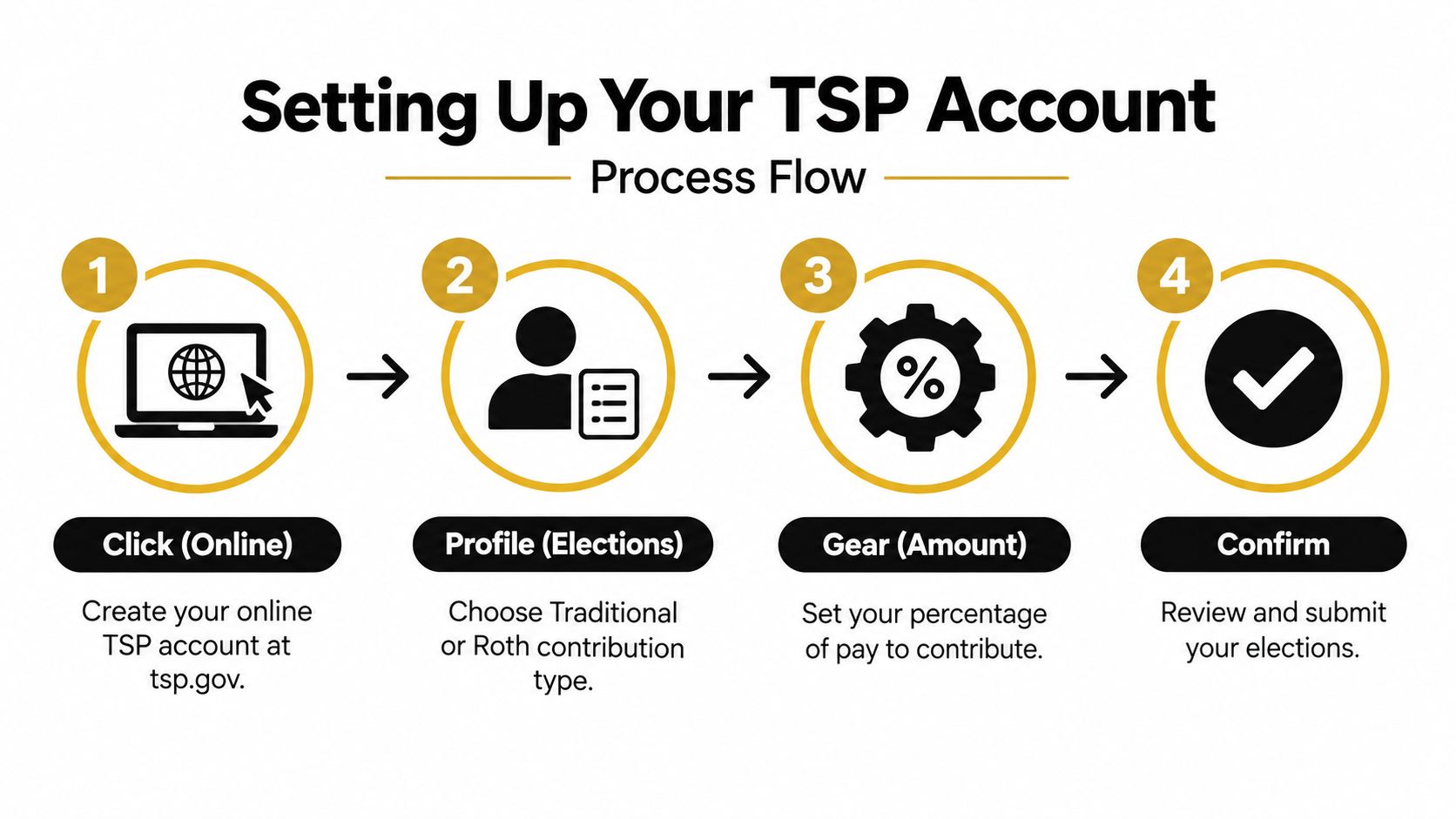
A new federal employee can set up a TSP account during a busy first week, then forget about it until the first pay statement arrives. A better approach is to handle each choice separately: establish access, select the tax treatment, set the payroll percentage, and confirm where contributions are invested.
Four practical setup steps
Create or access your account: Visit the official tsp.gov website to establish online access and review your account information.
Choose Traditional, Roth, or both: Traditional contributions generally reduce current taxable income. Roth contributions are made after tax, so they do not provide the same current deduction. This choice controls when you pay tax, while both options put money aside for retirement.
Set your payroll percentage: Choose the portion of basic pay that goes into the TSP. For a FERS employee, contributing at least 5% of salary is the threshold for receiving the full agency match described in the TSP contribution rules.
Review the election: Confirm the contribution type, percentage, and investment allocation. Check a later pay statement after the change takes effect. An election that was never submitted or processed cannot build savings.
FERS employees receive a 1% agency automatic contribution even when they contribute nothing. That amount does not come from the employee's paycheck. Matching contributions work differently: the employee's own contribution determines how much of the available match is received.
The employer-matching trap
Suppose a new employee chooses 3% because it fits the current budget. That contribution starts saving, but it may not capture the full available match. Raising the election to 5% sends more from each paycheck into the account and qualifies the employee for the full match under the plan's matching structure.
The practical question is what the employee gives up by stopping at 3%. The employee's Traditional and Roth contributions share one elective-deferral limit. Agency automatic and matching contributions do not count against that employee limit, while the separate annual-additions calculation includes employee contributions, the 1% automatic contribution, and agency matching contributions. The official TSP contribution-limit guidance explains why both categories matter, especially for employees who increase savings later in their careers.
Employees aged 50 and older may also qualify for catch-up contributions. Contribution limits can change, so check the official TSP guidance for the applicable year instead of relying on an old orientation handout.
Before changing funds, check your paycheck. A sound investment choice cannot repair a contribution election that misses available matching money.
Understanding TSP Fund Choices G F C S I and L
The fund letters are easier to understand when you match each one to a job. The G Fund emphasizes stability, the F Fund holds bonds, the C and S Funds invest in different segments of the U.S. stock market, the I Fund provides international exposure, and the L Funds combine the core funds into an automatically managed portfolio.
The five core funds
The G Fund invests in special U.S. Treasury securities created for the TSP. It isn't a stock fund, and it isn't a publicly traded bond fund. Its design focuses on preserving principal and avoiding the daily market-price fluctuations that affect many publicly traded investments. It can still face inflation risk, because a stable account balance doesn't guarantee stable purchasing power. The G Fund explanation from STW Serve provides additional detail.
The F Fund invests in a broad bond index. Bonds can add diversification, but their market values can change as interest rates and market conditions change.
The C Fund tracks large U.S. companies through a broad large-capitalization stock index. It gives investors exposure to established public companies and carries stock-market risk.
The S Fund tracks smaller U.S. companies outside the C Fund's large-company focus. Smaller-company exposure can complement the C Fund, but it can also fluctuate substantially.
The I Fund invests in international stocks. It adds exposure beyond the U.S. market, along with the risks associated with foreign markets, currencies, and different economic conditions.
Side-by-side comparison
| Fund | What It Tracks | Risk Level | Best For |
|---|---|---|---|
| G Fund | Special U.S. Treasury securities | Lowest market volatility | Capital stability and money needed for near-term retirement spending |
| F Fund | Broad U.S. bond-market index | Low to moderate | Bond diversification and a counterweight to stock funds |
| C Fund | Large U.S. companies | Moderate to high | Long-term U.S. stock growth |
| S Fund | Smaller U.S. companies | High | Broader domestic stock exposure |
| I Fund | International stocks | High | Diversification outside the United States |
| L Fund | A managed mix of the core funds | Changes with the target date | A single diversified option that adjusts over time |
Where Lifecycle Funds fit
An L Fund isn't a seventh underlying market category. It combines the G, F, C, S, and I Funds, then changes its mix as the target retirement date approaches. A younger participant may accept more stock exposure for long-term growth, while someone closer to retirement may prefer a more conservative mix.
For a new employee in their late 20s, a single L Fund that corresponds reasonably to the expected retirement period can be a straightforward starting point. Another employee may choose a custom mix of core funds. Neither approach is automatically right. Your choice should reflect your timeline, tolerance for losses, other retirement income, and ability to stay invested during market declines.
Avoid treating the G Fund as “safe” in every sense. It can reduce market volatility, but inflation can reduce what your savings buy. Likewise, a stock-heavy mix may offer more growth potential but can produce uncomfortable declines. The best starting choice is one you understand well enough to maintain.
Traditional Versus Roth TSP Which Path Makes Sense for You
Traditional and Roth TSP contributions differ mainly in tax timing. Traditional contributions generally receive a tax benefit now, while Roth contributions are made with after-tax money. That choice can feel abstract until you connect it to your career stage and expected retirement income.
A new federal employee may be earning less than they expect to earn later. In that situation, paying tax on Roth contributions today may be attractive because qualified Roth withdrawals can be tax-free in retirement. A senior employee at peak earnings may place greater value on the current deduction from Traditional contributions, especially when salary, pension income, and other taxable income are high.
The comparison isn't “Roth is better” or “Traditional is better.” It asks whether your tax rate is more burdensome now or may be more burdensome later.
Two tax-timing scenarios
A new hire with lower current income might choose Roth contributions because the current tax cost may be easier to absorb, while future qualified withdrawals can avoid federal income tax. That employee may also prefer a split election, using both tax treatments while learning how their career and retirement income develop.
An experienced employee near peak earnings might lean toward Traditional contributions to reduce current taxable income. The deduction can be valuable during high-earning years, but withdrawals in retirement are generally taxable, and retirement income can include a pension, Social Security, and required distributions.
The TSP states that rollover eligibility and tax treatment depend on whether the money is Traditional or Roth and on the type of receiving account. Its Traditional and Roth withdrawal guidance should be checked before moving funds or requesting a distribution.
Tax timing is a planning decision, not an investment personality test. The fund determines how money is invested. Traditional or Roth determines when taxes enter the picture.
The employee contribution limit is shared between Traditional and Roth contributions. Switching from one type to the other doesn't create a second employee-contribution allowance. You can, however, split contributions between the two types, which may reduce the pressure to make a perfect prediction about future tax rates.
For a broader comparison of the two elections, see this clear guide to Roth and Traditional TSP contributions.
Before changing your election, consider your federal tax bracket, state tax situation, pension expectations, spouse's income, Social Security, and likely withdrawal pattern. A tax professional or qualified retirement planner can help with individualized advice. This article can explain the mechanics, but it can't calculate your personal tax liability.
Withdrawals Loans and Rollover Rules You Need to Know
Contributing successfully doesn't mean you should withdraw casually. The tax result depends on the account type, your age, the reason for the distribution, and whether you move the money directly to another eligible retirement account.
Start with the reason for the transaction
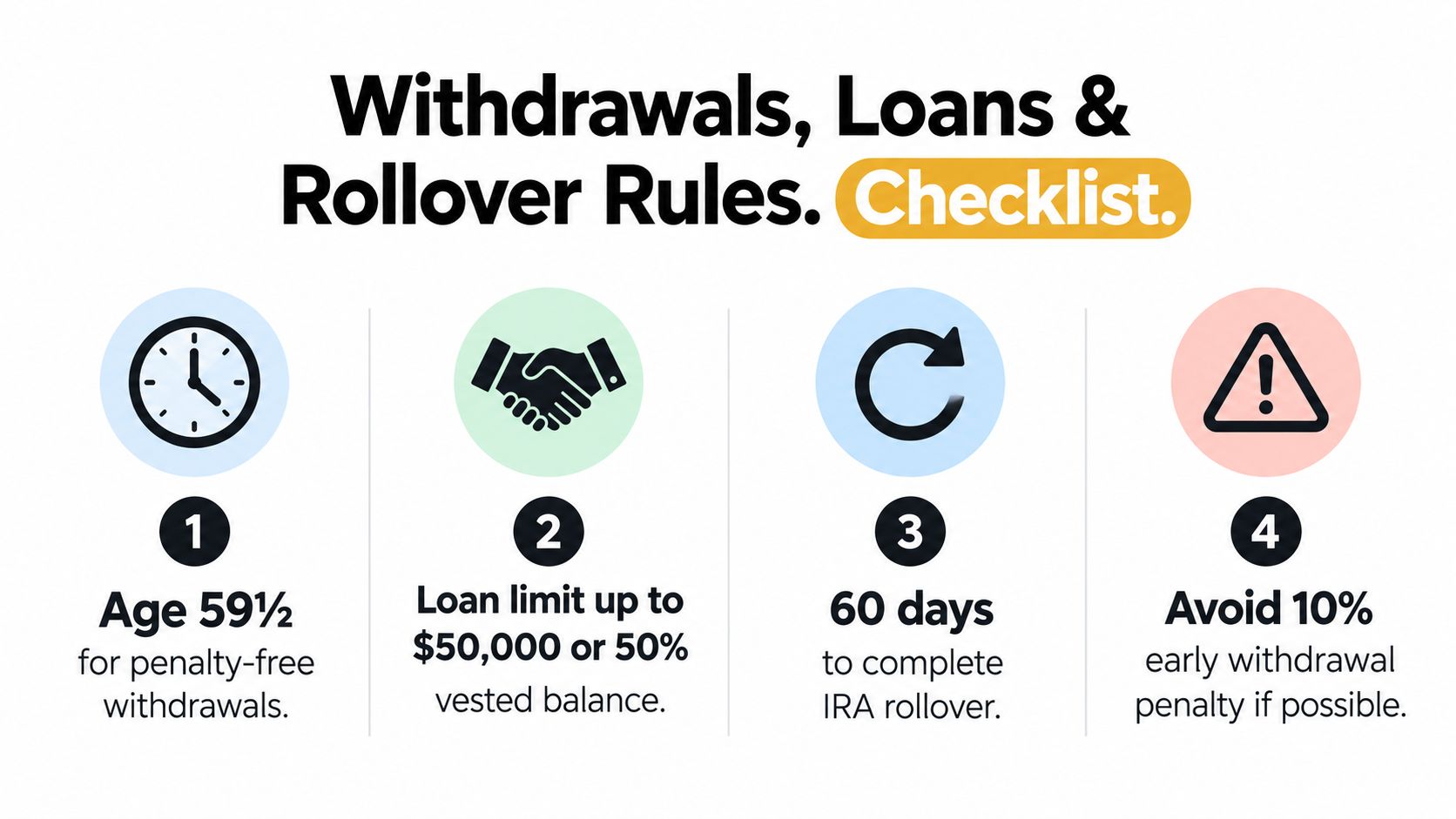
An employee still working for the federal government may have access to certain in-service withdrawal options, including withdrawals at age 59½ or older, subject to TSP rules. Someone separating from service may qualify for different treatment. The commonly discussed rule of 55 can allow penalty-free access to certain employer-plan funds after separation at age 55 or later, but eligibility details matter, and the rule shouldn't be assumed to apply to every account or withdrawal.
TSP loans are another option, but a loan isn't free money. You borrow from your account, repay under the plan's terms, and may face tax consequences if the loan isn't repaid properly or your employment situation changes. A loan also reduces the amount invested while the balance is outstanding.
Direct rollovers require careful handling
A direct rollover sends eligible retirement money from the TSP to another eligible retirement account without sending the funds to you first. That structure can help avoid current taxation, but Traditional and Roth money must be matched with an appropriate receiving account. A Traditional balance and a Roth balance don't automatically receive identical tax treatment.
An indirect rollover puts more responsibility on you. If the money is paid to you, timing and withholding rules can create avoidable complications. Before requesting a distribution, identify whether the receiving account accepts the specific type of money and whether the transaction is direct.
Federal and state taxes are separate questions
The TSP generally withholds federal tax from taxable withdrawals, but it generally doesn't withhold state or local tax. It still reports payments to applicable state tax agencies. That means the amount withheld on a federal form isn't necessarily your final tax bill.
A retiree coordinating TSP income with a FERS annuity, Social Security, required minimum distributions, and a spouse's income should model the combined picture. A TSP withdrawal can affect total taxable income and may influence whether Social Security benefits become taxable. Moving to another state adds another planning variable, because state treatment differs.
A withholding amount is a payment toward tax, not a guarantee that the tax bill is covered.
Required minimum distributions generally begin at age 73 under the rules described in the provided TSP guidance, but personal circumstances and law changes can affect the details. Use the TSP withdrawal options guide and confirm current requirements before selecting installments, partial withdrawals, a rollover, or a full distribution.
Retirement Strategy Tips by Career Stage and Next Steps
A new hire should first establish the payroll election needed to receive the full match, then choose a fund approach they can maintain. An L Fund can provide a simple diversified starting point, while a custom mix requires more ongoing attention.
A mid-career employee should review contribution rates, investment allocation, beneficiary designations, and the Traditional versus Roth balance as income changes. Rebalancing can restore the intended mix after markets move, but it shouldn't become an excuse to trade emotionally.
Someone near retirement needs an income plan, not just an account balance. Coordinate TSP withdrawals with the FERS annuity, Social Security, other household income, taxes, and healthcare costs. If you're also exploring complementary income ideas, educational resources about building hands-off rental income may help you evaluate whether real estate belongs in your broader plan.
Use this short checklist:
- New hire: Confirm the payroll election and capture the full match.
- Mid-career: Review savings rate, tax type, allocation, and beneficiaries.
- Near retirement: Model withdrawal timing, withholding, state taxes, pension income, and Social Security together.
- Everyone: Revisit the plan after major changes in pay, marriage, divorce, relocation, or retirement timing.
Federal Benefits Sherpa offers a free 15-minute benefit review, retirement planning, and gap analysis to help federal employees connect TSP decisions with pensions, healthcare, and Social Security. Visit Federal Benefits Sherpa to request a review and turn your next TSP decision into part of a complete retirement plan.
