Thrift Savings Plan Catch Up: The 2026 Guide
You're in the exact window where most federal employees start asking a hard question in the car, on the train, or after checking Employee Express for the third time, can I still catch up, and if I can, am I set up to do it right? The answer is yes, but only if you treat Thrift Savings Plan catch up as a payroll problem first and a retirement theory problem second. If you wait until December, you usually miss money, matching, or both.
What a TSP Catch-Up Contribution Is
A Thrift Savings Plan catch up contribution is extra elective deferral you put in after the regular annual limit is filled. For 2026, the regular elective-deferral limit is $24,500, and employees who are age 50 or older by the end of the calendar year may add $8,000 more, for a possible $32,500 employee contribution total, according to the IRS catch-up contribution guidance.
That does not mean you have to be behind to use it. The IRS treats catch-up contributions as additional elective deferrals available when the plan allows them, not as a rescue for people who missed earlier savings. If your agency offers the TSP and you meet the age rule, you can use it.
Federal employees near retirement usually care about catch-up contributions for one reason, they want one more clean payroll lever to push savings higher before they stop working. That matters most if you are in a higher grade, finally have room in the budget, or just realized your TSP balance needs more weight before separation.
A few people confuse this with IRA catch-up rules. Don't. The TSP sits inside the broader world of defined-contribution plans, alongside 401(k), 403(b), and governmental 457(b) plans, but the payroll mechanics are plan-specific. If you also want a separate angle on penalty exceptions outside the federal system, this resource on retirement penalty exceptions for business owners is useful context, especially if you are comparing workplace plans.
Practical rule: if you qualify by age, stop asking whether you are allowed to catch up. The practical question is whether your payroll election will still be running after the regular limit is reached.
The 2026 Dollar Limits in Plain English
Start with the payroll numbers, because that is where this gets real. For 2026, the standard employee limit is $24,500, the regular age-50 catch-up is $8,000, and employees who turn 60, 61, 62, or 63 during 2026 get the enhanced $11,250 catch-up amount.
That age-band rule matters more than people expect. A worker who is 60 in 2026 does not use the same catch-up ceiling as someone who is 50 to 59, or 64 and older. Your payroll election has to match the age band you fall into for that year, or you leave money on the table.
These are annual limits, and they reset with cost-of-living adjustments. A 2025 election can be wrong in 2026 even if it looked fine before. Use the 2026 TSP max contribution guide to sanity-check your payroll setup before the year starts.
| 2026 TSP Catch Up Limits by Age Band | Regular Elective-Deferral Limit | Catch Up Amount | Maximum Employee Contribution |
|---|---|---|---|
| Age 50 to 59, or 64 and older | $24,500 | $8,000 | $32,500 |
| Age 60, 61, 62, or 63 during 2026 | $24,500 | $11,250 | $35,750 |
A 60-year-old federal employee who sets payroll correctly can reach $35,750 in employee contributions in 2026. The agency match does not grow with catch-up dollars. It still follows the normal matching formula, generally up to 5% of salary, as the TSP explains in its contribution types.
That is the part to watch. Catch-up raises what you can defer, not what your agency matches.
How the Automatic Spillover Method Works
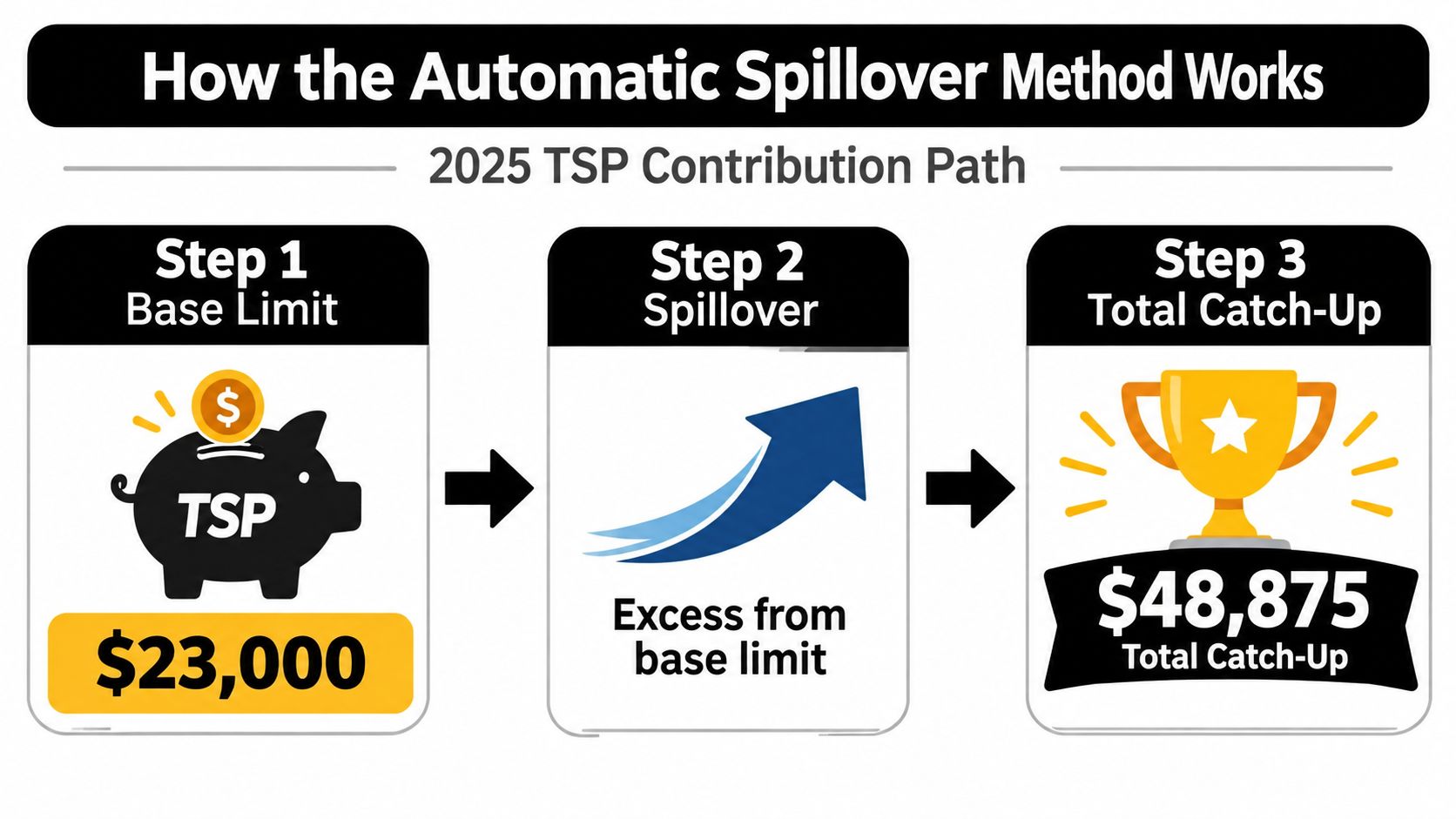
The TSP does not ask for a separate catch-up election. It uses an automatic spillover method, which means payroll keeps taking deductions until your regular elective-deferral limit is reached, then any additional employee contributions spill into catch-up status. If your payroll election is set too low, the spillover never happens. If it is set too high and stops early, you never reach the catch-up bucket.
Payroll mechanics matter here more than retirement theory.
What happens is simple. Your agency keeps sending TSP deductions through payroll, and the system sorts them in order. First comes the regular limit. After that, later deductions become catch-up contributions automatically. That is why the wrong election setting can leave a federal employee short even when the intent was fine.
The TSP also says catch-up spillover stays eligible for agency matching within the normal matching framework, generally up to 5% of salary matching rule. The match does not become extra just because you are making catch-up contributions. It still follows the usual rule.
Keep the deductions running after the regular limit is hit. That is the payroll trigger that matters. Stop the deductions early, and you stop the spillover.
If you want a practical reference for changing your election without guessing, the TSP contribution change walkthrough lays out the mechanics clearly.
The SECURE 2.0 Roth Catch Up Rule for Higher Paid Feds
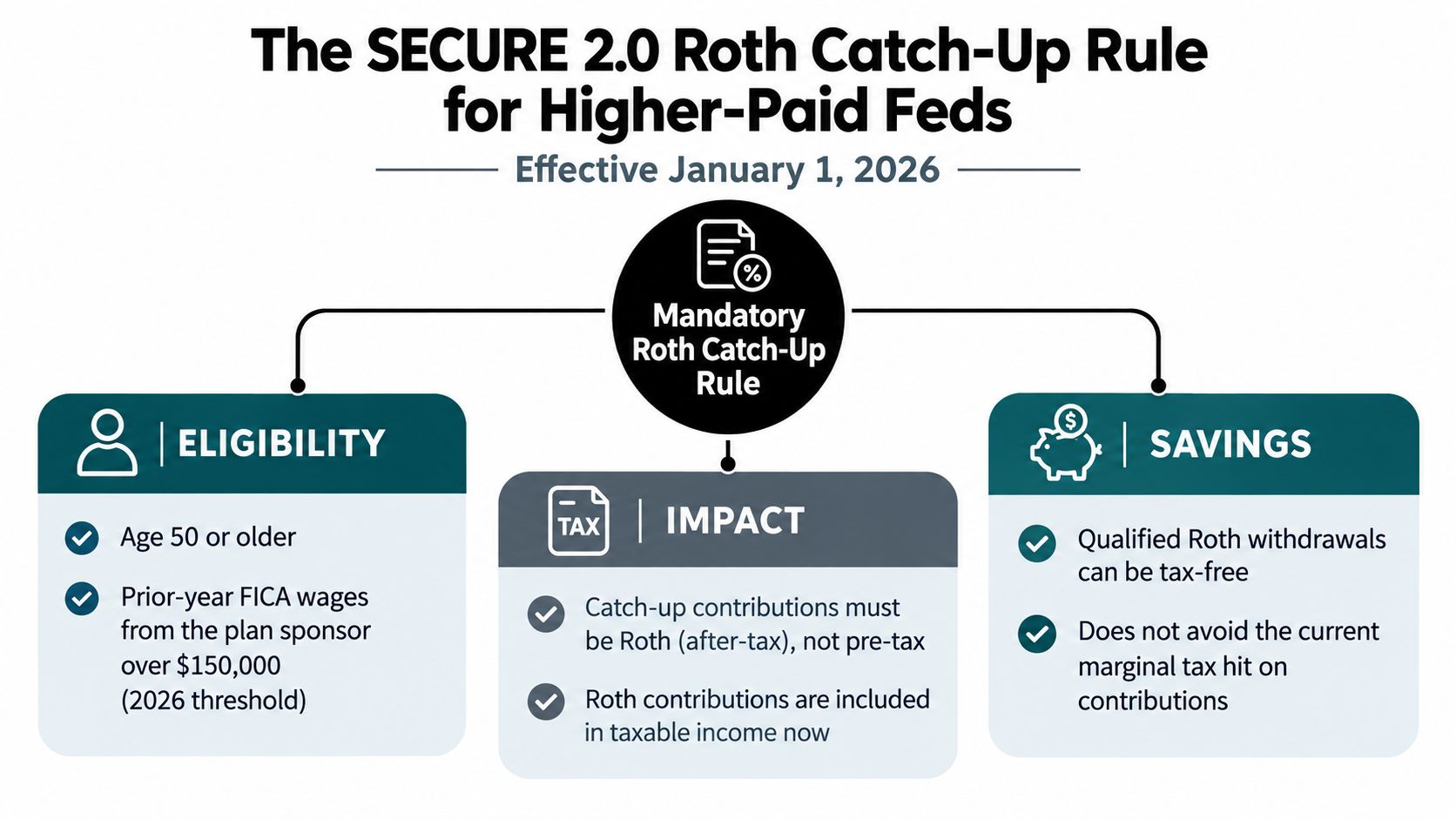
Starting January 1, 2026, the rule changes the tax bucket for catch-up dollars, not your right to make them. If your prior-year Medicare wages from TSP-eligible service cross the IRS threshold, the catch-up portion has to go to Roth, and the TSP says the threshold is adjusted for inflation annually. The 2026 figure is $150,000, based on prior-year Medicare wages in the TSP SECURE 2.0 update.
That wage test is broader than base pay. It generally tracks W-2 Box 5 Medicare wages, so overtime, locality pay, bonuses, and multiple TSP-eligible jobs can push a federal employee over the line even when the salary grade alone would not. Payroll does not care what you expected. It cares what showed up in Medicare wages.
The practical risk is simple. If your payroll election is still set around Traditional TSP, your catch-up dollars can be forced into Roth once the regular annual limit is reached. The contribution still goes through. The tax treatment changes under the hood. That is a payroll-design problem, not a retirement-theory problem.
Higher earners should understand the bracket side too, because Roth catch-up dollars are funded with after-tax money. HireAccountants on tax brackets is a clean refresher on how marginal rates work without pretending payroll is abstract.
Uniformed-services members in combat zones face an even stricter setup. Catch-up contributions must be Roth, and tax-exempt traditional contributions cannot be used for catch-up at all under TSP contribution rules. Civilian assumptions do not carry over there.
The part most guides soften is the payroll consequence. Once you cross the threshold, the system does not ask for a year-end opinion. It follows the account type and tax treatment already on file. If you want the regulatory mechanics in one place, use the SECURE 2.0 catch-up guide before you change deductions.
Setting Up Payroll to Reach the Catch Up
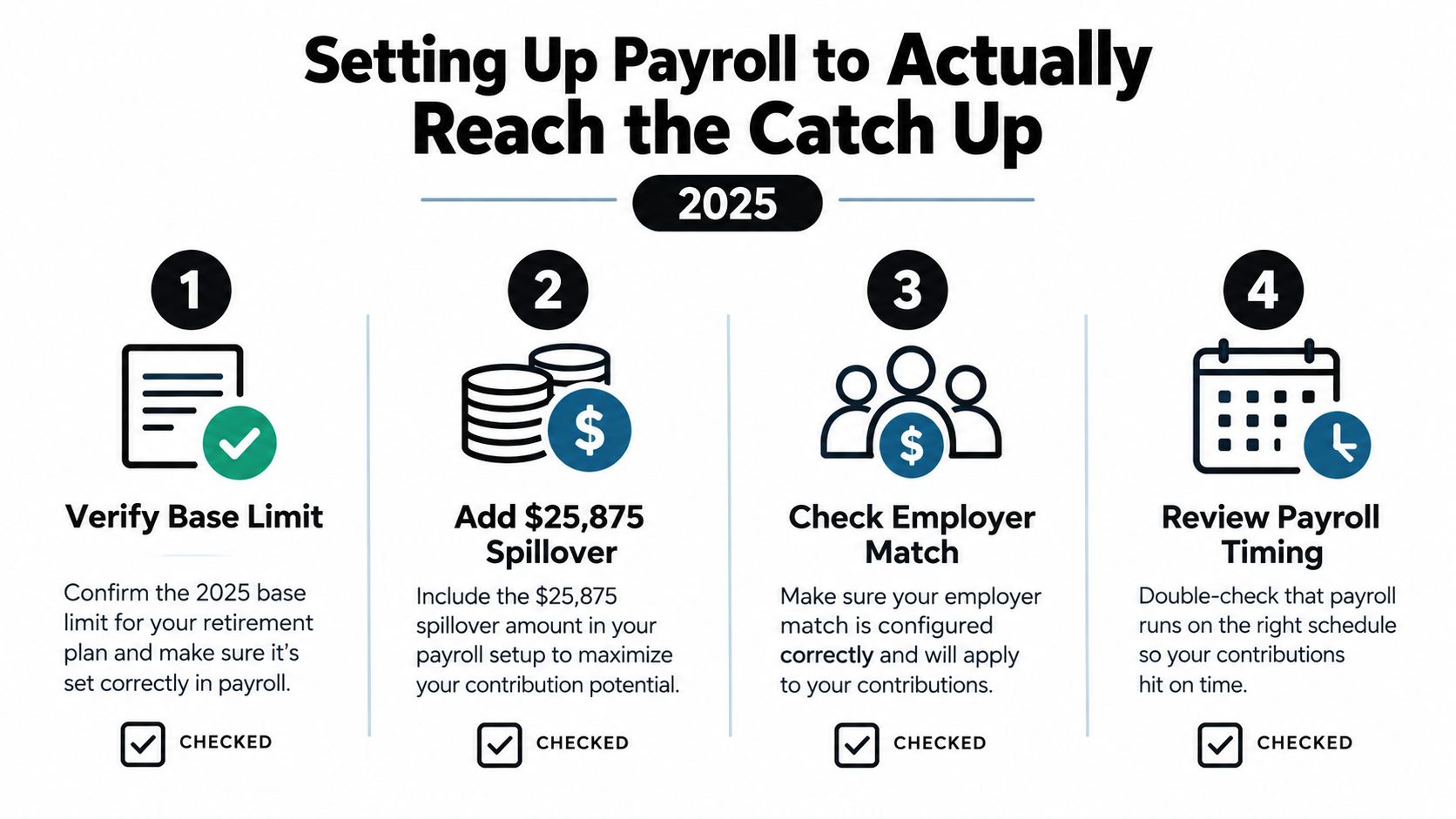
A lot of federal employees think they need a heroic December adjustment. They do not. They need a payroll election that holds up through the entire year. If you want the money to land, think in pay periods, not in wishful percentages.
Build the election off the year, not the month
Start with expected annual TSP-eligible pay, then divide your employee contribution target across the remaining pay periods. That keeps the deduction steady and lowers the chance that you hit the regular limit too early. Front-loading looks aggressive, but it often leaves a gap later in the year when catch-up dollars should still be flowing.
Agency payroll systems do not all behave the same. Biweekly payroll and semimonthly payroll can reach the limit at different times, and a bonus, award, or overtime spike can push one employee over the line much sooner than expected. If your agency portal makes edits painful, use how to change TSP contributions and maximize retirement savings as a practical guide while you work through the screens.
That is the part many people miss. Once the regular limit is exhausted, catch-up can only continue if payroll is still sending the right deduction type on the right schedule. If the election is too aggressive early in the year, the system can stop funding TSP before the final pay periods even arrive.
Use a payroll check, not a wish list
- Verify the current election: Confirm whether payroll is using Traditional, Roth, or a split.
- Check the pay-cycle math: Make sure the deduction fits biweekly or semimonthly timing.
- Watch for early exhaustion: Bonus-heavy pay can use up the regular limit ahead of schedule.
- Review before the last stretch: Fix the election before the year-end pay periods disappear.
The point is simple, payroll controls the result. A good election keeps catch-up dollars moving without forcing a last-minute scramble.
Real Scenarios From the Late Career Federal Workforce
A 50-year-old GS-13 often asks the wrong question first. The issue isn't whether you started federal service at 47, it's whether you're age-eligible and whether payroll is still funding the account after the regular limit is hit. If your pay election is too low, you won't get the full catch-up just because you qualify.
A 62-year-old who plans to retire in two years has a different problem. The enhanced age band matters only in the calendar year you turn 60, 61, 62, or 63, and the IRS ties that eligibility to the age reached during the year, not to being continuously inside the band per IRS limits guidance. If you turn 64, the special higher limit disappears the following year.
A federal worker with two TSP-eligible jobs has to coordinate across payroll systems. One agency doesn't care what the other agency deducted, but IRS catch-up treatment still has to be tracked across plans. That's where people accidentally overshoot one place and undershoot another.
A uniformed-services member in a combat zone has the cleanest rule and the least flexibility. Catch-up dollars go Roth, and that has to be built into the election from the start.
IRS guidance also makes one thing clear, you don't have to be “behind” to use catch-up contributions. If the plan permits them and your age qualifies, the door is open.
The best move in all four cases is the same, check age, check payroll, check whether the right tax bucket is being used, then leave the election alone long enough to do its job.

Putting It All Together Before Your Next Pay Period
Treat Thrift Savings Plan catch up as a payroll coordination task, not a December clean-up project. First, confirm your current election and whether it's Traditional, Roth, or split. Second, project your 2026 pay and make sure the deduction will hit $32,500 or, if you qualify for the enhanced age band, $35,750.
Third, estimate whether your prior-year Medicare wages will exceed $150,000, because that determines whether catch-up dollars must go Roth under the SECURE 2.0 rule as the TSP states. Fourth, adjust payroll now so the spillover happens automatically instead of hoping it works itself out later.
If you want help pressure-testing your TSP elections, Federal Benefits Sherpa offers retirement planning support, gap analysis, and guidance that's built for federal employees making late-career contribution decisions. Visit Federal Benefits Sherpa if you want a tighter read on whether your current payroll setup is going to deliver the contribution total you think it will.
