Social Security Planning for Married Couples: A 2026 Guide
What happens to your spouse's income if you die first, and how much of that future income did your claiming decision create or eliminate? That question exposes a gap in conventional Social Security advice. Many couples compare two individual retirement benefits, choose a convenient filing age, and overlook the household that remains after one person dies.
Social Security planning for married couples works better when you treat benefits as a coordinated system alongside a federal pension, TSP withdrawals, taxes, healthcare costs, and survivor protection. The right strategy isn't necessarily the one that produces the largest combined check while both spouses are alive. It may be the strategy that gives the surviving spouse enough dependable income decades later.
Why Coordinated Social Security Planning Matters for Couples
Consider a federal couple, Maya and Daniel. Maya earned more during her career, while Daniel has the smaller retirement benefit. Both are eligible for Social Security, and both are considering filing at the same time because the decision feels fair and straightforward. That approach may provide a simple starting point, but it treats two connected benefits as if they were unrelated accounts.
If Daniel dies first, Maya's income may change. If Maya dies first, Daniel may lose the smaller of the two Social Security checks, while household expenses, housing costs, and healthcare needs continue. The higher earner's filing age can influence not only that person's retirement income, but also the survivor benefit available to the other spouse.
Social Security has supported families since its early design. The original Social Security Act of 1935 generally paid old-age benefits only to the covered worker. The Social Security Administration's historical account of the 1939 amendments explains that Congress later added benefits for spouses, children, and survivors before retirement benefits began in 1940. Under those early rules, a qualifying wife at least age 65 could receive a spousal benefit equal to 50% of the retired worker's benefit, while an eligible widow could receive 75%.
That history matters because it reveals the program's family-oriented structure. One worker's record can affect household cash flow, spousal eligibility, and the income available to a surviving spouse.
Household planning versus individual planning
Individual maximization asks, “When should I claim my benefit?” Household maximization asks, “How should both benefits work together during retirement and after the first death?” The second question is more useful for couples with unequal earnings, an age difference, a prior marriage, or a federal pension that supplies much of their income.
Start with a shared cash-flow plan. A practical resource such as Peaceful Mindful Pocket's budgeting approach can help couples organize income, spending, goals, and financial responsibilities before they make an irreversible claiming decision. Then add Social Security scenarios to that household budget rather than deciding in isolation.
Planning principle: A claiming strategy isn't complete until it shows income for both spouses while both are alive and for the survivor after the first death.
The first review should identify the higher earner, the lower earner, each person's estimated retirement benefit, potential spousal eligibility, survivor needs, pension income, and available TSP resources. That information creates the foundation for a decision based on the couple's actual risks, not a rule that both people should file together.
Understanding Spousal Benefits and Dual Entitlement
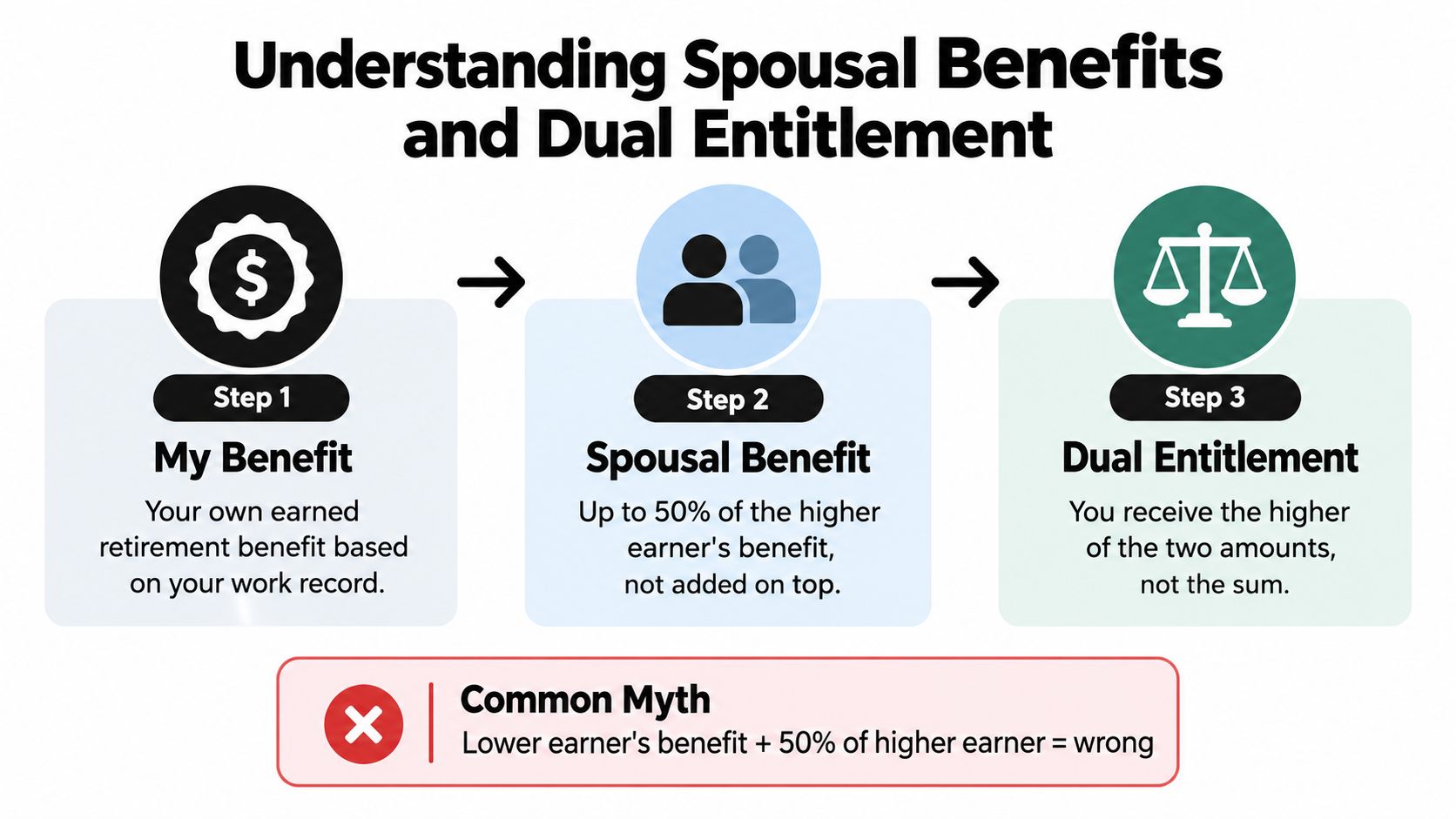
The most common misunderstanding is that a lower-earning spouse receives their own retirement benefit plus an additional 50% of the higher earner's benefit. That isn't how the calculation generally works. At full retirement age, a qualifying spouse's maximum spousal amount can reach 50% of the worker's primary insurance amount, subject to eligibility and reduction rules, but Social Security coordinates the two amounts.
The calculation in plain English
Suppose the higher earner's primary insurance amount is $2,400 per month. At the lower earner's full retirement age, the maximum spousal amount based on that record would be $1,200 per month, as described in the Social Security Bulletin discussion of dual entitlement.
Now suppose the lower earner's own retirement benefit is $700 per month. Social Security generally pays that person's own benefit first and adds a spousal supplement that brings the total toward the applicable spousal amount. The supplement could be approximately $500, producing $1,200 in total, not $1,900.
This is called dual entitlement. Think of the spousal benefit as a floor or target amount, not a second full check. The person's own work record remains part of the calculation, and the spousal portion fills the difference when the applicable spousal benefit is higher.
Why timing changes the result
The 50% figure applies at full retirement age. Claiming a spousal benefit earlier can permanently reduce the amount. A spouse also generally must meet marriage and other eligibility conditions. The estimate on a Social Security statement may show an individual retirement benefit, but it won't automatically answer every question about the household's spousal supplement.
For a federal household, gather each person's earnings record, primary insurance amount, full retirement age, employment plans, and prior-marriage history. Then compare the projected own benefit with the possible spousal amount. The Federal Benefits Sherpa guide to calculating spousal Social Security benefits can serve as a focused reference when you're organizing those figures.
Don't add the two headline numbers together without checking the dual-entitlement adjustment. That single error can make a retirement budget look stronger than the actual deposit.
The Survivor Benefit Imperative in Married-Couple Planning
A couple can appear financially secure while both spouses are alive and still leave the survivor exposed. The risk is especially serious when one spouse earned substantially more or when a federal pension and Social Security provide most of the household's dependable income.

The higher earner's claiming age has two effects. Delaying that worker's retirement benefit after full retirement age, up to age 70, can increase the worker's own benefit. Those delayed-retirement credits can also be included when Social Security calculates a surviving spouse's benefit after the worker dies, according to the Social Security regulation on delayed retirement credits and survivor benefits.
That makes the higher earner's delay more than a personal break-even decision. It can function as longevity insurance for the spouse who may live alone for many years. Spousal benefits don't earn delayed-retirement credits after full retirement age, so the analysis must distinguish the higher earner's retirement benefit from the lower earner's spousal benefit.
Why longevity changes the decision
The Social Security Administration states that married couples reaching age 65 typically have at least a 50% chance that one member will live beyond age 90. That doesn't predict what will happen to a particular couple, but it highlights why survivor income deserves a place in the initial decision rather than an afterthought.
A survivor may face a smaller household income but many of the same obligations. The mortgage, property expenses, healthcare costs, taxes, and support for family members may not fall in proportion to the lost benefit. A higher earner who delays can create a larger income stream that remains relevant after the survivor loses the other check.
Watch this explanation as a supplement to your written projections, especially if the couple is weighing a short-term income need against long-term protection.
A useful comparison should show at least these outcomes:
- Both spouses claim early: More immediate income, but potentially lower individual and survivor benefits.
- Lower earner claims while higher earner delays: Some household income begins while the larger worker's benefit grows.
- Both delay: The couple may need more bridge income, but the eventual benefit structure may provide stronger protection for the survivor.
The right answer depends on health, resources, work status, pension elections, and spending needs. A detailed survivorship guide for federal employees can help frame the questions, but the final analysis should use the couple's own estimates and survivor budget.
Strategic Coordination Between Spousal and Survivor Benefits
Spousal and survivor benefits don't follow the same optimization logic. A spouse claiming at full retirement age can generally receive up to 50% of the worker's primary insurance amount, while an early claim can reduce the spousal amount. A nondisabled surviving spouse may begin survivor benefits at age 60, or at age 50 if disabled, and survivor benefits are generally highest when claimed at the survivor's full retirement age, according to the SSA claiming guidance.
The distinction creates opportunities for sequencing. A surviving spouse may start one benefit and later switch to the other when the alternative becomes larger. For example, the survivor might use a survivor benefit first and delay their own retirement benefit, or use their own benefit first and switch to the survivor benefit later. The better path depends on the relative amounts, cash-flow needs, employment income, and expected longevity.
A practical sequence for couples
Start with the higher earner's benefit because it usually has the greatest survivor-income effect. Then test whether the lower earner can claim earlier while the higher earner delays. This can provide income without immediately locking in the larger worker's lower retirement benefit.
Next, examine the survivor's choices separately. Don't assume that the best joint-life strategy is also the best widow or widower strategy. Model what happens if the higher earner dies first, then reverse the order and test the other possibility.
Use after-tax income rather than gross Social Security alone. Include federal pension income, TSP withdrawals, Medicare premiums, employment income, and essential spending. A claiming age that looks attractive before taxes may produce a different result once withdrawals and healthcare costs enter the household budget.
Decision rule: Choose the sequence that your household can sustain, not the sequence that looks best on a single Social Security estimate.
Estate documents belong in the same conversation. Beneficiary designations and account instructions won't replace Social Security planning, but couples should coordinate them with their income strategy. A guide to online will generators from LegesGPT can help readers understand document options, while complex estates or family circumstances may require qualified legal advice.
The survivor plan should be written down. Identify which benefit begins first, which benefit is deliberately delayed, how TSP withdrawals bridge the gap, and who will contact Social Security after a death. A clear sequence reduces the chance that grief or administrative confusion will force a rushed decision.
Navigating Divorced-Spouse Rules and Recent Legal Changes
A prior marriage can create a separate Social Security path. A divorced spouse may qualify for up to 50% of a former spouse's primary insurance amount when the marriage lasted at least 10 years, or 120 months, subject to additional rules. That benefit is based on the former spouse's record, and the divorced person's own retirement benefit still affects how dual entitlement works.
Gather the details before estimating the benefit:
- Marriage length: Confirm that the marriage met the required duration.
- Current status: Review whether remarriage or a later divorce changes eligibility.
- Former spouse's record: Collect available information about the former spouse's work record and benefit.
- Survivor status: Ask whether a former spouse's death creates a potential divorced-survivor benefit.
- Filing age: Test the effect of claiming before full retirement age.
Don't rely on an old retirement-planning article that treats every federal pension case the same. The Social Security Fairness Act, signed on January 5, 2025, ended the Windfall Elimination Provision and Government Pension Offset for benefits payable from January 2024 onward, as explained by the Social Security Administration's Fairness Act guidance. SSA says the change applies to workers' own benefits as well as spouse and surviving-spouse benefits, and that more than 2.8 million people had been affected by WEP or GPO.
Questions for federal employees with non-covered pensions
The legal change doesn't eliminate the need for careful administration. Ask whether SSA has enough information to recalculate a benefit, whether a spouse or survivor benefit is affected, and whether a prior claim needs review. Don't assume an automatic adjustment answers every household question.
SSA also says survivor-benefit applications aren't available online. For some retirement and survivor claims, retroactivity is generally limited to six months, so filing decisions and records can have financial consequences. Keep pension statements, marriage and divorce records, death certificates when applicable, Social Security notices, and prior claim correspondence in one file.
Federal employees should separate current rules from obsolete WEP and GPO examples. Then rebuild the couple's projection using the pension, restored Social Security eligibility where applicable, survivor coverage, and the higher earner's claiming age.
Integrating Social Security with Federal TSP and Pensions
A federal retirement plan has several moving parts. Social Security may provide one income stream, a FERS pension another, and TSP withdrawals a flexible source for spending, taxes, or a bridge to delayed benefits. Treating each source separately can hide the trade-offs.
Suppose one spouse has the larger Social Security benefit and a federal pension, while the other spouse has a smaller benefit and access to TSP assets. The couple could claim both Social Security benefits early and preserve TSP funds. They could also use selected TSP withdrawals to cover expenses while the higher earner delays, or combine a lower earner's Social Security with pension income and modest withdrawals.
| Coordination choice | Immediate effect | Survivor question |
|---|---|---|
| Claim both Social Security benefits early | More Social Security cash flow now | Did the higher earner lock in a smaller survivor-related benefit? |
| Use TSP as bridge income | More flexibility while delaying one benefit | Can the surviving spouse maintain income if pension or benefits change? |
| Delay the higher earner's benefit | Less Social Security at first | Does the larger future benefit better protect the survivor? |
The numbers must come from the couple's own statements and plan documents. Include federal pension survivor elections, TSP withdrawal options, taxes, healthcare costs, and investment risk. A withdrawal that appears manageable on paper may become less comfortable after a market decline or a spouse's death.
GAO found that only 24% of married respondents reported a very strong understanding of how much their spouse would receive, and only 52% of married or formerly married respondents understood that the widow's claiming age affects widow's benefits, according to its analysis of Social Security knowledge. Those findings reinforce the need to explain the survivor outcome in plain language, not just present a combined-income chart.
For additional context on protecting retirement assets, couples can review retirement savings protection insights from Morgan & Morgan Attorneys. Federal employees can also consult the Government Pension Offset explanation, while remembering that older GPO guidance may not reflect the Fairness Act changes.
The purpose of TSP withdrawals isn't automatically to delay Social Security. It's to give the household options. Use the portfolio when it supports a deliberate survivor strategy, preserves essential liquidity, and fits the federal pension and tax picture.
Putting It All Together, A Federal Couple's Action Plan
Take a hypothetical federal couple, Elena and Marcus. Elena is the higher earner and expects a larger Social Security benefit. Marcus has a smaller work record, a federal pension, and TSP assets available for flexible withdrawals. Their first task isn't choosing a filing age. It's assembling the records that show what each decision would do.
They collect Social Security estimates, earnings histories, full retirement ages, federal pension projections, TSP balances, survivor-election details, tax information, marriage records, and any prior-marriage documents. They also write a survivor budget that separates essential expenses from discretionary spending.
Three scenarios to test
- Early household income: Both spouses claim as soon as their plan allows, preserving more TSP assets but accepting lower benefit amounts.
- Higher-earner delay: Marcus begins a benefit if appropriate, while Elena uses pension income and planned TSP withdrawals to delay the larger Social Security benefit.
- Survivor-first design: The couple selects the sequence that provides the strongest sustainable income for the survivor, even if the joint-income total looks less attractive during the years when both are alive.
They compare after-tax cash flow, pension survivor income, TSP sustainability, healthcare expenses, work income, and the result after the first death. They also identify which assumptions would change the recommendation, such as a decision to keep working, a different pension election, or a need for earlier portfolio withdrawals.
The final plan should fit on a practical checklist: who files first, which benefit is delayed, how TSP withdrawals fill the gap, what survivor income remains, and which documents must be updated. Revisit the analysis when federal rules, household health, employment, or pension choices change.
Federal Benefits Sherpa helps federal employees coordinate Social Security timing with FERS pensions, TSP decisions, healthcare considerations, and spousal survivor benefits. Visit Federal Benefits Sherpa to review available retirement-planning resources and request guidance for your household's specific situation.
