Social Security Benefits Retirement Age in 2026
Someone born in 1960 or later has a full retirement age of 67; claiming at 62 cuts the monthly benefit by about 30%, while waiting until 70 raises it by about 24%. For federal employees, the key is that leaving government service and filing for Social Security are separate decisions.
That distinction can shape retirement income for years. Your birth year sets the age adjustments, but your annuity, TSP savings, earnings, health coverage, and household's survivor needs all affect whether it makes sense to claim early, at full retirement age, or later.
Benefit Percent by Birth Year and Claiming Age
For a person born in 1959, the full retirement age is 66 years and 10 months. The table shows how the age adjustment changes with birth year, using age 62 for early claiming and age 70 for delayed credits.
| Birth year | Full retirement age | Reduction at 62 | Increase by waiting to 70 |
|---|---|---|---|
| 1937 or earlier | 65 | 20% | No delayed credits |
| 1938 through 1942 | 65 and 2 to 10 months | About 20% to 23.3% | No delayed credits |
| 1943 through 1954 | 66 | 25.0% | 32% |
| 1955 | 66 and 2 months | 25.8% | About 30.7% |
| 1956 | 66 and 4 months | 26.7% | About 29.3% |
| 1957 | 66 and 6 months | 27.5% | About 28% |
| 1958 | 66 and 8 months | 28.3% | About 26.7% |
| 1959 | 66 and 10 months | 29.2% | About 25.3% |
| 1960 or later | 67 | 30% | 24% |
The Social Security Administration's 2026 birth-year chart shows the full retirement age rising in steps. It is 65 for people born in 1937 or earlier, 66 for those born from 1943 through 1954, and 67 for anyone born in 1960 or later. For birth years between those groups, the age rises by two months per year.
The birth-year row gives you the adjustment, not your personal benefit amount. Your estimate is the starting point, and the age adjustment changes that amount. For example, someone born from 1943 through 1954 who claims at 62 receives 25% less than their full-retirement-age benefit.
Delayed retirement credits apply to people born in 1943 or later who wait beyond full retirement age, up to age 70. The credit rate is 8% for each full year of delay. The total increase depends on how many months pass between full retirement age and claiming at 70.
For a broader overview of navigating retirement benefit complexities, consider how the age adjustment fits into your household's income choices. Mark your birth-year row, then use your estimated benefit to compare the monthly amounts. Cost-of-living adjustments apply to the benefit after the claiming-age adjustment; they do not erase a reduction from claiming early.
How Early Claiming Cuts the Check for Good
Think of your full retirement age benefit as a whole loaf of bread. Every month you claim before that age takes a set slice from the loaf, and the slice doesn't grow back when you reach full retirement age.
The Social Security Administration calculates the reduction month by month. For the first 36 months before full retirement age, the benefit falls by 5/9 of 1% per month, equivalent to 6 2/3% per year. Each earlier month beyond those 36 reduces it by 5/12 of 1%. The Congressional Research Service's explanation of early claiming describes how those monthly rates produce different cuts for different birth cohorts.
A 60-month example
Suppose you were born in 1960 or later, so your full retirement age is 67, and you claim at 62. That's 60 months early. The first 36 months account for a 20% reduction; the remaining 24 months account for another 10%. The total reduction is 30%.
On a hypothetical full-retirement-age benefit of $2,000 a month, that leaves $1,400 a month before any later cost-of-living adjustments. By contrast, someone with a full retirement age of 65 who claims at 62 is only 36 months early, so the reduction is 20%.
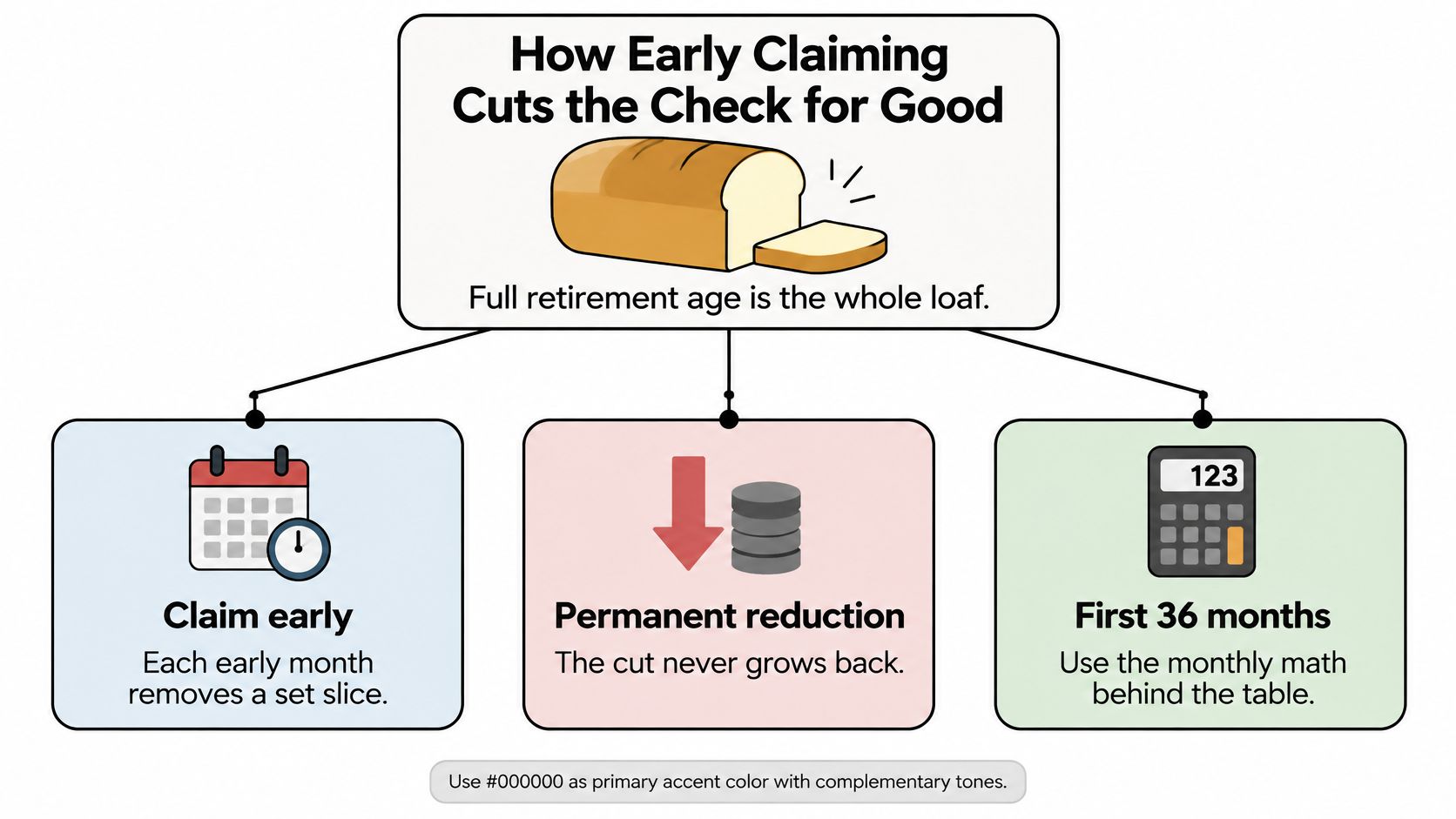
The reduced factor stays in place. Cost-of-living adjustments raise the benefit over time, but they're applied to the smaller base created by your filing age. That can matter to a federal employee who uses early Social Security to cover the period after leaving service: the income helps with the transition, but the lower starting benefit continues through retirement. A worker's claim can also affect the survivor benefit available to a spouse.
Before filing early, compare the immediate income with the permanent change to your retirement baseline.
A useful retirement-income test should account for your birth year and full retirement age, expected longevity, spouse or survivor effects, and what it would cost to draw from TSP or other savings instead of claiming early. For the dollar comparison, the example in “Three Claiming Paths in Monthly Dollars” shows what those choices can mean on a sample benefit.
What Waiting Until 70 Adds Each Year
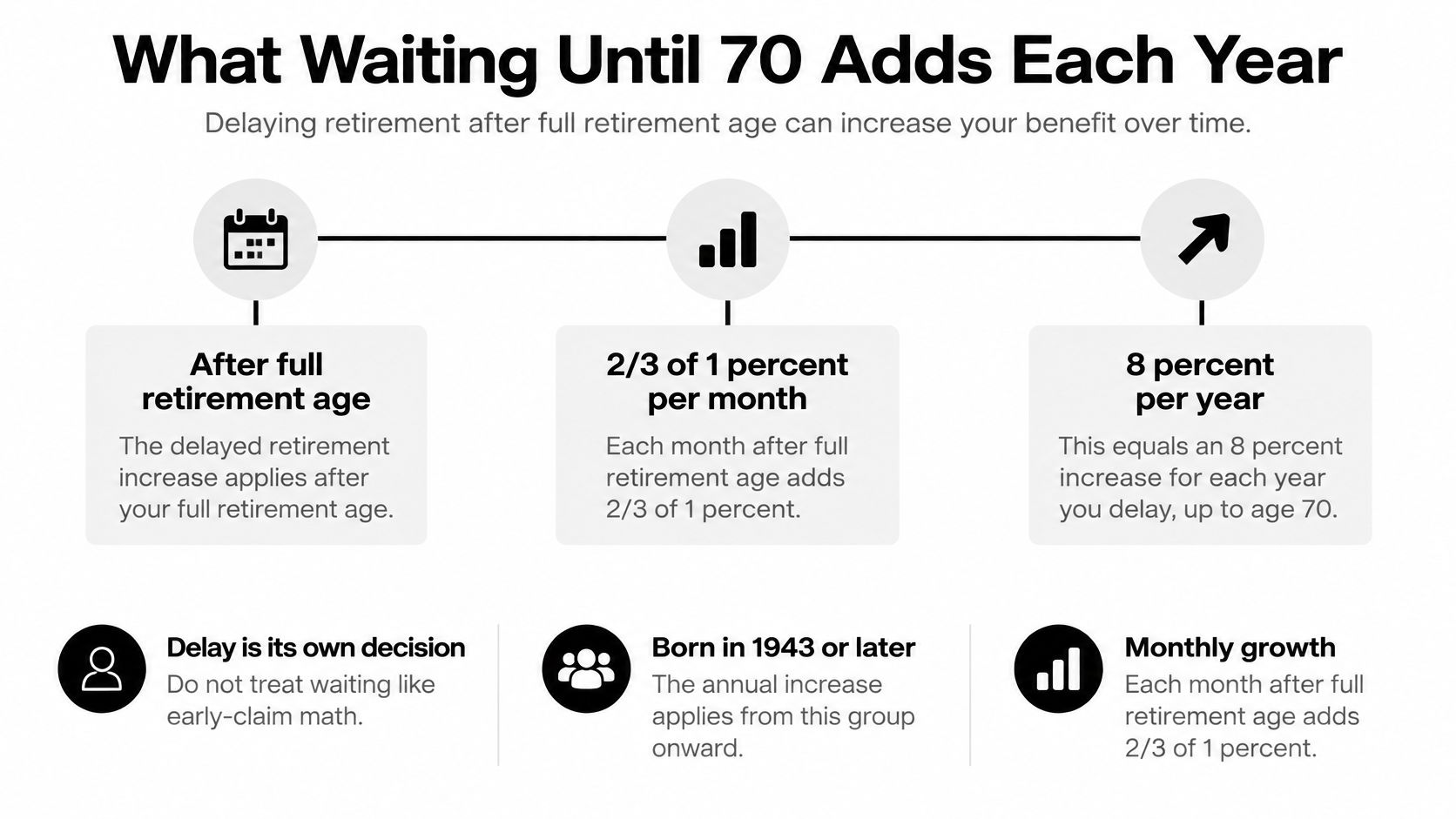
Waiting is a separate choice from claiming early. For workers born in 1943 or later, each month after full retirement age adds 2/3 of 1%, or 8% per year, to the monthly retirement benefit, up to age 70. The credit stops at 70. The Congressional Research Service's analysis of delayed retirement credits explains that the increase is designed to offset the shorter period in which benefits are expected to be paid, not to reward people for staying employed.
For someone with a full retirement age of 67, waiting to 70 means three years of credits and an increase of about 24% before cost-of-living adjustments. A worker with a full retirement age of 66 has four years to build credits. Filing after age 70 doesn't add another retirement-benefit increase.
Treat the larger benefit as longevity protection
A higher monthly benefit can provide a stronger base if you live a long time or if your benefit will support a surviving spouse. Delaying can also mean using more of your own assets first. For a federal employee, compare the guaranteed increase to what happens if you spend TSP savings during the waiting period: consider investment returns, taxes, the possibility of selling investments after a decline, and the cash needed for healthcare.
The question isn't whether a higher benefit is attractive. It's whether your annuity and savings can fund the years before you claim, and whether drawing those assets changes your retirement security in other ways. A household may decide to use TSP withdrawals as a bridge, or may prefer the flexibility of claiming sooner and preserving more savings.
Claiming patterns have shifted as retirement ages have changed. Between 2008 and 2018, the average claiming age rose from 63.6 to 64.7 for men and from 63.6 to 64.6 for women, according to the same Congressional Research Service analysis. That trend isn't a recommendation for any one person. It underscores why you should compare the income available at each filing age with the expenses your own retirement plan must cover.
Leaving Federal Service Without Filing Yet
You can stop working for the federal government without starting Social Security. A federal employee might leave service, use a FERS or CSRS annuity and planned TSP withdrawals, and wait to file. The retirement date and the benefit-claim date are different decisions.
Your earnings history also matters. Social Security calculates a worker's benefit using the highest 35 years of covered earnings. If you leave before you have 35 covered-earnings years, years without covered earnings can affect the calculation. Working longer may replace a lower-earning year with a higher one. The Social Security Administration's guidance on stopping work before claiming explains this connection between work history and benefits.
Check the earnings test before filing while working
If you claim before full retirement age and keep earning wages, the earnings test can affect your payments. In 2026, someone below full retirement age for the entire year can earn $24,480 before the test applies. Social Security withholds $1 for every $2 above that limit. The earnings test ends at full retirement age, and earnings after that don't reduce the benefit.
That withholding isn't the same as the permanent early-claim reduction. Still, if you expect a paycheck above the limit, filing early may provide less immediate income than you expect. Include your work plans when comparing claim dates.
A bridge plan might look like this: leave federal service when you're eligible to retire, use the annuity and planned TSP withdrawals to cover expenses, and file at full retirement age or later if the larger benefit fits your plan. The bridge must be affordable without exhausting assets you'll need later. For a broader look at how FERS income and Social Security fit together, see this FERS pension and Social Security guide.
Who the WEP and GPO Repeal Actually Helps
The Social Security Fairness Act helps people whose pensions are based on work not covered by Social Security. That includes some Civil Service Retirement System employees, but federal employment alone does not qualify someone for a higher benefit. FERS service is generally covered by Social Security, so a typical FERS retiree should not assume the repeal changes their payment.
The law was signed on January 5, 2025, and ended the Windfall Elimination Provision (WEP) and Government Pension Offset (GPO) for benefits payable beginning in January 2024. The Social Security Administration's Fairness Act information says more than 2.8 million people had been subject to WEP or GPO reductions. SSA then began adjusting affected payments and issuing retroactive one-time payments in the months after the law took effect.
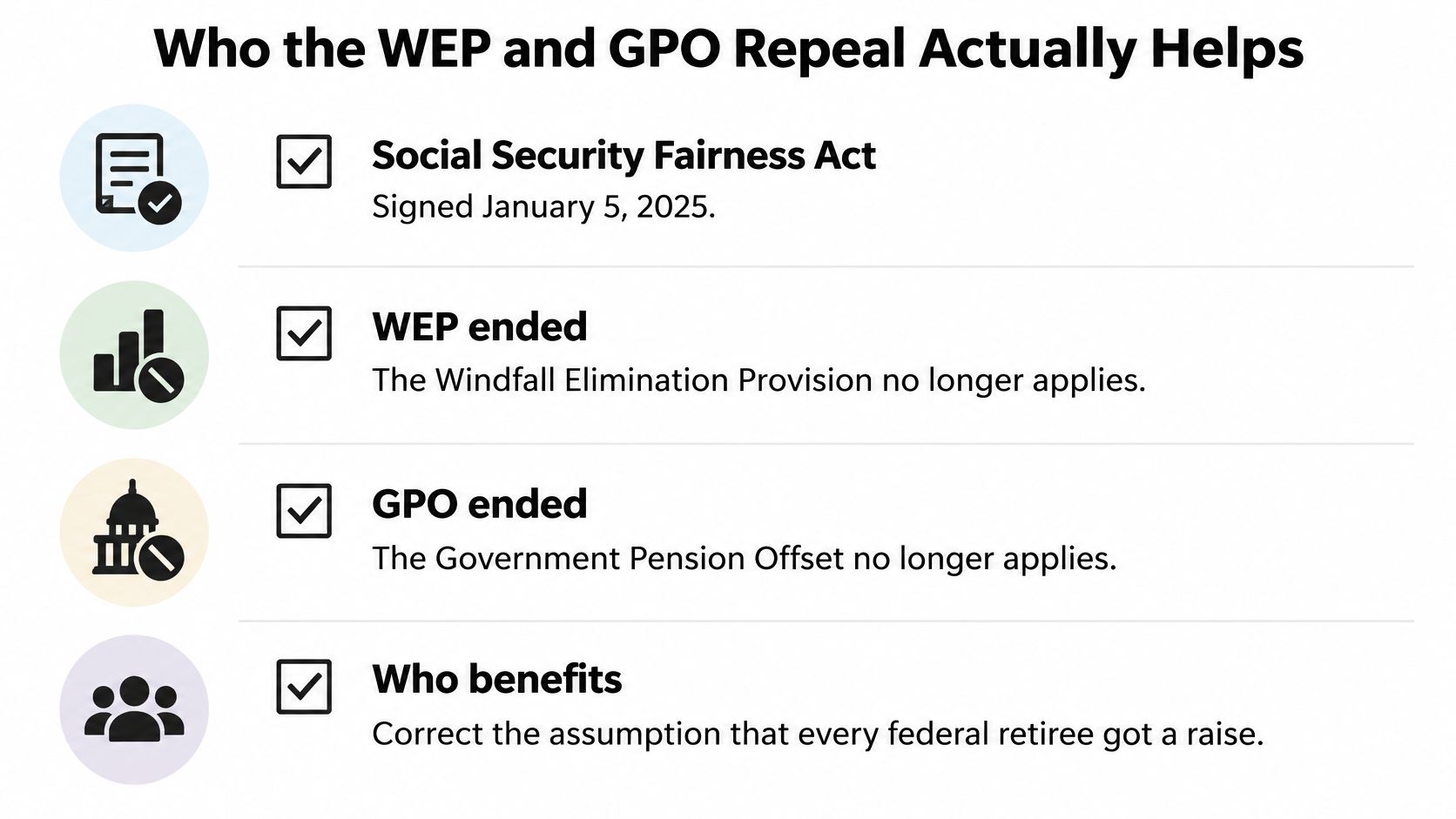
The deciding factor is whether the pension comes from non-covered work, not just whether you worked for the federal government. The repeal can also affect certain spouse and surviving-spouse benefits. That means a change to one person's benefit may matter to household planning, even if the worker's own retirement benefit is unchanged. For details on how the offset affected spouse and survivor benefits, see this guide to the Government Pension Offset.
Review your record before changing your budget
Before counting on a larger payment, check the details that determine whether the repeal applies:
- Pension coverage: Is your pension from CSRS, FERS, or another system?
- Work history: Was the service that earned the pension covered by Social Security?
- Earnings record: Which covered earnings appear on your Social Security record?
- Household benefits: Could a spouse or survivor benefit be affected?
- SSA adjustment: Has Social Security reviewed your record and sent a notice?
A higher payment for one person does not automatically mean every household member qualifies for an increase. Keep the Social Security notice and use the amount SSA calculates when updating your retirement budget.
Three Claiming Paths in Monthly Dollars
Consider a worker born in 1960 or later with a hypothetical full-retirement-age benefit of $2,000 a month. The figures below apply the age adjustments to that example. Your own estimate may be different, so use your personal Social Security statement when planning.
| Claiming age | Monthly benefit | Change vs. FRA |
|---|---|---|
| 62 | $1,400 | $600 less per month |
| 67 | $2,000 | Baseline |
| 70 | $2,480 | $480 more per month |
At 62, the worker gets $600 less each month than at full retirement age. Waiting until 70 adds $480 a month compared with claiming at 67. Those amounts show the tradeoff between getting payments sooner and establishing a larger monthly benefit later.
The age-62 filer receives payments during the years the other worker waits. In a simple planning sketch that ignores cost-of-living adjustments, taxes, and survivor effects, the cumulative totals may cross in the late 70s or around 80. That isn't a forecast for an individual household. It's a reminder that the choice depends on how long benefits are received, how the household funds the waiting period, and whether one person's benefit will later support a survivor.
Apply the comparison to federal retirement income
A CSRS retiree with a pension from non-covered work should compare the previous WEP-reduced estimate with the amount Social Security pays after any Fairness Act adjustment. Don't build a budget around a projected increase until the record confirms it.
A FERS employee who stops working before claiming might use the annuity and planned TSP withdrawals to cover the gap. The aim could be to make the larger benefit available later, but that only works if the bridge withdrawals fit the household's income needs and savings plan.
The right path is the one your pension and savings can fund. The largest percentage on a page isn't automatically the best choice if reaching it leaves you short of cash or puts other retirement goals at risk.
Pick a Filing Age Before You Submit the Claim
Before you file, work through five checks:
- Confirm your birth year and full retirement age. Use the matching row in the first table.
- Get your personal estimate. Sign in to your Social Security account and use your own benefit estimate instead of relying on the hypothetical dollar example.
- Test the cash flow. Compare claiming at 62, at full retirement age, and at 70 with your FERS or CSRS annuity and the amount of TSP savings you could use as a bridge.
- Review pension coverage. If your pension comes from non-covered work, check whether WEP or GPO applied and whether Social Security has recalculated your record.
- Consider household benefits. Ask how your filing age could affect a spouse's or survivor's income before you submit a claim.
Benefit rules change, and this explanation is education, not an instruction to file at a specific age. Federal employees looking at those tradeoffs can also read these Social Security claiming strategies for federal employees.
Federal Benefits Sherpa's optional process is straightforward: learn the basics through the free class or Learning Center, talk with Joe for 15 minutes, get a Gap Report, then decide what to do next. The report includes Social Security timing alongside pension, TSP, healthcare, and survivor considerations. You can call (833) 753-1825. Federal Benefits Sherpa is independent and isn't affiliated with or endorsed by OPM, SSA, the TSP board, or any government agency. Its educational content isn't tax, legal, investment, or securities advice.
If you're nearing retirement or already retired, use Federal Benefits Sherpa to connect Social Security timing with your pension, TSP, healthcare, and survivor choices. Start with the free class or Learning Center, then talk with Joe for 15 minutes and get a Gap Report to help decide what to do next.
