retirement calculator for federal employees: Quick Guide
If you're a federal employee, grabbing any old retirement calculator off the internet is a recipe for disaster. Those generic tools just don't get it. They're built for the private sector and can't begin to grasp the unique three-pillar system that is the Federal Employees Retirement System (FERS).
To get a real, trustworthy projection of your future income, you need a retirement calculator for federal employees. It's the only way to accurately weave together your pension, Social Security, and TSP into a single, cohesive picture.
Why Federal Retirement Planning Is Different

Planning for your post-government life is a completely different ballgame than private-sector retirement planning. Your financial future is built on three distinct pillars, and figuring out how they fit together is the absolute first step toward a comfortable retirement. Generic tools? They simply aren't up to the task.
The whole FERS system is a multi-layered benefits package. I always tell my clients to think of it like a three-legged stool. If one leg is too short or wobbly, the entire thing is unstable. Using a generic calculator is like trying to balance on a one-legged stool—you're ignoring the very structure that's meant to support you.
The Three Pillars of FERS
To get a forecast you can actually rely on, any calculator you use must account for all three of your income streams. Each one comes with its own rulebook, its own calculation formulas, and its own timeline for when you can start drawing funds.
Here's the breakdown:
FERS Basic Benefit Annuity: This is your pension. It’s a defined-benefit plan calculated from your years of service and your "high-3" average salary. The formula is precise, and a good calculator knows whether to apply the 1.0% multiplier or the 1.1% multiplier based on your retirement age and service years.
Social Security: Just like your private-sector friends, your federal service earns you credits toward Social Security. But it can get complicated. Things like the Windfall Elimination Provision (WEP) can throw a wrench in the works if you have a non-FERS pension from another job.
Thrift Savings Plan (TSP): This is your 401(k)-style plan. Its final value hinges on what you contribute, the generous government match you receive, and, of course, how your investments perform over your career.
A purpose-built retirement calculator for federal employees is designed to understand these moving parts. It asks for the right inputs—like your service computation date and your TSP fund choices—to produce a projection that reflects the reality of your federal benefits.
The real challenge for federal employees isn't just one big number. It's figuring out how three separate income sources will flow together in retirement. A specialized calculator doesn't just add them up; it models their interaction over time, giving you a much more reliable roadmap.
Without a tool that understands this complexity, you're flying blind. You could easily underestimate your expenses or overestimate your income, creating a serious financial gap just when you need the money most. Getting the numbers right from the beginning is the key to building a retirement plan you can truly count on.
Getting Your Numbers Together for an Accurate Forecast
Any retirement calculator, especially one built for federal employees, is only as good as the numbers you put into it. Think of it like a recipe: if you use the wrong ingredients, you can't expect the right result. The old saying "garbage in, garbage out" is absolutely true here, so spending a little time upfront to gather the right documents will make all the difference.
This isn't the time for ballpark figures or guessing. Your entire retirement picture depends on specific numbers pulled straight from your career and financial records. Let's walk through exactly what you'll need to dig up to make sure your calculations are built on solid ground.
Your Federal Service History
First things first, you need the basic details of your government career. These numbers are the foundation for your pension calculation, so getting them right is critical. You can find most of this on your SF-50 (Notification of Personnel Action), which you can usually access through your agency's electronic Official Personnel Folder (eOPF).
Service Computation Date (SCD) for Retirement: This date is huge. It’s not always the day you first started working for the government because it often includes credit for military service or other civilian work. Make sure you're using the SCD that the Office of Personnel Management (OPM) will use for your retirement.
Retirement System: Which system are you in? It's usually FERS, but could be FERS-RAE, FERS-FRAE, or the older CSRS. Your SF-50 will state this clearly, and since the pension formulas are completely different, it's a detail you can't get wrong.
A Quick Tip from Experience: Double-check that SCD. I've seen cases where being off by just a few months pushed someone's retirement eligibility date out or changed their pension calculation enough to matter. Always pull your most recent SF-50 to be safe.
Nailing Down Your High-3 Salary
Your "high-3" is the average of your highest 36 consecutive months of basic pay, and it’s the main ingredient in your FERS annuity formula. While a calculator can take a stab at estimating it, plugging in the actual number is always better.
To figure it out, you'll want to grab your pay stubs or SF-50s from your peak earning years. For most people, this is their last three years of service, but that's not always the case, especially if you took a lower-paying job toward the end of your career. Find that 36-month window, add up the basic pay for each month, and divide by 36. That gives you the monthly average; just multiply by 12 to get the annual figure the calculator needs.
TSP and Social Security: The Other Pieces of the Puzzle
Your pension is just one part of your retirement income. To get a complete picture, you need to account for your TSP and Social Security. This means logging into a couple of different websites to get the latest info.
Your TSP Account: Log in to the official TSP website to get your current balance. Don't stop there—also make a note of how your money is invested. Your allocation across the C, S, I, F, and G funds is what drives the growth projections, so it's just as important as the balance itself.
Your Social Security Estimate: Head over to the Social Security Administration's website and create an account if you haven't already. You can download your most recent statement, which will give you a solid estimate of your benefits at different claiming ages.
Unused Sick Leave: Grab your latest Leave and Earnings Statement (LES) and find your total accrued sick leave hours. Under FERS, every hour of unused sick leave gets converted into more creditable service, which gives your pension a small but welcome boost.
Once you have these documents handy—your SF-50, pay stubs, TSP statement, Social Security estimate, and LES—you're ready to go. You've done the essential prep work that turns a retirement calculator from a fun guessing game into a genuinely powerful planning tool.
How to Use a Federal Retirement Calculator
Alright, you've gathered your documents—now for the fun part. It's time to put a good retirement calculator for federal employees to work and see what your future looks like. Think of these tools as a way to turn all that raw data from your career into a clear, actionable retirement projection. But it's not just about plugging in numbers; it's about understanding how each piece of the puzzle affects the final picture.
Let's walk through the key information you'll need and how it all comes together. The best calculators focus on three core areas: your employment history, your salary progression, and your savings.

This approach ensures you're getting a holistic view of your financial future, not just a snapshot of your TSP balance today.
FERS or CSRS? Getting It Right from the Start
One of the very first things you'll be asked is which retirement system you're in. While the vast majority of current feds are under the Federal Employees Retirement System (FERS), some long-time employees might still be covered by the older Civil Service Retirement System (CSRS).
Getting this right is absolutely critical. The pension formulas for FERS and CSRS are completely different animals. If you're a FERS employee but accidentally run the numbers for CSRS, the results will be wildly inaccurate because it won't account for Social Security or your TSP. When in doubt, check your most recent SF-50 form to confirm.
Plugging in Your Core Data
Now you'll start entering the key figures you gathered. Each number plays a specific role in building the foundation of your retirement income, especially your FERS annuity.
Projected Retirement Date: This is your target. It tells the calculator how many more years you'll be contributing and, just as importantly, how much longer your TSP has to grow.
High-3 Average Salary: This is the big one. It's the bedrock of your pension calculation. The calculator uses this figure as the base for the entire FERS annuity formula.
Years of Creditable Service: This isn't just your time in your current role. It includes all your federal employment, any military time you've bought back, and your unused sick leave. More service means a bigger pension. Simple as that.
The real magic of a good calculator is seeing the instant feedback. Change your retirement date by just one year, and watch your estimated monthly pension jump. That's powerful motivation to stay on track.
Demystifying the FERS Annuity Formula
At its core, any retirement calculator for federal employees is built to master the FERS pension formula. The standard calculation uses a 1% multiplier for each year of service. But here's a pro tip: there's a powerful enhancement that can give your pension a permanent boost.
The formula takes your 'high-3' average salary and multiplies it by your years of service. If you retire at age 62 or older with at least 20 years of service, that multiplier jumps from 1.0% to 1.1%. It might not sound like much, but it’s a 10% raise on your pension for the rest of your life.
For instance, an employee with a high-3 of $80,000 and 25 years of service retiring at 62 would get an annual pension of $22,000 (25 years × 1.1% × $80,000). You can dive deeper into these pension estimation details from financial planning experts who specialize in federal benefits.
To really see the impact, let's look at how this plays out in a couple of scenarios.
FERS Annuity Calculation Scenarios
The table below shows how small changes in retirement age can trigger the enhanced 1.1% multiplier, leading to a significant increase in your annual pension.
ScenarioHigh-3 SalaryYears of ServiceRetirement AgeMultiplierAnnual PensionStandard Retirement$90,00025601.0%$22,500Enhanced Multiplier$90,00025621.1%$24,750Late Career Retirement$95,00030611.0%$28,500Enhanced Multiplier$95,00030621.1%$31,350
As you can see, hitting that age 62 milestone with enough service provides a substantial, permanent bump to your retirement income. This is the kind of strategic insight a good calculator should give you.
Making Sense of Your Calculator Results
Alright, you've plugged in all your numbers and hit the "calculate" button. Now you’re staring at a screen full of data. This is where the magic happens—turning those figures into a real, tangible picture of your future. A solid retirement calculator for federal employees won’t just spit out a single giant number; it will break everything down for you.
At first glance, it can feel a bit like information overload. You'll see projections for your FERS annuity, what your TSP might grow to, and what you could pull from it each month. Let's walk through what these key metrics actually mean for your life after you turn in your badge.
From Annuity to Daily Life
The first number most people gravitate toward is the projected monthly FERS annuity. This is your pension—the steady, reliable government paycheck you'll get for the rest of your life. I always tell my clients to think of this as the bedrock of their retirement finances. It's the income you can absolutely count on, come what may.
Then you'll see your future TSP balance. This is usually the eye-popping, big number on the page. But hold on—it's not a lump sum you'll cash out and take to the bank. The far more useful figure is the estimated TSP withdrawal income. This shows what you can likely draw from that balance each month without the well running dry too early. This is the flexible part of your income, and it will dance with the market's ups and downs.
Put your FERS annuity and your TSP withdrawals together, and you've got the core of your retirement paycheck. Factor in your estimated Social Security benefit, and suddenly you have a complete snapshot of your total monthly income.
Reading the Fine Print on Special Benefits
Beyond those "big three" income sources, a really good calculator will also show you projections for other crucial federal benefits. These are the details people often miss, but they can make a world of difference for your financial security.
FERS Special Retirement Supplement: Planning to retire before you hit 62? This is a big one. Look for this estimate, which is a temporary payment meant to bridge the gap until your Social Security kicks in. Knowing this amount is absolutely essential if you're aiming for an early exit.
Survivor Benefits: The calculator might also show how your pension changes if you choose to provide a survivor benefit for your spouse. Seeing the actual dollar reduction helps you weigh the cost versus the peace of mind it offers your family.
Cost-of-Living Adjustments (COLAs): Your projections should also factor in COLAs. These adjustments help your FERS annuity keep up with inflation, making sure your buying power doesn't get whittled away over a 20 or 30-year retirement.
The goal here isn't just to see if the final number looks "big enough." It's about understanding how all these different income streams will work together. Your pension, TSP withdrawals, and Social Security all begin at different times and are treated differently for tax purposes. These calculator results are your first step in building a cohesive strategy.
By breaking down each output, you can go from looking at abstract numbers to having a concrete vision for your retired life. This is also how you spot potential income gaps—the difference between what you'll have coming in and what you expect to spend—giving you the crucial time you need to make corrections right now.
Using Scenarios to Make Smarter Decisions
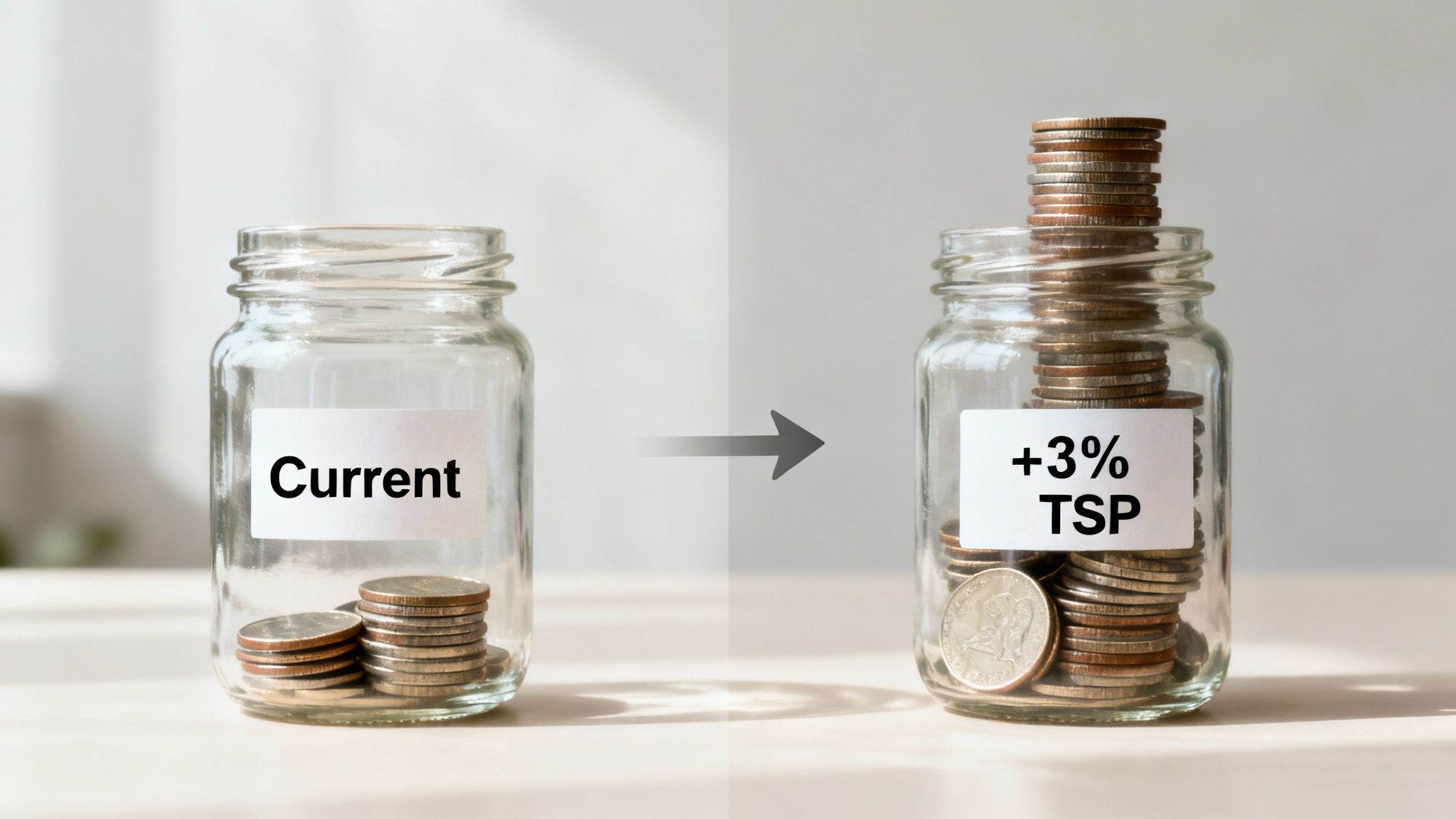
The real magic of a good retirement calculator for federal employees isn’t in seeing just one potential outcome—it’s in exploring many of them. Once you've plugged in your numbers and have a baseline projection, the real work begins. Now you can use the calculator as your personal financial sandbox.
This is your chance to ask all those powerful "what if" questions that keep you up at night and see the immediate financial consequences of your decisions.
Think of it like a flight simulator for your federal career. What would happen if you boosted your TSP contributions by just 3% starting next month? A good calculator will instantly show you the long-term compounding effect, which is almost always much bigger than you’d expect.
This process turns you from a passenger into the pilot of your own retirement plan. You can start making informed, proactive choices today that will have a real, measurable impact on your financial future.
Modeling Key Career Decisions
Beyond just tweaking your savings rate, you can test out major career decisions. For instance, have you ever wondered how much working three extra years would actually add to your monthly FERS pension? Just by changing the retirement date, you’ll see the numbers for your years of service and high-3 salary adjust, giving you a clear picture of that bigger annuity.
You can also run scenarios for more complicated possibilities:
Future Pay Raises: What's the difference between a conservative 2% annual raise and a more optimistic 4%? Model both to see how salary growth directly impacts your high-3 and, consequently, your pension.
TSP Allocation Changes: See the potential outcome of shifting from a G Fund-heavy portfolio to a more aggressive mix of the C and S Funds over the next decade.
The goal here isn't to predict the future with 100% accuracy. It's about understanding the direct link between your actions and your results. When you see that a small, consistent change today could mean tens of thousands of extra dollars later, it's a powerful motivator.
Advanced Inputs for a Clearer Picture
The best calculators let you get into the weeds with more advanced inputs, like accounting for pensions from your pre-federal career. This is absolutely critical if you might be affected by the Windfall Elimination Provision (WEP). The WEP can reduce your Social Security benefits if you're also receiving a pension from a job where you didn't pay into Social Security.
Specialized tools like the Federal Ballpark E$timate® are built to handle these unique federal complexities. Including an accurate WEP assumption is non-negotiable for a realistic income projection. It helps you avoid nasty surprises when it's too late to fix them. You can find more tips on how federal employees can ensure accurate retirement estimates on govexec.com.
Common Questions About Federal Retirement Calculators
When you start digging into federal retirement planning, questions are a good sign. It means you're taking this seriously. A good retirement calculator for federal employees is an indispensable tool, but it's totally normal to have a few uncertainties pop up.
Let's walk through some of the most common questions I hear from federal employees. Getting clear, straightforward answers helps you go from just plugging in numbers to truly understanding what they mean for your future.
How Accurate Are These Calculators?
The honest answer? A calculator is only as good as the numbers you feed it. If you put in your exact service computation date, your precise high-3 salary, and your up-to-date TSP balance, the projections for your federal benefits can be surprisingly on the money.
But—and this is a big but—they are still estimates. They have to make educated guesses about things no one can control, like future inflation or how the market will perform. Think of the results not as a guarantee etched in stone, but as a well-informed forecast of where you're headed. It’s a snapshot of the path you're on right now.
Which Calculator Is the Best One to Use?
You've got a lot of options out there, but I always recommend starting with the official sources. The calculator on the TSP website or any tools your own agency provides are great places to begin. The Federal Ballpark E$timate® is another solid, purpose-built choice.
Ultimately, the "best" calculator for you is one that understands the federal system. It needs to account for all three legs of the FERS stool: your pension, Social Security, and the TSP. Even better if it lets you tweak assumptions, like future pay raises or different growth rates for your TSP funds. That level of control lets you run scenarios that feel real to your situation.
A Word of Caution: The biggest mistake a calculator can make is being too optimistic. If you're projecting a 12% annual return on your TSP or assuming you'll get a huge pay raise every single year, you're setting yourself up for a dangerous false sense of security. Always run a conservative scenario to keep your expectations grounded in reality.
How Often Should I Update My Calculations?
Retirement planning isn't something you do once and then file away. Think of it more like an annual financial check-up. I strongly suggest revisiting your calculations at least once a year to make sure you're still on track.
You should also make it a point to run new numbers after any major life or career event. This could be anything from:
Getting a promotion or a significant pay bump.
Changing how much you contribute to your TSP or how it's invested.
A big life event, like getting married or having a kid.
A major market swing that noticeably changes your TSP balance.
Doing these regular check-ins keeps your retirement plan connected to your real life. It allows you to make small, smart adjustments over time instead of having to make massive, stressful changes down the road. It keeps your plan alive and relevant.
Navigating the ins and outs of your federal benefits can feel overwhelming, but you don't have to figure it all out on your own. At Federal Benefits Sherpa, we specialize in guiding federal employees toward a clear and secure retirement. Let's make sure you're getting the most out of your hard-earned future.
