Reemployment of Annuitants Explained for Federal Retirees
You've retired from federal service, settled into a new routine, and then your former agency calls. A critical position has opened, your experience fits it perfectly, and the proposed appointment might be part time or temporary. The offer sounds attractive, but one question changes the entire calculation: Will your federal salary be reduced by your retirement annuity, or can you receive both in full?
That question sits at the center of the reemployment of annuitants. For agencies, reemployment can preserve hard-won institutional knowledge. For retirees, it can provide continued purpose, professional connection, and income. But the financial result depends on the appointment, the retirement system, any applicable waiver, and how long you return to service.
A reemployed annuitant usually keeps receiving the civil service annuity, while the agency offsets the salary by the annuity amount unless a dual-compensation waiver applies. Later, the length of the appointment can affect health coverage and whether additional service changes future retirement benefits. This guide translates those rules into a practical decision path, from the basic definition through payroll mechanics, agency procedures, FEHB planning, and future annuity consequences.
If you're still evaluating your original retirement choices, your guide to federal employee retirement can provide useful background. By the end, you should be able to identify the questions that determine whether an offer is ordinary salary-offset reemployment, a waiver appointment, or a longer-term return that may alter your benefits.
Introduction to Reemployment After Federal Retirement
Consider a retired federal analyst who is asked to return for a limited assignment. The agency needs someone who understands a specialized process, while the retiree wants to keep working without giving up the annuity already earned. The proposed salary may look substantial on paper, but the retiree can't evaluate it correctly until the agency explains whether an offset will apply.
That's why the phrase reemployed annuitant matters. It doesn't mean “a retired person hired again.” It describes a retiree who receives a civil service retirement annuity while working again for the federal government under a regulated compensation arrangement. The annuity generally continues, but the salary may be reduced by the portion of the annuity tied to the reemployment period.
Practical rule: Never compare the advertised salary with your expected take-home pay until HR identifies the appointment authority and confirms whether a dual-compensation waiver applies.
The decision is especially important for people considering part-time work. A non-waiver appointment doesn't necessarily stop the annuity, but the salary reduction can make the offer look very different from a normal federal rehire. A waiver appointment can produce a different result, allowing full salary and full annuity in circumstances authorized by law.
The choice also extends beyond immediate pay. Reemployment can affect FEHB enrollment, leave accrual, retirement deductions, and the possibility of a supplemental or redetermined annuity after separation. Those consequences don't always appear in the initial offer letter, so retirees need a benefits conversation before accepting the position.
Agencies face a parallel responsibility. They must classify the appointment correctly, determine whether offset or waiver treatment applies, set up payroll accurately, and retain documentation supporting the decision. A mistake can create delayed pay, later recovery demands, or confusion about coverage.
The practical objective is straightforward. Before you accept, you should know which compensation path applies, how the offset will be calculated, whether benefits continue during service, and whether the appointment is short-term earnings support or part of a longer retirement strategy.
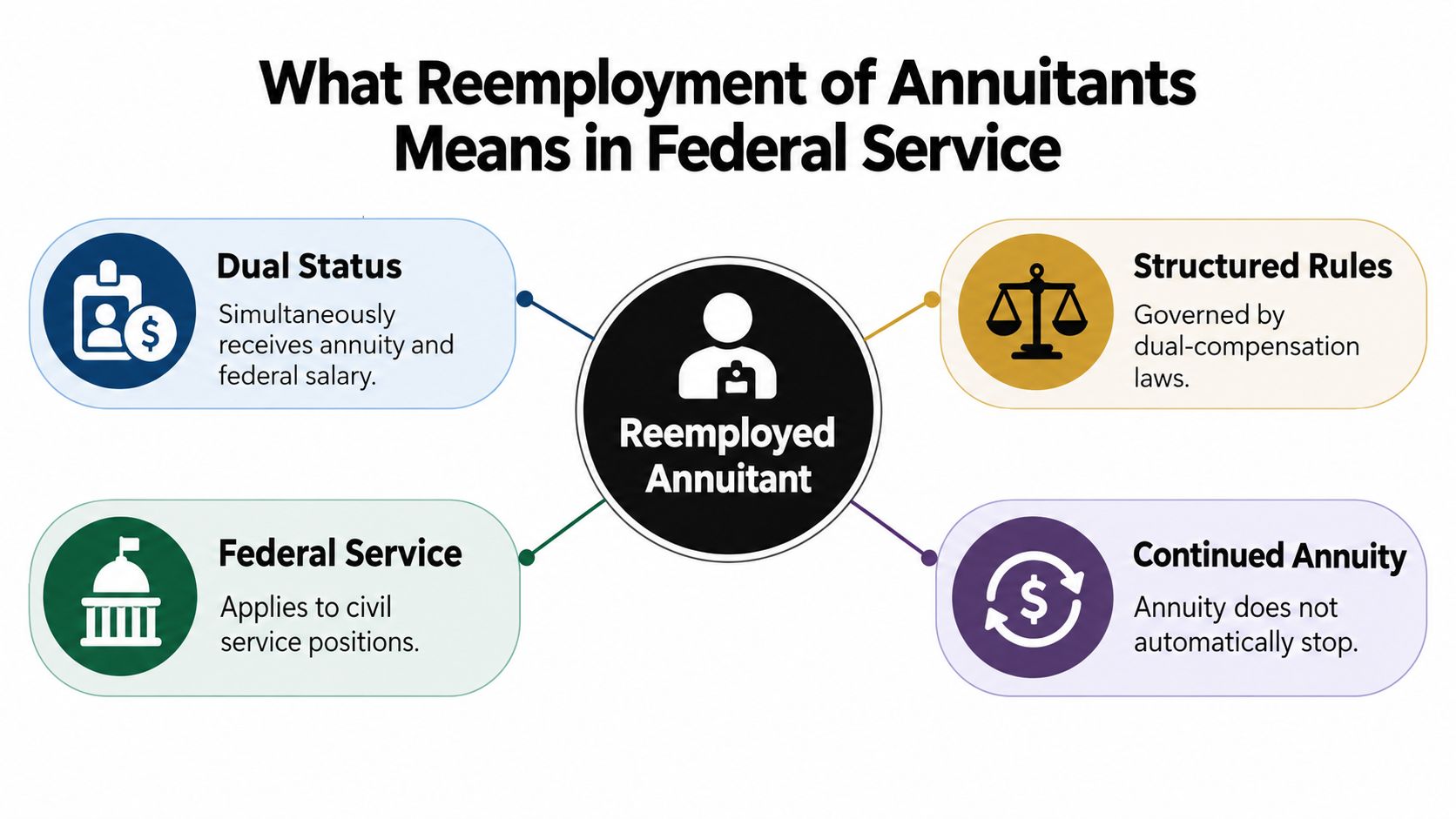
What Reemployment of Annuitants Means in Federal Service
A reemployed annuitant has two connected roles. The person is already receiving a civil service retirement annuity and then returns to work for a federal agency. The arrangement is governed by federal dual-compensation rules, so the person isn't treated exactly like a brand-new employee who has never retired.
A useful analogy is two water lines feeding the same household. One line is the retirement annuity. The other is the federal salary. Under the ordinary rule, the annuity line stays open, but a valve reduces the salary stream by the applicable annuity amount. Under an authorized waiver, the valve can be opened fully, allowing the retiree to receive both streams at the same time.
The ordinary offset structure
The Office of Personnel Management explains that, in most circumstances, the annuity continues while the salary is offset by the amount of the annuity. The employing agency must remit the offset to the Civil Service Retirement and Disability Fund, which keeps the arrangement tied to federal retirement financing rather than treating the appointment as ordinary unrestricted pay. OPM's financial management guidance describes this structure and the related responsibilities.
That distinction matters because the retiree doesn't usually lose the annuity because work resumes. Instead, the payroll office adjusts the salary. The offset is a compensation control, not automatically a suspension of retirement status.
Why this isn't a normal rehire
A normal rehire conversation often starts with grade, salary, schedule, and duties. A reemployed-annuitant appointment adds another question, the interaction between the new salary and the existing annuity. HR must identify the governing appointment authority and determine how the agency should process the compensation.
The arrangement also isn't a second retirement. The retiree returns to federal service under specific rules, earns salary according to the appointment, and may have separate benefit consequences depending on the type and duration of service. A waiver can change the pay result, but it doesn't erase the other rules governing retirement coverage, FEHB, or leave.
In plain language, reemployment is a structured bridge between retirement and federal service. The agency gets access to experience, and the retiree gets an opportunity to work again, but both sides must follow rules that ordinary employees may never encounter.
How CSRS and FERS Rules Differ for Reemployed Annuitants
The first comparison to make is between the retirement system that produced the annuity and the appointment being offered. CSRS and FERS annuitants can both face salary-offset rules, but the details surrounding retirement coverage and future benefits can differ.
The common starting point is annuity continuation. Under the usual arrangement, the retiree continues receiving the annuity, and the employing agency reduces salary by the applicable offset. A dual-compensation waiver can change that result, allowing salary and annuity to be paid concurrently when the appointment qualifies.
CSRS and FERS at a glance
| Issue | CSRS annuitant | FERS annuitant |
|---|---|---|
| Annuity during reemployment | Usually continues, subject to salary offset unless waived | Usually continues, subject to salary offset unless waived |
| Full salary and full annuity | Possible only when an applicable waiver authorizes it | Possible only when an applicable waiver authorizes it |
| Additional retirement coverage | Treatment depends on the appointment and applicable rules | Additional retirement coverage and future annuity treatment require careful review |
| Social Security | A waiver appointment doesn't provide additional retirement coverage beyond Social Security | A waiver appointment doesn't provide additional retirement coverage beyond Social Security |
| Leave | Reemployed annuitants can earn annual and sick leave during reemployment | Reemployed annuitants can earn annual and sick leave during reemployment |
The table shows why the retirement system alone doesn't answer the pay question. Waiver versus non-waiver status is the controlling fork for immediate compensation. If no waiver applies, the agency must use offset treatment. If a waiver applies, the retiree may receive full salary and the full annuity, but the waiver comes with limits on additional retirement coverage beyond Social Security.
Waiver authority requires appointment-specific review
Some Department of Defense reemployment situations have special waiver authority. Limited cases under Public Law 111-84 can also affect the result. The relevant question isn't whether the agency wants to pay both amounts. HR must establish that the position, appointment, and authority satisfy the conditions for the waiver.
Retirees should slow down. A recruiter may describe an opportunity as a “reemployed annuitant” position, but that label doesn't by itself prove that salary offset has been waived. Ask for the written appointment authority and the payroll treatment before relying on the advertised salary.
The distinction between systems still matters for future retirement outcomes. A FERS retiree may need to examine whether later service can support a supplemental annuity or another retirement calculation. A CSRS retiree may face different contribution and election issues. For a plain-language overview of the underlying systems, review the difference between CSRS and FERS before discussing a return appointment with HR.
Understanding Annuity Offsets Pay Caps and Waivers
Once HR confirms that no waiver applies, the next issue is calculation. The agency doesn't subtract an arbitrary amount from each paycheck. OPM provides an hourly method that connects the annuity attributable to the pay period with the hours paid.
The calculation begins by identifying the annuity for the calendar days in the pay period. The agency divides that amount by the number of hours in a full-time tour, then multiplies the resulting hourly amount by the hours paid. The calculation is capped at the full-time hours for the period. OPM's CSRS and FERS handbook provides the formula and explains that the agency must remit the full offset amount to the retirement fund.
How the formula works conceptually
Suppose a retiree works fewer hours than a full-time schedule. The salary offset is applied in proportion to the hours paid, rather than automatically treating the person as full time for the entire period. That proportional approach is why part-time reemployment can produce a different payroll result from a full-time appointment.
The key terms are:
- Annuity allocation: The agency identifies the annuity amount associated with the calendar days in the pay period.
- Full-time tour: Payroll uses the hours in a full-time tour as the denominator.
- Hours paid: The agency applies the hourly amount to the hours paid during that period.
- Full-time cap: The hours used in the calculation can't exceed the full-time hours for the period.
A payroll recovery can follow if the agency initially pays too much or applies the wrong treatment. Retirees should review the first earnings statement and ask HR to explain any line that doesn't match the written appointment terms.
A compact decision matrix
| Appointment result | Annuity | Salary | Additional retirement coverage |
|---|---|---|---|
| No waiver | Generally continues | Reduced by the applicable offset | Governed by the appointment and retirement rules |
| Authorized waiver | Continues | May be paid in full with salary | No additional retirement coverage beyond Social Security under the waiver framework |
| Unclear authority | Don't assume the result | Obtain written payroll confirmation | Delay the decision until HR resolves the classification |
A waiver matters because it changes the amount that reaches the retiree's paycheck. It doesn't mean every appointment qualifies, and it doesn't remove the need to review leave, FEHB, or later retirement treatment.
For a related explanation of the mechanics, see this guide to the Civil Service Retirement System offset.
A visual walkthrough can help HR teams and retirees connect the formula to payroll processing:
Required Notifications Forms and Agency Procedures
A retiree accepts an appointment, but the financial result depends on how the agency classifies it before payroll begins. HR and the retiree should create a shared record showing the annuity status, appointment authority, waiver decision, and expected treatment of salary. 5 CFR Part 837 provides the governing framework for reemployment of annuitants in federal service. The Social Security Administration Inspector General summary identifies that regulation as the foundation for these arrangements.
A practical sequence for the appointment
Begin with the written offer, not the first paycheck. Ask HR to identify the appointment type, explain whether salary offset will apply, and state whether the agency is seeking a waiver. The retiree should supply the records needed to verify annuity status and establish payroll correctly.
Use this checklist as a working record:
- Confirm annuity status: Give HR accurate information about the civil service annuity and retirement system.
- Document the appointment: Keep the offer, appointment paperwork, schedule, and written explanation of compensation treatment.
- Resolve waiver authority: Ask whether a waiver applies, who approves it, and whether approval is complete before work begins.
- Coordinate with OPM: The agency must complete required reporting and notifications so annuity and payroll records agree.
- Review benefit enrollment: If the position conveys FEHB eligibility, ask how enrollment, transfer rules, and premium conversion will be handled.
- Check leave treatment: Reemployed annuitants may earn annual and sick leave, so confirm the applicable leave category and accrual setup.
- Inspect the first pay statement: Compare salary, offset, deductions, and leave balances with the written appointment terms.
These records work like a control panel for the appointment. If the salary is reduced by an offset, the written terms should show why. If a waiver is approved, the approval should identify its authority and effective date. If either point is unclear, ask HR for a written answer before relying on the projected pay.
FEHB administration also requires careful review. OPM guidance generally places reemployed annuitants under the same benefit-enrollment rules as other employees, including FEHB transfer rules and premium-conversion treatment. In some situations, an employee has a 60-day window to waive premium conversion. HR should explain when that window starts and what follows if no election is made.
Recordkeeping matters: Keep the appointment decision, waiver documentation, annuity verification, benefit elections, and payroll explanations together. Those records make later corrections easier.
Agencies can reduce clerical friction with structured HR tools for government agencies that organize employee communications, forms, and workflow records. Technology cannot decide whether a waiver applies, but it can preserve the documents showing how the agency reached its decision.
How Reemployment Affects Benefits and Future Retirement
A retiree accepting a return appointment faces more than a salary choice. The decision tree also includes health insurance, leave, and future annuity treatment. Short service may provide temporary income, while longer service can change the retirement calculation at the next separation.
A position that carries FEHB eligibility may let a reemployed annuitant enroll under the rules for employees. Enrollment during the appointment does not by itself guarantee continued coverage afterward. That result depends on the service and coverage conditions tied to a supplemental or redetermined annuity, as explained in OPM's guidance for returning as a reemployed annuitant.
Short assignment or longer retirement strategy
A short appointment usually serves as temporary earnings support and a way to contribute professional experience. A longer appointment calls for a different review: whether the added service can support a future retirement adjustment and whether the retiree can preserve insurance rights at the next separation.
Calendar time alone does not answer that question. HR and the retiree must confirm whether the service qualifies under the applicable rules, whether retirement deductions will be withheld, and whether the resulting benefit would be supplemental or redetermined. These details determine whether additional work changes retirement math or adds current earnings.
OPM updated its reemployed-annuitant guidance in 2026 and added decision-table material. That update supports an appointment-specific review instead of relying on informal explanations. The updated OPM health coverage guidance remains a starting point for enrollment and separation questions.
Questions to ask before extending service
Ask HR:
- Does this position convey FEHB eligibility?
- Which service and coverage conditions apply if I leave again?
- Will retirement deductions be withheld during the appointment?
- Could this service support a supplemental or redetermined annuity?
- How will annual and sick leave be handled?
- Would extending the appointment change the benefit analysis?
The right choice depends on the retiree's goal. For a limited professional return, verify the adjusted pay and benefit administration. For stronger future retirement security, review service duration, retirement contributions, and insurance consequences before extending the appointment.
Real World Examples and Next Steps for Retirees and HR
Two retirees can have similar skills and very different financial results because their appointments use different authorities.
A retiree who accepts part-time work without a dual-compensation waiver generally keeps the annuity, while payroll applies the salary offset described earlier. Annual and sick leave may still accrue during reemployment, but the amount advertised for the position is not necessarily the amount paid after the offset. This option can fit someone seeking limited work and flexibility. The budget should use the adjusted pay, not the recruitment figure.
A retiree in an authorized hard-to-fill position may qualify for a waiver. The result can be full salary together with the full annuity. The waiver does not add retirement coverage beyond Social Security, although annual and sick leave may accrue during the appointment. The immediate cash flow may be better, but the retiree still needs to review FEHB and rights at the next separation.
A historical SSA snapshot shows why waiver authority deserves a direct question. As of November 1, 2014, SSA had 1,185 reemployed annuitants. Of those, 136 employees, or 11 percent, worked under salary-offset arrangements, while 1,049 employees, or 89 percent, had dual-compensation waivers, according to the SSA Inspector General summary cited earlier. Those figures describe one agency at one point in time, not an individual offer. They do show that salary offset is not the only possible arrangement.
Use the offer review as a decision tree:
- Offset: What amount will payroll reduce, and where will it appear on the earnings statement?
- Waiver: What appointment authority supports the waiver, and has approval been documented?
- Benefit recalculation: Can the service support a supplemental or redetermined annuity?
- Coverage: Does the position provide FEHB eligibility, and what happens when the appointment ends?
- Administration: Will the annuity continue, and which leave and retirement deductions apply?
HR should provide these answers in writing. A clear appointment decision prevents months of incorrect payroll treatment and makes it easier to compare short-term earnings with the possible effect of longer service on retirement benefits.
Federal Benefits Sherpa helps federal employees and retirees understand how reemployment interacts with annuities, FEHB, Social Security, and long-term retirement income. Visit Federal Benefits Sherpa to request a free benefit review and explore personalized retirement planning and gap analysis support before you accept a return-to-service offer.
