Is FEGLI Worth It for Federal Employees in 2026
Basic is often worth keeping for the employer subsidy, no medical exam at enrollment, and the reduced benefit after 65, while large Option B amounts are often not worth keeping as age-banded premiums climb. The strongest retirement case for Basic is the 75% reduction election, not a promise to preserve your full working-career death benefit forever.
The popular advice to replace all FEGLI with private term is too blunt. So is the advice to keep everything because the payroll deduction looks manageable. Neither tells you what your spouse will receive after retirement or what you'll pay to preserve it.
Ask "Is FEGLI worth it?" separately for Basic and each optional election. Then judge the answer against the coverage you'll need in retirement, not the coverage you happened to elect when your children were young.
When FEGLI Is Worth Keeping
Keep coverage that solves a real survivor-income problem. Cut coverage that no longer has a job. That sounds obvious, but automatic deductions make it easy to carry yesterday's insurance needs into tomorrow's retirement budget.
Basic and optional FEGLI deserve different verdicts. Basic combines employer support with group access and a retirement benefit. Optional coverage is an additional purchase that should compete on price, duration, and the person being insured.
Is FEGLI worth it by situation
| Situation | Basic | Option B or C | Why |
|---|---|---|---|
| Healthy employee early in a career | Keep only if the full comparison supports it | Usually replace large multiples with competitively priced level term | Composite Basic can cost more than underwritten term |
| Parent needing temporary income replacement | Keep the subsidized base | Use salary multiples or private term until debts and children are covered | Extra coverage serves a temporary need |
| Health condition or declined private coverage | Keep | Keep a modest multiple if affordable | Group access avoids seeking new individual underwriting |
| Approaching retirement with coverage needed later | Often keep and plan a reduced benefit | Price each multiple through retirement | Basic and optional coverage have different retirement economics |
| Retiree still insured for full Option B | Keep reduced Basic if eligible and useful | Usually drop unneeded multiples | Unnecessary optional coverage consumes retirement income |
| Only a small spouse or child benefit wanted | Check whose death would create the expense | Consider Option C against separate family coverage | Basic insures the employee, not the family member |
The last distinction matters. Your Basic death benefit doesn't pay when your spouse dies. If the financial problem is replacing a spouse's unpaid caregiving or paying a child's final expenses, compare coverage on that person.
Before cancelling anything, verify your election, deduction, and continuation eligibility with your benefits office. Don't assume you can restore cancelled coverage whenever you change your mind. Later enrollment can require an eligible enrollment opportunity or evidence of insurability.
Apply the verdict to your household
A healthy new hire with a mortgage and no children. Say you're buying protection mainly so your partner could keep the house. Get an underwritten level-term quote covering the mortgage-risk period, then compare it with the FEGLI coverage you're considering.
Don't buy large optional multiples merely because enrollment is convenient. Revisit the amount when marriage, children, or a larger financial obligation changes the loss your household would face. Your salary alone isn't a needs calculation.
A parent with children and a mortgage. Keep a base of protection, then calculate the temporary gap: lost earnings, childcare, education commitments, and debt, less assets already available to survivors. Use Option B or private term to fill that gap.
Set a review point before the next expensive premium band. A policy that was appropriate when children depended entirely on your income may be excessive once they're independent and the mortgage is nearly paid.
An employee with diabetes approaching retirement. Don't cancel group coverage based on an online quote that assumes excellent health. Obtain an actual underwriting decision before treating private insurance as a replacement.
Preserve Basic while deciding whether its reduced retirement benefit will meet the lasting need. If a spouse needs more permanent money, compare the cost and guarantees of keeping additional coverage with a separately underwritten policy. A small final-expense policy isn't automatically a bargain.
A dual-income couple with no debt and a survivor annuity. Large life-insurance elections may duplicate protection the household already has. Start with the surviving spouse's actual spending, pension income, Social Security, and available savings.
Our guide to federal employee survivor benefits can help you identify which benefits belong in that calculation. Don't subtract a survivor pension from the insurance need until you've confirmed the election and its effect on household income.
Separate protection from estate planning
A death benefit can support a surviving spouse without requiring a complicated estate structure. But if your objective includes controlling distributions, protecting a vulnerable beneficiary, or coordinating a larger estate, ownership and beneficiary decisions need legal attention.
For readers considering trust ownership, Coto & Waddington, Attorneys at Law offers a resource to explore ILIT benefits in Florida. Use it to prepare questions for estate counsel, not as a reason to assume your FEGLI ownership should change.
Employees leaving federal service early need a different plan. Deferred retirement and a move to private-sector employment aren't interchangeable with eligible retirement continuation. An individual policy already in force is the coverage you control independently of your federal job.
Decision rule: Match the closest household profile, then change only the coverage that no longer serves that household's needs.
Finish with two answers: how much money your survivors will still need in later retirement, and whether you can obtain private coverage at the quoted rate. Those answers matter more than a small deduction today.
What Each FEGLI Part Pays
FEGLI is employer group term life insurance, not a savings account. You're buying a death benefit, not cash value or a paid-up investment.
The parts fit together as follows.
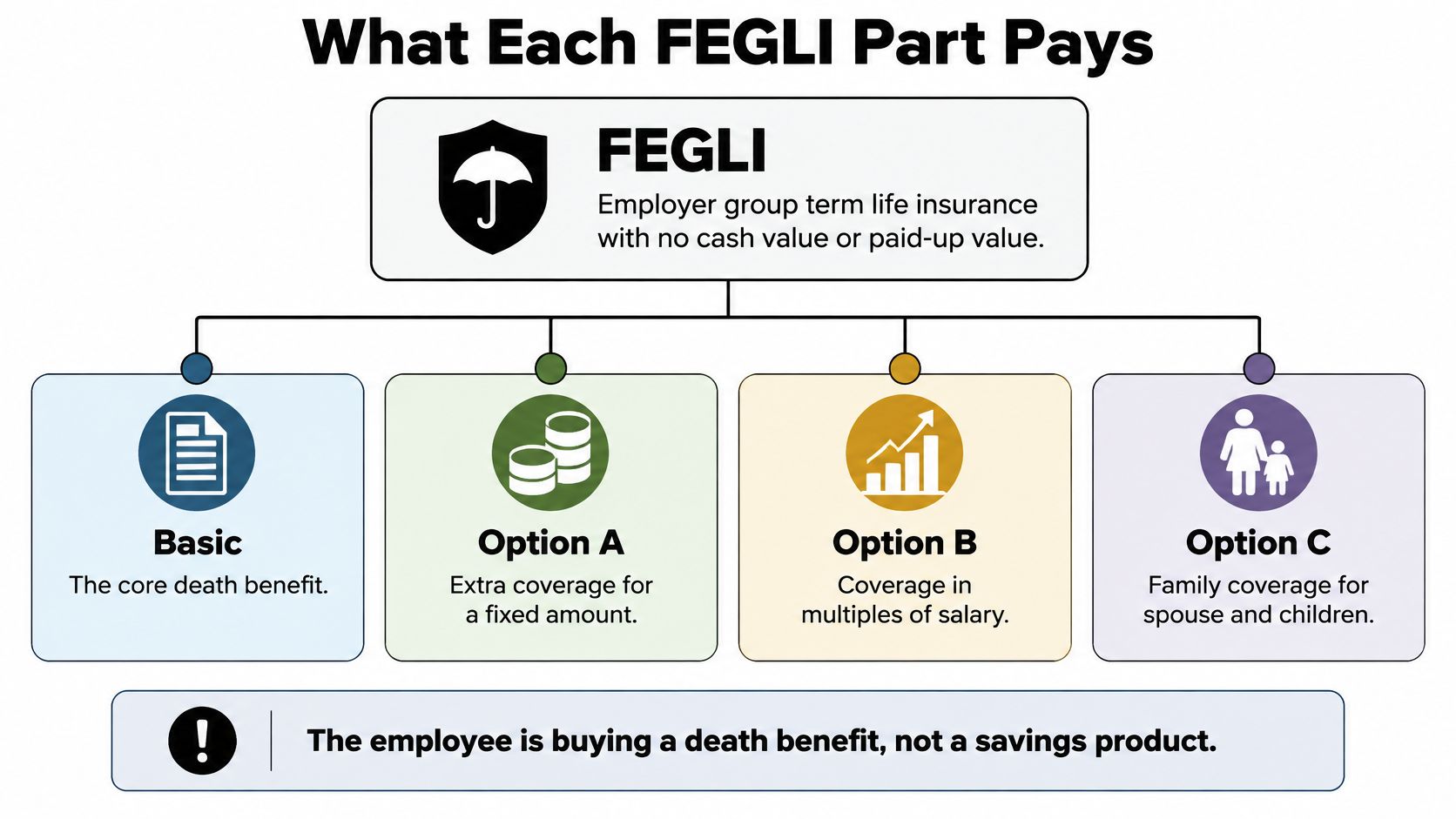
Know which life each election insures
According to the Congressional Record's description of FEGLI, Basic generally equals annual basic pay rounded up to the next $1,000, plus $2,000, subject to statutory limits.
- Basic: The core benefit on the employee's life.
- Option A: A fixed additional benefit on the employee.
- Option B: Additional employee coverage expressed in salary multiples.
- Option C: Coverage on a spouse and eligible dependent children.
Most eligible new employees receive Basic unless they waive it; optional elections require attention rather than an assumption that everything is included. Later increases generally require an applicable enrollment opportunity, and medical evidence can apply.
Write down your actual elections before comparing policies. Include the insured person, death benefit, premium, beneficiary, and whether the need continues after retirement.
Keep beneficiary planning separate
A will and a life-insurance beneficiary designation serve different purposes. Don't assume changing your will updates your FEGLI beneficiary.
For a separate question about assets passing through an estate, Tanner Law explains California small estate probate exceptions. State probate planning doesn't replace reviewing the beneficiary form for your insurance.
Use this video as an additional introduction to the coverage choices.
FEGLI Compared with Private Term
Private term is often the stronger tool for a healthy employee who needs a fixed benefit until a specific obligation ends. FEGLI can be stronger when access to insurance matters more than obtaining the lowest advertised rate.
The OPM Basic premium FAQ states that employees pay $0.15 per $1,000 of Basic coverage every two weeks and that the government pays one-third of the total premium. Its composite pricing doesn't change with your individual health or age, which can favor someone who would receive an expensive private underwriting offer.
Compare the contract, not the sales quote
| Criterion | FEGLI Basic | FEGLI Options A, B, C | Individual term |
|---|---|---|---|
| Who pays | Employee and government share the cost | Employee funds the optional coverage | Policyholder funds the coverage |
| Medical questions | Generally none at hire | Can apply outside applicable enrollment opportunities | Usually medically underwritten |
| Price by age | Composite rate, not age-banded | Age-banded pricing | Level during a guaranteed level-premium term |
| Cash or paid-up value | None | None | None for ordinary term insurance |
| After retirement | Can continue if eligible, with a reduction election | Continuation and reductions follow option-specific rules | Remains subject to the purchased term |
| If you leave federal service early | Not portable like a personal policy | Same employment-related limitation | Remains in force under the contract if premiums are paid |
| Best fit | A base benefit where access and retirement value matter | Additional protection while its cost is competitive | A defined financial need with a defined end date |
Association or union group coverage can provide another quote. Check its underwriting, future age-based increases, membership requirements, benefit reductions, and continuation provisions. A group label doesn't guarantee either a lower lifetime cost or a level premium.
This comparison shows the different roles these policies can serve.
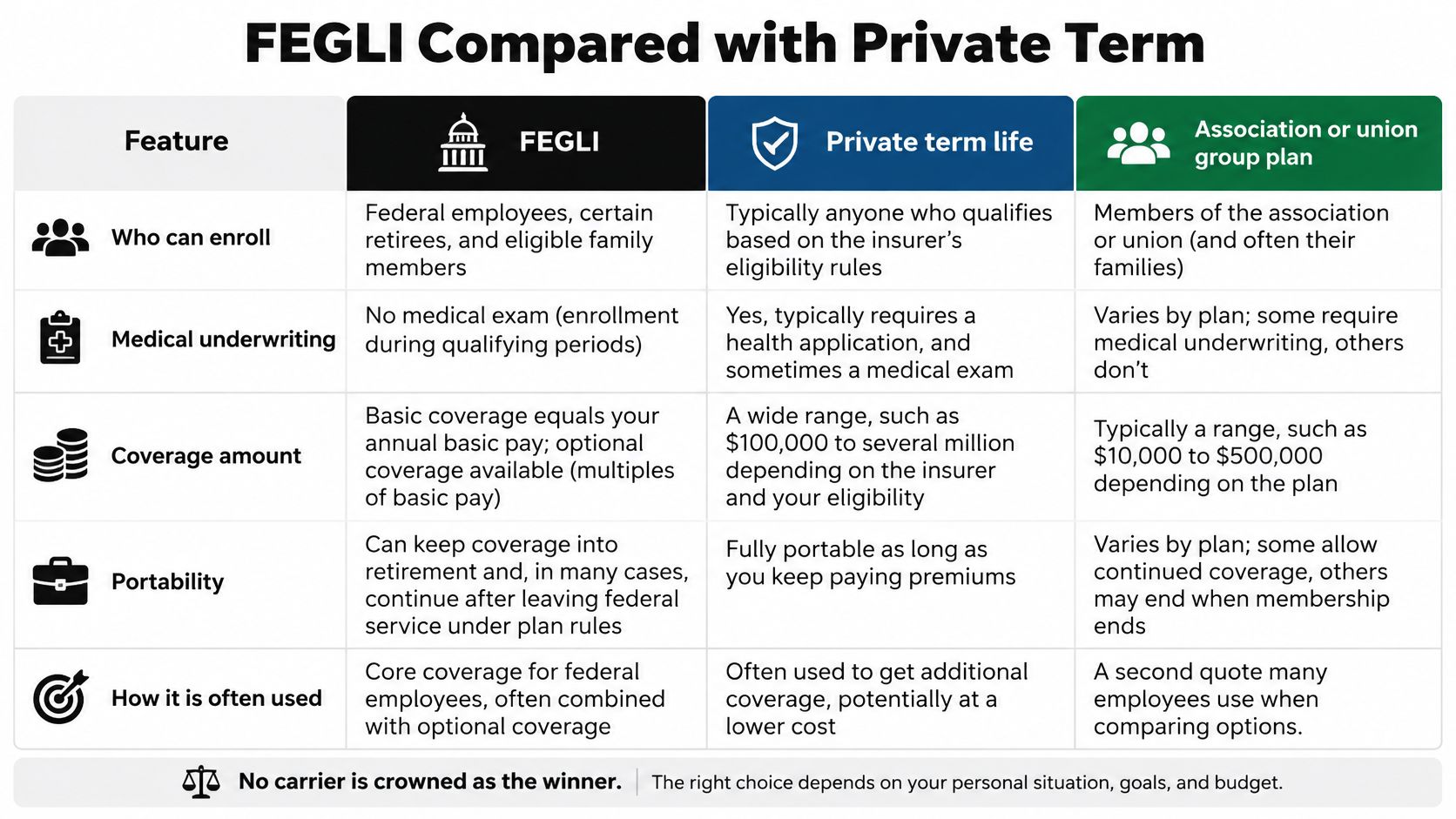
Match the amount and the years
Judge Basic on subsidy, insurability, and the retirement benefit you intend to keep. Judge Option B on its premium at the age when your family will still need the death benefit.
Use OPM's FEGLI calculator alongside an actual private quote. Compare annual premiums for matching death benefits and matching coverage periods, including scheduled FEGLI increases rather than just the current deduction.
Our FEGLI versus private life insurance guide provides additional decision context. For private term, verify the guaranteed premium period, expiration date, renewal provisions, and conversion rights before accepting the comparison.
Business owners also need to distinguish household protection from business protection. The Law Office of Bryan Fagan's insurance guide addresses key-person insurance, a different purpose from replacing income for your spouse. Don't count a business-owned policy as household coverage without confirming who receives its proceeds.
What FEGLI Costs as You Age
Start with the arithmetic, then decide whether the benefit is worth the price. A low unit rate can still produce a large bill when you carry a substantial death benefit.
The Government Accountability Office's 2011 FEGLI analysis provides these historical benchmarks, not current payroll quotes: typical employee Basic cost $13.65 every two weeks, or $354.90 annually; Option A's additional $10,000 cost $0.30 biweekly under age 35 and $6.00 biweekly at age 60 and older; Option B cost $0.065 monthly per $1,000 under age 35 and $5.20 at age 80 or older. Applying those historical Option B rates to a hypothetical $100,000 benefit produces $6.50 a month for the younger employee and $520 a month for the oldest group.
FEGLI premium benchmarks by coverage and age
The table organizes those historical benchmarks and the arithmetic derived from them. The oldest Option B benchmark is deliberately labeled separately; it isn't a quote for someone just entering retirement.
| Coverage | Under 35 | Age 60 or older | What changes |
|---|---|---|---|
| Basic, typical employee in the 2011 GAO example | $13.65 every two weeks ($354.90 a year) | Same composite employee rate, not age-banded | Government shares the premium |
| Option A, extra $10,000 | $0.30 every two weeks ($7.80 a year) | $6.00 every two weeks ($156 a year) | Employee pays the age-banded premium |
| Option B, per $1,000 per month | $0.065 | $5.20 at age 80 or older | Oldest benchmark is 80 times the youngest |
| Option B, hypothetical $100,000 | $6.50 monthly ($78 yearly) | $520 monthly ($6,240 yearly) at age 80 or older | A large optional amount magnifies the increase |
For a separate hypothetical Basic calculation, take an employee with an $80,000 salary and an $82,000 Basic amount. Applying OPM's employee rate gives $12.30 every two weeks, approximately $320 annually. That example illustrates premium arithmetic, not a personalized benefits statement.
Put every quote on an annual basis
For an ordinary biweekly deduction, multiply by the number of biweekly pay periods in the year. For a monthly quote, multiply by the months in the year. Then divide the annual premium by the coverage amount expressed in thousands to compare annual cost per unit of benefit.
Don't stop at the unit price. A private quote might stay level while FEGLI optional premiums change, and the policies may not last equally long. Compare the total premiums over the period your household needs protection.
Confirm today's rates and your actual elections in OPM's calculator before changing coverage. Historical benchmarks explain the pricing structure; they don't tell you what your next paycheck or annuity deduction will be.
Cut unnecessary multiples before dismantling the base. If projected Option B costs exceed an approved level-term alternative for the remaining mortgage or dependent-child years, replace that temporary layer first. Leave the Basic decision open until you've priced the retirement election.
FEGLI After 65 and the Reduction Choice
Retirement is where an apparently inexpensive policy can become a costly commitment. The right comparison starts with the benefit you want your survivor to receive, not the benefit printed on your current statement.
Under the OPM FEGLI fast facts, the 75% Basic reduction election reduces coverage by 2% of the original amount monthly after age 65 until 25% remains; optional insurance is fully employee-paid, and Option B offers one to five salary multiples with premiums rising in five-year age bands.
Use the retirement timeline to separate continuation eligibility from the coverage election.
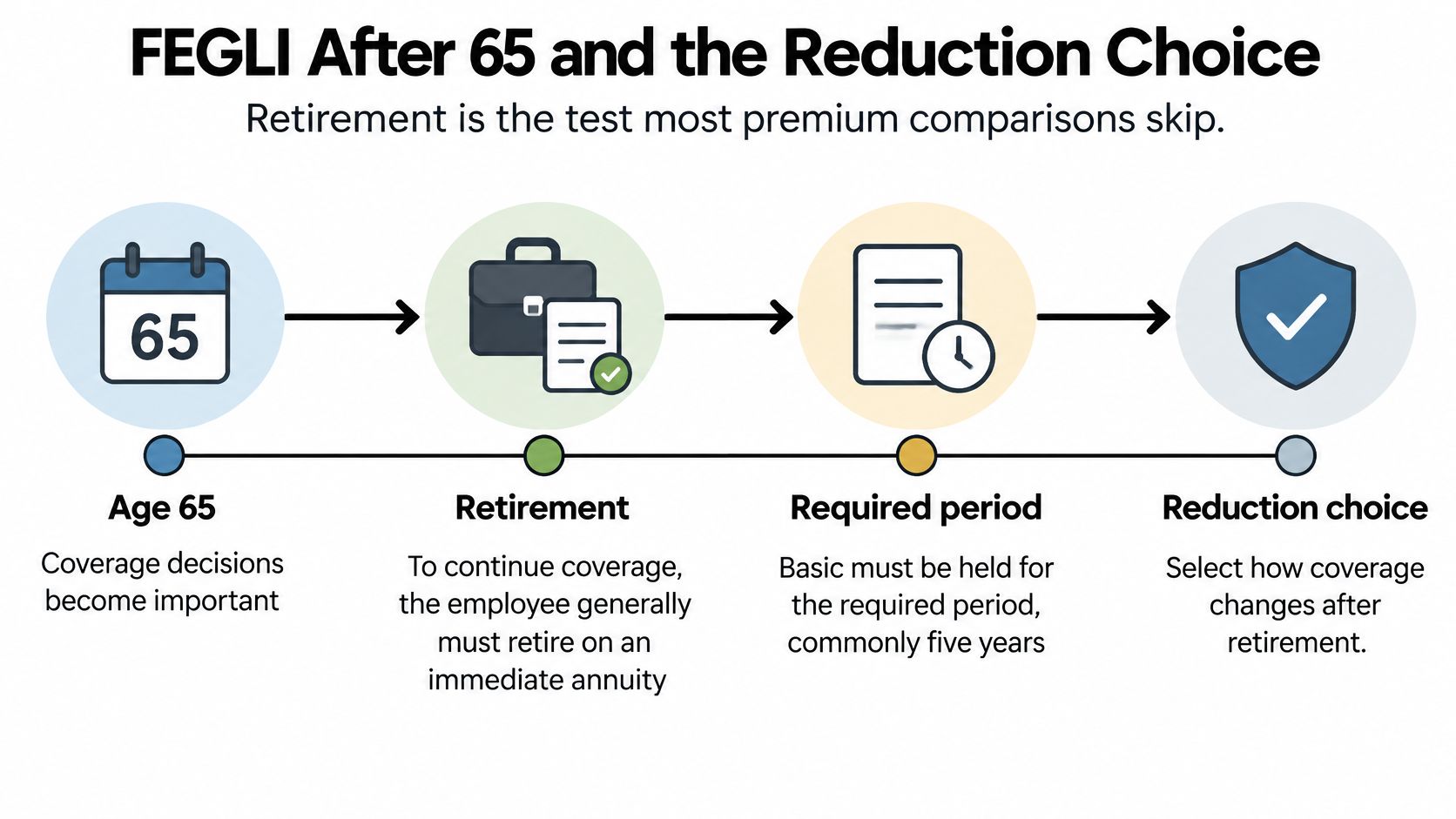
Make reduced Basic the starting comparison
OPM's FEGLI program information explains that eligible retirees can retain reduced Basic without premiums after age 65 under the 75% reduction election, while the 50% and no-reduction choices carry continuing premiums.
Start with the reduced election if you mainly want final-expense protection. Pay for a larger retained benefit only when you can identify the lasting financial need and afford the continuing charge.
Using the hypothetical Basic amount from the premium example, the fully reduced benefit would be $20,500. That may handle a modest final-expense goal, but it won't replace a substantial lifetime income shortfall.
Basic reduction under the 75% election
This simplified schedule assumes retirement and eligibility allow reductions to begin after the illustrated starting age. Retiring later changes the timing; don't treat the age labels as a universal schedule.
| Age | Share of original Basic left |
|---|---|
| 65 | 100%, before reductions begin |
| About 68 and a half | 25%, after the reduction process finishes |
Years of level Basic premiums help support the later premium-free reduced benefit. Cancelling Basic near retirement can surrender that future value; cancelling unnecessary Option B is a different decision.
Higher-retention Basic elections buy a larger death benefit. They don't create an account you can withdraw from or borrow against. Price that additional protection against a genuine permanent need rather than a preference to keep your old face amount.
Option B requires its own retirement analysis, including its reduction election. Don't assume every retained multiple must stay at full value forever, or that its premium treatment matches Basic.
Before submitting retirement paperwork, record the premium before the retirement-age transition, the premium afterward under each election, and the actual survivor benefit after reductions finish. Confirm continuation eligibility with your benefits office, especially if you've had breaks in coverage or plan to leave before an immediate retirement.
Choose Your FEGLI Election Before You Retire
Make the coverage decision before completing the forms. Otherwise, you risk choosing an election because it preserves a familiar benefit rather than because it supports your retirement plan.
Work through the decisions in order
Separate temporary and lasting needs. Mortgage payments, dependent children, and lost earnings usually have different end dates from final expenses or ongoing support for a vulnerable spouse.
Price each piece independently. Compare reduced Basic with the larger-retention elections. List each Option B multiple and family-coverage election separately so you can remove an unnecessary layer without cancelling useful protection.
Obtain a comparable private quote. Cover only the temporary gap for the years it exists. Use the approved underwriting result, not an advertised best-health rate.
Replace before cancelling. Put replacement coverage in force, confirm the premium and beneficiaries, and only then reduce the coverage it replaces.
Coordinate the retirement elections. Review pension survivor benefits, FEHB continuation, and life insurance together. Your spouse needs a workable household plan, not independently optimized benefits that leave an income or healthcare gap.
Check the paperwork against the decision
Use our SF 2818 completion and filing guide while preparing the life-insurance continuation election. Match the form to your chosen benefit and premium, and retain copies of the submitted election and confirmation.
Our 15-minute benefits review is a short call with a licensed specialist that costs nothing and carries no obligation. It can help you examine how these choices fit together before signing forms that may be hard to undo.
Educational help doesn't replace the official OPM election or your agency's eligibility determination. Don't cancel existing insurance until any replacement has been approved and is in force.
Federal Benefits Sherpa offers a free Gap Report that includes FEGLI costs after retirement alongside pension income, healthcare, and survivor benefit options. Visit Federal Benefits Sherpa to compare the coverage you intend to keep with the income your household will need.
