how to calculate pension benefits: A Quick Guide
Calculating your pension isn't some mystical art; it really just comes down to a simple formula. Think of it as a three-part recipe: your accrual rate, your years of service, and your final average salary. Get a handle on these three things, and you've taken the most important step toward understanding what your retirement income will actually look like.
Cracking the Code of Your Pension Formula
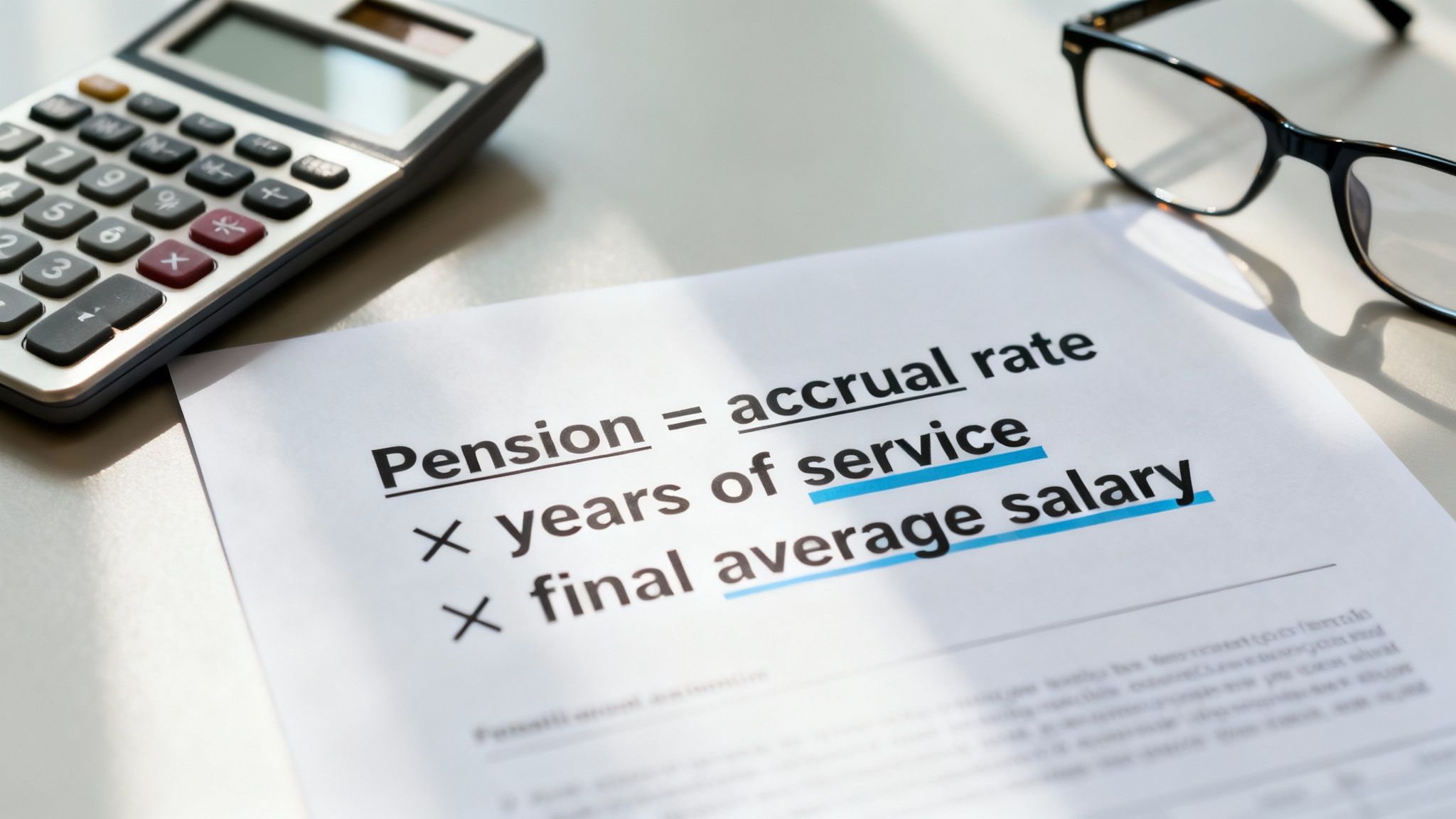
At its heart, a defined benefit pension is much more straightforward than most people think. The whole system is designed to reward you for your loyalty and your earning history with an income you can count on. So, let's pull back the curtain and look at the essential pieces you'll need to start running the numbers for yourself.
These three variables are the bedrock of pretty much every pension calculation out there. Each one plays a unique role in shaping how big that monthly check will be once you retire.
The Three Pillars of Your Pension Calculation
To figure out your pension, you first need to get comfortable with its main ingredients. Each one tells a different part of your career story.
To help you visualize how these pieces fit together, here’s a quick breakdown of what each component means for your bottom line.
Core Components of the Pension Formula
ComponentWhat It IsHow It Affects Your PensionAccrual RateA percentage set by your plan, usually between 1.5% and 2.5%.This is the rate at which you earn benefits each year. A higher rate means your pension grows faster.Years of ServiceThe total number of years you've been a member of the pension plan.The more years you work, the higher your final payout. It’s a direct reward for your long-term commitment.Final Average Salary (FAS)The average of your highest earnings over a set period, typically your last 3 to 5 years.This smooths out any salary bumps or dips, using your peak earning years to calculate your benefit.
These three factors are multiplied together to determine your final benefit. It’s a simple but powerful calculation that directly links your career to your retirement security.
The key takeaway: The standard formula is (Accrual Rate) × (Years of Service) × (Final Average Salary) = Your Annual Pension Benefit. For example, a 2% accrual rate, 30 years of service, and a $60,000 final average salary results in an annual pension of $36,000 (2% × 30 × $60,000). If you're curious about the bigger picture, you can see how these formulas are applied globally by reviewing the pension statistics guidelines from the OECD.
Putting the Formula into Action: A Real-World Example
Let's walk through a scenario with a federal employee we'll call Alex.
Alex has 25 years of service.
His pension plan has a 1.8% accrual rate.
His final average salary (the average of his highest three earning years) is $85,000.
Now, we just plug those numbers into the formula:
1.8% (Accrual Rate) x 25 (Years of Service) x $85,000 (Final Average Salary) = $38,250 per year.
This quick calculation tells Alex he can expect an annual pension of $38,250, which breaks down to about $3,187.50 a month before any taxes or other deductions. This is the kind of baseline number that provides a solid foundation for retirement planning.
Factors That Shape Your Final Payout
While the basic pension formula gives you a solid estimate, it's just the beginning. Several other factors can dramatically change your final benefit amount. Think of the core calculation as the starting point; the details we're about to cover are what truly determine the check you'll receive each month.
Getting these nuances right is crucial for accurately forecasting your retirement income. These are the kinds of details often buried in plan documents, but they can have a massive impact on your financial future.
How Your Salary Is Actually Defined
The phrase "final average salary" seems straightforward enough, but its definition can vary quite a bit from one pension plan to another. This single detail can swing your benefit by thousands of dollars over your retirement.
Highest 3 vs. Highest 5 Years: Many federal plans, like the Federal Employees Retirement System (FERS), use your "high-3" average salary. This is the average of your highest 36 consecutive months of basic pay. Other plans might use a five-year average. A shorter period usually benefits employees who get significant pay bumps later in their careers.
What Counts as Pay: Does your plan's definition of pensionable pay include overtime, bonuses, or other special payments? It’s critical to know this, as it can either boost or limit the salary figure used in your calculation.
Always dig into your specific plan's summary description to see exactly how your salary is calculated. This is one of the most common areas where people miscalculate, so don't just make an assumption.
The Financial Impact of Your Retirement Age
Choosing when to retire is a huge personal decision, but it's an even bigger financial one. Retiring early might be tempting, but it often comes at a steep cost—a permanent reduction in your monthly benefits.
On the flip side, working longer can increase your payout. It's not just about adding more years of service; it's also about avoiding those early retirement penalties. For instance, some plans might cut your pension by 5% for every year you retire before reaching the full retirement age.
Retiring just a few years early can lead to a substantial, lifelong reduction in your pension income. Before you make a final decision, run the numbers to see the concrete financial difference between retiring at 62 versus waiting until 65.
Vesting Schedules and COLAs
Two other key concepts that shape your final payout are vesting and cost-of-living adjustments (COLAs).
Vesting is when you officially earn a non-forfeitable right to your pension benefits, even if you leave your job. For federal employees, this typically happens after five years of creditable civilian service. If you leave before you’re vested, you might only get a refund of your own contributions, not the pension itself.
Cost-of-Living Adjustments (COLAs) are periodic increases to your pension checks designed to help your benefits keep up with inflation. While not all private plans offer them, they are a standard and valuable feature of federal pensions. A COLA can be the difference between maintaining your purchasing power and watching it slowly disappear over time.
Understanding Your Specific Pension Plan
Before you can get anywhere with the numbers, you have to know exactly what kind of retirement plan you’re dealing with. It sounds basic, but this is the critical first step. The way you calculate your benefits is completely different depending on whether you have a Defined Benefit (DB) plan or a Defined Contribution (DC) plan.
Most federal employees under the Federal Employees Retirement System (FERS) have a retirement that's actually a mix of a few things. The piece we’re focused on here—the actual pension—is a classic Defined Benefit (DB) plan. This is the old-school pension model where your employer promises to pay you a specific, predictable monthly check for the rest of your life once you retire. The amount is figured out using a set formula based on your salary and how long you worked, which we'll dive into.
With a DB plan, the key thing to remember is that the investment risk is all on your employer. They’re the ones on the hook for making sure the money is there to pay what they promised. This is a world away from a Defined Contribution (DC) plan, like the government's Thrift Savings Plan (TSP) or a private company's 401(k).
Defined Benefit vs Defined Contribution Plans
Getting a handle on the fundamental differences between these two is essential. It tells you whether you're using a formula to find a guaranteed number or just checking an account balance.
Let's break it down side-by-side.
FeatureDefined Benefit (DB) PlanDefined Contribution (DC) PlanBenefit CalculationBased on a formula (salary x years of service x accrual rate).Based on account balance (contributions + investment returns).Income PredictabilityHighly predictable; a set monthly payment for life.Unpredictable; depends on market performance and your withdrawals.Investment RiskThe employer bears all investment risk.You, the employee, bear all investment risk.Primary GoalProvides a steady, guaranteed income stream in retirement.Provides a savings vehicle that you manage and draw from.
As you can see, they are two totally different animals. When you're calculating your FERS pension, you're working with the DB formula. With a DC plan like your TSP, the "calculation" is just a snapshot of your account balance. You can run projections on what it might grow to, but you can't nail down a guaranteed benefit the same way.
Knowing your plan type is non-negotiable. It's the difference between using a precise formula and analyzing an investment portfolio. For federal employees, your FERS Basic Benefit Annuity is the DB portion you'll calculate with a formula.
Public vs Private Sector Plans
It's also helpful to recognize the landscape of public versus private retirement plans. Public sector plans, for federal or state government employees, are much more likely to be the DB type we're discussing. A huge plus is that they often come with built-in protections like Cost-of-Living Adjustments (COLAs), which help your pension check keep up with inflation over time.
In the private sector, the story is different. Most companies have moved away from traditional pensions, shifting almost entirely to DC plans like 401(k)s. If you happen to have an older pension from a private employer, you absolutely need to track down a copy of the Summary Plan Description (SPD). This is the official rulebook for your plan, and it will spell out everything you need to know—from the accrual rate and vesting schedule to exactly how they define your final average salary. The rules can vary a lot more than they do in federal plans, so that document is your guide.
Putting It All Together: A Start-to-Finish Pension Calculation
Alright, we've covered the key ingredients—the accrual rate, your years of service, and that all-important High-3 salary. Now, let's connect the dots and see how these pieces come together to form your actual pension check. This is where theory gets real, and you can see how different decisions will directly impact your retirement income.
To walk through this, we'll follow a fictional federal employee, Sarah.
This visual gives you a great birds-eye view of the process. You start by gathering your plan's details, run the basic calculation, and then start layering in different scenarios, like retiring early or adding a survivor benefit.
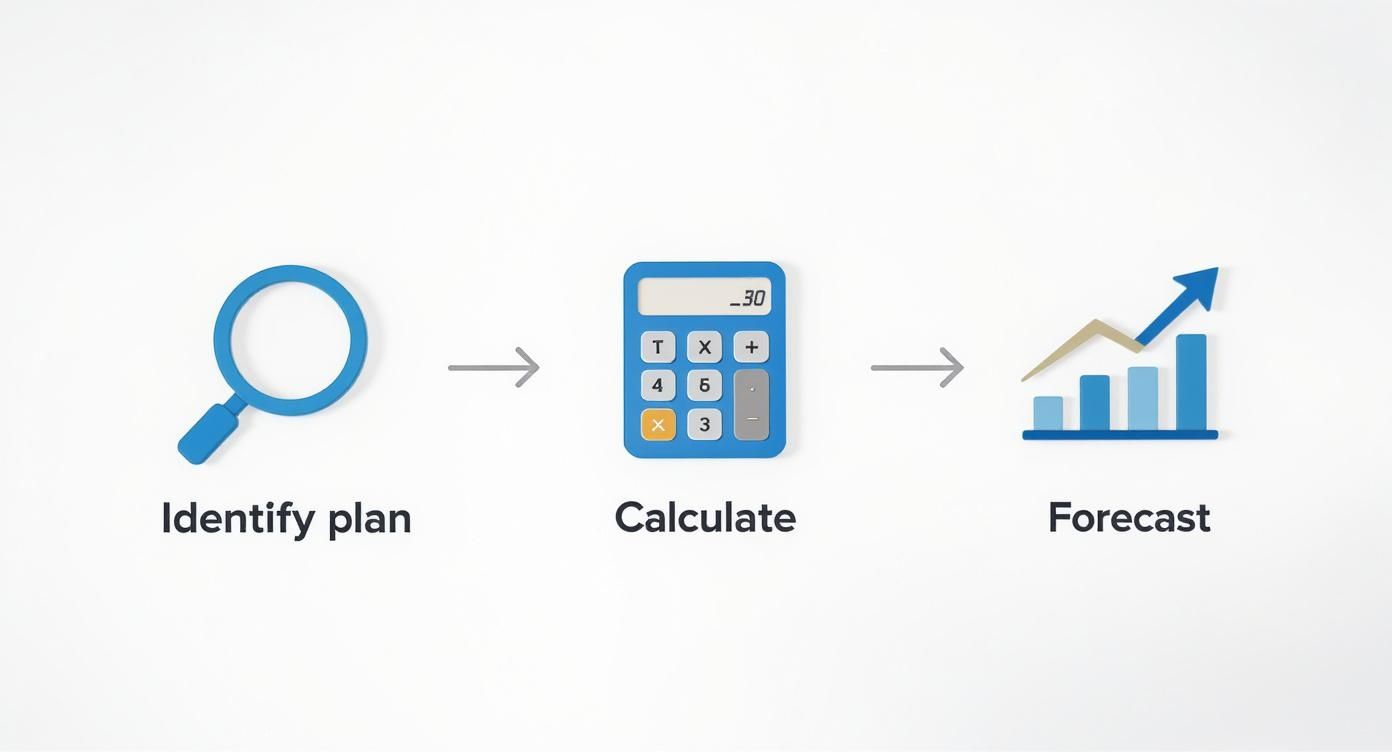
As you can see, that initial calculation is just the beginning. The real planning happens when you start adjusting for your specific life choices.
Meet Sarah: Our Federal Employee Example
Let's get practical with a real-world profile.
Employee: Sarah, a federal employee covered by FERS.
Years of Service: She's put in 30 years of creditable service.
Plan Accrual Rate: 1.0%, which is standard for FERS retirees under age 62.
Final Average Salary (High-3): Her highest three years of earnings average out to $90,000.
With these numbers, we can plug them into the core formula to find her baseline pension.
(Accrual Rate) x (Years of Service) x (Final Average Salary) = Annual Pension
1.0% x 30 x $90,000 = $27,000 per year
This gives Sarah a standard annual pension of $27,000, which comes out to $2,250 a month before any deductions or adjustments are made. Think of this as the gross figure—a solid starting point, but it’s almost never the final number that hits your bank account.
What Happens if She Retires Early?
Let's say Sarah is eager to start her retirement and wants to leave at her Minimum Retirement Age (MRA) of 57. The good news is that with 30 years of service, she's eligible.
However, retiring before age 62 often comes with a catch. For FERS employees who retire at their MRA with at least 10 but fewer than 30 years of service, their benefit is cut by 5% for each year they are under 62.
Because Sarah has a full 30 years in, she actually sidesteps this MRA+10 penalty. But it's a critical detail that trips up a lot of people. If she had only worked 25 years, that $2,250 monthly benefit would have taken a serious hit.
Factoring in a Survivor Benefit
Now for the next big decision: protecting her spouse. Sarah needs to decide if she wants to elect a survivor benefit, which ensures her spouse receives a continuing income if she passes away first. This is a common and incredibly important choice, but it comes at a cost—it directly reduces the retiree's own pension.
Let's assume Sarah opts for the full survivor annuity, which will provide her spouse with 50% of her basic pension.
Cost of Full Survivor Benefit: This choice results in a 10% reduction of her base pension.
Her Reduced Annual Pension: $27,000 - ($2,700) = $24,300.
Her New Monthly Pension: This brings her check down to $2,025.
Spouse's Monthly Benefit: Her husband would receive $1,125 per month (50% of her original $2,250 benefit).
By making this election, Sarah’s monthly check is now $2,025, but she's bought peace of mind, securing a lifelong income of $1,125 per month for her husband.
It's essential to understand that a pension plan’s ability to pay these long-term benefits depends on its financial health. The funding ratio—the ratio of plan assets to pension liabilities—is a key metric used globally to assess this. A ratio below 100% signals underfunding. You can discover more insights about how pension funding is tracked across advanced economies by reviewing reports from the European Central Bank.
Common Pension Calculation Mistakes to Avoid
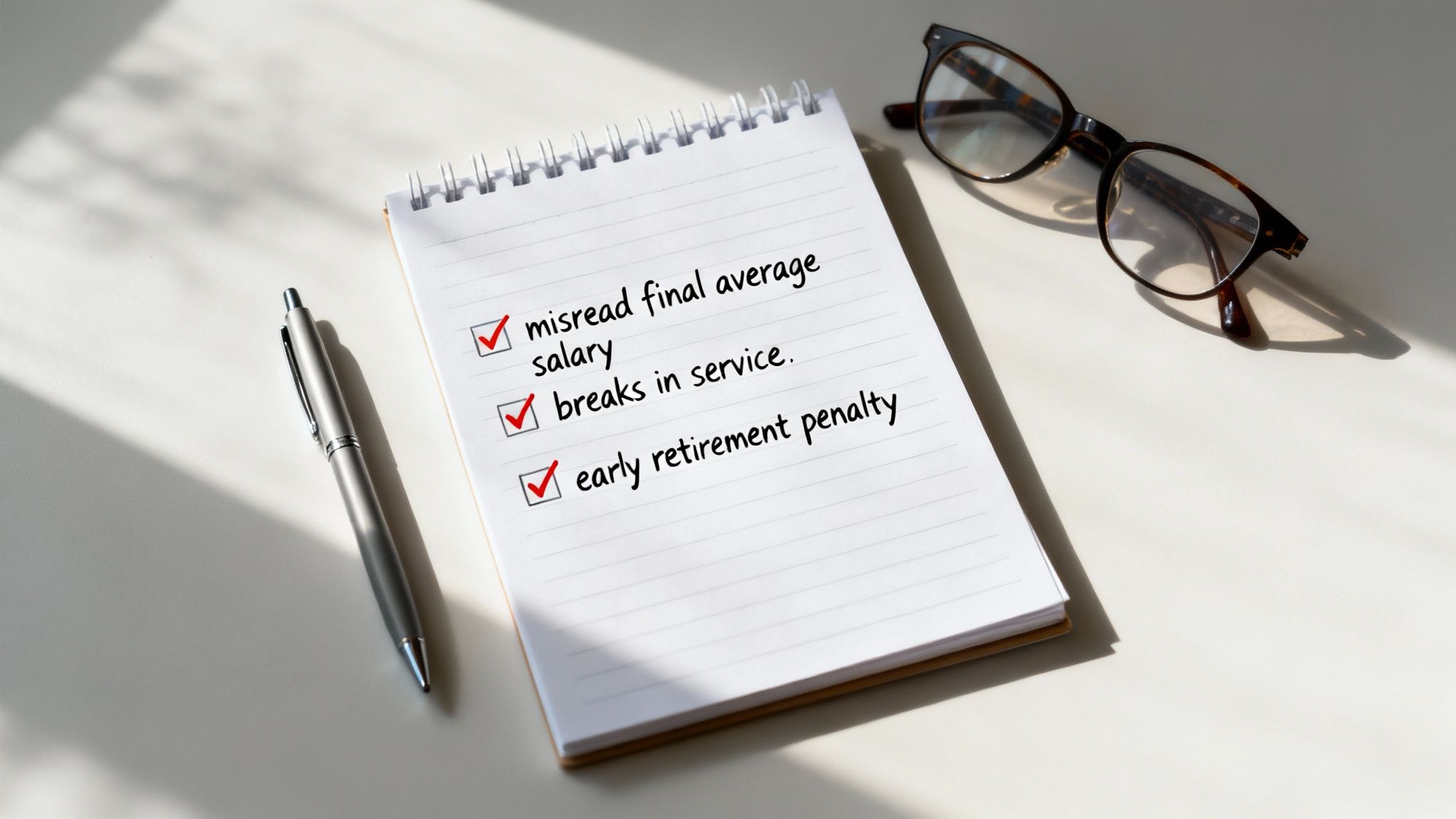
Knowing the pension formula is one thing, but getting the details right is where the real work begins. I've seen it happen time and again—even tiny miscalculations can create a huge gap between the retirement income you think you'll have and what you actually receive.
Let's walk through some of the most common pitfalls I see federal employees make. Steering clear of these can save you a world of financial stress down the road.
Misinterpreting Your High-3 Salary
This is probably the biggest and most frequent mistake. People often get their "High-3" average salary wrong because they assume it includes every dollar they've earned. But in reality, it's almost always based on your basic pay.
Things like overtime, performance bonuses, or special awards typically don't count. So, if you worked a ton of overtime in your last few years and plug that higher number into your calculation, you're going to end up with an inflated, unrealistic pension estimate. The official calculation from OPM will bring a nasty surprise.
Pro Tip: Always double-check what your agency considers "pensionable pay." This single detail is often the source of the largest discrepancies I see in people's self-calculated estimates.
Forgetting About Breaks in Service
Your "years of service" figure needs to be exact, and this is where breaks in service can trip you up. Did you leave federal work for a while and then come back? If you took a refund of your retirement contributions when you left, that period of service doesn't count unless you pay it back—with interest.
It’s easy to overlook this. For example, say you have 25 years on your resume in federal jobs, but there was a three-year gap where you cashed out your FERS contributions. If you never made a redeposit, you only have 22 years of creditable service for your pension. That three-year difference makes a real dent in your final monthly payment.
Underestimating Early Retirement Penalties
The idea of retiring early is tempting, but it comes with a serious financial catch. Most plans hit you with a permanent reduction for every single month you retire before you're eligible for an unreduced benefit. Many people either don't know this penalty exists or they seriously underestimate its lifelong impact.
Let's put it in perspective. A common reduction is 5% for every year you're under the full retirement age. Retiring just five years early could mean a permanent 25% cut from your pension check. That's a massive reduction that you'll feel every month for the rest of your life.
Pensions are a cornerstone of financial security for millions. The Thinking Ahead Institute's 2025 Global Pension Assets Study found that worldwide pension assets hit about $57 trillion in 2023. The U.S. alone makes up roughly 63.9% of that total, which shows just how critical these funds are. You can dive deeper into the global retirement trends and figures in their full report.
Common Questions About Pension Calculations
Even after you've run the numbers, it's natural to have a few lingering questions. Let's be honest, federal pension rules can get complicated. I've put together some straightforward answers to the questions I hear most often from federal employees trying to figure out their benefits.
Think of this as a quick reference for those nagging "what-if" scenarios. Getting these details straight will give you a ton of peace of mind and help you plan your future with real confidence.
What Happens to My Pension if I Change Jobs?
A big worry for many is, "What if I leave federal service? Do I lose my pension?" The good news is, once you're vested, that benefit is yours to keep. For most FERS employees, vesting happens after five years of creditable civilian service.
So, if you leave for a private-sector job after you've hit that five-year mark but before you're old enough to retire, your pension is considered "deferred." It just means the benefit you've earned will be waiting for you. You can typically start collecting it once you turn 62.
The bottom line is this: you don't lose the benefit. You simply file for a "deferred retirement" when you hit the right age down the road. Just make sure you keep your contact information updated with the Office of Personnel Management (OPM) so they know where to find you!
How Can I Find the Specifics for My Plan?
General formulas are a great starting point, but the devil is always in the details of your specific plan. The most critical document you can get your hands on is your Summary Plan Description (SPD) or its federal equivalent. For FERS folks, the most reliable information comes directly from OPM and your own agency's HR department.
Here’s where to turn for answers you can trust:
Your Agency's HR Office: This should always be your first stop for personalized questions. They know your situation best.
The OPM Website: It's a goldmine of official handbooks, forms, and calculators straight from the source.
Your Personal Statement of Benefits: This statement, which you should receive annually, provides a snapshot of your service history and benefit estimates.
A word of caution: don't put all your faith in generic online calculators. They can be helpful for a ballpark figure, but always double-check their numbers against your official documents to make sure the salary figures and accrual rates are correct for your plan.
Are My Pension Benefits Taxed?
Yes, in almost all cases, your federal pension payments are considered taxable income. When you retire, you'll have to decide on federal and state tax withholding for your monthly annuity. How much you'll owe depends on things like your total income and which state you live in.
There's a silver lining, though. A portion of your pension might actually be tax-free. This is usually the part that comes from your own after-tax contributions you made to the retirement system over the years. With your first annuity payment, OPM will send a statement breaking down the taxable and non-taxable portions of your benefit. Hang onto that document—it’s incredibly important come tax time.
Figuring out the ins and outs of your federal benefits is a huge step toward building a secure retirement. Federal Benefits Sherpa offers one-on-one guidance to help you put all the pieces together. You can start with a free 15-minute benefit review to make sure you're heading in the right direction. Learn more and schedule your review at https://www.federalbenefitssherpa.com.
