Federal Long Term Care Insurance Program: A Guide
The Federal Long Term Care Insurance Program, or FLTCIP as it's commonly known, is a group insurance plan created by the U.S. government. At its core, it’s designed to be a financial backstop for the "federal family" when long-term care becomes a reality.
Understanding the Federal Long Term Care Insurance Program

Think about your retirement plan. You've likely accounted for your mortgage, daily bills, and maybe even some travel. But have you planned for the curveballs? A sudden illness or injury that leaves you needing help with everyday tasks is a major one, and that's precisely where the Federal Long Term Care Insurance Program (FLTCIP) was designed to help.
It’s a common misunderstanding that regular health insurance—like the Federal Employees Health Benefits (FEHB) program or even Medicare—will pick up the tab for this kind of care. The truth is, they won't. Those plans are built for doctor visits, hospital stays, and prescriptions, not the long-haul, non-medical support that defines long-term care.
The Core Purpose of FLTCIP
The FLTCIP exists to fill that exact gap. Its main job is to help federal employees and their families handle the often-staggering costs of long-term care services. We're talking about the kind of help you might need if a chronic condition, a disability, or cognitive decline makes it impossible to handle basic daily activities by yourself.
Here's a simple way to look at it: your FEHB plan pays the doctor who sets your broken leg. A plan like FLTCIP, on the other hand, pays for the professional who helps you get dressed, take a shower, and make meals while you're recovering at home for the next few months.
Who Is Part of the Federal Family?
This program wasn't created just for current employees. The term "federal family" casts a wide net, covering a broad group of people with ties to federal service. Although enrollment for new applicants is currently on hold, the groups who have historically been eligible include:
- Federal and U.S. Postal Service employees and annuitants
- Active and retired members of the uniformed services
- Qualified relatives, including spouses, domestic partners, adult children, and even the parents of eligible employees
Overseen by the U.S. Office of Personnel Management and run by a third-party administrator, FedPoint, the FLTCIP provides a group insurance framework designed for the federal community. The goal is to manage the costs that come with needing assistance in your daily life. For a deep dive into the program's official structure, the FLTCIP's administration and purpose booklet is a great resource.
The need for this kind of planning is very real. Statistics show that more than half of Americans turning 65 today will require some form of long-term care during their lives. Without a plan, those costs can wipe out a lifetime of savings in a hurry.
Understanding why the FLTCIP was created is the first step. It's about protecting the financial independence of the people who serve our country, making sure they can get quality care without putting an impossible strain on their families or their retirement nest egg.
Who Can Get FLTCIP? A Breakdown of Eligibility
One of the first questions people ask about the Federal Long Term Care Insurance Program (FLTCIP) is a simple one: am I eligible? The program was built for a specific group of people connected to federal service, what's often called the "federal family."
While new applications have been on hold since December 19, 2022, knowing the eligibility rules is still crucial. It helps existing policyholders understand their coverage and provides important context for everyone if the program reopens to new applicants in the future.
Think of eligibility not as a single bucket, but as a series of connected groups. At the center, you have federal and uniformed service members, and extending outward from them are their qualified relatives.
The Core Group: Federal Employees and Service Members
The program was fundamentally designed for those who work for or have retired from the federal government and the uniformed services. This is the bedrock of the FLTCIP.
- Current Federal and U.S. Postal Service Employees: If you're currently in a job that makes you eligible for the Federal Employees Health Benefits (FEHB) Program, you generally qualify. The key here is eligibility for FEHB—you don't actually have to be enrolled in it.
- Federal and U.S. Postal Service Annuitants: This covers retirees receiving a federal annuity. It’s a way to ensure that dedicated, long-term federal employees have access to this benefit well into their retirement years.
- Active and Retired Members of the Uniformed Services: This broad category includes members of the Army, Navy, Air Force, Marine Corps, Coast Guard, and the new Space Force. It also covers the Commissioned Corps of both the National Oceanic and Atmospheric Administration (NOAA) and the Public Health Service.
One of the most important features is that your coverage is portable. If you enrolled while you were a federal employee and then left for a job in the private sector, you can keep your FLTCIP policy. You just have to continue paying the premiums.
Extending the Circle to Family Members
The FLTCIP recognizes that a long-term care event doesn't just affect one person; it impacts the whole family. That's why eligibility extends beyond the primary employee or service member to certain qualified relatives.
Each family member applies for their own individual policy, but their ability to apply hinges on their relationship to an eligible federal family member.
Here's a quick look at the main groups who can apply for FLTCIP coverage.
FLTCIP Eligibility Groups at a Glance
This table summarizes the primary groups of individuals who are eligible to apply for the Federal Long Term Care Insurance Program.
| Eligible Group | Description of Eligibility |
|---|---|
| Federal & USPS Employees | Current employees in positions eligible for the FEHB Program. |
| Federal & USPS Annuitants | Retirees currently receiving an annuity from a federal retirement system. |
| Uniformed Service Members | Active and retired members of the Army, Navy, Air Force, Marine Corps, Coast Guard, Space Force, and Commissioned Corps of NOAA and PHS. |
| Spouses & Domestic Partners | Spouses of eligible federal employees and annuitants. Also includes same-sex and opposite-sex domestic partners who provide the necessary documentation. |
| Adult Children | Natural, adopted, or stepchildren who are at least 18 years old. |
| Parents & In-Laws | The parents, parents-in-law, and stepparents of living, eligible federal employees and their spouses. |
It's a common misconception that the federal employee has to be enrolled for their relatives to qualify. That's not the case. As long as the employee or service member is eligible, their qualified family members can apply for their own coverage.
This structure is incredibly flexible. It allows families to create a patchwork of protection tailored to their specific needs and financial situations, with each person holding and paying for their own individual policy.
Choosing Your FLTCIP Coverage and Benefits
Think of the federal long term care insurance program (FLTCIP) as a toolkit. Your job is to pick the right tools to build a plan that fits your personal needs and, just as importantly, your budget.
Every decision you make—from how much daily coverage you want to whether you add inflation protection—directly impacts your premium and the level of security you’ll have down the road. It’s a balancing act, for sure.
The infographic below gives a quick visual of who can get coverage under the program.
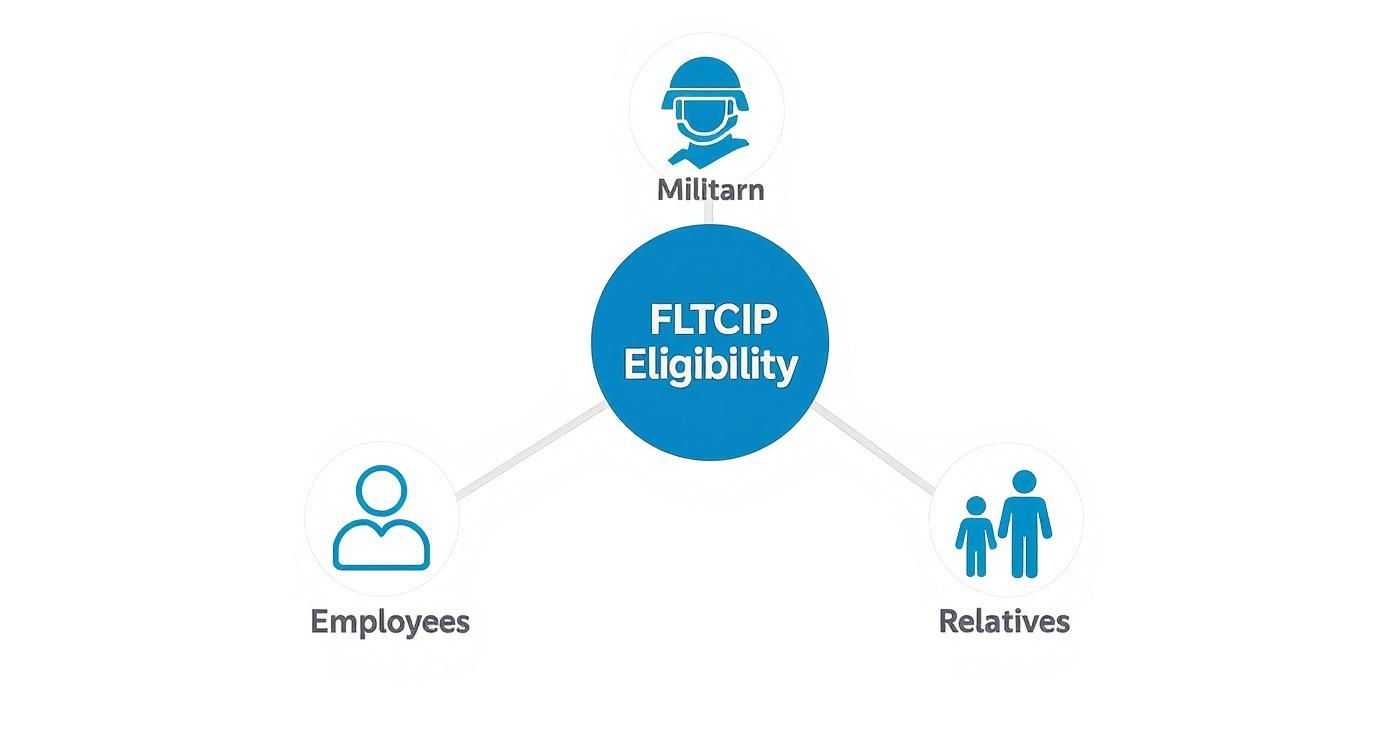
As you can see, the program is open to federal and postal employees, members of the uniformed services, and certain qualified relatives.
The Daily Benefit Amount: Your Daily Care Allowance
The simplest way to think about the Daily Benefit Amount is as your daily spending cap for care. It's the maximum amount the plan will pay for your care services on any given day.
Let’s say you select a $150 daily benefit. That’s your limit.
- A $100 daily benefit might be enough for a few hours of home health aide services, but it probably won't cover the full cost of an assisted living facility.
- A $200 daily benefit gives you much more breathing room, potentially covering comprehensive home care or a significant chunk of nursing home expenses.
Choosing a smaller daily benefit keeps your premiums lower now, but you risk having to pay more out-of-pocket later if your care needs are expensive. On the flip side, a higher benefit provides greater peace of mind but comes with a bigger price tag today.
Where Will You Receive Care? Comparing Your Options
Long-term care isn't a one-size-fits-all situation. The FLTCIP covers you in different settings, including at home, in an assisted living facility, or in a traditional nursing home. Where you receive care really changes how far your daily benefit will go.
Let's stick with our $150 daily benefit example to see how it plays out in different scenarios.
| Care Setting | How a $150 Daily Benefit Might Work |
|---|---|
| Home Care | This often fits well within the daily limit, covering costs for aides and necessary supplies. |
| Assisted Living | The $150 may only cover a portion of the daily fee, requiring you to supplement from savings. |
| Nursing Home | Depending on the facility, the benefit could cover a substantial part of the daily nursing fees. |
Visualizing the costs this way makes it clear how your choice of care setting can affect your personal finances. For many, home care is a priority, and a modest daily benefit can make that possible. For others who anticipate needing facility-based care, a higher benefit might be the smarter move.
How to Customize Your Plan Step-by-Step
Building your ideal plan doesn't have to be overwhelming. It really boils down to a few key decisions that let you align your coverage with your financial reality.
Here’s a straightforward approach:
- Set Your Daily Benefit Amount: Start with a realistic estimate of daily care costs in your area.
- Pick a Benefit Period: This determines the total lifetime value of your policy. Common options are two years, three years, five years, or even unlimited coverage.
- Add Inflation Protection: This is a crucial one. It helps your benefit grow over time so it can keep up with the rising cost of care.
- Consider Extra Features: Look into options like Shared Care if you and your spouse are both enrolling.
As you make these selections on the FLTCIP website, you'll see your estimated premium update in real-time. This lets you play with different combinations until you find a sweet spot between robust coverage and a manageable cost.
Finding the Right Balance Between Premiums and Benefits
There’s no magic formula here—it’s all about trade-offs. Your premium is heavily influenced by your age when you apply, the benefit amounts you choose, and any riders like inflation protection.
The single biggest factor you can control is when you apply. Enrolling at a younger age locks in a lower premium for the life of the policy.
A healthy 45-year-old might pay significantly less than a 60-year-old for the exact same coverage. In some cases, waiting can increase lifetime premiums by 40% or more.
While the FLTCIP is designed to keep premiums stable, they can and do increase over time. It’s wise to factor potential future rate hikes into your long-term budget.
Here are a few final tips for fine-tuning your plan:
- Generate several quotes to see how small tweaks to your benefits affect the premium.
- If you're married, run the numbers for a shared care plan—it can sometimes be more cost-effective.
Ultimately, designing your FLTCIP coverage is a deeply personal process. By breaking it down and understanding how each piece works, you can build a plan that truly protects your financial future and gives you confidence for the years ahead.
How FLTCIP Premiums and Costs Are Calculated
Figuring out the financial side of the federal long term care insurance program (FLTCIP) is a huge part of planning for your future. Think of your premium as the price tag on your peace of mind, and that price isn't pulled out of a hat. It's carefully calculated based on a few key factors that measure your potential risk.
The two biggest variables that will shape your premium are your age when you apply and the specific benefits you choose. The logic here is pretty simple: the younger and healthier you are when you sign up, the lower the insurer sees your risk. That translates directly to a lower premium for you.
This is the bedrock principle of how insurance works. An insurer is betting that a younger applicant has a long runway before they might need care, giving them more time to pay premiums into the pool. It’s exactly why you’ll hear financial advisors talk about looking into long-term care insurance earlier in your career, not later.
The Power of Applying Early
Of all the things that affect your premium, the one you have the most control over is when you apply. Locking in a premium at a younger age gives you a massive financial leg up over the life of your policy. Waiting just a few years can mean paying a noticeably higher price for the exact same coverage.
Let’s look at a quick example with two federal employees applying for identical FLTCIP plans:
- Sarah, Age 45: She applies for a plan with a solid daily benefit and automatic inflation protection. Her premium is based on her younger age and good health, making her monthly payment pretty manageable.
- David, Age 58: Her colleague, David, puts it off. When he finally applies for the very same plan 13 years later, his premium is substantially higher. This reflects his increased age and the higher statistical chance of needing care sooner rather than later.
Over the lifetime of their policies, David will end up paying thousands of dollars more than Sarah, all because he waited. This really drives home the financial advantage of getting enrolled as early as you can.
Balancing Coverage with Manageable Premiums
Beyond your age, the choices you make when you build your plan are the next biggest cost drivers. Every benefit you add or enhance—like a higher daily benefit amount or a longer benefit period—will nudge your premium upward. The trick is to find a balance that you can comfortably afford for the long haul.
It's so important to see long-term care insurance not just as another bill, but as a shield for your hard-earned assets. The average lifetime cost of long-term care services is around $138,000, which makes a solid insurance plan an essential piece of any smart financial strategy.
This is especially true when you realize that over half of Americans turning 65 today are expected to need some kind of long-term care in their remaining years. If you want to dig deeper into the numbers, you can review the data on long-term care costs to see why this is becoming such a critical issue.
Planning for Potential Premium Increases
Here's a crucial point to understand about the FLTCIP: your premiums are not guaranteed to stay the same forever. The insurer can request a premium increase, which has to be approved by the U.S. Office of Personnel Management (OPM), after reviewing the program's overall financial health.
These adjustments are usually made to account for things like people living longer and the rising cost of care—factors that might not have been fully predicted when the original rates were set. In fact, significant premium hikes have happened in the past, and they can catch existing policyholders by surprise.
So, as you budget for FLTCIP, it’s a smart move to build in a little wiggle room for potential rate increases down the road. Taking this proactive step means that if an increase does happen, it won’t throw your entire financial plan off track. It keeps your long-term care strategy resilient and sustainable.
Navigating the FLTCIP Application Process

Applying for the federal long term care insurance program (FLTCIP) can feel a bit intimidating, but once you know the steps, it’s a lot more straightforward. The whole point of the application is to assess your eligibility and current health to see if you qualify. I like to think of it as a two-lane highway: a fast lane for new hires and a standard lane for everyone else.
If you're brand new to federal service, you get access to the fast lane. For the first 60 days on the job, you can apply with what’s called abbreviated underwriting. This is a huge advantage. It's a much simpler review, asking just a handful of health questions, which makes getting approved significantly easier.
Miss that 60-day window? Or not a new employee? No problem. You’ll just merge into the standard lane, which involves full underwriting. This is simply a more detailed look at your overall health history.
What Is Medical Underwriting?
Medical underwriting sounds technical, but it’s really just how an insurer evaluates your health to determine your eligibility for coverage. It’s their way of understanding the risk involved. This isn’t something unique to FLTCIP; it's standard practice across the board for long-term care insurance.
You’ll be asked to fill out a pretty detailed health questionnaire covering your medical history, any ongoing conditions, and the medications you’re taking. Sometimes, they might ask to see your medical records or schedule a quick phone interview to get a clearer picture.
The most important thing here is to be completely honest and thorough. If you leave something out, it could cause a claim to be denied down the road, which defeats the whole purpose of paying for the policy.
This review is what helps the insurer make their decision. A little prep work on your end can make the entire process feel much less stressful.
Tips for a Smoother Application
A bit of preparation can make a world of difference when you're applying. Getting all your ducks in a row beforehand means you can answer everything accurately and keep the process moving without any frustrating delays.
Here’s a simple checklist to get you started:
- Gather Your Health Information: Jot down the names and contact info for all your doctors. Make a list of any chronic conditions you have and all your current medications, including the dosages.
- Review Your Medical History: Take a few minutes to think about any major health events from the past few years—surgeries, hospital stays, or significant treatments. Having these details ready makes filling out the forms a breeze.
- Understand the Questions: Don't rush. Read every question on the application carefully. If you’re not 100% sure what something means, it’s always better to ask for clarification than to guess.
Keep in mind, the FLTCIP is currently suspended for new applicants. However, understanding how the process works is still valuable. When applications do reopen, being prepared will give you a real head start and help you navigate the system with confidence.
How to File a Claim and Use Your Benefits
Even with the best preparation, the moment you actually need to use your long-term care benefits can feel incredibly stressful. Understanding how the federal long term care insurance program (FLTCIP) claims process works before you need it can make all the difference, taking a lot of the pressure off when it's time to get care.
The good news is that the process is designed to be pretty clear-cut, starting with specific "triggers" that activate your policy.
You don't just decide one day to start using your benefits. Your coverage officially kicks in after a licensed healthcare practitioner certifies that you need help with at least two of the six Activities of Daily Living (ADLs). This isn't a temporary thing; the need for substantial assistance must be expected to last for at least 90 days.
These ADLs are the fundamental tasks of self-care, like bathing, dressing, eating, and getting in and out of a bed or chair. Alternatively, benefits can be triggered by a severe cognitive impairment, such as Alzheimer's, which poses a threat to your health and safety.
Understanding the Waiting Period
Once your doctor confirms you meet the eligibility criteria, a timer starts on what’s called your elimination period, or waiting period. You can think of this as a deductible measured in time, not money. It's a 90-day period that must pass after you become eligible before FLTCIP starts paying for your care.
It's really important to remember that you are responsible for covering all care costs during this waiting period. This is a critical piece to factor into your financial planning, so you have savings ready to bridge that gap.
The need for programs like FLTCIP is growing more apparent every year. Right now, about 6.9 million people receive services from long-term care facilities across the country. And that number is set to skyrocket—some projections show the nursing home population alone could grow by more than 75% by 2030. You can discover more insights about long-term care trends on consumeraffairs.com.
A Step-by-Step Guide to Initiating Your Claim
When the time comes, getting your claim started involves just a few key steps. Having the right information organized ahead of time will make the entire experience much smoother for you and your family.
Here's how it generally works:
- Contact the Claims Administrator: Your first move is to get in touch with the program's administrator, which is currently FedPoint. You or a designated family member should call them to formally start the process and get the required paperwork.
- Gather Necessary Documentation: You’ll need to submit the official certification from your doctor that details your condition—either your inability to perform ADLs or your cognitive impairment. It’s always a good idea to have your policy documents and any relevant medical records easily accessible.
- Develop a Plan of Care: The administrator will collaborate with you, your family, and your healthcare provider to map out a formal Plan of Care. This document simply outlines the specific services you’ll receive, making sure everything aligns with what your policy covers.
By knowing these triggers and steps, you can confidently tap into the benefits you’ve planned for. This lets you focus on what truly matters: getting the right care without the added burden of financial stress.
A Few Common Questions About FLTCIP
When you start digging into the Federal Long Term Care Insurance Program, you’ll likely find the same questions popping up again and again. Let's tackle some of the most common ones head-on, because understanding these details is key to figuring out how FLTCIP fits into your life, especially when things change.
A big one I hear all the time is about job changes. What if you sign up for FLTCIP and then leave your federal job for the private sector? Do you lose all that investment?
Thankfully, the answer is no. Your FLTCIP coverage is completely portable, which is a huge plus. If you leave federal service, you can take your policy with you. You'll just start paying the premiums directly, and your coverage stays exactly the same. Your employment status has no effect on it.
Are FLTCIP Premiums Guaranteed to Never Go Up?
This is a critical question for anyone trying to budget for the future. The short answer is that FLTCIP premiums are not guaranteed and can increase over time. It's really important to know this from day one.
The program's insurer, John Hancock, can request a premium increase for a group of policyholders if their financial projections show it's necessary. That request isn't automatic, though—it has to be reviewed and approved by the U.S. Office of Personnel Management (OPM).
We’ve seen this happen before. Significant premium hikes have hit policyholders in the past, with the most recent increase rolling out in early 2024. This is why it’s so important to think of your premium as a potentially variable cost, not a fixed expense you can set and forget.
Factoring in the possibility of future rate increases is just smart planning. It helps ensure you can afford to keep your coverage for the long haul.
What Happens if My Application Is Denied?
Getting a denial during the medical underwriting process can feel like a major setback, but it’s not necessarily the end of the road.
First, you won’t be left guessing why. You’ll get an official letter that explains the specific reason for the denial. And if you think the decision was based on wrong or missing information, you have the right to appeal.
A denial also doesn't mean you're banned for life. If your health improves significantly down the line, you might be able to reapply if the program opens up again for new applications.
Planning for long-term care is one of the most important things you can do for a secure retirement. At Federal Benefits Sherpa, we help you navigate the complexities of your federal benefits to build a solid financial plan. Schedule your free 15-minute benefits review to make sure you're on the right track.