federal employee life insurance after retirement: guide
Yes, you absolutely can keep your federal employee life insurance after retirement, but it’s not automatic. You have to meet a couple of key requirements to carry that coverage into your next chapter.
The big rule is this: you must have been enrolled in the Federal Employees' Group Life Insurance (FEGLI) program for the five consecutive years right before you retire. On top of that, you must be eligible for an immediate annuity. Making the right calls about your coverage before you hang up your hat is one of the most important financial decisions you'll make for your family.
Keeping Your FEGLI Coverage After Federal Service

Retirement is a massive milestone, and figuring out how your benefits work on the other side is a huge priority. For many federal employees, FEGLI is a critical piece of their family's financial safety net. Unlike a private policy you buy on your own, FEGLI is a group term life insurance plan. A major perk is that you don't need a medical exam to enroll while you're working, which makes it an incredibly accessible benefit.
FEGLI is made up of Basic Insurance and three optional add-ons: Option A (Standard), Option B (Additional), and Option C (Family). Here’s something you really need to understand: if you’ve dropped FEGLI coverage in the past, you can't just sign back up whenever you want. There is no regular open season for it. This puts a lot of pressure on making the right choices before you leave federal service, because getting coverage back is nearly impossible unless you have a Qualifying Life Event.
You can learn more about how FEGLI works for federal employees and retirees on our main guide page.
Planning Your Post-Federal Life
As retirement gets closer, you'll have to make some permanent decisions about each piece of your FEGLI coverage. The choices you make will have a direct impact on your monthly premiums and, more importantly, the death benefit your loved ones will eventually receive.
This guide will walk you through the most important things to think about:
Meeting Eligibility Rules: We’ll double-check that you meet the "five-year rule" and are set for an immediate annuity.
Understanding Your Coverage Options: You'll need to decide on the reduction levels for your Basic insurance and figure out what to do with Options A, B, and C.
Navigating the Costs: It's crucial to prepare for how premiums can, and often do, increase dramatically as you get older.
Taking the time to build a smart FEGLI strategy means you can align your life insurance with your family's long-term financial goals. This isn't just about filling out paperwork; it's about making sure your legacy is secure and providing real peace of mind.
Meeting the Key Eligibility Rules for FEGLI
Keeping your Federal Employees' Group Life Insurance (FEGLI) after you retire isn't something that just happens automatically. You have to meet a very specific set of rules laid out by the Office of Personnel Management (OPM). Think of them as the final checkpoints you must clear before heading into retirement with your life insurance intact.
The good news is that these rules are straightforward. There are just two main requirements you have to satisfy, but they are non-negotiable. If you miss either one, your FEGLI coverage will end the day you leave federal service.
The Five-Year Rule Explained
First up is what everyone calls the "five-year rule," and it's the most important one to understand. Simply put, you must have been covered by FEGLI for the five full years of service immediately before the date your retirement annuity begins.
Think of it this way: OPM looks back at the last five years of your career. They need to see an unbroken chain of FEGLI enrollment during that entire time. It doesn't matter if you were enrolled for 25 years prior; that final five-year stretch is the only period that counts.
Key Takeaway: The five-year rule is a hard stop. A gap of even a few months within that final five-year window will disqualify you from continuing your federal employee life insurance after retirement.
There is one small exception. If your entire period of eligibility to have FEGLI was less than five years, you just need to have been enrolled for that entire shorter period.
Retiring with an Immediate Annuity
The second major requirement is that you must be retiring on an immediate annuity. This just means your pension checks have to start within 31 days after you officially separate from service.
This rule is simple, but it’s where some people get tripped up, especially if they're considering a deferred retirement.
Let's break down the difference:
Immediate Annuity: You leave your job, and your pension starts almost right away. If this is your plan, you've met the requirement.
Deferred Annuity: You leave federal service but aren't old enough to start drawing your pension. In this case, your FEGLI coverage will terminate. You can't pick it back up years later when you finally start receiving your annuity.
This is a critical distinction. Choosing a deferred retirement severs the connection required to keep your group life insurance. You'll be given the option to convert your FEGLI to a private individual policy, but be warned—this is a completely different animal, and the premiums are almost always significantly higher. Securing that immediate annuity is your only path to keeping the FEGLI benefits you've come to rely on.
Choosing Your FEGLI Coverage Options
So, you've cleared the eligibility hurdles for keeping your FEGLI benefits in retirement. That's a huge step. Now comes the real decision-making: how much of that federal employee life insurance after retirement do you actually want to keep, and what are you willing to pay for it?
This isn't a simple "yes" or "no" situation. You have distinct choices for your Basic Insurance and separate decisions to make for your Optional coverages. Think of your Basic Insurance as the foundation. At retirement, you have to decide how that foundation will look years from now. You’ve got three paths to choose from, and each one has a very different impact on your coverage amount and your wallet.
This decision tree helps visualize the core requirements you need to meet to continue your federal employee life insurance after retirement.
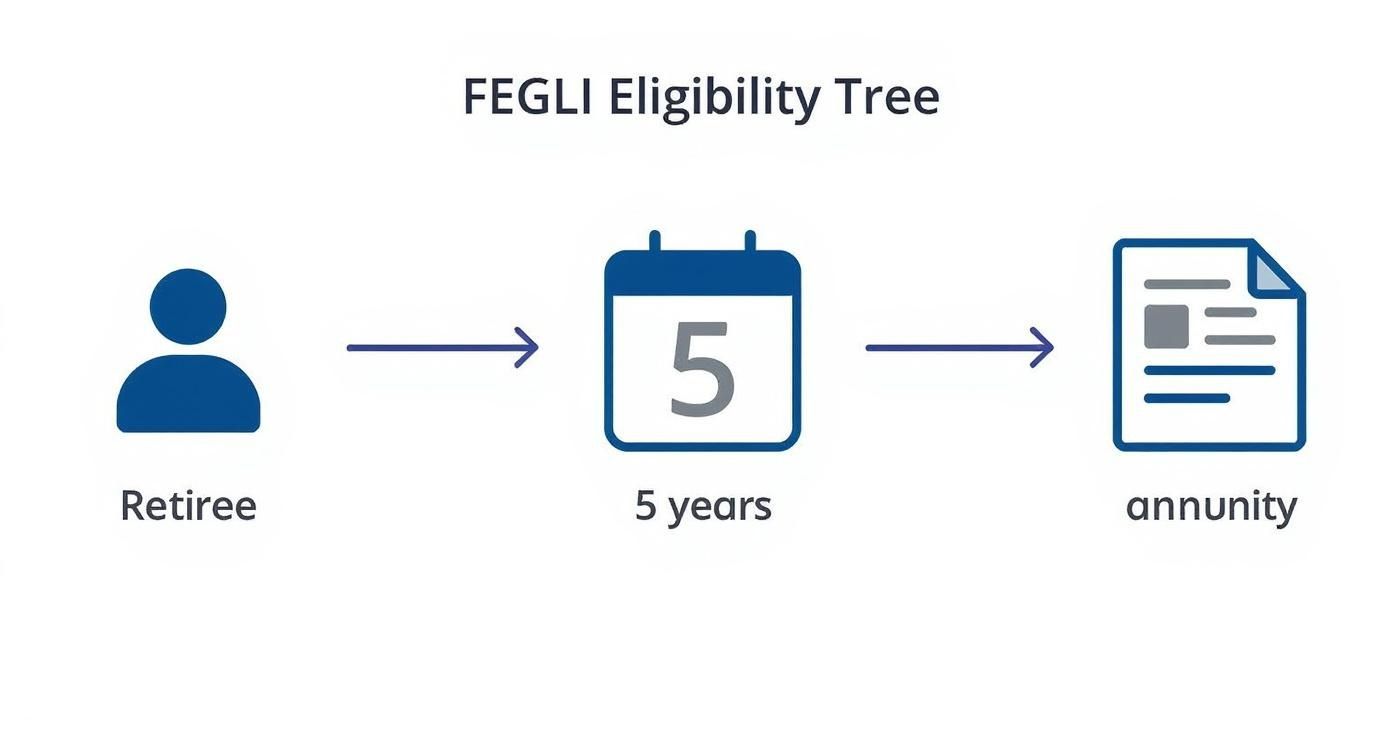
As you can see, it all starts with retiring on an immediate annuity and having that crucial five years of prior coverage. Once you've checked those boxes, it's time to dig into the details.
Your Three Choices for Basic Insurance
When you fill out your retirement paperwork (the SF 2818 form), you’ll be asked to make a crucial choice about your Basic Insurance. The question really boils down to this: how much are you willing to pay to stop your coverage amount from shrinking over time?
You have to pick one of three reduction levels:
75% Reduction: This is the default option and, frankly, the one most federal retirees choose. With this choice, your Basic coverage amount starts to decrease by 2% each month once you turn 65 (or at retirement, if you're already over 65). This reduction continues until the policy's value hits 25% of its original amount, where it will stay for the rest of your life. The biggest selling point? Once you turn 65, you stop paying premiums for Basic Insurance forever.
50% Reduction: If you want to keep a bit more coverage, you can choose the 50% reduction. Here, your insurance value decreases by just 1% per month after age 65 until it reaches 50% of its original value. You'll pay a higher premium for this choice compared to the 75% option, but you hang on to a larger death benefit.
No Reduction: For those who want to keep their full death benefit intact, there's the No Reduction option. Your Basic Insurance stays at 100% of its value for life. As you can imagine, this benefit comes at a steep price. The premiums are significantly higher, and you have to keep paying them for the rest of your life.
To make this easier to visualize, let's break down how these choices stack up.
FEGLI Basic Insurance Reduction Options in Retirement
The table below compares the three reduction choices for your Basic life insurance coverage, showing how each affects your coverage amount and premium costs after age 65.
Reduction OptionCoverage After Age 65Monthly Premium After Age 65Best For Retirees Who...75% ReductionReduces to 25% of original value$0.00Want to eliminate premiums but keep a small policy for final expenses.50% ReductionReduces to 50% of original valueHigher than 75% optionNeed a moderate death benefit and are comfortable with the ongoing premiums.No ReductionStays at 100% of original valueHighest premium costHave a significant, long-term need for life insurance and can manage the high cost.
Choosing the right option means taking a hard look at your family's financial needs versus what you can comfortably afford in premiums over the long haul.
Handling Your Optional FEGLI Coverages
Now, let’s talk about your Optional coverages. The choices here are a bit more straightforward, but they're just as important.
Option A (Standard): If you elected to have Option A, which provides a $10,000 death benefit, its path is already set. It automatically follows a 75% reduction schedule after age 65, eventually leaving a final benefit of $2,500. Just like with the 75% Basic reduction, the good news is that you stop paying premiums for Option A when you turn 65. You don't get to choose a different reduction level for this one.
Option B (Additional): This is where you have more control. You can choose to keep some or all of your Option B multiples. For example, if you have 5 multiples, you could decide to keep all 5, or you could reduce down to 3 to lower your premiums. What you can't do is ever increase your multiples after retiring. A critical point to remember is that Option B premiums continue for life and they get more expensive as you get older, with rates increasing every five years.
Option C (Family): Option C, which provides coverage for your spouse and eligible children, works a lot like Option B. You can keep all your multiples or reduce them. The premiums also continue for life and will increase based on your age bracket.
One final, crucial thought: your choices for federal employee life insurance after retirement are set in stone once your retirement is finalized. There are no do-overs. That’s why it’s so important to carefully weigh the costs against your family’s actual needs before you sign on the dotted line.
The Sticker Shock: Why FEGLI Costs Skyrocket in Retirement
One of the biggest surprises new federal retirees face is the staggering cost of keeping their FEGLI coverage. It’s a common and often painful realization. While you're working, the government picks up a good chunk of your Basic life insurance premium, making it feel quite affordable. But that all changes once you retire. The cost dynamic shifts dramatically, especially as you get older.
It’s crucial to remember what FEGLI is: group term life insurance. This isn't a permanent whole life policy with premiums that stay the same forever. Think of your Optional coverages, like Option B and Option C, as a subscription that automatically gets more expensive every five years when you hit a new age bracket.
This structure means that what seems like a reasonable premium for Option B at age 65 can quickly become a budget-buster by the time you're in your 70s or 80s. Many retirees find the escalating costs simply become unaffordable, forcing them to either reduce their coverage or drop it entirely—often at the very time in life when their family might need it most.
The Financial Reality of Age-Based Premiums
These premium hikes aren't small, gradual increases. They can be massive. For instance, the cost for Option B more than doubles between the 65-69 age bracket and the 75-79 age bracket. That kind of exponential growth has to be factored into your long-term retirement plan.
This financial pressure doesn't exist in a vacuum. It’s happening alongside other rising costs for federal benefits, particularly health insurance.
The Office of Personnel Management (OPM) is responsible for the health benefits of roughly 8.2 million federal employees, retirees, and their families. With an average group age of 60, the cost structure for all federal benefits, including life insurance, is heavily influenced by this older demographic.
When your Federal Employees Health Benefits (FEHB) premiums also see big jumps, it makes that expensive FEGLI premium even harder to swallow. If you're interested in the bigger picture, you can learn more about how demographics shape federal benefit costs directly from OPM.
A Look at Sample FEGLI Costs
To get a real sense of the long-term financial commitment, let's walk through a quick example. Imagine a retiree who keeps $100,000 in Option B coverage. Here’s a rough idea of how their monthly premium would climb over the years.
Age 65-69: The premium starts at about $130 per month.
Age 70-74: It then jumps to over $216 per month.
Age 80+: By this point, the cost skyrockets to over $650 per month for the exact same $100,000 of coverage.
Seeing the numbers laid out like this really drives home why planning ahead is so important. Before you sign that SF 2818 form to lock in your retirement benefits, you have to project these costs out over the next 20 or 30 years. If you don't, you could face a terrible choice later on: either drain your nest egg to keep the insurance or lose the coverage you thought your family could depend on. Taking a hard, realistic look now is the only way to make a sustainable decision about your federal employee life insurance after retirement.
How to Get Your SF 2818 Form Right the First Time

When it's time to make your federal employee life insurance after retirement decisions permanent, it all comes down to one document: Form SF 2818, the Continuation of Life Insurance Coverage. This form is where you officially tell the Office of Personnel Management (OPM) exactly what you want to do with your FEGLI coverage.
Think of the SF 2818 as the final say. Once OPM processes your retirement, the choices you lock in here are pretty much set in stone. One wrong checkmark or a simple misunderstanding can leave you with a plan that’s too expensive or doesn't provide the protection your family needs. Getting it right is non-negotiable.
Navigating the Key Sections of the Form
The SF 2818 is designed to walk you through each piece of your FEGLI coverage, asking you to make a clear choice for every part. The first and most important decision revolves around your Basic Insurance, where you'll have to pick one of the three reduction options we covered earlier.
After that, you'll need to make elections for your optional coverages:
For Option B: You get to decide exactly how many of your salary multiples you want to carry into retirement. You can keep all of them or reduce the number to better manage your premiums down the road.
For Option C: It's the same idea here. You’ll select the number of multiples you want to keep for your family coverage.
Take your time and read every section. Leaving a required field blank is a surefire way to have your retirement paperwork kicked back, causing frustrating delays.
Getting your SF 2818 correct has never been more important. In 2025, OPM was hit with a tidal wave of retirement applications, receiving 70,351 by the middle of the year—a staggering 40% jump from the year before. This flood of paperwork has stretched average processing times to 70 days or more, even for perfectly filled-out applications. You can learn more about the OPM retirement backlog and its impact on federal employees and why a clean application matters.
Submitting Your Paperwork for a Smooth Transition
Once you’ve filled out and signed your SF 2818, it becomes part of your larger retirement application package that you'll submit to your agency’s human resources office. Your HR specialist is your best ally in this process, so use them to make sure everything is in order before it’s sent off to OPM.
Here are a few final tips to ensure a painless submission:
Double-Check Everything: Give the form one final look-over. Do the elections you made on paper match the plan you have in your head?
Make a Copy: Always, always keep a copy of the completed SF 2818 for your personal records. You’ll be glad you have it.
Confirm Receipt: A quick call or email to your HR office to confirm they received your complete package can provide valuable peace of mind.
These simple steps can help you sidestep common pitfalls and needless delays, making sure your life insurance continues seamlessly as you start your retirement.
Common Questions About FEGLI After Retirement
Once you get a handle on the main rules for keeping your federal employee life insurance after retirement, the more specific, practical questions start to pop up. You've got the big picture, but what about the little details that could trip you up? This section is here to tackle those common "what if" scenarios head-on.
Think of it as the FAQ you've been looking for. We'll get straight to the point on everything from changing your coverage to what happens if you delay your pension. My goal is to clear up any confusion so you can walk into retirement feeling completely sure about your decisions.
Can I Increase My FEGLI Coverage After I Retire?
Let's get this one out of the way right now: the answer is a firm no. You absolutely cannot increase your FEGLI coverage once you retire. The amount of insurance you have in force on your last day of work is the high-water mark for the rest of your life.
While you'll have plenty of chances to reduce or cancel your coverage later on, the door to adding more insurance slams shut the moment you separate from service. This is precisely why a thorough review of your life insurance needs before you finalize your retirement paperwork is so critical. There are no open seasons for retirees, and the choices you make are pretty much set in stone.
What Happens to FEGLI with a Deferred Retirement?
This is a huge point of confusion, and it's vital to get it right. If you leave federal service but aren't eligible for an immediate annuity (meaning your pension doesn't start right away), you're in a completely different boat.
Choosing a deferred retirement means your FEGLI coverage terminates. Full stop. You can't just put it on hold and reactivate it years later when your FERS or CSRS payments finally begin.
When your coverage ends, you’ll have a 31-day window to convert your group policy into a private, individual whole life policy. Here’s the catch:
No Medical Exam: This is the main perk. You can get this new policy without having to prove you're in good health.
Higher Premiums: The downside is that you’ll be paying commercial rates based on your age. These premiums are almost always significantly more expensive than what you were paying as a federal employee.
To keep your FEGLI benefits rolling into your golden years, you must retire with an immediate annuity. This means your pension payments have to start within 31 days of your separation from service. A deferred retirement severs that chain of continuous coverage.
Is Keeping FEGLI Better Than Buying Private Insurance?
Ah, the million-dollar question. And the honest answer is: it depends entirely on you. There's no one-size-fits-all solution here. For some feds, FEGLI is an unbeatable lifeline; for others, a private policy is a much smarter financial play.
FEGLI really shines if you have health issues that would make getting private insurance difficult or outrageously expensive. Because continuing your FEGLI doesn't require a new medical exam, it provides a crucial safety net for those who might otherwise be uninsurable.
On the flip side, if you're in good health, you owe it to yourself to shop around. A healthy 50- or 60-year-old can often get a larger private term life policy with a level premium that's guaranteed not to increase for 20 or 30 years. That kind of cost stability is something FEGLI Option B just can't offer. I always tell my clients to get quotes from a few private insurers and lay them side-by-side with the long-term cost projections for FEGLI before making a final call.
How Are FEGLI Premiums Paid in Retirement?
Here's some good news: the payment process for your federal employee life insurance after retirement couldn't be easier. It's completely automated.
Once your retirement is finalized, the Office of Personnel Management (OPM) will simply deduct your FEGLI premiums directly from your monthly annuity check. You don't have to set up a new payment or worry about mailing a check. This "set it and forget it" system ensures your coverage never accidentally lapses because of a missed payment, giving you seamless and uninterrupted protection.
Nailing down these details is a key part of building a secure retirement. At Federal Benefits Sherpa, we specialize in helping federal employees make sense of their complex benefits. If you're ready to get personalized guidance and build a clear roadmap for your future, we're here to help.
Take the first step toward a confident retirement by scheduling your free 15-minute benefit review with us today.
