Federal Employee Dental Insurance Comparison: 2026 Guide
In 2026, the best federal dental plan is determined by your ZIP code, expected treatment, and whether your dentist participates, not by premium alone. MetLife's 2026 High Option illustrates the point with an unlimited in-network annual maximum, while its Standard Option has a $2,000 annual maximum and different orthodontic limits.
A low payroll deduction feels safe because the cost is predictable. Dental treatment isn't. A crown, implant, periodontal procedure, or orthodontic treatment can expose the weakness in a plan that looked attractive during enrollment. The right federal employee dental insurance comparison starts with your providers and likely care, then uses premiums to break a tie.
Why Premium Alone Is the Most Expensive Mistake
The most popular advice about federal dental insurance is also the most incomplete: choose the plan with the lowest premium. That works only when your dental needs stay limited to routine care and your preferred providers remain in network.
Consider a retiree who chooses a low-cost option, then learns that the oral surgeon handling a planned procedure doesn't participate in that specific network. The retiree may face a different allowance, higher member responsibility, or a benefit category that pays less than expected. The premium was affordable. The treatment wasn't.

The three costs premiums hide
A serious comparison needs three questions answered before you look at the payroll deduction:
- Will my dentist and specialists participate at my ZIP code? A national carrier name doesn't guarantee that your dentist participates in the relevant network tier.
- How much can the plan pay for each person? The annual maximum matters when several procedures occur in the same benefit year.
- What treatment is likely to happen soon? Preventive care, a crown, implants, periodontal treatment, and orthodontics produce very different results under the same policy.
OPM's FEDVIP comparison tool provides standardized plan information, but OPM warns that the display isn't the official statement of benefits. The individual brochure controls the final interpretation, especially for exclusions, allowances, network rules, and treatment limitations.
| Decision factor | Why it changes the result | What to verify |
|---|---|---|
| Provider participation | An out-of-network provider can change the member's share | Dentist, orthodontist, oral surgeon, and specialist network status |
| Annual maximum | A cap can leave later treatment largely uncovered | Maximum per person and services applied against it |
| Treatment category | Major and orthodontic services follow different rules | Preventive, intermediate, major, and orthodontic benefits |
| Enrollment tier | More covered people create more opportunities to use benefits | Self Only, Self Plus One, or Self and Family |
| Timing | A plan may look good for routine care but fail before scheduled treatment | Waiting periods, switching constraints, and treatment start date |
Practical rule: Verify the provider first. Compare premiums only among plans that can actually serve the care you expect to use.
The cheapest plan can be sensible for someone who expects routine maintenance and has a participating dentist. It can be the wrong financial decision for someone approaching retirement with a crown scheduled, a dependent beginning orthodontic treatment, or a specialist who has just left the network. Total cost is the premium plus the cost of care, not the deduction alone.
Understanding the FEDVIP Program Structure and Eligibility
The lowest FEDVIP premium can become the highest-cost choice. A plan that fits your current dentist may fail after retirement if that provider leaves the network, stops accepting the plan, or no longer practices near your ZIP code. Compare the plan available where you live and where you expect to receive care, not a national ranking.
FEDVIP is not one federal dental plan. It is a standardized national marketplace where multiple insurers offer plan options under rules administered by the Office of Personnel Management. That structure creates choice, but it also produces meaningful differences in benefits, networks, cost sharing, and premiums. The right comparison starts with your ZIP code, expected treatment, and likely retirement location.
Congress created FEDVIP after enacting the Federal Employee Dental and Vision Benefits Enhancement Act of 2004. President George W. Bush signed the law on December 23, 2004, directing OPM to establish supplemental dental and vision programs for federal employees, annuitants, and eligible family members. Section 715 of the Fiscal Year 2017 National Defense Authorization Act later expanded participation to certain TRICARE-eligible individuals beginning in 2019, after the TRICARE Retiree Dental Plan ended. OPM's FEDVIP program information summarizes these program milestones.
What makes FEDVIP different
FEDVIP is an enrollee-pay-all program. The government does not pay a premium share, so your payroll or annuity deduction is only the first cost to examine. Provider access, deductibles, annual limits, and cost sharing can matter more when treatment is planned or a network changes. OPM's group purchasing structure is intended to support competitive premiums, and FEDVIP does not impose pre-existing-condition limitations.
FEDVIP operates separately from the Federal Employees Health Benefits Program. FEHB provides the main federal health coverage, while FEDVIP supplies supplemental dental and vision coverage through its own marketplace. Dental eligibility generally follows eligibility for FEHB, the Postal Service Health Benefits Program, or an applicable Marketplace enrollment category. Certain TRICARE-eligible individuals qualify through the later expansion.
Choose the right enrollment category
FEDVIP offers three choices:
- Self Only: Coverage for the enrollee.
- Self Plus One: Coverage for the enrollee and one eligible family member.
- Self and Family: Coverage for the enrollee and eligible family members.
Choose based on who needs treatment, not just household size. Compare the added premium with expected use by each covered person, especially if orthodontic or major services are likely. A family member's treatment can make a broader enrollment tier worthwhile, while unused coverage can make the cheaper tier the better decision.
Specialized care raises separate questions. Someone researching jaw pain, sleep-related symptoms, or treatment exclusions can review navigating insurance for TMJ care while relying on the official FEDVIP brochure for enrollment rules.
OPM sets the program framework. Each carrier sets the plan design, network arrangements, and member cost rules. Compare those details for your ZIP code before choosing the premium that looks cheapest.
The Six Fields That Actually Matter When Comparing Plans
OPM's 2026 public-use benefits file makes a spreadsheet-level comparison possible. The file includes standardized fields that let an enrollee compare plans beyond premium rankings. Use the same plan option and rating region for every row, because premiums vary by enrollment type and geographic region.
The six fields below should be the foundation of your worksheet.
| Comparison Field | What It Measures | Highest-Impact Scenario |
|---|---|---|
| Preventive | Coverage for routine preventive services | Regular examinations, cleanings, and preventive visits |
| Intermediate | Cost sharing for services between routine and major treatment | Fillings and other moderate procedures |
| Major | The plan's share for higher-cost dental services | Crowns, implants, periodontal treatment, or dentures |
| Orthodontic | The plan's payment structure for orthodontic treatment | Braces or other covered orthodontic care |
| Orthodontic lifetime maximum | The cumulative ceiling for orthodontic benefits | A dependent or adult beginning a long treatment plan |
| Annual maximum per person | The most the plan pays for covered care for one person during the year | Multiple procedures in one benefit year |
Build an estimated annual member cost
The decisive metric is estimated annual member cost:
Annual premiums + expected out-of-pocket costs for planned treatment
That estimate must account for deductibles, coinsurance, annual maximums, network rules, and the plan allowance. A premium-only ranking ignores the part of the decision that can dominate the bill.
For a routine-care profile, enter expected preventive visits and modest intermediate services. A lower-premium plan may remain the practical choice if the network includes the preferred dentist and no major treatment is expected.
For a high-utilization profile, enter the planned crown, implant, periodontal treatment, or orthodontic care. Apply the deductible and cost-sharing rules, then stop the plan payment when the annual maximum or orthodontic lifetime maximum is reached. A plan with a higher premium can produce the lower total member cost if it provides stronger protection for the treatment you know is coming.
The comparison should also reflect who provides the care. A favorable in-network percentage isn't enough if the intended specialist is out of network or if the plan's allowance is below the provider's charge.
A broader consumer perspective can help you understand how insurers describe their networks and benefit structures. For that context, see this review from My Policy Quote, then return to the official FEDVIP documents for the actual terms of your selected plan.
OPM's comparison display is a screening tool, not a substitute for the brochure. Before enrollment, confirm the six fields in the official plan document, verify the provider, and calculate the likely member cost for the care that matters most.
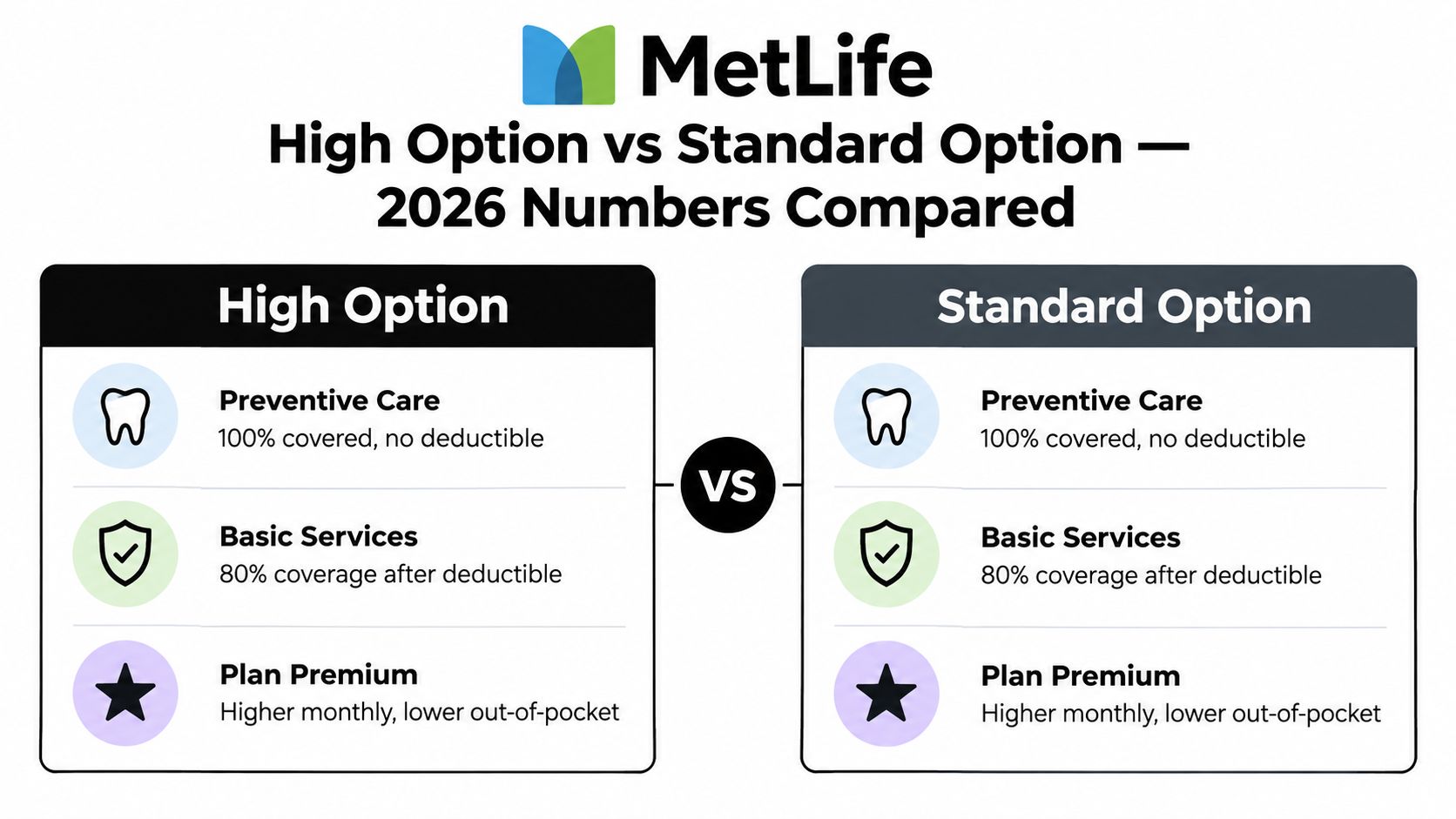
MetLife High Option vs Standard Option 2026 Numbers Compared
MetLife's 2026 brochure provides a useful example of why a headline coinsurance figure doesn't tell the whole story. The two options have materially different annual and orthodontic limits, and those limits can matter more than the difference in premium when treatment is extensive.
| Feature | High Option | Standard Option |
|---|---|---|
| In-network annual maximum | Unlimited | $2,000 |
| Child orthodontic lifetime maximum | $3,500 | $1,500 |
| Adult orthodontic lifetime maximum | $3,000 | $1,500 |
| Orthodontic payment | 50% of the plan allowance | 50% of the plan allowance |
| Payment timing | Allocated across the treatment plan | Allocated across the treatment plan |
The figures above come from MetLife's 2026 FEDVIP brochure. The High Option lists an unlimited in-network annual benefit maximum, while the Standard Option lists a $2,000 annual maximum. For orthodontics, the High Option lists a $3,500 lifetime maximum for a child and $3,000 for an adult. The Standard Option lists $1,500.
Why the annual maximum changes the decision
A person expecting only routine care may never approach an annual maximum. Someone receiving several major services can reach a cap quickly, leaving later covered treatment subject to substantial member payment. That distinction makes the Standard Option potentially efficient for limited use and potentially exposed for concentrated treatment.
The orthodontic figures require equal care. Both options pay orthodontic benefits at 50% of the plan allowance, but the payment isn't an unrestricted cash reimbursement. The brochure explains that payments are allocated across the treatment plan. The lifetime maximum therefore affects the total benefit available over the course of treatment, not just the amount paid at the start.
Network economics can reverse the apparent advantage. OPM's comparison results display in-network benefits, and the member's actual responsibility depends on provider participation and the plan allowance. A High Option benefit is not a guarantee that every local dentist, orthodontist, or oral surgeon will bill under the favorable in-network terms.
A generous benefit attached to the wrong network is a brochure advantage, not a household saving.
Use the MetLife example as a reading exercise for any carrier. Look for the annual maximum, orthodontic lifetime maximum, allowance rules, treatment allocation, and network tier. Don't select an option because “High” sounds all-encompassing. Select it when the extra protection fits your providers and expected procedures.
For readers comparing related federal options, this guide to the GEHA Dental High Option plan can provide additional plan-specific context. It shouldn't replace the current brochure or a direct provider check.
How ZIP Code and Expected Treatment Change the Best Plan
A national “best FEDVIP plan” list is often too broad to be useful. The plan that works in one ZIP code may be less attractive in another if a preferred dentist participates in one network but not another. OPM's comparison interface displays in-network benefits, so the result can look better than the actual cost if you don't confirm the provider.
Use a four-part decision frame:
- Provider availability: Search for the exact dentist, orthodontist, oral surgeon, and specialist you intend to use. Confirm the specific FEDVIP network, not merely the carrier's name.
- Treatment timing: Identify whether care is routine, planned before retirement, or likely to begin during the next plan year.
- Annual maximum exposure: Estimate how quickly expected treatment could consume the annual benefit.
- Switching constraints: Review whether changing plans would affect treatment continuity, waiting periods, or an active orthodontic arrangement.
Three ZIP-code decisions
The newly hired employee with routine needs should begin with provider access and preventive benefits. If the current dentist participates and no major treatment is expected, a lower-premium option may be reasonable. The decision should still be checked against the intermediate field because routine examinations can uncover fillings or other moderate care.
The employee covering a dependent who needs orthodontics should prioritize the orthodontic payment structure and lifetime maximum. A plan that ranks poorly by premium may provide more usable protection if the orthodontist participates and the treatment plan fits the benefit rules. Confirm how payments are distributed over treatment, rather than assuming the lifetime maximum is available immediately.
The employee nearing retirement with a scheduled crown or implant should verify the dentist and specialist before considering price. A plan with a lower annual maximum or an unavailable provider can create a larger total bill even if its payroll deduction is appealing. Compare the likely treatment cost under the actual network allowance and check whether the care will cross a retirement or plan-year boundary.
The GEHA Find a Provider tool guide is useful as an example of the provider-search process, but every carrier's directory should be checked directly. Direct confirmation matters because directories and network participation can change.
ZIP-code rule: Verify your intended providers first, then compare premiums among the plans that can deliver the care.
This approach also protects retirees who expect to relocate. A plan that fits today may require a fresh provider search after retirement, especially when care is scheduled or a specialist relationship is important. Network continuity deserves the same attention as the annual maximum.
When to Renew, Switch, or Self-Insure 2026 Volatility Guide
FEDVIP isn't static. For 2026, average dental premiums are reported to rise 3.3%, with individual plan changes ranging from roughly 0.6% to 11%, according to MOAA's discussion of 2026 FEDVIP premiums. The same source notes that 11 dental carriers will participate after HealthPartners Dental was dropped.
Those changes make retirement planning more complicated. A carrier can leave, a provider can exit a network, or your expected treatment can change while the plan remains available. A premium increase also isn't the same as a benefit redesign. A seemingly modest price can accompany less favorable cost sharing, narrower access, waiting periods, or lower orthodontic and annual limits.
Use a renew, switch, or self-insure worksheet
Write down five items before Open Season:
- New annual premium: Compare the full deduction for your enrollment tier with the expected value of the benefits, not just the change from last year.
- Likely procedures: List known treatment and realistic near-term needs. A scheduled crown deserves more weight than a vague concern about future care.
- Remaining annual maximum: Determine how much protection remains for each person and which services use that limit.
- Waiting periods: Check whether a new plan delays access to the treatment you need.
- Provider continuity: Confirm that the dentist and specialists will remain available under the option you select.
Renew when the network remains intact, the treatment profile still fits, and the revised premium is justified by usable benefits. Switch when the carrier no longer supports your providers, the benefit design no longer fits, or a different plan materially improves protection for expected care.
Self-insuring can make sense for someone with routine needs, reliable provider access, and expected costs below the annual plan premium. It becomes a poor substitute for coverage when treatment is imminent or one major procedure could consume the household's available dental budget.
The lowest-premium plan is riskiest when it offers little protection for known treatment or depends on a network that may not serve you. For federal employees close to retirement, that risk deserves more attention because a fixed annuity deduction doesn't eliminate the possibility of a large dental bill.
Next Steps Enrollment Rules, Qualifying Events, and Free Review Guidance
The cheapest premium can become the most expensive choice after retirement. Start with eligibility, enrollment category, and the ZIP code where you will receive care. A plan that looks inexpensive on paper can cost more if your dentist leaves its network or a specialist is unavailable nearby.
FEDVIP eligibility follows applicable federal pathways, including FEHB eligibility, Postal Service Health Benefits enrollment, and certain Marketplace enrollment categories. Eligible TRICARE participants may also qualify under the program's later expansion. Choose Self Only, Self Plus One, or Self and Family according to who needs coverage.
Check the enrollment event
Open Season is the standard period for reviewing and changing coverage. New employees must follow the enrollment instructions and deadline supplied by their benefits office or BENEFEDS. A qualifying life event may permit a change outside Open Season, but confirm both the event and request window through the official enrollment channel.
Retirement deserves its own review. Eligible annuitants remain part of the FEDVIP population, while premiums come from the annuity instead of an employee paycheck. That recurring deduction can look manageable while a network change creates a much larger treatment bill. Confirm provider access in your retirement ZIP code before choosing based on premium alone.
Use OPM's 2026 public-use benefits file and plan comparison resources, then verify the selected option against its official brochure. TRICARE-eligible retirees should also review these TRICARE dental program changes and 2026 FEDVIP details before making a coverage decision.
A free benefits review can provide a second check. It should test ZIP-code provider access, expected dental costs, and the effect of the deduction on retirement income. It does not replace the official brochure or confirmation from your dental office. It can expose an expensive assumption before enrollment.
Use this checklist:
- Download the current benefits file for the plan year.
- Compare preventive, intermediate, major, orthodontic, orthodontic lifetime maximum, annual maximum, and deductible fields.
- Search for your dentist and relevant specialists by ZIP code.
- Ask the dental office to confirm participation in the exact FEDVIP network.
- Add annual premiums to expected out-of-pocket costs.
- Read the official brochure for allowances, waiting periods, exclusions, and treatment limits.
- Decide whether to renew, switch, or self-insure before the applicable enrollment deadline.
Watch the accompanying explanation after completing the provider and cost worksheet.
A sound federal employee dental insurance comparison weighs access, treatment timing, annual exposure, and provider continuity before the premium. Apply those tests to your ZIP code, then decide whether the deduction buys protection you can use.
Federal Benefits Sherpa provides benefits guidance for federal employees comparing dental coverage with retirement income and provider access. Visit Federal Benefits Sherpa for a free review of whether your FEDVIP choice fits your ZIP code, expected treatment, and retirement plans.
